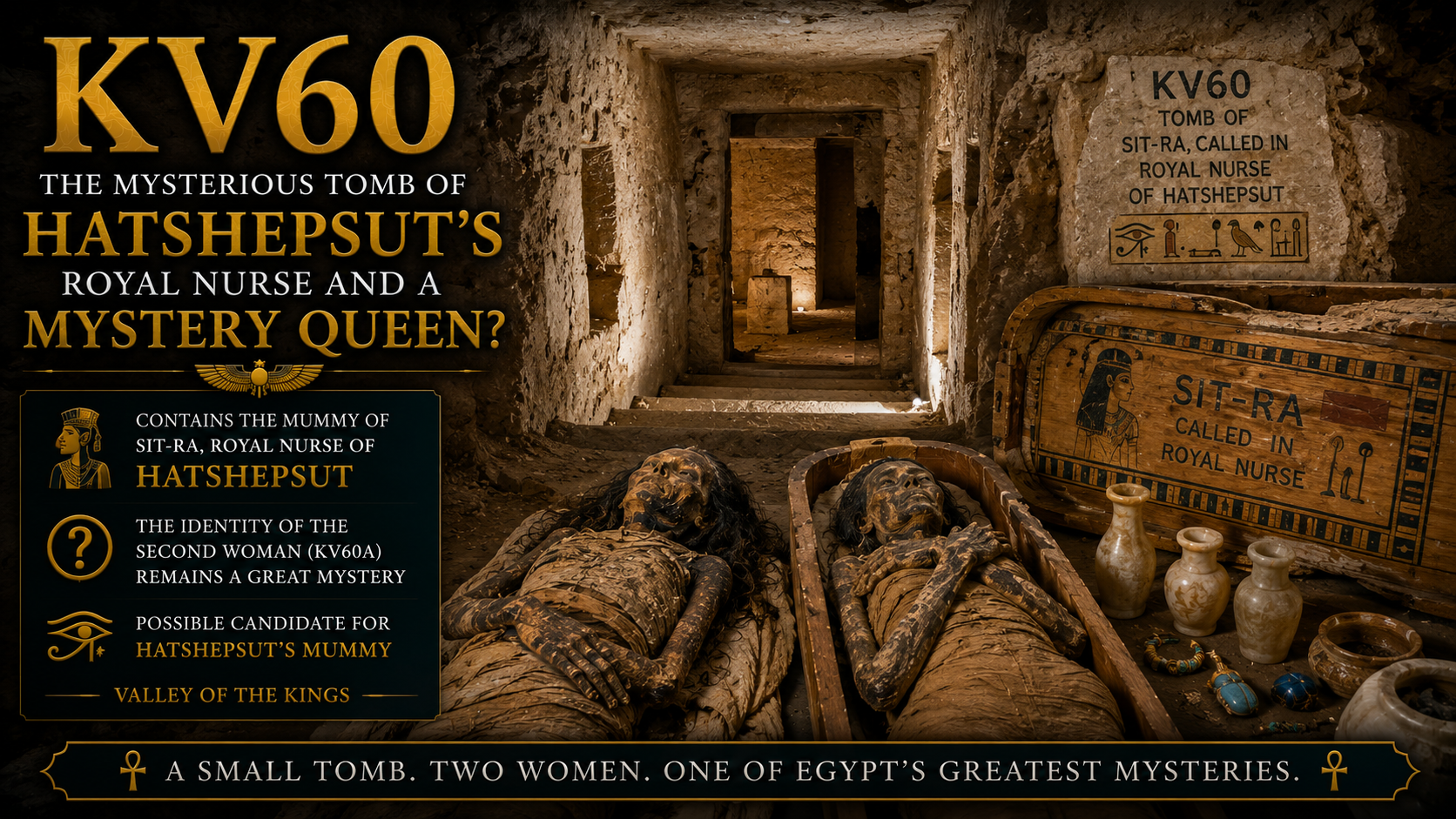
KV60 is one of the most intriguing and controversial tombs in the Valley of the Kings. This small, undecorated monument contained two female mummies, one of whom, identified by her coffin as Sit-Ra, also called In, the royal nurse of Pharaoh Hatshepsut. The identity of the second woman, now designated KV60A, remains the subject of considerable debate.
Egyptologist Elizabeth Thomas was among the first to suggest that KV60A could be the missing mummy of Hatshepsut, one of ancient Egypt’s most famous female pharaohs. Decades later, CT scans and the apparent match between a loose tooth and a gap in the mummy’s jaw led Zahi Hawass and his team to announce that KV60A was probably Hatshepsut. However, questions surrounding the tooth and the absence of conclusive published DNA evidence mean that the identification should still be described as probable or possible rather than certain.
Despite its modest architecture, KV60 has become one of the most discussed tombs in the Valley of the Kings. Its story connects Hatshepsut, her royal nurse, Howard Carter, modern mummy research, and the continuing search for the identities of Egypt’s unidentified dead.
Structure: KV60
Location: Valley of the Kings, East Valley, Thebes West Bank, Luxor
Known Occupant: Sit-Ra, also called In, royal nurse of Hatshepsut
Possible Occupant: Hatshepsut
Site Type: Non-royal tomb
KV60 lies in the eastern cliffs of the Valley of the Kings, in the southeastern branch of the main wadi. Its entrance is immediately beside and partly beneath the approach to KV19, the tomb of Prince Mentuherkhepshef, and south of KV20, the royal tomb associated with Hatshepsut and Thutmose I.
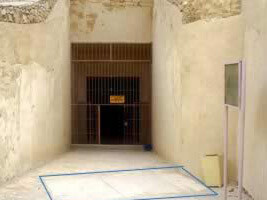
The modern entrance is protected by a metal cover and can easily be overlooked among the surrounding rock and pathways.
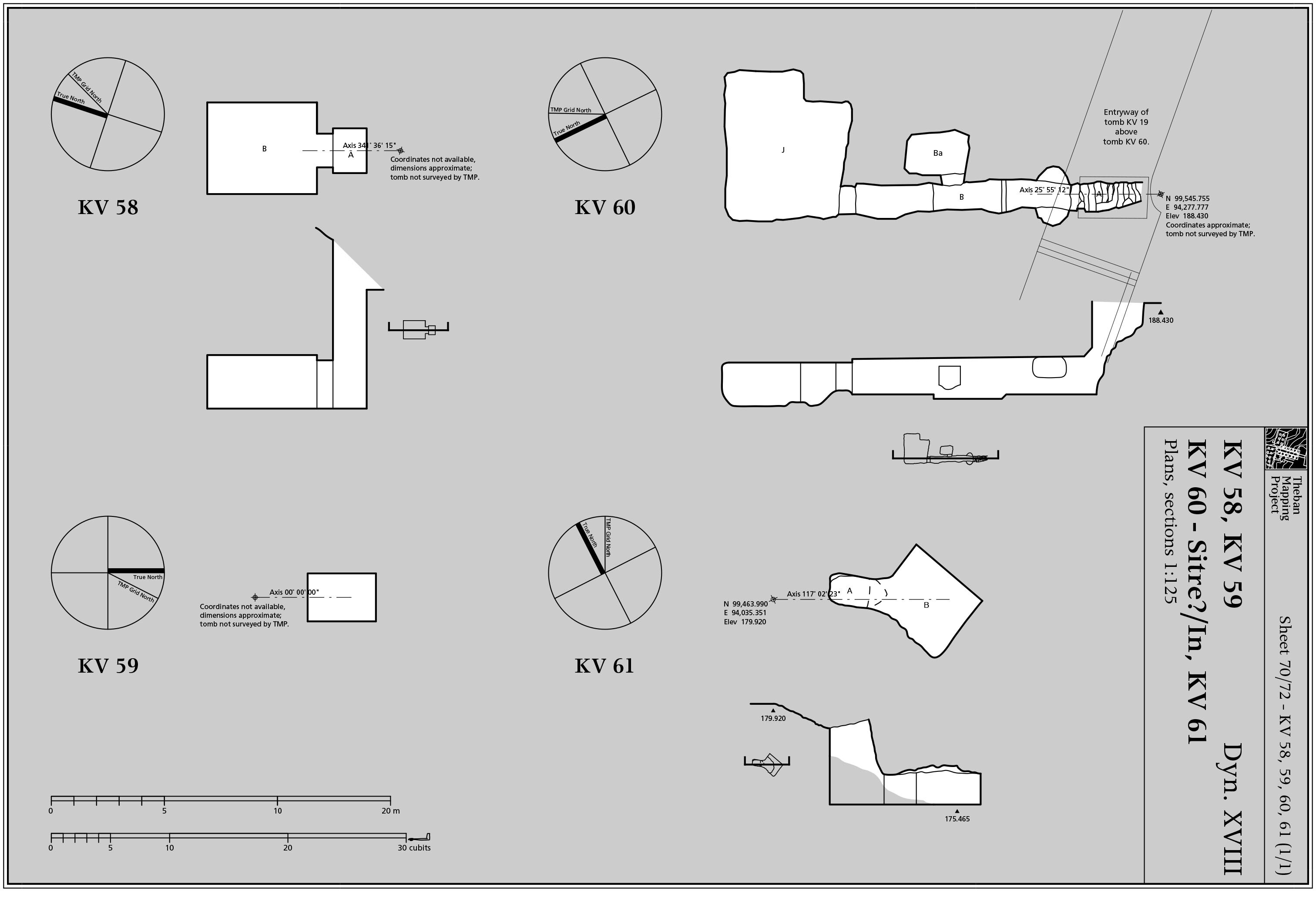
KV60 is a small, undecorated tomb with a straightforward plan. A steep entrance stairway leads to a descending corridor containing several recesses and a small side chamber. The passage ends in a roughly cut rectangular burial chamber.
The tomb consists of:
- An entrance stairway
- A descending corridor
- Recesses cut into the corridor walls
- A small side chamber
- A roughly finished burial chamber
The monument lacks the painted walls, carved reliefs, pillared halls, and extensive storerooms associated with royal tombs. Its comparatively simple construction is more consistent with that of the burial place of an important court official or a member of the royal household.
Discovery by Howard Carter
Howard Carter discovered KV60 in 1903 while working for the American lawyer and financier Theodore M. Davis.
The tomb had already been robbed in antiquity. Carter found broken funerary objects, damaged burial equipment, pottery fragments, and other scattered remains. He also recovered mummified geese, which may originally have been placed in the tomb as food offerings.
Two female mummies lay inside the burial chamber. One rested on the floor, while the other had been placed in a lidless wooden coffin. The inscription on the coffin identified its owner as a royal nurse named In.
Because the tomb was undecorated and contained few valuable objects, Carter examined it only briefly before closing the entrance again. He published only a short account of the discovery.

Sit-Ra, Called In
The coffin found in KV60 belonged to a woman named Sit-Ra, also called In. Her title identified her as a royal nurse.
A sandstone statue discovered at Deir el-Bahari later established that Sit-Ra was Hatshepsut’s nurse. Royal nurses occupied trusted positions within the palace and sometimes maintained close personal relationships with the children they raised.
Sit-Ra’s association with Hatshepsut dramatically increased the importance of KV60. It also raised the possibility that the unidentified woman found beside her might have belonged to Hatshepsut’s family or court.
In 1906, Edward Russell Ayrton reopened KV60 and removed the coffin and mummy associated with Sit-Ra. They were transported to Cairo, although they were not formally registered in the Egyptian Museum until several years later.
The mummy in the coffin is now generally designated KV60B.
The Unidentified Mummy KV60A
The second woman, KV60A, remained on the floor of the burial chamber after the coffin and KV60B were removed.
KV60A was an older, heavily built woman whose left arm was bent across her chest. This arm position has often been associated with royal women of the Eighteenth Dynasty, although it is not by itself proof of royal identity.
The mummy had long hair, heavily worn teeth, and evidence of poor dental health. Modern examination suggested that she died between approximately 50 and 60 years of age. She was about 1.59 meters, or 5 feet 2 inches, tall.
CT scans revealed several health problems, including obesity, severe dental disease, and possible evidence of diabetes and cancer. The exact cause of death could not be established with certainty.
Could KV60A Be Hatshepsut?
Elizabeth Thomas proposed that KV60A might be Hatshepsut, whose mummy had not been securely identified. She suggested that Hatshepsut could have been moved from her royal tomb, KV20, and placed in the tomb of her trusted nurse for protection.
Donald P. Ryan remained cautious about the theory when he rediscovered KV60 in 1989. Although the mummy’s age and arm position were consistent with a royal woman, the tomb contained no inscription directly identifying her as Hatshepsut.
The debate changed dramatically in 2007, when Zahi Hawass and a team of researchers examined several unidentified female mummies using CT scanning.
A small wooden box bearing Hatshepsut’s royal names had been discovered in the Deir el-Bahari royal cache, DB320. The box contained mummified tissue and a loose molar. Researchers reported that this tooth appeared to fit a gap in the upper jaw of KV60A, where part of a broken root remained.
The physical match, combined with KV60A’s estimated age, possible royal arm position, and cranial similarities to members of the Thutmosid family, led Hawass to identify the mummy as Hatshepsut.
Why the Identification Remains Debated
The identification of KV60A as Hatshepsut is widely repeated but not universally accepted.
Questions remain about whether the loose tooth is the correct type to fit the gap in KV60A’s jaw. The tooth and the mummified tissue from the box have not been conclusively matched to KV60A through published DNA testing.
There is also no surviving inscription naming KV60A, and her presence in the tomb of a royal nurse does not necessarily mean that she was Hatshepsut.
For these reasons, the most accurate description is that KV60A is the leading candidate for Hatshepsut’s mummy, but the identification has not been proven beyond dispute.
Hatshepsut
Hatshepsut was the daughter of Thutmose I and the principal wife of Thutmose II. After her husband’s death, she initially served as regent for the young Thutmose III before assuming the full titles and authority of a pharaoh.
She ruled during the Eighteenth Dynasty, approximately 1479 to 1458 BCE. Her reign was marked by political stability, ambitious building programs, and renewed trade with foreign regions.
Her greatest surviving monument is her terraced mortuary temple at Deir el-Bahari. She also commissioned obelisks and additions at Karnak and organized the celebrated expedition to the land of Punt.
Hatshepsut prepared the deep royal tomb KV20 for herself and her father, Thutmose I. Her mummy was no longer there when the monument was excavated in modern times.
Rediscovery by Donald P. Ryan
After Carter and Ayrton finished their work, KV60 was closed and gradually disappeared beneath debris. Its exact location was eventually forgotten.
In 1989, Donald P. Ryan and the Pacific Lutheran University Valley of the Kings Project conducted an excavation in the area near KV19. Ryan’s team relocated the tomb after sweeping debris from the bedrock and identifying the outline of its buried entrance.
Inside, the team found KV60A still lying on the floor of the burial chamber. Her long hair had fallen from her skull and lay beneath her head.
Ryan’s team documented the tomb, collected scattered objects, and constructed a protective wooden box around the mummy. A metal cover was placed over the entrance to protect the monument.
The rediscovery brought KV60 back into archaeological attention and made the subsequent scientific examination of KV60A possible.
Objects Recovered
The objects recovered from KV60 include:
- Two female mummies
- A wooden coffin belonging to the royal nurse Sit-Ra, called In
- Coffin and burial-equipment fragments
- Pottery vessels and sherds
- Stone vessels
- Jewelry
- Scarabs and seal impressions
- Mummy trappings
- Carpenters’ and sculptors’ tools
- Lighting equipment
- Written material
- Mummified geese and other animal remains
A large resin-covered coffin fragment recovered during the later excavation was eventually found to bear the name of a previously unknown temple singer named Ty. This raises the possibility that material belonging to more than two burials was deposited in KV60.

Noteworthy Features
KV60 is notable for several reasons:
- It contained two female mummies.
- One coffin belonged to Sit-Ra, the royal nurse of Hatshepsut.
- The second mummy, KV60A, is the leading candidate for Hatshepsut.
- Howard Carter discovered the tomb in 1903.
- Edward Ayrton removed Sit-Ra’s coffin and mummy in 1906.
- The tomb’s location was later forgotten.
- Donald P. Ryan relocated it in 1989.
- KV60 is small and completely undecorated.
- It lies immediately beside the entrance to KV19.
- The proposed identification of KV60A depends heavily on a loose tooth from a box bearing Hatshepsut’s names.
Site Information
- Axis in degrees: 25.92
- Axis orientation: Northeast
Location
- Latitude: 25.44 N
- Longitude: 32.36 E
- Elevation: 188.43 m above sea level
- North: 99,545.755
- East: 94,277.777
- JOG map reference: NG 36-10
- Modern governorate: Qena
- Ancient nome: Fourth Upper Egyptian Nome
Measurements
- Maximum height: 1.92 m
- Minimum width: 1 m
- Maximum width: 6.57 m
- Total length: 20.98 m
- Total area: 55.66 m²
- Total volume: 86.62 m³
Additional Tomb Information
Entrance location: Base of a sheer cliff
Owner type: Official or member of the royal household
Entrance type: Staircase
Interior layout: Corridor and chambers
Axis type: Straight
Decoration: None
Dating
KV60 was probably constructed and first used during:
- New Kingdom, Eighteenth Dynasty
The architecture, burial equipment, and association with Hatshepsut’s royal nurse support an Eighteenth Dynasty date, although the precise year of construction is unknown.
History of Exploration
- Howard Carter, 1903: Discovery and excavation for Theodore M. Davis; removed mummified geese and closed the tomb.
- Edward Russell Ayrton, 1906: Reopened the tomb and removed the coffin and mummy of Sit-Ra.
- Donald P. Ryan, 1989–1990: Relocated, excavated, documented, and protected the tomb.
- Egyptian Mummy Project, 2007: Removed and examined KV60A using CT scanning as part of the search for Hatshepsut’s mummy.
Conservation History
During Donald Ryan’s work in 1989, a protective wooden box was constructed around KV60A. A metal cover was installed over the entrance to protect the tomb from debris and accidental damage.
KV60A was later transferred to Cairo for scientific examination and conservation.
Site Condition
KV60 has suffered from ancient robbery, natural deterioration, and periods of neglect. Most of its original burial equipment was destroyed or removed, and the undecorated walls provide no direct evidence identifying the original owner.
The tomb is now sealed and is not normally open to visitors.
Why KV60 Matters
KV60 demonstrates that even the smallest and least decorated tombs in the Valley of the Kings can contain discoveries of enormous historical importance.
If KV60A is eventually confirmed to be Hatshepsut’s tomb, it would preserve the remains of one of ancient Egypt’s most successful rulers alongside those of her royal nurse. Even without definitive identification, KV60 provides rare evidence of the burials of women associated with the Eighteenth Dynasty court.
Its modern history is equally remarkable. Discovered by Howard Carter, forgotten beneath debris, relocated by Donald Ryan, and later subjected to scientific testing, KV60 has repeatedly returned to the center of Egyptological debate.
Interesting Facts About KV60
- KV60 lies beside the entrance to KV19.
- Howard Carter discovered it nearly twenty years before finding Tutankhamun’s tomb.
- The tomb contained two female mummies.
- One woman was Hatshepsut’s royal nurse, Sit-Ra.
- The other woman may be Hatshepsut herself.
- A tooth found in a box bearing Hatshepsut’s name appeared to match a gap in KV60A’s jaw.
- The tooth-based identification remains disputed.
- Donald Ryan rediscovered the lost tomb using a broom to clear debris from the bedrock.
- KV60 has no painted or carved decoration.
- The tomb is not normally accessible to the public.