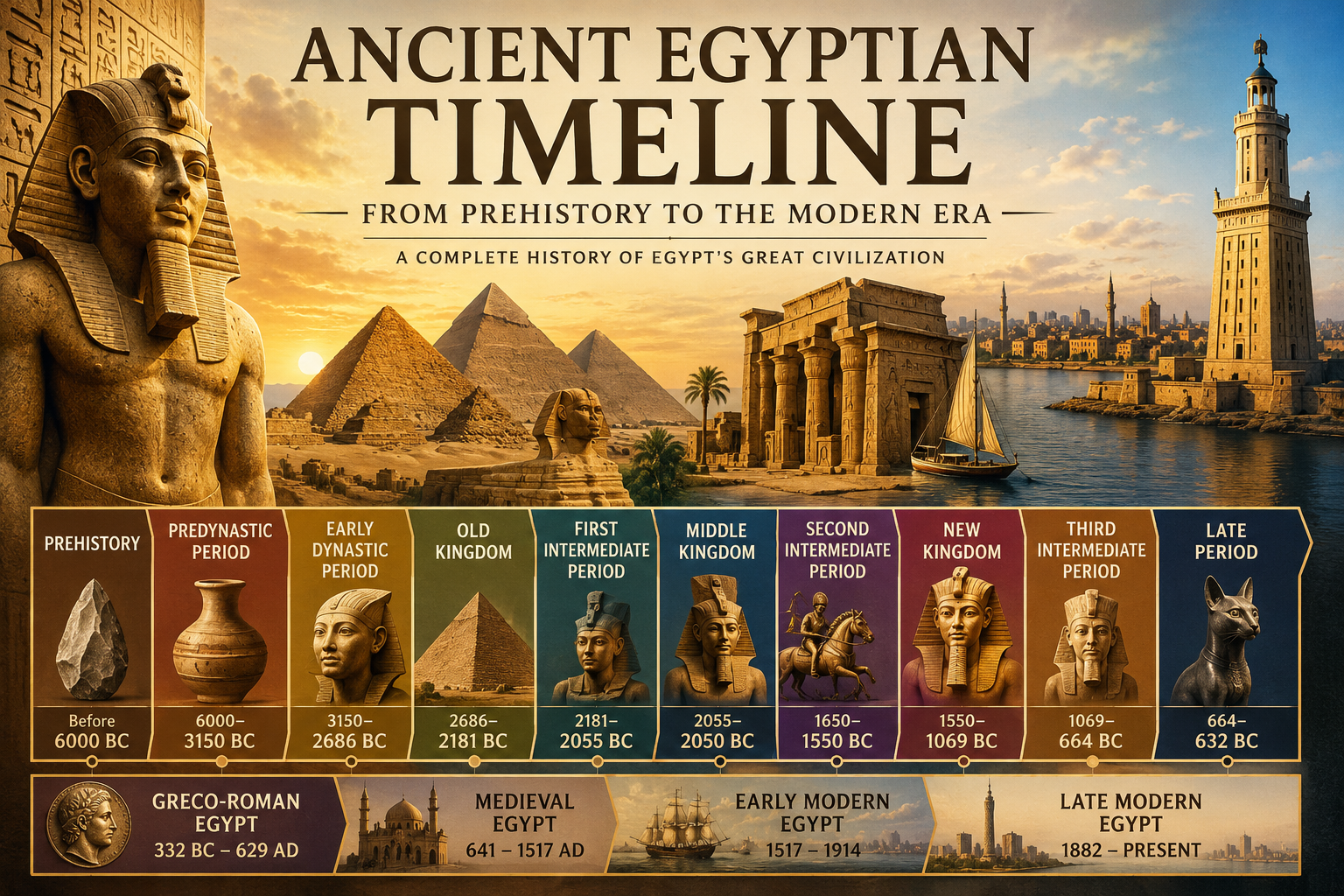
Ancient Egypt was one of the longest-lasting civilizations in world history. Its story stretches from prehistoric hunter-gatherers living along the Nile Valley to powerful pharaohs, pyramid builders, foreign conquerors, Roman emperors, Islamic dynasties, Ottoman rulers, and the modern Egyptian state.
But when did ancient Egypt actually begin? How old is ancient Egypt? And what are the main periods of Egyptian history? This ancient Egyptian timeline provides a clear overview of Egypt’s major historical periods, from prehistoric times to the modern era.

Ancient Egyptian Timeline at a Glance
| Period | Approximate Dates |
|---|---|
| Prehistoric Egypt | Before 6000 BC |
| Predynastic Period | c. 6000 to 3150 BC |
| Early Dynastic Period | c. 3150 to 2686 BC |
| Old Kingdom | c. 2686 to 2181 BC |
| First Intermediate Period | c. 2181 to 2055 BC |
| Middle Kingdom | c. 2055 to 1650 BC |
| Second Intermediate Period | c. 1650 to 1550 BC |
| New Kingdom | c. 1550 to 1069 BC |
| Third Intermediate Period | c. 1069 to 664 BC |
| Late Period | c. 664 to 332 BC |
| Greco-Roman Egypt | 332 BC to AD 629 |
| Medieval Egypt | AD 641 to 1517 |
| Early Modern Egypt | AD 1517 to 1914 |
| Late Modern Egypt | AD 1882 to Present |
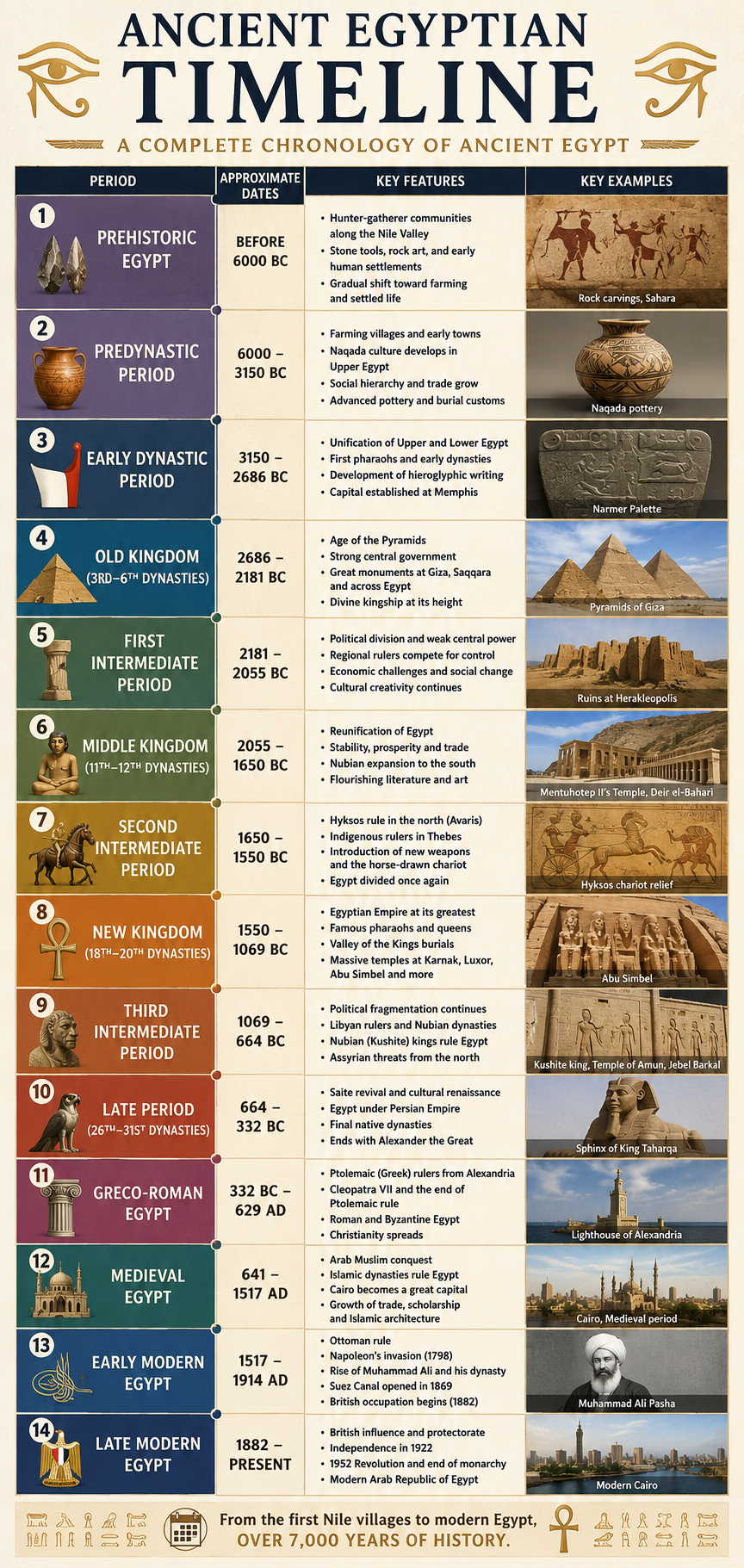
How Old Is Ancient Egypt?
Ancient Egypt is usually said to have begun around 3150 BC, when Upper and Lower Egypt were unified under the first pharaohs. This means ancient Egyptian civilization is more than 5,000 years old.
However, people lived in the Nile Valley long before the first pharaohs. Evidence of human activity in northeastern Africa dates back hundreds of thousands of years. By the Middle and Upper Paleolithic periods, roughly 90,000 to 10,000 years ago, hunter-gatherer groups were living in and around the Nile Valley.
Over time, climate change caused parts of the Eastern Sahara to become drier. As lakes, grasslands, and savannah regions shrank, more people moved toward the Nile, where water, fertile soil, plants, fish, and animals made settled life possible.
This gradual movement toward the Nile helped create the conditions for farming villages, social hierarchy, religious beliefs, long-distance trade, and eventually the rise of the Egyptian state.
Prehistoric Egypt: Before 6000 BC
Long before the pyramids, temples, tombs, and pharaohs, the Nile Valley was home to prehistoric communities of hunter-gatherers.
These early people left behind stone tools, rock carvings, and other traces of activity in places such as the Nile terraces, the oases, and the desert regions near the river. In areas such as the western Theban plateau, archaeologists have found evidence that people used the landscape thousands of years before Thebes became one of Egypt’s greatest religious centers.
During this time, people relied on hunting, fishing, gathering wild plants, and moving through the landscape as conditions changed. The Nile was already important, but Egypt had not yet become a unified kingdom.
Predynastic Period: c. 6000 to 3150 BC
The Predynastic Period was the long age before Egypt’s first dynasties. It was during this period that many of the foundations of ancient Egyptian civilization began to form.
As people settled closer to the Nile, they gradually adopted farming and animal herding. Villages grew. Pottery became more advanced. Burial customs developed. Social differences became more visible. Trade expanded between Egypt and nearby regions.
Earlier scholars used names such as Badarian, Amratian, and Gerzean for some of the major Predynastic cultures. Today, these are often discussed through the Naqada sequence:
| Predynastic Culture Phase | Approximate Date | Notes |
|---|---|---|
| Naqada I | c. 4000 to 3500 BC | Early Upper Egyptian culture with distinctive pottery and burial customs |
| Naqada II | c. 3500 to 3200 BC | Growth of trade, social hierarchy, and elite burials |
| Naqada III | c. 3200 to 3000 BC | Final phase before full political unification |
These cultures developed mainly in Upper Egypt, but their influence gradually spread northward into Lower Egypt and southward toward Nubia.
Lower Egypt also had important Neolithic cultures of its own, including sites such as Maadi, Merimde, the Fayyum, and el-Omari. These communities were not identical to those in Upper Egypt, but contact between regions increased over time.
Predynastic Burials and the Rise of Social Hierarchy
Burial customs from the Predynastic Period show that Egyptians were already developing beliefs about death and the afterlife.
Pit graves were common throughout the Nile Valley, especially in Upper Egypt. Over time, some graves became more elaborate, with rectangular chambers cut into bedrock and covered with debris or mud-brick structures.
Grave goods such as pottery, jewelry, weapons, cosmetic palettes, tools, and food offerings suggest that people believed the dead needed provisions for another existence. The uneven distribution of these goods also shows that society was becoming more stratified. Some people were buried with far more wealth than others.
This growing inequality points to the rise of chiefs, elites, and early rulers before the first pharaohs.
El-Tarif and Early Thebes
El-Tarif is one of the oldest necropolises on the West Bank of the Nile at ancient Thebes, near modern Luxor. It lies northwest of Luxor, southeast of the Valley of the Kings, and opposite Karnak.
Evidence of Naqada I and Naqada II structures and graves has been found in the Theban region, including at El-Tarif. This shows that the area around Thebes was important long before it became the religious capital of Egypt during the Middle and New Kingdoms.
Early Dynastic Period: c. 3150 to 2686 BC
The Early Dynastic Period began when Upper and Lower Egypt were unified into a single kingdom. This is traditionally associated with King Narmer, who is often identified with Menes, the legendary first king of Egypt.
This period includes the 1st and 2nd Dynasties.
During the Early Dynastic Period, the Egyptian state took shape. Kingship became more formalized, writing developed rapidly, royal tombs became larger, and the government began to control agriculture, taxation, labor, and religious institutions.
The capital was established at Memphis, near the meeting point of Upper and Lower Egypt. This was a strategic location that allowed the early kings to control the entire Nile Valley.
Important developments of the Early Dynastic Period include:
| Development | Why It Mattered |
|---|---|
| Unification of Egypt | Created one of the world’s earliest centralized states |
| Development of hieroglyphic writing | Allowed administration, religious texts, and royal propaganda |
| Growth of royal tombs | Reflected the divine status of kings |
| Expansion of government | Helped manage farming, taxation, trade, and labor |
| Rise of Memphis | Created a powerful political capital |

Old Kingdom: c. 2686 to 2181 BC
The Old Kingdom is often called the “Age of the Pyramids.” This was the period when Egypt’s most famous pyramids were built, including the Step Pyramid of Djoser at Saqqara and the Great Pyramid of Khufu at Giza.
The Old Kingdom includes the 3rd through 6th Dynasties.
During this time, the pharaoh was seen as a divine ruler with enormous religious and political authority. The state organized massive building projects, controlled resources, and used skilled labor to create monuments that still define ancient Egypt today.
Major achievements of the Old Kingdom include:
| Achievement | Example |
|---|---|
| Pyramid building | Step Pyramid, Bent Pyramid, Red Pyramid, Great Pyramid |
| Centralized kingship | Strong royal control over Egypt |
| Monumental architecture | Large stone temples, tombs, and pyramid complexes |
| Religious development | Growth of solar worship and royal afterlife beliefs |
| Elite tomb art | Mastabas with scenes of daily life, farming, hunting, and offerings |
The Old Kingdom eventually weakened because of political decentralization, economic pressure, possible climate stress, and the increasing power of local governors.
First Intermediate Period: c. 2181 to 2055 BC
The First Intermediate Period followed the collapse of the Old Kingdom. It was a time of political division, regional rulers, and competition between rival power centers.
Egypt was no longer controlled by one strong central government. Local governors, especially in places such as Herakleopolis and Thebes, gained power.
Although older histories often described this period as pure chaos, modern scholars see it as more complex. It was a time of hardship and political fragmentation, but also of cultural creativity, local identity, and new forms of literature and art.
The period ended when rulers from Thebes reunified Egypt and established the Middle Kingdom.
Middle Kingdom: c. 2055 to 1650 BC
The Middle Kingdom is often considered one of ancient Egypt’s golden ages. It began when Mentuhotep II of the 11th Dynasty reunited Egypt after the First Intermediate Period.
The Middle Kingdom includes the later 11th Dynasty, the 12th Dynasty, and part of the 13th Dynasty.
During this period, Egypt became more stable, wealthy, and culturally sophisticated. Kings expanded irrigation, promoted trade, strengthened the bureaucracy, and launched military campaigns into Nubia.
Major features of the Middle Kingdom include:
| Feature | Description |
|---|---|
| Reunification | Egypt was brought back under centralized rule |
| Literature | Classic Egyptian literary works flourished |
| Nubian expansion | Egypt built forts and extended control southward |
| Religious change | Osiris became increasingly important in afterlife beliefs |
| Royal building projects | Temples, pyramids, and administrative centers expanded |
The Middle Kingdom eventually weakened as royal authority declined and foreign groups gained influence in the eastern Nile Delta.
Second Intermediate Period: c. 1650 to 1550 BC
The Second Intermediate Period was another age of political division. During this time, a group known as the Hyksos ruled parts of northern Egypt from their capital at Avaris in the eastern Delta.
The Hyksos were rulers of western Asian origin who adopted many Egyptian customs while also introducing or popularizing new military technologies, including horse-drawn chariots and advanced weapons.
Meanwhile, native Egyptian rulers continued to control parts of southern Egypt from Thebes.
Conflict between the Theban rulers and the Hyksos eventually led to war. The Theban kings Seqenenre Tao, Kamose, and Ahmose I played major roles in the struggle to expel the Hyksos and reunify Egypt.
Ahmose I’s victory marked the beginning of the New Kingdom.
New Kingdom: c. 1550 to 1069 BC
The New Kingdom was ancient Egypt’s imperial age. It includes the 18th, 19th, and 20th Dynasties and produced some of Egypt’s most famous rulers.
This was the age of Hatshepsut, Thutmose III, Akhenaten, Tutankhamun, Seti I, Ramesses II, and Ramesses III.
During the New Kingdom, Egypt became one of the most powerful states in the ancient world. Its armies campaigned in Nubia, Syria, and Palestine. Its temples grew richer. Its pharaohs built massive monuments. Its royal families were buried in the Valley of the Kings.
Important New Kingdom developments include:
| Development | Example |
|---|---|
| Egyptian empire | Military campaigns in Nubia and the Near East |
| Valley of the Kings | Royal burials hidden in the cliffs of western Thebes |
| Karnak and Luxor expansion | Massive temple building in Thebes |
| Amarna Period | Akhenaten’s religious revolution centered on the Aten |
| Ramesside monuments | Abu Simbel, Ramesseum, Medinet Habu, and more |
The New Kingdom eventually declined due to economic problems, external attacks, internal instability, corruption, and the weakening of royal authority.
Third Intermediate Period: c. 1069 to 664 BC
The Third Intermediate Period began after the end of the New Kingdom. Egypt was once again politically divided, with rulers in the north and powerful priestly families in Thebes.
This period includes Libyan dynasties, regional kingdoms, and eventually Nubian rule during the 25th Dynasty.
The Nubian kings from Kush, including Piye, Shabaka, Shebitku, Taharqa, and Tantamani, ruled Egypt as pharaohs and revived many traditional Egyptian religious and artistic practices.
However, Egypt also faced pressure from the Assyrian Empire. Assyrian invasions eventually weakened Nubian control and reshaped Egypt’s political landscape.
Late Period: c. 664 to 332 BC
The Late Period began with the 26th Dynasty, also known as the Saite Period, named after the city of Sais in the Nile Delta.
This was a time of cultural revival. Egyptian rulers looked back to earlier periods for artistic, religious, and political inspiration. Temples were restored, older artistic styles returned, and Egypt remained an important power in the eastern Mediterranean.
However, Egypt was also increasingly caught between larger empires.
The Late Period included:
| Phase | Description |
|---|---|
| Saite Period | Egyptian revival under the 26th Dynasty |
| First Persian Period | Egypt became part of the Persian Empire |
| Native Egyptian revival | Brief return of Egyptian dynasties |
| Second Persian Period | Persia regained control before Alexander the Great |
The Late Period ended in 332 BC when Alexander the Great conquered Egypt.
Greco-Roman Egypt: 332 BC to AD 629
Greco-Roman Egypt began when Alexander the Great entered Egypt in 332 BC. After his death, one of his generals, Ptolemy I, took control and founded the Ptolemaic Dynasty.
The Ptolemies ruled Egypt from Alexandria, a major center of Greek culture, learning, trade, and politics. Although they were Macedonian Greek rulers, they presented themselves as pharaohs and supported many traditional Egyptian temples.
The most famous Ptolemaic ruler was Cleopatra VII. Her political alliances with Julius Caesar and Mark Antony brought Egypt into direct conflict with Rome.
In 30 BC, after Cleopatra’s death, Egypt became a province of the Roman Empire.
During the Roman and Byzantine periods, Egypt remained one of the most important grain-producing regions in the Mediterranean world. Christianity spread widely, and traditional Egyptian religion gradually declined.
Medieval Egypt: AD 641 to 1517
In AD 641, Arab Muslim forces conquered Egypt. This marked the beginning of the Islamic period in Egyptian history.
Over the following centuries, Egypt was ruled by several Islamic dynasties and powers, including the Rashidun, Umayyads, Abbasids, Tulunids, Ikhshidids, Fatimids, Ayyubids, and Mamluks.
Cairo became one of the great cities of the medieval Islamic world. It was a center of religion, scholarship, trade, architecture, and political power.
Major medieval developments include:
| Development | Importance |
|---|---|
| Arab conquest | Egypt became part of the Islamic world |
| Founding of Cairo | Cairo became a major capital |
| Fatimid rule | Al-Azhar was founded, and Cairo expanded |
| Ayyubid rule | Saladin made Egypt a major regional power |
| Mamluk rule | Egypt became a powerful military and trade state |
The medieval period ended when the Ottoman Empire conquered Egypt in 1517.
Early Modern Egypt: AD 1517 to 1914
After 1517, Egypt became part of the Ottoman Empire. Ottoman control varied over time, and local Mamluk elites continued to hold significant power.
In 1798, Napoleon Bonaparte invaded Egypt. Although the French occupation was short-lived, it had a major impact on European interest in ancient Egypt and helped spark the modern field of Egyptology.
In the 19th century, Muhammad Ali Pasha became the dominant ruler of Egypt. He modernized the army, economy, agriculture, and administration. His dynasty continued to rule Egypt into the 20th century.
Important early modern developments include:
| Event | Date |
|---|---|
| Ottoman conquest of Egypt | 1517 |
| French invasion of Egypt | 1798 |
| Rise of Muhammad Ali | 1805 |
| Opening of the Suez Canal | 1869 |
| British occupation begins | 1882 |
| Egypt becomes a British protectorate | 1914 |
Late Modern Egypt: AD 1882 to Present
Late modern Egyptian history overlaps with the final Ottoman and British periods. In 1882, Britain occupied Egypt after the Urabi Revolt. Egypt remained under heavy British influence for decades.
In 1922, Egypt gained nominal independence, although British influence continued. In 1952, the Egyptian Revolution ended the monarchy, and Egypt became a republic.
Modern Egypt has continued to play a major role in the history of the Middle East, Africa, the Mediterranean, and the world.
Key modern events include:
| Event | Date |
|---|---|
| British occupation begins | 1882 |
| Egypt declared a British protectorate | 1914 |
| Nominal independence | 1922 |
| Egyptian Revolution | 1952 |
| Republic declared | 1953 |
| Suez Crisis | 1956 |
| Modern Arab Republic of Egypt | 20th century to present |
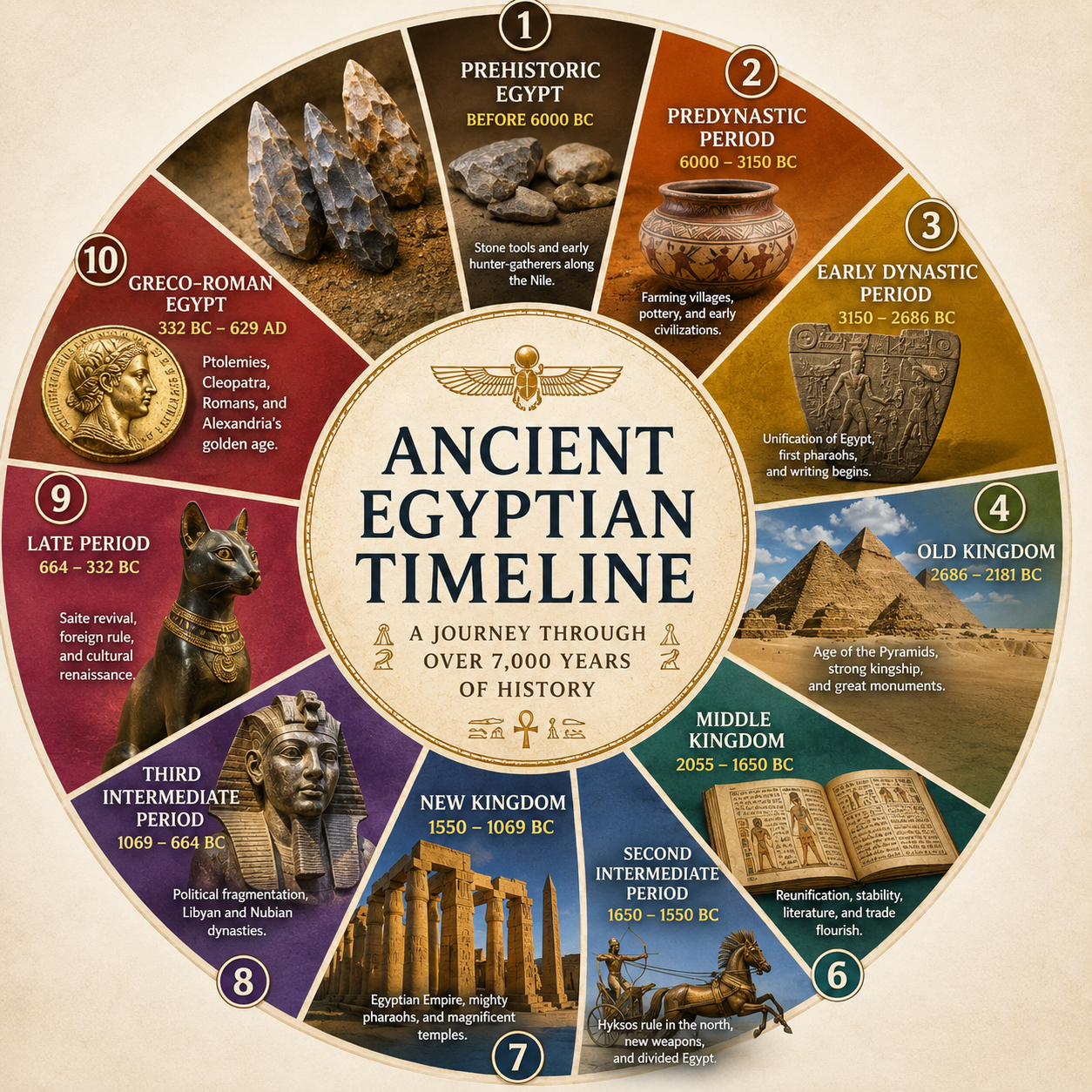
Complete Ancient Egyptian Timeline by Period
| Period | Dates | Key Features |
|---|---|---|
| Prehistoric Egypt | Before 6000 BC | Hunter-gatherers, stone tools, rock art, early Nile settlement |
| Predynastic Period | c. 6000 to 3150 BC | Farming villages, Naqada culture, elite burials, early social hierarchy |
| Early Dynastic Period | c. 3150 to 2686 BC | Unification of Egypt, first pharaohs, Memphis, early writing |
| Old Kingdom | c. 2686 to 2181 BC | Pyramid building, strong kingship, Giza, Saqqara |
| First Intermediate Period | c. 2181 to 2055 BC | Political division, regional rulers, decline of central power |
| Middle Kingdom | c. 2055 to 1650 BC | Reunification, literature, Nubian expansion, cultural flowering |
| Second Intermediate Period | c. 1650 to 1550 BC | Hyksos rule in the Delta, Theban resistance |
| New Kingdom | c. 1550 to 1069 BC | Empire, Valley of the Kings, famous pharaohs, massive temples |
| Third Intermediate Period | c. 1069 to 664 BC | Divided rule, Libyan dynasties, Nubian pharaohs |
| Late Period | c. 664 to 332 BC | Saite revival, Persian rule, final native dynasties |
| Greco-Roman Egypt | 332 BC to AD 629 | Alexander, Ptolemies, Cleopatra, Roman and Byzantine Egypt |
| Medieval Egypt | AD 641 to 1517 | Islamic conquest, Cairo, Fatimids, Ayyubids, Mamluks |
| Early Modern Egypt | AD 1517 to 1914 | Ottoman rule, Napoleon, Muhammad Ali, Suez Canal, British occupation |
| Late Modern Egypt | AD 1882 to Present | British control, independence, revolution, modern republic |
Why Egyptian Chronology Can Be Confusing
Ancient Egyptian chronology can be difficult because dates are often approximate. Scholars use archaeological evidence, king lists, inscriptions, astronomical data, radiocarbon dating, and comparisons with other ancient civilizations to build the Egyptian timeline.
Different books and websites may give slightly different dates for the same period. This is normal. For example, one source may place the beginning of the Old Kingdom around 2686 BC, while another may use a slightly different date.
The overall sequence, however, remains the same:
Predynastic Egypt came first, followed by the Early Dynastic Period, the Old Kingdom, the Middle Kingdom, the New Kingdom, the Late Period, Greco-Roman Egypt, and later medieval and modern periods.
The Three Great Kingdoms of Ancient Egypt
The most famous parts of ancient Egyptian history are often grouped into three major kingdoms:
| Kingdom | Dates | Best Known For |
|---|---|---|
| Old Kingdom | c. 2686 to 2181 BC | Pyramids and powerful divine kingship |
| Middle Kingdom | c. 2055 to 1650 BC | Reunification, literature, and cultural stability |
| New Kingdom | c. 1550 to 1069 BC | Empire, famous pharaohs, and monumental temples |
Between these kingdoms were intermediate periods, when Egypt was divided, weakened, or ruled by competing powers.
When Did Ancient Egypt End?
Ancient Egypt did not end all at once. Politically, pharaonic Egypt ended in 332 BC when Alexander the Great conquered the country. After that, Egypt was ruled by the Greek Ptolemaic Dynasty.
Traditional Egyptian religion and temple culture continued for centuries under Greek and Roman rule. Some Egyptian temples remained active well into the Roman period.
A common end date for ancient Egyptian civilization is 30 BC, when Cleopatra VII died and Egypt became a Roman province. Another possible end point is late antiquity, when Christianity spread and the old temples gradually closed.
So, depending on how you define it:
| End Point | Meaning |
|---|---|
| 332 BC | End of native pharaonic independence with Alexander’s conquest |
| 30 BC | End of Ptolemaic Egypt and beginning of Roman rule |
| Late Roman period | Decline of traditional Egyptian religion and temple culture |
Frequently Asked Questions About the Ancient Egyptian Timeline
When did ancient Egypt begin?
Ancient Egypt is usually said to have begun around 3150 BC, when Upper and Lower Egypt were unified under the first pharaohs.
How long did ancient Egypt last?
If ancient Egypt is counted from unification around 3150 BC to Cleopatra’s death in 30 BC, it lasted for more than 3,000 years. If the prehistoric roots of Egyptian civilization are included, the story goes back much further.
What was the first period of ancient Egypt?
The first major period before the pharaohs was the Predynastic Period. The first period of dynastic Egyptian history was the Early Dynastic Period.
What was the greatest period of ancient Egypt?
The answer depends on what you mean by “greatest.” The Old Kingdom is famous for the pyramids. The Middle Kingdom is known for stability and literature. The New Kingdom is famous for empire, temples, wealth, and rulers such as Hatshepsut, Akhenaten, Tutankhamun, and Ramesses II.
What are the main periods of ancient Egyptian history?
The main periods are the Predynastic Period, Early Dynastic Period, Old Kingdom, First Intermediate Period, Middle Kingdom, Second Intermediate Period, New Kingdom, Third Intermediate Period, Late Period, and Greco-Roman Egypt.
What came before ancient Egypt?
Before ancient Egypt, prehistoric communities lived in the Nile Valley and surrounding deserts. These people were hunter-gatherers at first, then gradually became farmers and village dwellers.
What came after ancient Egypt?
After the pharaonic and Greco-Roman periods, Egypt entered the medieval Islamic period, followed by Ottoman rule, British occupation, and the modern Egyptian state.
The ancient Egyptian timeline covers thousands of years of human history. It begins with prehistoric people living along the Nile and develops into one of the world’s greatest civilizations.
From the first farming villages to the unification of Egypt, from the pyramids of the Old Kingdom to the temples of the New Kingdom, and from Cleopatra’s court to Roman and Islamic Egypt, the history of Egypt is not a single moment. It is a long, layered story of change, survival, conquest, religion, kingship, and cultural achievement.
Ancient Egypt lasted for more than three millennia, but its influence has continued for thousands of years more.