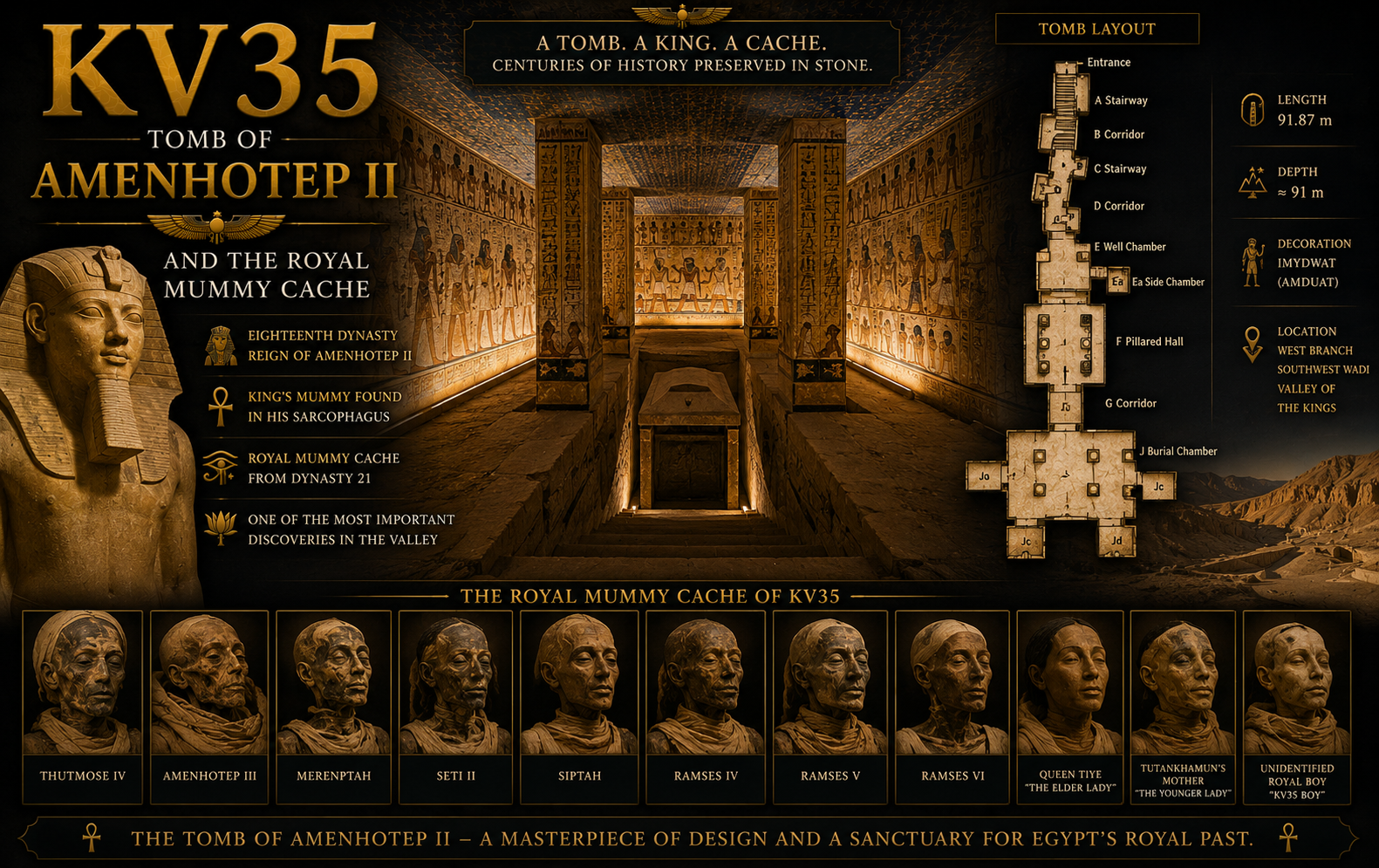
KV35 is the royal tomb of Amenhotep II, one of the most powerful warrior pharaohs of Egypt’s Eighteenth Dynasty. Located deep within a secluded branch of the Valley of the Kings, the tomb is important not only for its innovative architecture and early funerary decoration, but also for one of the most remarkable discoveries in the history of Egyptology.
When French Egyptologist Victor Loret entered KV35 in 1898, he found the mummy of Amenhotep II still lying within its original stone sarcophagus. Even more astonishingly, several side chambers contained the relocated remains of other pharaohs, queens, princes, and unidentified members of the royal family. These bodies had been hidden inside KV35 by ancient priests attempting to protect them from tomb robbers.
Among the mummies discovered in the tomb were Thutmose IV, Amenhotep III, Merenptah, Seti II, Siptah, Setnakhte, Ramesses IV, Ramesses V, and Ramesses VI. Three unidentified bodies found together in a side chamber later became known as the Elder Lady, the Younger Lady, and the KV35 Boy. Modern genetic and forensic research has linked two of these women to the family of Tutankhamun.
KV35 therefore serves two very different roles in Egyptian history. It was the carefully planned royal burial place of Amenhotep II, but centuries later it became a secret refuge for some of the most famous rulers of the New Kingdom.
- Structure: KV35
- Location: Valley of the Kings, East Valley, Thebes West Bank, Luxor
- Owner: Amenhotep II
- Site Type: Royal Tomb
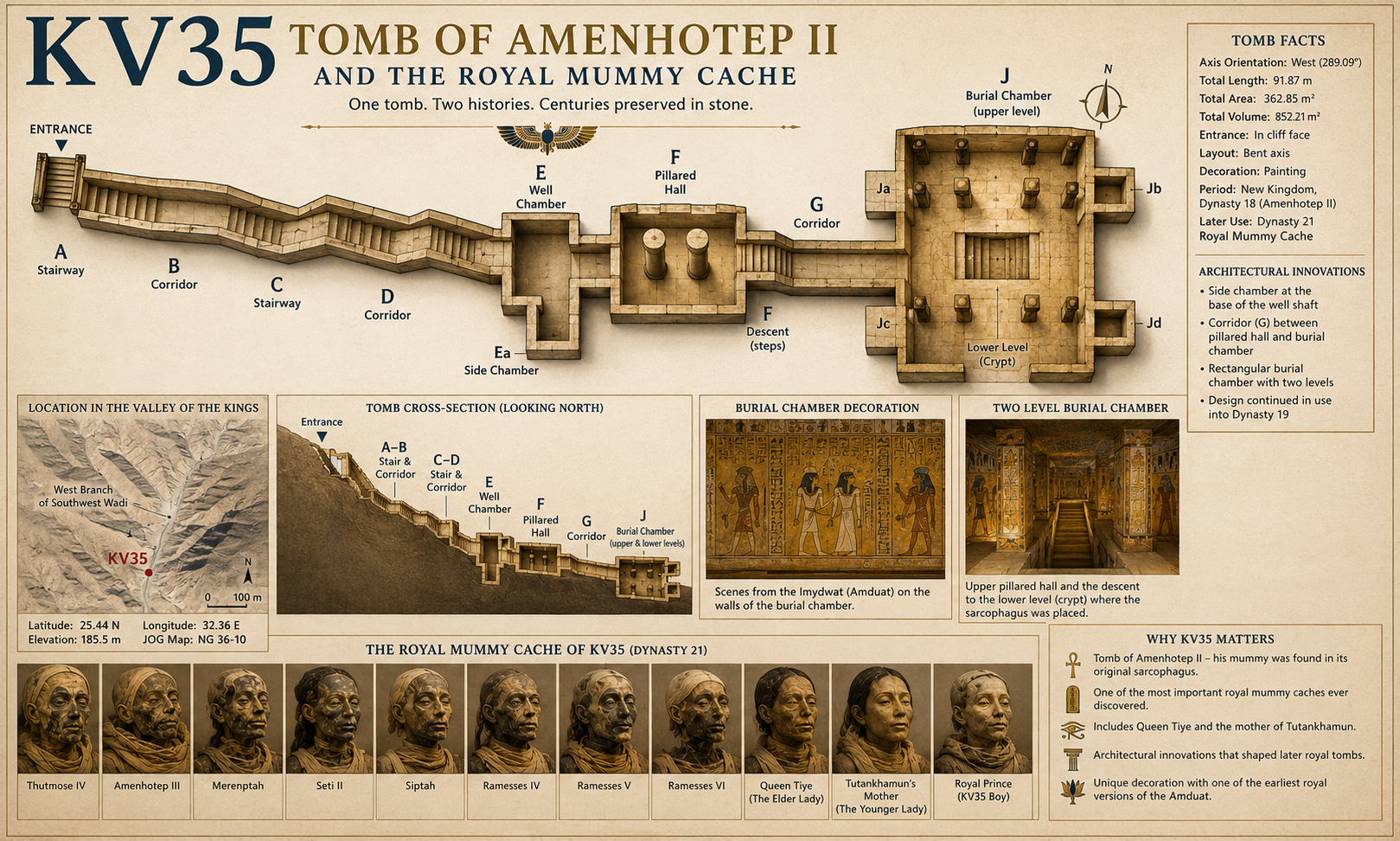
KV35 is located in the western branch of the southwest wadi of the East Valley of the Kings. Its entrance is cut into the face of a cliff, helping conceal it from casual view.
The tomb’s isolated location may have contributed to its selection as a secure hiding place for royal mummies during the Twenty-first Dynasty.
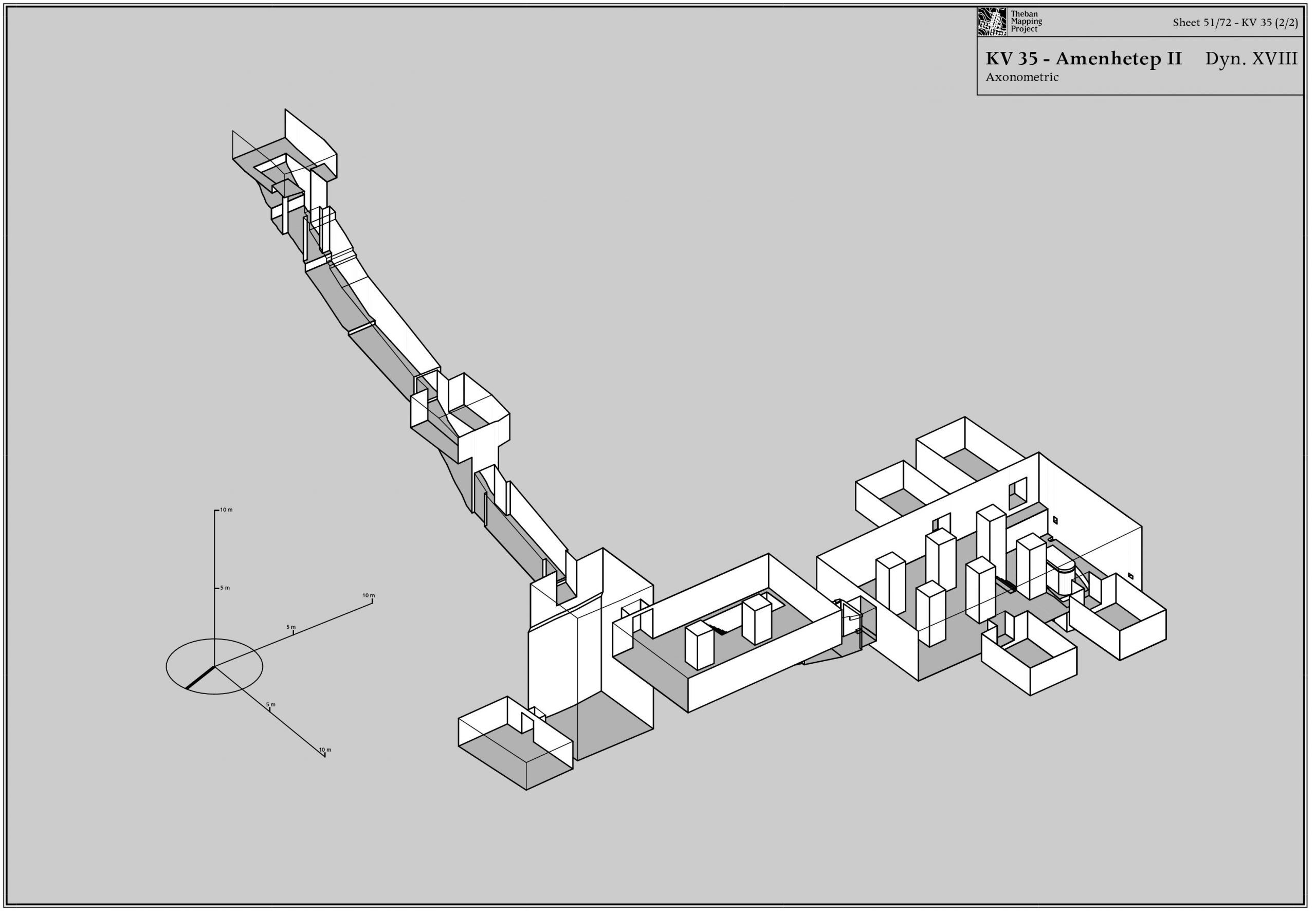
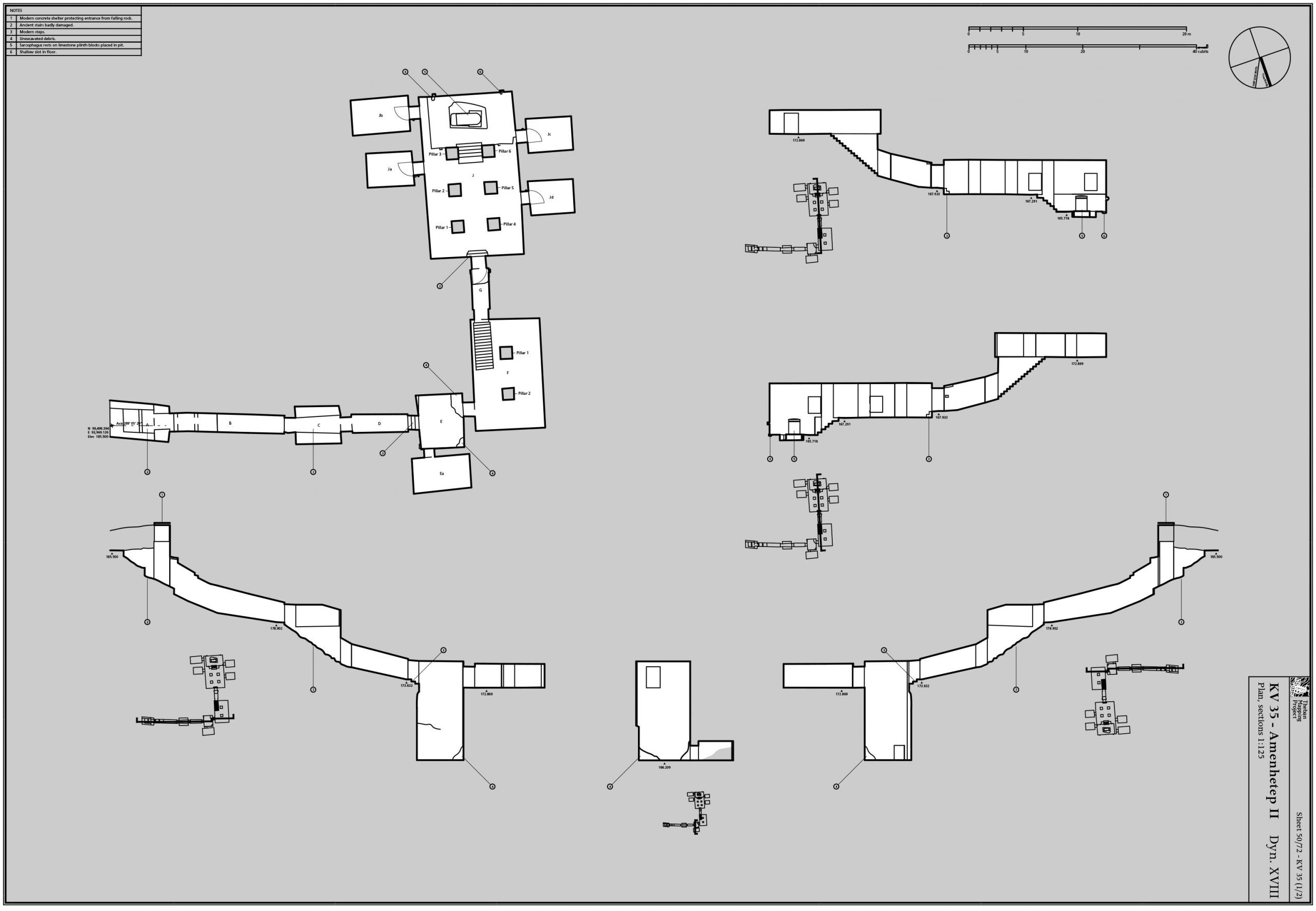
KV35 follows a bent-axis plan derived from the tomb of Amenhotep II’s father, Thutmose III, but introduces several architectural features that influenced later royal tombs.
Two stairways and two descending corridors lead to a well chamber. A small side room opens from the base of the well shaft, an innovation not found in earlier royal tombs.
Beyond the well lies a rectangular pillared chamber containing two columns. Its long axis runs perpendicular to the preceding passages, forcing visitors to turn sharply before continuing deeper into the tomb.
A staircase cut into the southeastern corner of the pillared chamber leads to a descending corridor and the burial chamber. The burial chamber is divided into two levels. The upper section contains three pairs of pillars, while a central staircase descends to the lower section, sometimes called the crypt, where the king’s sarcophagus was placed.
Four side chambers open from the burial chamber. These rooms were later used to store the relocated royal mummies.
Architectural Innovations
KV35 represents an important stage in the development of royal tomb architecture.
Its most significant innovations include:
- A side chamber at the bottom of the well shaft
- A separate corridor between the pillared hall and burial chamber
- A rectangular burial chamber rather than an oval or cartouche-shaped room
- A burial chamber divided into upper and lower levels
- Three pairs of pillars arranged around the central axis
- Multiple side chambers opening from the burial chamber
The rectangular, two-level burial chamber introduced in KV35 became highly influential. Variations of this design continued to appear in royal tombs through the Nineteenth Dynasty.
The Well Chamber
The well chamber formed an important part of many Eighteenth Dynasty royal tombs.
The deep shaft may have served several purposes. It could help collect floodwater and debris before these reached the deeper chambers, although it was not always effective against major flooding. The well may also have possessed symbolic meaning, representing the primeval waters from which life emerged or the tomb of Osiris within the underworld.
KV35 introduced a small chamber opening from the base of the shaft. Similar rooms later appeared in other royal tombs.
The Burial Chamber
The rectangular burial chamber is the most impressive room in KV35.
Three pairs of square pillars divide the upper portion of the chamber into aisles. A short central stairway leads down to the lower floor, where Amenhotep II’s stone sarcophagus stands.
Unlike most royal tombs discovered in modern times, KV35 still contained the body of its intended owner. Victor Loret found Amenhotep II lying inside the sarcophagus with a garland around his neck.
Although robbers had disturbed the king’s burial equipment, ancient priests had restored and rewrapped his body before sealing the tomb again.
Decoration
Only the burial chamber of KV35 is decorated.
Its walls are painted with scenes and texts from the Amduat, also called the Book of What Is in the Underworld. This funerary composition describes the twelve-hour nighttime journey of the sun god Ra through the underworld.
The decoration is presented in a distinctive, diagrammatic style. Figures and hieroglyphs are painted in dark lines against a yellow background, creating the appearance of an enormous funerary papyrus spread across the walls.
Amenhotep II is also shown standing before several deities who would protect and guide him in the afterlife.
The ceiling is painted dark blue and covered with yellow stars, representing the night sky through which the king hoped to travel eternally.
The Amduat
The Amduat divides the sun god’s nightly journey into twelve hours.
Each hour, Ra passes through a different region of the underworld, encountering gods, spirits, gates, enemies, and other supernatural beings. The deceased king was expected to accompany the sun god, overcome the dangers of darkness, and share in Ra’s rebirth at dawn.
KV35 preserves one of the most important early royal versions of the Amduat. Its imagery helped establish decorative traditions that continued in later royal tombs.
Discovery by Victor Loret
Victor Loret discovered KV35 in March 1898 while serving as director of Egypt’s Antiquities Service.
After entering the tomb, Loret encountered debris, damaged burial equipment, and evidence of ancient robbery. In the burial chamber, he found Amenhotep II’s stone sarcophagus with the king’s mummy still inside.
The discovery was extraordinary. Few royal mummies had ever been found within their original tombs, and the unexpected presence of numerous other kings and queens transformed KV35 into one of the most important archaeological discoveries in the Valley of the Kings.
The Royal Mummy Cache
During the Twenty-first Dynasty, priests entered KV35 and placed numerous royal mummies inside its side chambers.
By this period, organized tomb robbery had become a severe problem. Royal tombs were repeatedly opened, valuables were stripped away, and the bodies of kings and queens were damaged.
Priests gathered surviving mummies from vulnerable tombs, repaired and rewrapped many of them, recorded their names on linen or coffins, and transferred them to more secure hiding places. KV35 became one of two major royal mummy caches in the Theban region, the other being the Deir el-Bahari cache known as DB320.
The kings deposited in KV35 included:
- Thutmose IV
- Amenhotep III
- Merenptah
- Seti II
- Siptah
- Setnakhte
- Ramesses IV
- Ramesses V
- Ramesses VI
These mummies represented several generations of Egyptian history, spanning the Eighteenth, Nineteenth, and Twentieth Dynasties.
Amenhotep II

Amenhotep II was the son and successor of Thutmose III. He ruled during the Eighteenth Dynasty, when Egypt controlled a vast empire extending into Nubia and the Near East.
Royal inscriptions emphasize his physical strength, athletic ability, horsemanship, archery skills, and military achievements. He led campaigns into Syria and maintained Egyptian authority over territories his father had conquered.
Amenhotep II was succeeded by his son Thutmose IV, whose mummy was later hidden within KV35.
The Elder Lady
One of the three unidentified bodies found in a side chamber became known as the Elder Lady.
She was an older woman with long, well-preserved hair. A lock of hair found inside Tutankhamun’s tomb had been labeled as belonging to Queen Tiye, the Great Royal Wife of Amenhotep III.
Comparisons of the hair, together with later genetic testing, strongly identified the Elder Lady as Queen Tiye. She was the wife of Amenhotep III, mother of Akhenaten, and grandmother of Tutankhamun.
Queen Tiye was one of the most influential women of the Eighteenth Dynasty and appeared prominently in royal art and diplomatic correspondence.
The Younger Lady
The second woman became known as the Younger Lady.
Her mummy has suffered severe damage, including a large wound to the face. She was once controversially identified as Nefertiti, but surviving historical and genetic evidence does not support that conclusion.
DNA testing indicated that the Younger Lady was the daughter of Amenhotep III and Queen Tiye. The same study identified her as the mother of Tutankhamun and as a close sibling of the male mummy found in KV55.
Her personal name remains unknown. She may have been one of the daughters of Amenhotep III and Tiye whose later lives are poorly documented.
The KV35 Boy
A young male mummy was discovered beside the Elder Lady and Younger Lady.
The boy wore the sidelock of youth and appears to have died during adolescence. His identity has never been conclusively established.
He was once commonly identified as Webensenu, a son of Amenhotep II, but other possibilities have been proposed. Some researchers have suggested that he might be Prince Thutmose, the eldest known son of Amenhotep III and Queen Tiye, who died before he could inherit the throne.
Until further genetic testing is performed, the boy should be treated as an unidentified Eighteenth Dynasty prince.
Prince Webensenu
Objects bearing the name of Prince Webensenu were discovered in KV35, showing that he was probably buried there.
Webensenu was a son of Amenhotep II who died before reaching the throne. His canopic equipment and funerary remains indicate that he received a burial within his father’s tomb.
However, the presence of his objects does not conclusively prove that the unidentified boy found in the side chamber was Webensenu. The royal cache contained bodies and equipment moved from several different locations.
The Other Unidentified Remains
In addition to the famous royal mummies, KV35 contained fragmentary and unidentified human remains.
Some may have belonged to relatives of Amenhotep II, including royal women and children, who were originally buried in the tomb. Others may have entered KV35 when the priests created the later cache.
The proposed identification of one woman as Hatshepsut Meryetre, the mother of Amenhotep II, remains uncertain. Her mummy has not been securely identified.
Objects Recovered
Objects found inside KV35 included:
- Human mummies and mummy fragments
- Royal coffins and coffin fragments
- Canopic equipment
- Stone and pottery vessels
- Jewelry and personal ornaments
- Clothing and linen
- Food offerings
- Wooden models
- Sculptures and statues
- Chariot, warfare, and hunting equipment
- Written labels and documents
- Plant remains
- Funerary furniture
- Architectural fragments
Most of Amenhotep II’s valuable burial equipment had been removed by robbers, but surviving fragments demonstrate that his original funeral had been richly furnished.
Noteworthy Features
KV35 is notable for several reasons:
- It is the royal tomb of Amenhotep II.
- The king’s mummy was found inside his original sarcophagus.
- The burial chamber introduced a rectangular, two-level plan used in later tombs.
- Only the burial chamber is decorated.
- The walls contain a major version of the Amduat.
- The tomb was later used as a royal mummy cache.
- Nine relocated kings were found in its side chambers.
- Queen Tiye was discovered in the tomb as the Elder Lady.
- The Younger Lady was identified genetically as the mother of Tutankhamun.
- An unidentified royal boy was found beside the two women.
Site Information
Axis in degrees: 289.09
Axis orientation: West
Location
- Latitude: 25.44 N
- Longitude: 32.36 E
- Elevation: 185.5 m above sea level
- North: 99,499.394
- East: 93,969.126
- JOG map reference: NG 36-10
- Modern governorate: Qena
- Ancient nome: Fourth Upper Egyptian Nome
- Surveyed by TMP: Yes
Measurements
- Maximum height: 3.44 m
- Minimum width: 0.94 m
- Maximum width: 10.15 m
- Total length: 91.87 m
- Total area: 362.85 m²
- Total volume: 852.21 m³
Additional Tomb Information
- Entrance location: Cliff face
- Owner type: King
- Entrance type: Staircase
- Interior layout: Corridors and chambers
- Axis type: Bent
- Decoration: Painting
KV35 was used during the following periods:
- New Kingdom, Eighteenth Dynasty, reign of Amenhotep II
- Third Intermediate Period, Twenty-first Dynasty, use as a royal mummy cache
History of Exploration
- Victor Loret, 1898: Discovery and excavation for the Egyptian Antiquities Service
- Paul Bucher, 1932: Photography
- Erik Hornung, 1982–1992: Epigraphic study and documentation
Conservation History
KV35 was closed following flooding in 1994.
The Supreme Council of Antiquities constructed a protective shelter near the entrance to reduce the threat of further flood damage. Modern lighting was added, glass barriers were installed around decorated pillars and walls, and wooden walkways were placed across parts of the pillared and burial chambers.
Conservation work has focused on stabilizing the painted surfaces, monitoring humidity, controlling visitor movement, and protecting the tomb from future flooding.
Site Condition
KV35 is generally well preserved, although the tomb remains vulnerable to environmental changes and flood damage.
The painted decoration in the burial chamber survives in relatively good condition, and the architectural layout remains largely intact. Protective installations have helped limit physical contact with the walls and pillars.
Why KV35 Matters
KV35 is one of the most important tombs in the Valley of the Kings.
Architecturally, it introduced features that helped shape royal tomb design for generations. Artistically, its burial chamber preserves an important early version of the Amduat. Archaeologically, its royal mummy cache preserved the remains of some of ancient Egypt’s most famous kings and queens.
The tomb also connects several of the greatest figures of the Eighteenth Dynasty. Amenhotep II was buried there, Thutmose IV and Amenhotep III were hidden there, Queen Tiye was discovered there, and the mother of Tutankhamun was found in one of its side chambers.
Few tombs contain such an extraordinary concentration of royal history.
Interesting Facts About KV35
- Amenhotep II was found inside his original sarcophagus.
- KV35 contained nine relocated royal mummies.
- Queen Tiye was discovered there as the Elder Lady.
- Tutankhamun’s mother was discovered there as the Younger Lady.
- The Younger Lady’s personal name remains unknown.
- A mysterious teenage prince was found with the two women.
- The burial chamber resembles a giant painted funerary papyrus.
- KV35 introduced architectural features later used throughout the Valley.
- The tomb became a royal hiding place centuries after Amenhotep II’s burial.
- Victor Loret discovered KV35 in 1898.