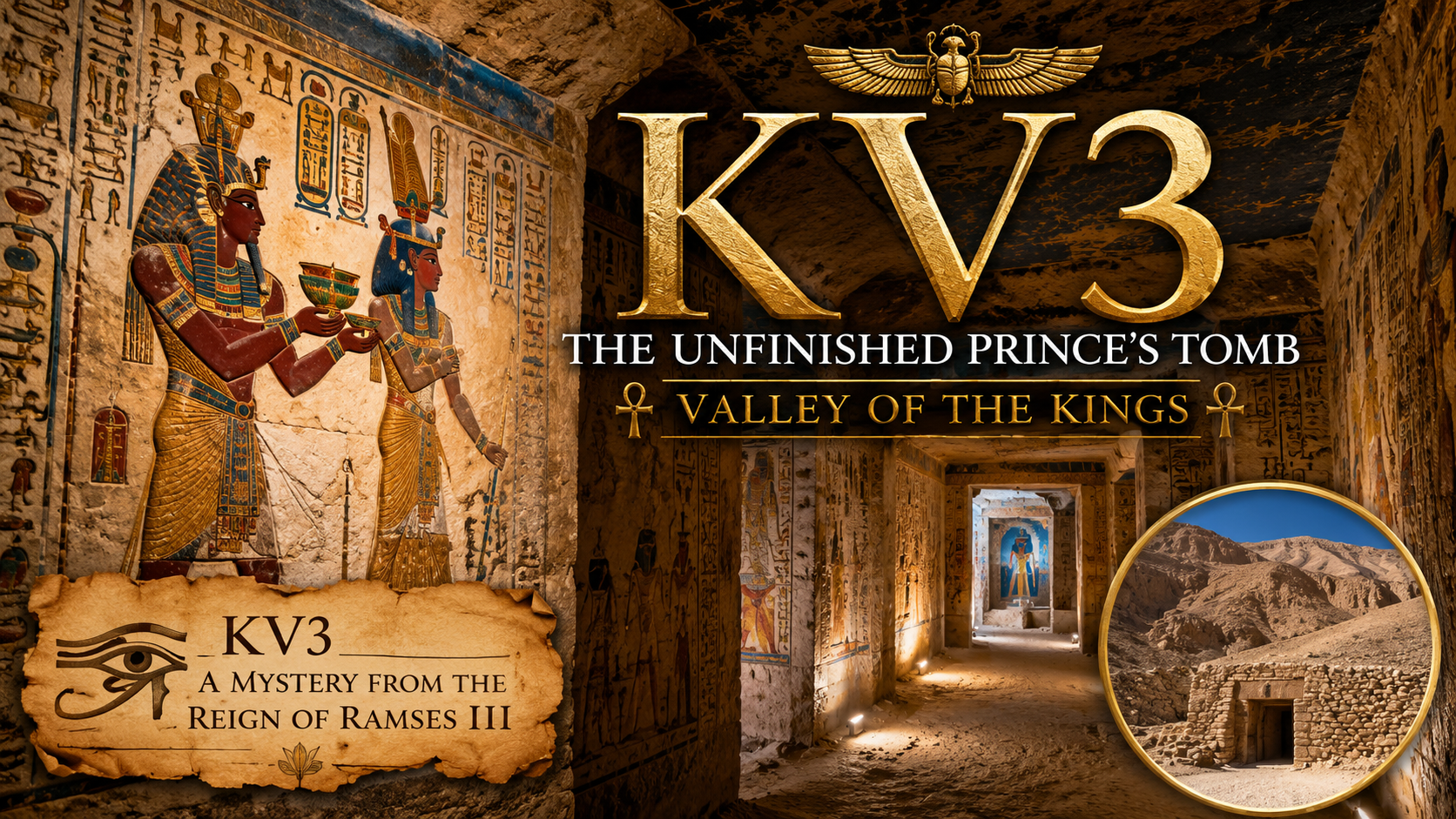
Tomb KV3 was intended for the burial of an unidentified son of Pharaoh Ramesses III during the early part of the Twentieth Dynasty. It is similar in design to the “straight axis” tombs typical of this dynasty, and an ostracon written in hieratic script from the time of Ramesses III mentions the founding of a tomb for a royal prince, likely this tomb.
The unfinished state of several rooms within the tomb, along with the scant archaeological evidence recovered from the site, suggests that KV3 was never used for burial. The abrupt abandonment of side chambers and the absence of funerary equipment, human remains, or substantial burial debris strongly indicate that the tomb was never completed or occupied.
Some have suggested that it was originally intended for use by the prince regent, who would succeed as Ramesses IV, and who started building his own tomb (KV2) soon after he came to the throne.
- Structure: KV 3
- Location: Valley of the Kings, East Valley, Thebes, West Bank, Thebes
- Owner: Son of Rameses III
- Other designations: 3 [Hay], 3 [Lepsius], 5 [Champollion], Ier Tombeau à l’est [Description], O, plan N (?) [Pococke], P [Burton]
- Site type: Tomb
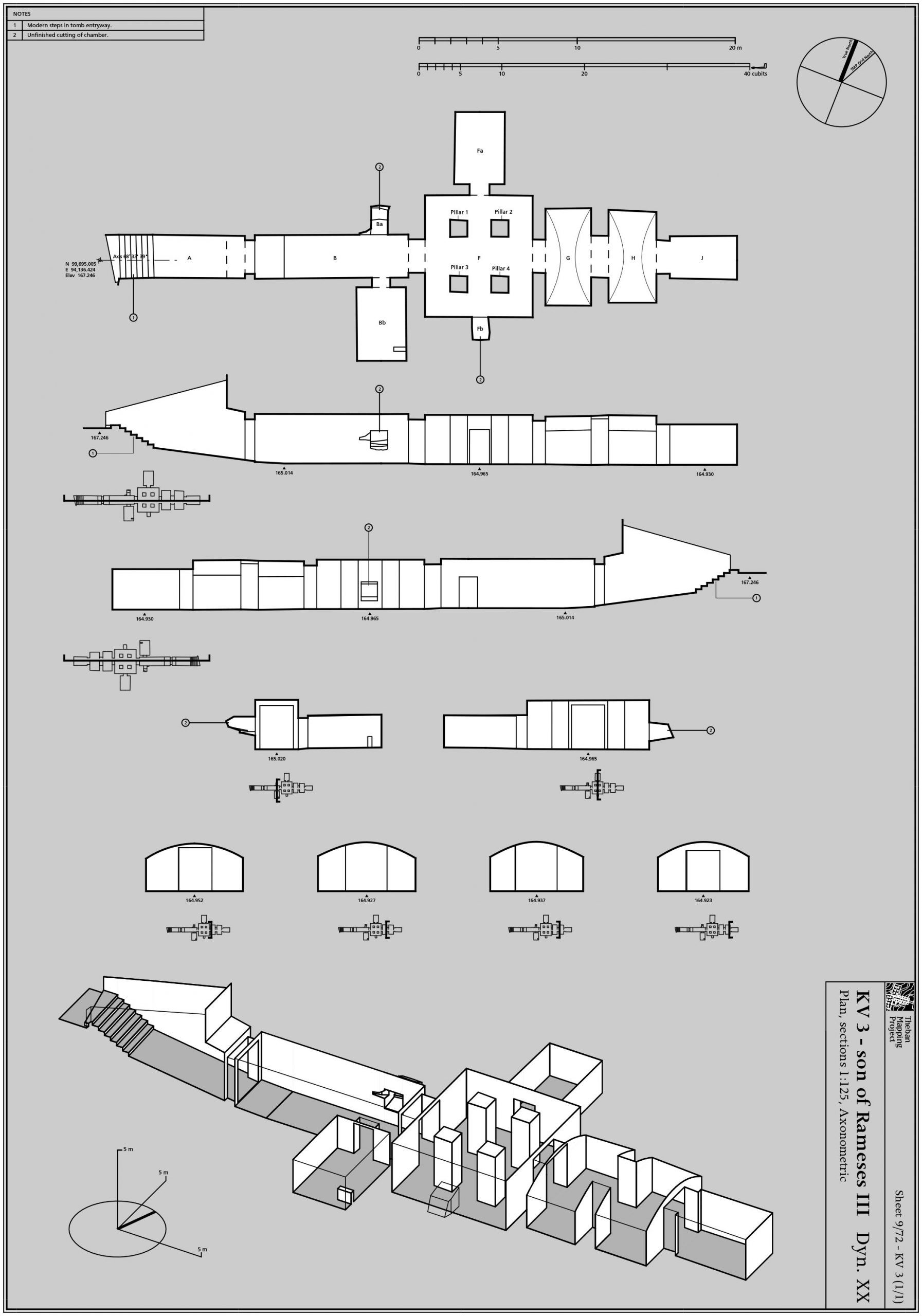
Description: KV 3, located in the first southeast branch off the main wadi, resembles, in plan, the tombs of royal family members of Dynasty 20 in the Valley of the Queens. Its open entryway (A) leads to a corridor (B), from which side chambers (Ba, Bb) open off each side. Only the right (south) side chamber Bb was fully cut; a cutting on the left (north) marks the beginning of the gate and side chamber Ba. A pillared chamber (F) follows on the main axis, also with side chambers (Fa, Fb). Here, the left (north) side chamber Fa was completed, while on the right (south) Fb is represented only by the abandoned gate cutting. On the same main axis, three smaller chambers (G, H, J) occupy the rear; the first two have vaulted ceilings.
The tomb’s extant decoration in painted sunk relief on plaster survives only in corridor B and in gates B and F. The principal decorative theme consisted of depictions of Rameses III, followed by a prince, before various deities.
Although little decoration survives today, Carl Richard Lepsius recorded additional painted scenes in the nineteenth century, including decoration on the ceilings of the vaulted chambers and scenes of Ramesses III in corridor B and at several gateways. This suggests that the tomb may once have possessed a more extensive decorative program than is visible today.
Noteworthy features: This is one of the few decorated tombs of a prince in the Valley of the Kings. It has two narrow rear chambers, with vaulting at ninety degrees to the usual form.
Axis in degrees: 68.56
Axis orientation: East
Site Location
- Latitude: 25.44 N
- Longitude: 32.36 E
- Elevation: 167.246 msl
- North: 99,695.005
- East: 94,136.424
- JOG map reference: NG 36-10
- Modern governorate: Qena (Qina)
- Ancient nome: 4th Upper Egypt
- Surveyed by TMP: Yes
Measurements
Maximum height: 3.13 m
Minimum width: 1.03 m
Maximum width: 7.71 m
Total length: 53.47 m
Total area: 193.36 m²
Total volume: 464.98 m³
Additional Tomb Information
- Entrance location: Base of a sloping hill
- Owner type: Prince
- Entrance type: Ramp
- Interior layout: Corridor and chambers
- Axis type: Straight
- Decoration
- Sunk relief
Categories of Objects Recovered
- Architectural elements
- Vessels
Site History
An ostracon in the Berlin Museum (Berlin Ostracon P.10663) records that in regnal year 28 of Ramesses III, a group of workmen went to the Valley of the Kings to “found the [tomb] of a prince of His Majesty.” The tomb may be KV 3, but the name of the prince is unknown, although some have suggested that it was intended for the prince who succeeded his father as Rameses IV. There are no indications that the tomb received a royal burial. Bricks and remains of sandstone columns indicate that KV 3 was used as a Christian chapel during the Byzantine Period.
This site was used during the following period(s):
- New Kingdom, Dynasty 20, Rameses III (dated by the presence of the king’s cartouches)
- Byzantine Period
History of Exploration
- Pococke, Richard (1737-1738): Mapping/planning
- Burton, James (1825): Mapping/planning
- Franco-Tuscan Expedition (1828-1829): Epigraphy
- Lepsius, Carl Richard (1844-1845): Visit
- Ayrton, Edward Russell (1904-1906): Excavation (conducted around entrance)
- Quibell, James Edward (1904-1906): Excavation (conducted around entrance)
- Burton, Harry (1912): Excavation (conducted for Theodore M. Davis)
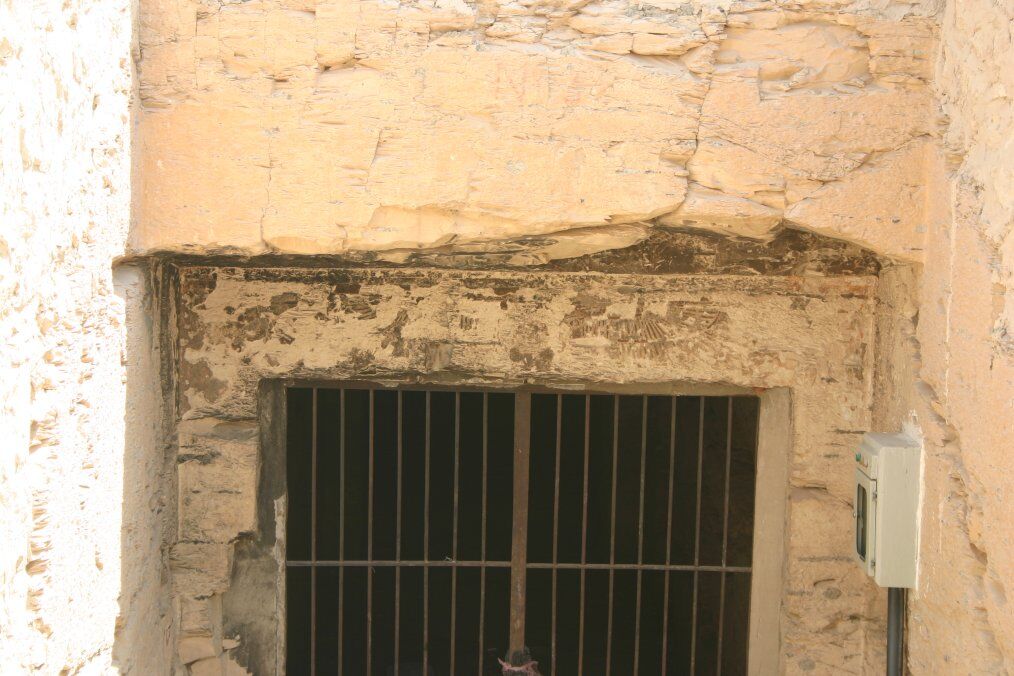
Conservation history: A rubble revetment was constructed around the entrance, together with a wall across the entry. A metal gate has been installed in Gate B, partly covering inscriptions on the thickness.
Site condition: The painted plaster wall decoration has almost entirely fallen away except near the ceiling in corridor B. Smoke from the recent burning of trash in the corridor entrance has damaged the ceiling.

Interesting KV3 Facts
- KV3 is one of only a handful of non-pharaonic tombs located in the Valley of the Kings.
- The owner’s identity remains unknown.
- The tomb’s architecture closely parallels royal family tombs in the Valley of the Queens.
- Some scholars believe the intended owner may have been the future Ramesses IV.