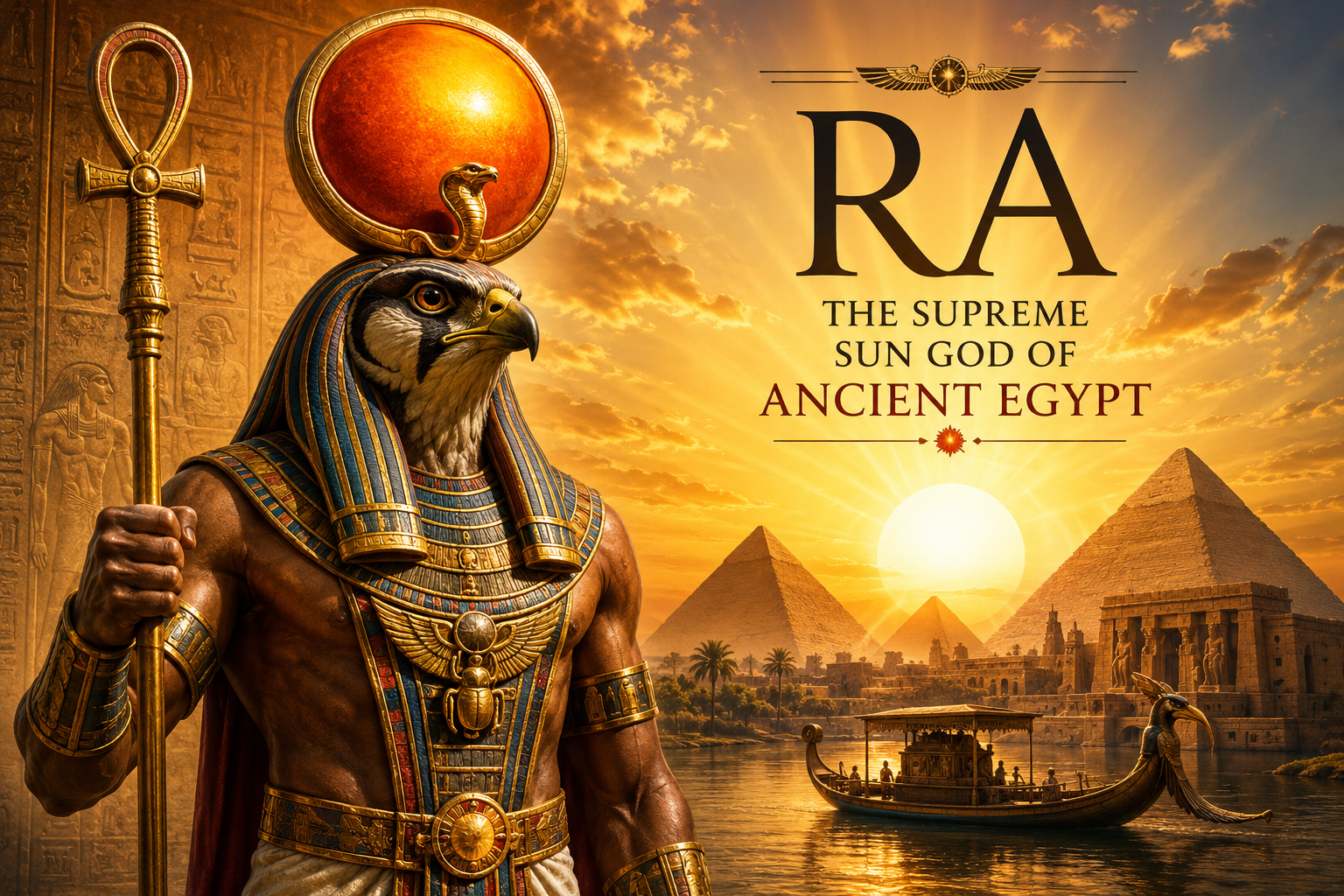
Ra, also spelled Re, was one of the oldest and most important gods in Ancient Egyptian mythology. Revered as the god of the sun, light, creation, kingship, and divine power, Ra occupied the highest position in the Egyptian pantheon for thousands of years. Ancient Egyptians believed that he was the creator of all life and the ruler of both gods and humans.
Ra was so influential that many later Egyptian deities became associated with or merged with him. Over time, gods such as Amun, Horus, and Atum were combined with Ra to create powerful forms such as Amun-Ra, Ra-Horakhty, and Atum-Ra. His importance endured throughout much of Egyptian history, making him one of the most recognizable figures of ancient religion.
Ra as the Sun
In the ancient Egyptian language, the word “Ra” literally meant “sun.” However, Ra was not merely associated with the sun; he was believed to be the sun itself. Every sunrise represented his daily rebirth, while every sunset symbolized his descent into the underworld.
Ancient Egyptians believed that Ra traveled across the sky each day aboard a magnificent solar barque, or sun boat. During the daytime, he sailed across the heavens in the Mandjet, often called the “Boat of Millions of Years,” bringing warmth, light, and life to the world.
As evening approached, Ra descended below the western horizon and entered the underworld, known as the Duat. There, he traveled aboard a second vessel called the Mesektet, or Night Boat. His nightly journey through the underworld was considered dangerous and essential for maintaining cosmic order.
Ra and the Battle Against Apep
Each night during his journey through the Duat, Ra faced his greatest enemy, the giant serpent Apep, also known as Apophis. Apep represented chaos, darkness, destruction, and disorder. The monstrous serpent sought to destroy Ra and prevent the sun from rising.
Ancient Egyptians believed that if Apep succeeded, the world would be plunged into eternal darkness and chaos. Fortunately, Ra was aided by several gods, including Seth, who defended the solar barque by battling the serpent.
The daily victory of Ra over Apep symbolized the triumph of order over chaos, light over darkness, and life over death. Every sunrise served as proof that Ra had once again emerged victorious.
Ra as the Creator God
Ra was considered the creator of the universe in many Egyptian traditions. According to the Heliopolitan creation myth, Ra emerged from the primordial waters of chaos known as Nun. Having created himself, he then brought forth the first divine pair: Shu, the god of air, and Tefnut, the goddess of moisture.
Shu and Tefnut later gave birth to Geb, the god of the earth, and Nut, the goddess of the sky. Geb and Nut, in turn, became the parents of Osiris, Isis, Seth, and Nephthys. Through this divine lineage, Ra became the ancestor of many of the most important Egyptian gods.
Some myths even state that humanity was created from Ra’s tears. According to these stories, humans sprang into existence wherever the tears of Ra fell upon the earth.
Ra and the Pharaohs
Ra played a central role in Egyptian kingship. Beginning during the Fifth Dynasty of the Old Kingdom, pharaohs increasingly associated themselves with the sun god and adopted the title “Son of Ra.”
The Egyptian ruler was believed to govern on behalf of Ra and to maintain Ma’at, the principle of truth, balance, justice, and cosmic order. Because of this divine relationship, many temples, monuments, and religious ceremonies were dedicated to Ra throughout Egyptian history.
The Merging of Ra with Other Gods
As Egyptian religion evolved over thousands of years, Ra became closely associated with several other deities. This practice allowed different local traditions and cults to coexist.
Some of the most important combined forms of Ra included:
- Amun-Ra: a fusion of Ra and Amun that became the supreme state deity during the New Kingdom.
- Ra-Horakhty: a combination of Ra and Horus, representing the rising and midday sun.
- Atum-Ra: uniting Ra with Atum, another creator god associated with the setting sun.
- Khepri-Ra: representing the morning sun and rebirth, often depicted as a scarab beetle.
Although the cult of Amun-Ra became extremely powerful, Ancient Egypt remained largely polytheistic throughout its history. The only major attempt to establish a form of monotheism occurred during the reign of Pharaoh Akhenaten, who promoted the exclusive worship of the Aten, the solar disk. Following Akhenaten’s death, traditional Egyptian religion quickly returned.
Symbols and Depictions of Ra
Ra was usually depicted as a man with the head of a falcon, crowned by a solar disk encircled by a sacred cobra known as the uraeus. The cobra symbolized royal authority and divine protection.
Other symbols associated with Ra include:
- The sun disk
- The falcon
- The solar barque
- The scarab beetle
- The Bennu bird
The Bennu bird, often linked with Ra, symbolized rebirth, renewal, and creation. Many scholars believe that the Bennu may have inspired the later Greek legend of the phoenix.
Worship of Ra
The principal center of Ra’s worship was Heliopolis, whose Greek name means “City of the Sun.” Located near modern Cairo, Heliopolis was one of the most important religious centers in Ancient Egypt.
Priests at Heliopolis performed daily rituals, offered sacrifices, recited hymns, and conducted ceremonies intended to ensure the continued journey of the sun across the sky. Obelisks, which symbolized the rays of the sun, were commonly erected in temples dedicated to Ra.
Ra was first worshipped during the Old Kingdom (c. 2613 to 2181 BC) and remained one of Egypt’s most revered deities for over two thousand years, until the spread of Christianity during the Roman period.
Festivals Honoring Ra
Ancient Egyptians celebrated numerous religious festivals dedicated to solar deities, particularly in Heliopolis and other major temple centers. These celebrations often included public processions, ritual offerings, prayers, music, and sacred ceremonies honoring the sun god.
Modern practitioners of Kemetic religion sometimes celebrate contemporary festivals dedicated to Ra, including an observance known as “The Receiving of Ra” on May 26. However, historians do not consider this festival to have been part of the original ancient Egyptian religious calendar.
The Children of Ra
The family relationships of Egyptian gods often varied depending on the historical period, region, and religious tradition. Consequently, there is no universally accepted list of Ra’s children.
In the Heliopolitan creation myth, Ra is most commonly described as the father of Shu and Tefnut. Other deities, including Hathor, Sekhmet, Bastet, and Ma’at, are sometimes portrayed as daughters or manifestations of Ra in certain myths and local traditions.
Because Egyptian mythology evolved over thousands of years, different temples and priesthoods preserved their own versions of divine genealogies.
Legacy of Ra
Ra remains one of the most famous gods of the ancient world. His image appears in countless works of art, temple inscriptions, tomb paintings, and archaeological discoveries throughout Egypt. Even today, Ra continues to fascinate historians, archaeologists, and mythology enthusiasts around the world as the supreme sun god and creator deity of Ancient Egypt.