Anubis was one of the most recognizable and important gods in Ancient Egyptian mythology. Easily identified by his jackal head, Anubis was the god of mummification, funerary rites, cemeteries, and the afterlife. For thousands of years, Egyptians looked to Anubis as the divine protector of the dead and the guide who safely led souls into the next world.
Long before Osiris became ruler of the underworld, Anubis served as Egypt’s principal god of the dead. Even after Osiris assumed that role, Anubis remained one of the most important deities in Egyptian religion, overseeing the preparation of the deceased and ensuring that proper burial rituals were performed.
Ancient Egyptians believed that without Anubis, the dead could not successfully complete their journey into the afterlife.
Origins and Family
The parentage of Anubis varies depending on the myth and historical period.
The most common tradition identifies Anubis as the son of Osiris and Nephthys. According to myth, Nephthys disguised herself as Isis and seduced Osiris, resulting in the birth of Anubis. Fearing the wrath of her husband Set, Nephthys abandoned the child, who was later discovered and raised by Isis.
Other traditions identify Anubis as the son of Set and Nephthys, while some earlier texts simply describe him as the son of Ra.
Because Egyptian religion evolved over more than three thousand years, multiple versions of Anubis’ parentage existed simultaneously.
What Does the Name Anubis Mean?
The name “Anubis” is the Greek form of the ancient Egyptian name Inpu or Anpu.
Although the exact meaning of his Egyptian name remains uncertain, scholars have suggested translations such as “royal child” or “to decay.”
The Greeks identified Anubis with their own messenger god Hermes, creating the composite deity Hermanubis during the Greco-Roman period.
God of Mummification
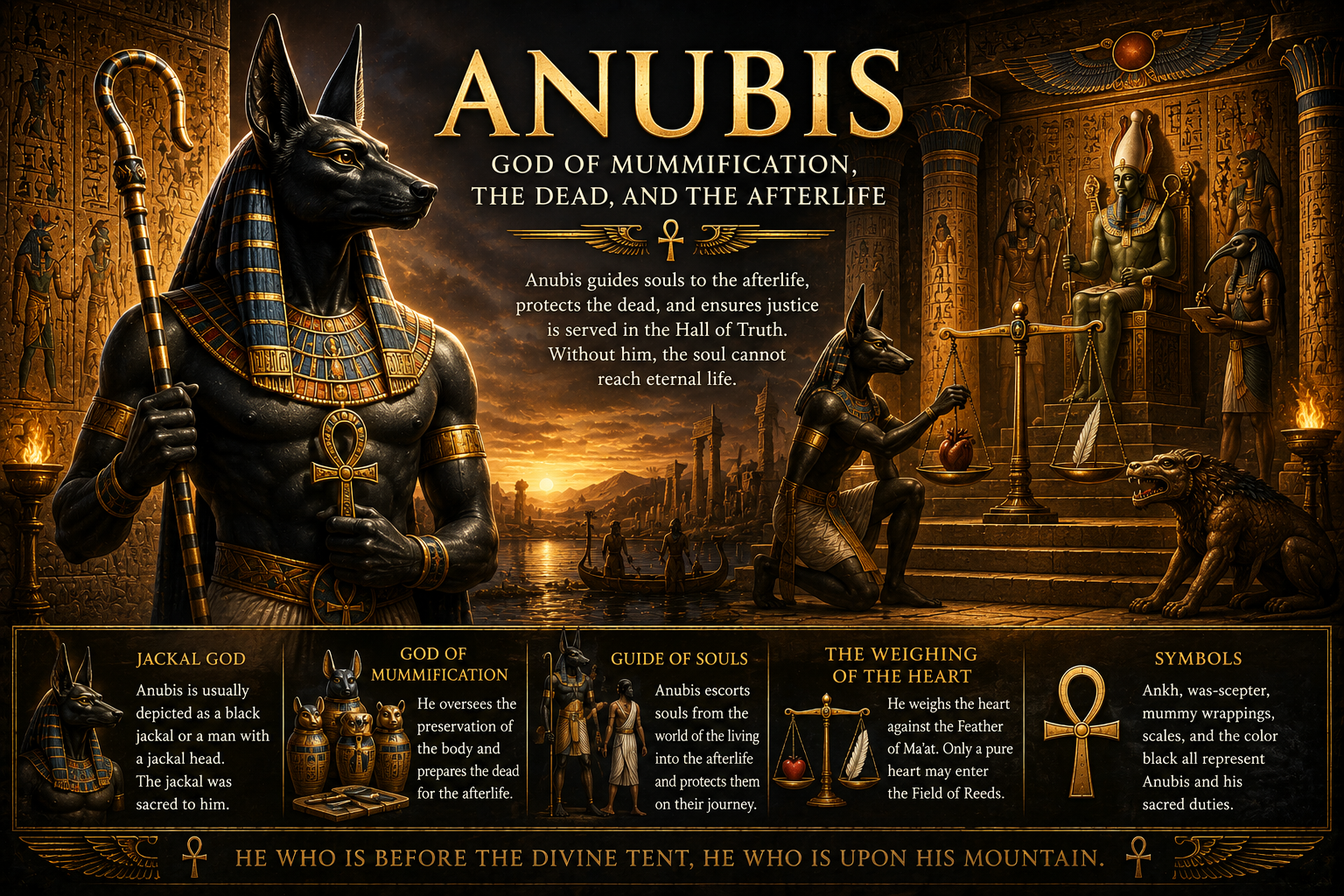
Anubis was most famous as the patron god of embalming and mummification.
Ancient Egyptians believed that preserving the body was essential for survival in the afterlife. Priests responsible for mummification often wore jackal masks while performing funerary rituals, symbolically becoming Anubis during the ceremony.
According to mythology, Anubis performed the first mummification when he embalmed the body of Osiris after the god was murdered by Set.
Because of this act, Anubis became forever associated with the preservation of the dead.
Guide of Souls
Anubis served as a psychopomp, a guide who escorted souls from the world of the living to the afterlife.
After death, Anubis was believed to lead the deceased safely through the dangers of the underworld and into the Hall of Judgment.
There, the soul would stand before Osiris and the divine tribunal to determine whether it was worthy of eternal life.
This role made Anubis one of the most compassionate and protective deities in Egyptian religion.
Anubis and the Weighing of the Heart
One of Anubis’ most important responsibilities was overseeing the Weighing of the Heart ceremony.
During this ritual, Anubis placed the deceased person’s heart on a scale opposite the Feather of Ma’at, the goddess of truth and justice.
If the heart balanced perfectly against the feather, the deceased was declared pure and allowed to enter the eternal paradise known as the Field of Reeds.
If the heart proved heavier than the feather due to wrongdoing, it was devoured by the fearsome creature Ammit, resulting in the permanent destruction of the soul.
Thoth recorded the results of the judgment while Osiris presided over the tribunal. Because of his role in this ceremony, Anubis became closely associated with justice, truth, and morality.
Why Was Anubis Depicted as a Jackal?
Anubis was usually portrayed as either a black jackal or a man with the head of a jackal.
Wild jackals and other canids often roamed cemeteries located on the edges of the desert. Ancient Egyptians may have chosen the jackal as Anubis’s sacred animal in hopes that the god would protect graves from scavengers.
Anubis’s black color was also symbolic. Although real jackals are not black, the color represented:
- Death
- Rebirth
- Fertile Nile soil
- Resurrection
Thus, Anubis embodied both death and renewal.
Appearance and Symbols
Anubis was most commonly depicted in one of two forms:
- A black jackal lying upon a shrine.
- A man with the head of a black jackal.
He often carried:
- An ankh, symbolizing life
- A was-scepter, symbolizing power
- Mummification bandages
His principal symbols included:
- The jackal
- Mummies and embalming tools
- Funerary masks
- The scales of judgment
- The color black
Worship of Anubis
Anubis was worshipped throughout Egypt.
His principal cult center was Cynopolis, meaning “City of the Dogs,” located in Upper Egypt.
Because every Egyptian hoped to achieve eternal life, Anubis held universal appeal across all levels of society.
Funerary priests regularly invoked Anubis during burial ceremonies, and countless tomb inscriptions ask for his protection in the afterlife.
Amulets depicting Anubis were also extremely popular and were often placed within tombs to safeguard the deceased.
Anubis in the Afterlife
Ancient Egyptians believed that Anubis protected tombs and watched over the dead.
He guarded cemeteries, defended mummies against evil forces, and ensured that proper funerary rites were observed.
Without his assistance, a soul risked becoming lost or destroyed in the underworld.
For this reason, Anubis remained one of the most universally respected gods in Ancient Egypt.
Legacy of Anubis
Anubis remained one of Egypt’s most important deities from the Early Dynastic Period until the spread of Christianity.
As guardian of the dead, master of embalming, and guide of souls, he provided comfort and protection to millions of Egyptians seeking eternal life.
Today, Anubis remains one of the most recognizable figures from Ancient Egypt and continues to fascinate historians, archaeologists, and mythology enthusiasts around the world.