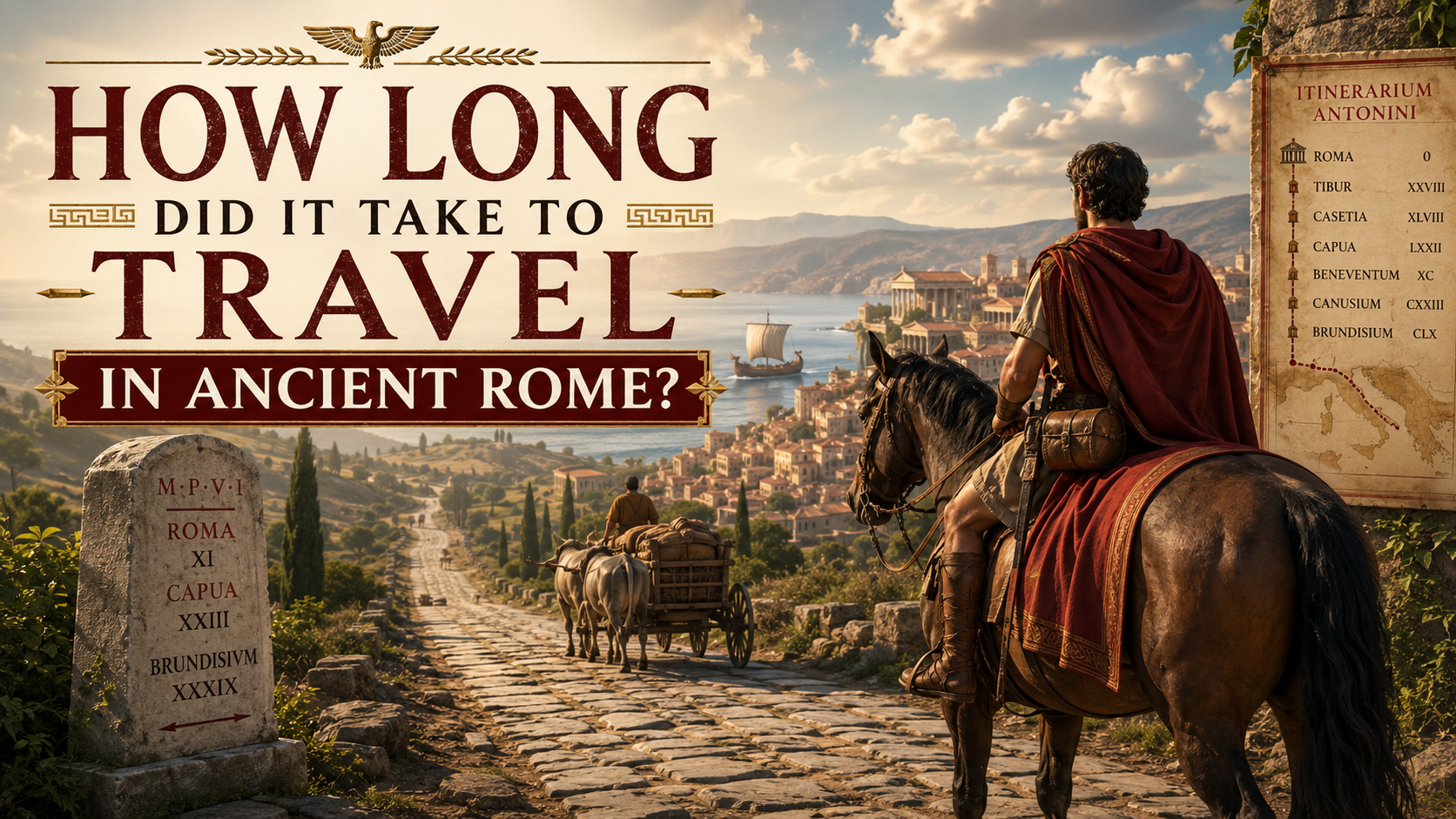
The Roman Empire built one of the ancient world’s most extensive transportation networks, connecting cities across Europe, North Africa, and western Asia.
But how long did it actually take to travel in ancient Rome?
For an ordinary traveler, a reasonable overland pace was about 15 to 25 miles per day, or approximately 24 to 40 kilometers. A person riding a horse could often cover 35 miles, or 56 kilometers, in a day, while a heavily loaded ox cart might manage only 7 miles, or 12 kilometers.
Government couriers using relay stations and fresh horses could travel much faster. In exceptional circumstances, an urgent message might cover more than 100 miles in a day.
Sea travel was often faster and cheaper than moving by land, but sailing times depended heavily on winds, weather, currents, season, and the availability of ships.
The answer, therefore, depended on how someone traveled.
How Fast Did Romans Normally Travel?
Researchers with Stanford University’s ORBIS project created a model of transportation across the Roman Empire around AD 200. The model combines Roman roads, rivers, sea routes, terrain, seasonal conditions, and different types of transportation to estimate ancient journey times.
Its approximate daily travel distances include:
| Method of travel | Approximate distance per day |
|---|---|
| Ox cart | 7 miles, or 12 kilometers |
| Porter or heavily loaded mule | 12 miles, or 20 kilometers |
| Walking traveler | 18 miles, or 30 kilometers |
| Roman army on a normal march | 18 miles, or 30 kilometers |
| Private carriage | 22 miles, or 36 kilometers |
| Faster private carriage | 31 miles, or 50 kilometers |
| Horseback rider | 35 miles, or 56 kilometers |
| Rapid military march | 37 miles, or 60 kilometers |
| Fast carriage or courier | 42 miles, or 67 kilometers |
| Continuous horse relays | Up to 155 miles, or 250 kilometers |
These figures are estimates rather than fixed speed limits. They represent useful averages based on ancient evidence and comparisons with transportation before modern engines.
A traveler might move faster on a straight, well-maintained road across level ground. Mud, mountains, damaged bridges, illness, broken wheels, crowded inns, flooded rivers, and bad weather could reduce progress dramatically.
How Far Could a Roman Walk in One Day?
An ordinary traveler on foot could probably cover about 15 to 20 miles per day, or approximately 24 to 32 kilometers, under reasonable conditions.
Someone carrying heavy baggage would travel more slowly. A traveler accompanied by children, servants, animals, or carts might also cover considerably less ground.
Roman roads made walking easier in some areas, but they were not smooth modern highways. A road could include stone paving, gravel, compacted earth, steep slopes, ruts, dust, and uneven surfaces.
Walking also involved more than placing one foot in front of the other. Travelers needed time to:
- Find food and water
- Cross rivers
- Pay tolls or fees
- Ask for directions
- Care for animals
- Repair shoes or equipment
- Locate shelter before dark
- Avoid dangerous stretches of road
A journey of 100 miles could therefore require approximately five to seven days on foot, assuming favorable conditions and no lengthy interruptions.
How Fast Did Roman Soldiers March?
A Roman army on a normal march could cover approximately 18 to 20 miles per day, or about 30 kilometers.
The late Roman writer Vegetius stated that recruits should be trained to march 20 Roman miles at the ordinary military pace and 24 Roman miles at a faster pace. A Roman mile was approximately 1.48 kilometers, making those distances roughly 30 and 35.5 kilometers.
However, training standards should not be mistaken for what every army accomplished every day.
A marching army was an enormous moving community. It could include:
- Thousands of soldiers
- Pack animals
- Supply wagons
- Engineers
- Servants
- Medical personnel
- Artillery
- Food and equipment
The speed of the entire column depended on its slowest sections.
At the end of the day, soldiers might also have to construct a fortified marching camp. This required digging ditches, raising defenses, arranging tents, guarding the perimeter, preparing food, and caring for weapons and animals.
A small, lightly equipped military unit could move much faster than a full legion with its baggage train. ORBIS uses approximately 60 kilometers, or 37 miles, as a model for a rapid military march, but that pace could not necessarily be sustained indefinitely.
How Fast Could Romans Travel on Horseback?
A routine horseback journey might cover approximately 35 miles per day, or around 56 kilometers.
A rider could travel farther if:
- The road was good
- The terrain was level
- The horse was healthy
- The rider carried little baggage
- Fresh horses were available
- The journey was urgent
- Lodging and supplies had been arranged in advance
One horse could not gallop across the empire without rest. Horses needed water, food, grooming, and recovery time. Long-distance speed depended less on how fast one animal could run and more on whether the traveler could replace tired animals along the route.
A private traveler with one horse was therefore much slower than an imperial messenger using a relay network.
How Fast Were Roman Carts and Carriages?
Roman wheeled transportation varied greatly.
A light carriage carrying one or two passengers could move much faster than a wagon filled with grain, stone, military supplies, or household possessions.
Estimated daily distances include:
- Ox cart: about 7 miles, or 12 kilometers
- Private carriage: about 22 miles, or 36 kilometers
- Fast private carriage: about 31 miles, or 50 kilometers
- Courier carriage: about 42 miles, or 67 kilometers
Oxen were strong and dependable but slow. They were useful for pulling heavy cargo and working in agricultural settings, not for rapid passenger travel.
Mules were often better suited to difficult terrain. They could carry loads along roads and paths that were unsuitable for large wagons.
Wealthy travelers might use covered vehicles for comfort and privacy, but a carriage was not necessarily the fastest option. Wheels could break, animals could tire, and rough roads could make the ride uncomfortable.
What Was the Cursus Publicus?
The cursus publicus was the Roman Empire’s official transportation and communication system. It was established and developed under imperial authority to move:
- Government messages
- Imperial officials
- Military orders
- Tax information
- State supplies
- People traveling on authorized business
The system included stations positioned along important roads. Travelers with official authorization could obtain fresh animals, food, lodging, vehicles, and other assistance.
It was not a public postal service that any Roman citizen could use. Access required official permission.
The system gave the government an enormous advantage over ordinary travelers. A courier could change horses repeatedly instead of waiting for one exhausted animal to recover.
Research into Roman communication places normal messenger speeds in a range of approximately 50 to 80 kilometers per day, with a median near 67 kilometers, or 45 Roman miles.
Exceptionally urgent journeys could be much faster.
Could a Roman Courier Travel 100 Miles in One Day?
Yes, under exceptional conditions. A courier with access to fresh horses, prepared stations, good roads, and official assistance could cover more than 100 miles in a day.
Some extremely fast ancient journeys reportedly reached approximately 100 miles per day for several consecutive days. These were extraordinary achievements rather than normal travel speeds.
ORBIS includes a theoretical rate of about 250 kilometers, or 155 miles, per day for continuous horse relays. Such speed required an organized system of replacement animals and riders or couriers who continued through much of the day and night.
An ordinary merchant, pilgrim, family, or tourist could not expect anything close to this pace.
Were Roman Roads Fast?
Roman roads made movement more dependable, but they did not make ancient travel fast by modern standards.
The road system helped the empire move soldiers, messages, officials, goods, and taxes between major settlements. Mile markers identified distances, while bridges and engineered surfaces allowed important routes to cross difficult terrain.
A Roman mile measured approximately 1.48 kilometers, or about 0.92 modern miles.
Major roads could be remarkably durable, but not every Roman road was paved with large stone slabs. Construction varied according to location, importance, available materials, and period.
Some roads had multiple engineered layers and drainage systems. Others consisted primarily of gravel or compacted earth.
Travel could still be slowed by:
- Steep mountain passes
- Snow
- Flooding
- Mud
- Fallen trees
- Damaged bridges
- Banditry
- Road repairs
- Animal exhaustion
- Mechanical failure
Roman roads were valuable because they improved reliability and connected the empire. They did not eliminate the natural limitations of human and animal power.
Did All Roads Really Lead to Rome?
Not literally, but Rome stood at the center of Italy’s road network.
Important roads radiating from the city included:
- The Via Appia
- The Via Flaminia
- The Via Aurelia
- The Via Cassia
- The Via Salaria
- The Via Latina
These routes connected Rome with ports, military frontiers, regional capitals, and other roads extending across the empire.
The phrase “all roads lead to Rome” reflects the capital’s political and symbolic importance. The wider imperial network, however, contained many regional hubs that connected with one another without requiring travelers to pass through Rome.
Was It Faster to Travel by Land or Sea?
Sea travel was usually faster and significantly cheaper for heavy cargo.
Transporting grain, wine, olive oil, stone, pottery, or other bulk goods over land required animals, handlers, carts, food, repairs, and repeated stops. A ship could carry much more cargo with a smaller crew.
The Mediterranean therefore functioned as a major transportation highway.
However, travel by sea was unpredictable. Sailing speed depended on:
- Wind direction
- Wind strength
- Currents
- Type of vessel
- Cargo weight
- Crew experience
- Route
- Season
- Storms
- Time spent waiting in ports
A favorable voyage could be surprisingly fast. An unfavorable one could take weeks longer than expected.
Stanford’s ORBIS model treats maritime travel as central to understanding Roman connectivity and calculates routes using reconstructed sailing performance, prevailing winds, and seasonal variation.
How Far Could a Roman Ship Travel in One Day?
There was no standard daily distance.
A sailing ship did not move according to a fixed schedule. With favorable winds, it could continue traveling through the night and cover a large distance. Without wind, it might make very little progress.
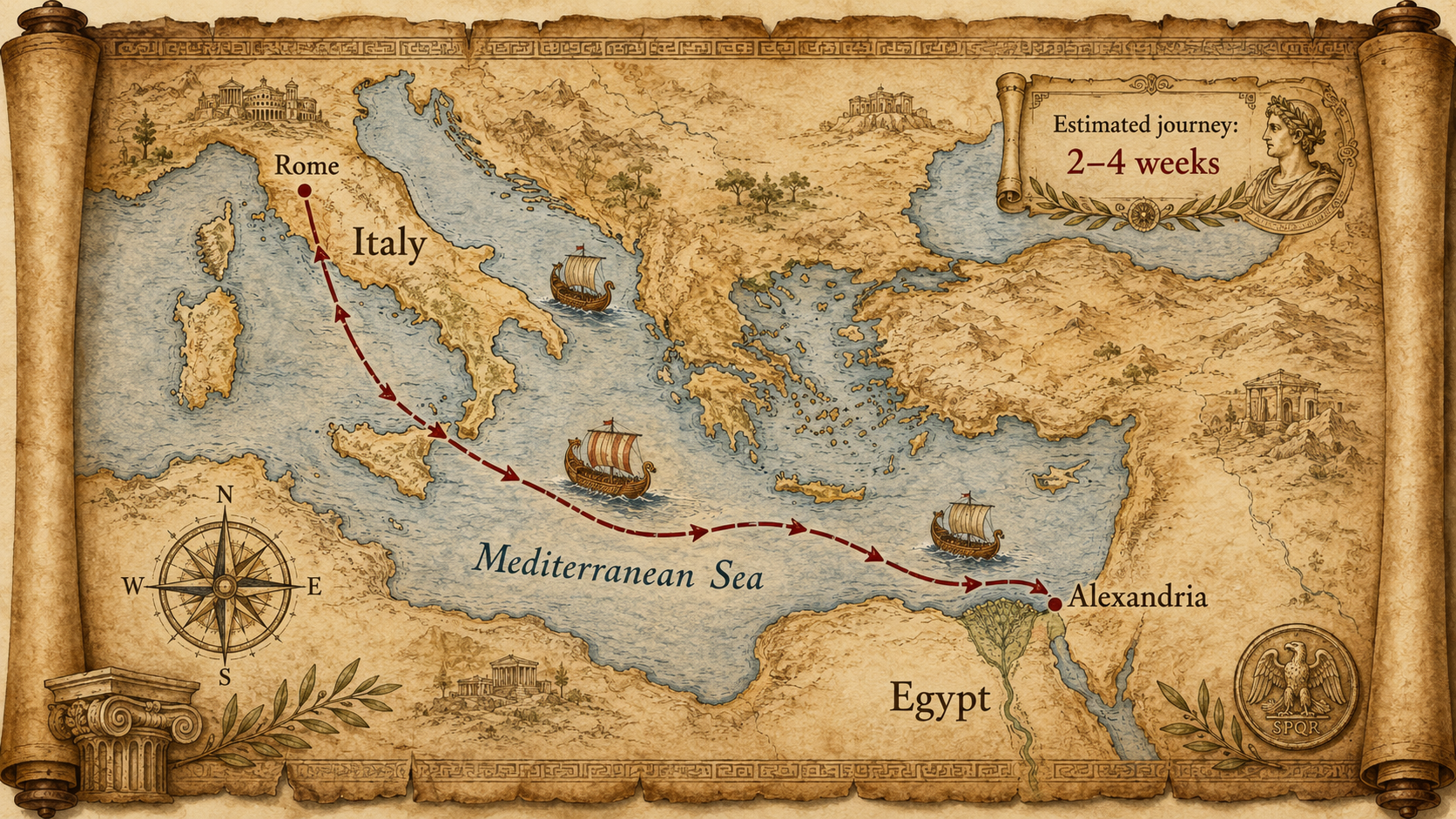
Direct ancient evidence records some exceptionally quick voyages to Alexandria:
- Sicily to Alexandria in approximately six or seven days
- Puteoli to Alexandria in approximately nine days
Researchers emphasize that these were unusually fast journeys, not guaranteed schedules.
A voyage could also be delayed while a traveler waited days or weeks for a suitable ship or favorable weather.
Travel time should therefore include more than the number of days spent physically sailing.
Did Romans Sail During Winter?
Roman sailors generally preferred the warmer sailing season.
Winter brought more dangerous storms, less predictable conditions, shorter daylight hours, and greater risks to wooden sailing vessels.
This did not mean every ship stopped sailing throughout winter. Military emergencies, trade demands, government orders, and personal necessity could still push people to sea.
The season could dramatically change the expected duration of a journey. A route that was practical in summer might be slow, dangerous, or unavailable during winter.
This is one reason ancient travel times should be presented as ranges rather than exact figures.
How Long Did It Take to Travel From Rome to Pompeii?
Rome and Pompeii were separated by approximately 150 miles, depending on the route.
A traveler using roads and moving at an ordinary pace might need approximately six to nine days.
A faster rider or carriage could potentially complete the journey in approximately three to five days, while a slow wagon carrying heavy cargo could require considerably longer.
Another possibility was to travel from Rome to a port, sail south toward the Bay of Naples, and continue overland or by coastal vessel.
The quickest option depended on available ships, weather, baggage, money, and the traveler’s social status.
How Long Did It Take to Travel From Rome to Naples?
The overland distance was approximately 140 to 150 miles along ancient routes.
Estimated travel times might include:
- On foot: seven to ten days
- Horseback: four to five days
- Fast official travel: two to three days
- Heavy wagon: two weeks or more
These figures are approximate. A traveler did not move at the maximum possible rate every day.
How Long Did It Take to Travel From Rome to Brundisium?
Brundisium, modern Brindisi, was one of Italy’s most important eastern ports.
The Via Appia connected Rome with Brundisium across roughly 350 Roman miles, or more than 500 modern kilometers.
Estimated travel times include:
- Ordinary walking: approximately 17 to 20 days
- Military march: approximately 17 days
- Horseback: about nine to twelve days
- Fast courier: approximately one week
- Heavy wagon: more than a month
Travelers heading toward Greece or the eastern Mediterranean often went to Brundisium and crossed the Adriatic by ship.
How Long Did It Take to Travel From Rome to Athens?
A journey from Rome to Athens usually combined land and sea travel. One possible route involved:
- Traveling south and east across Italy
- Reaching Brundisium
- Crossing the Adriatic Sea
- Continuing through Greece toward Athens
Under favorable conditions, a fast traveler might complete the journey in roughly two weeks.
A more ordinary journey could take three to four weeks, particularly when waiting time, sea conditions, baggage, and rest days were included.
Bad weather could delay the Adriatic crossing and extend the trip substantially.
How Long Did It Take to Travel From Rome to Alexandria?
Travel from Rome to Alexandria was normally completed primarily by sea.
Ancient evidence records an exceptional voyage from Puteoli to Alexandria in approximately nine days. A journey that fast depended on favorable winds and should not be treated as typical.
A more cautious estimate would be:
- Fast voyage in favorable weather: approximately nine to fourteen days
- More typical journey: two to four weeks
- Delayed or difficult journey: one month or longer
The traveler also needed to reach the Italian departure port, find passage, wait for the ship to sail, and pass through arrival procedures.
The real door-to-door journey could therefore take considerably longer than the voyage itself.
How Long Did It Take to Travel From Rome to Londinium?
Travel from Rome to Londinium, now London, required a long combination of roads, rivers, and sea crossings.
The fastest practical route could involve sailing through the Mediterranean, continuing along Atlantic coastal routes, crossing into Britain, and traveling onward by river or road.
Depending on the chosen route, season, and transportation method, the journey could take approximately four to eight weeks.
Travel entirely or mostly by road could be slower, particularly when crossing the Alps and moving through Gaul.
The shortest geographic route was not always the quickest. Sea travel could cover greater distances more efficiently than wagons or pedestrians.
How Long Did It Take to Cross the Roman Empire?
The Roman Empire at its greatest extent stretched from Britain to Egypt and from the Atlantic coast to the Near East.
Crossing a large portion of it could take months.
A journey from Britain to Rome might require more than a month. Continuing from Rome to Egypt or Syria could add several more weeks.
A merchant traveling with cargo might need an entire season. A military unit with a full baggage train might take months to relocate between distant frontiers.
Government news also traveled slowly by modern standards. An event in Britain, Syria, or Egypt might not be known in Rome for weeks.
The Roman transportation network was impressive because it made such communication possible at all, not because it made it instantaneous.
Where Did Roman Travelers Sleep?
Travelers used several forms of accommodation.
Mansiones
Mansiones were official stopping places located along major routes. They could provide lodging, food, animals, and other services, especially for authorized government travelers.
Mutationes
Mutationes were smaller stations associated with changing or resting horses.
Inns
Private inns served ordinary travelers. Their quality and reputation varied greatly.
Private homes
Wealthy Romans often relied on networks of relatives, friends, clients, officials, and business associates. Hospitality could make travel safer and more comfortable.
Camps and roadside shelter
Soldiers camped in organized formations. Poor travelers, laborers, and others might sleep outdoors, in simple shelters, or wherever they could find space.
A traveler’s experience depended heavily on wealth and status. An official carrying imperial authorization lived in a different travel world from an enslaved porter or poor pedestrian.
Was Travel in Ancient Rome Dangerous?
Yes. Travelers faced risks including:
- Robbery
- Assault
- Shipwreck
- Storms
- Illness
- Injured animals
- Broken vehicles
- Flooded rivers
- Mountain snow
- Extreme heat
- Lack of clean water
- Poor lodging
- Getting lost
- Political unrest
Travelers often formed groups for protection. Merchants joined caravans, officials traveled with attendants, and wealthy passengers brought servants or guards.
Roman law, military patrols, roads, and government stations could improve safety, but they did not eliminate danger.
Could Women Travel in Ancient Rome?
Roman women traveled for marriage, family visits, religious festivals, business, exile, migration, and other reasons.
Elite women could use prestigious carriages and travel with servants, attendants, or male relatives. Roman literature and art refer to vehicles associated particularly with high-status women, including the carpentum.
Travel conditions still depended on legal status, wealth, social position, and purpose.
An elite woman with a household entourage experienced travel differently from an enslaved woman being transported against her will.
Did Ordinary Romans Travel Often?
Many Romans probably spent most of their lives relatively close to home.
Long-distance travel required time, money, food, animals, lodging, and freedom from work or family responsibilities.
However, the Roman world was highly mobile. People traveled because they were:
- Soldiers
- Merchants
- Sailors
- Government officials
- Enslaved people
- Pilgrims
- Entertainers
- Craftspeople
- Students
- Messengers
- Migrants
- Diplomats
Roman inscriptions and archaeological evidence show people living and dying far from where they were born.
Travel was common enough to shape the empire, but it was not equally accessible to everyone.
Why Did Roman Travel Take So Long?
Roman travelers relied almost entirely on:
- Human muscle
- Animal power
- River currents
- Wind
There were no engines, railways, automobiles, or powered ships.
Even excellent roads could not remove the need to feed animals, rest travelers, repair wheels, wait for daylight, cross rivers, and respond to weather.
A trip that now takes two hours could take several days in Roman times. A modern international flight lasting a few hours might replace an ancient journey requiring weeks or months.
How Did Romans Measure Distance?
Romans measured roads in Roman miles.
One Roman mile, or mille passus, represented 1,000 double paces and equaled approximately:
- 1,480 meters
- 1.48 kilometers
- 0.92 modern miles
Milestones placed along major roads could record distances, the names of emperors, and information about construction or repairs.
Travelers also used written itineraries listing settlements and stopping points.
The Roman road map traditionally known as the Peutinger Table depicts routes and cities across much of the empire. It was designed to show connections rather than accurate geographic shapes.
What Determined the Length of a Roman Journey?
The most important factors were:
Method of transportation
Walking, riding, sailing, and using a wagon produced very different travel times.
Social status
Government officials and wealthy travelers had better access to horses, accommodations, servants, and supplies.
Purpose
An urgent military message moved faster than a family relocating with household possessions.
Season
Winter storms, summer heat, spring flooding, and mountain snow could alter routes.
Terrain
Flat roads were faster than deserts, mountains, marshes, and narrow passes.
Cargo
Heavy goods slowed animals and vehicles.
Weather
Wind determined the speed and direction of sailing ships.
Road conditions
A famous Roman highway could still contain damaged, crowded, muddy, or steep sections.
Political conditions
War, rebellion, banditry, and closed borders could force travelers to delay or change routes.
Estimated Ancient Roman Travel Speeds
The following figures offer a useful general guide:
| Traveler or vehicle | Approximate daily distance |
|---|---|
| Heavy ox cart | 7 miles |
| Loaded porter or mule | 12 miles |
| Ordinary traveler on foot | 15 to 20 miles |
| Roman army | About 18 miles |
| Private carriage | About 22 miles |
| Fast private traveler | About 31 miles |
| Horseback rider | About 35 miles |
| Rapid military unit | About 37 miles |
| Government courier | About 42 to 50 miles |
| Exceptional relay courier | 100 miles or more |
| Sailing ship | Highly variable |
These are planning estimates, not promises. Ancient travel was too unpredictable for modern-style timetables.
So, How Long Did Travel Take in Ancient Rome?
For most people, travel was measured in days, weeks, or months rather than hours.
A traveler could expect to cover approximately:
- 15 to 20 miles per day on foot
- 30 to 35 miles per day on horseback
- About 20 miles per day in an ordinary carriage
- Around 7 miles per day with a heavy ox cart
- 40 to 50 miles per day as a fast courier
- More than 100 miles per day using exceptional horse relays
Sea travel could be much faster than travel by land, but it was also less predictable.
A trip from Rome to Pompeii might take about a week. Athens could be several weeks away. Alexandria might be reached in less than two weeks under exceptional conditions, but delays could stretch the journey to a month or longer.
Rome’s roads did not make the ancient world small. They made an enormous empire governable.
Frequently Asked Questions
How many miles could a Roman travel in one day?
An ordinary traveler on foot could cover approximately 15 to 20 miles per day. A horseback rider might travel about 35 miles.
How fast did Roman soldiers march?
A Roman army commonly marched approximately 18 to 20 miles per day, although a lightly equipped force could move faster.
How long did it take to travel 100 miles in Roman times?
On foot, approximately five to seven days. On horseback, about three days. A fast official courier might cover the distance in one or two days.
How long did it take to travel from Rome to Pompeii?
An ordinary journey likely took approximately six to nine days by land.
How long did it take to travel from Rome to Egypt?
A fast sea voyage could reach Alexandria in approximately nine to fourteen days, but two to four weeks was a safer expectation.
How long did it take to travel from Rome to Britain?
A journey to southern Britain could take approximately one to two months depending on the route, season, and method of travel.
Did Romans travel at night?
Most ordinary land travelers stopped at night. Urgent couriers and some ships could continue traveling after dark.
Was sea travel faster than Roman roads?
Usually, especially over long distances. Ships could carry more cargo and cover greater distances, although weather made sailing unpredictable.
Could anyone use the cursus publicus?
No. It was an official imperial transportation network requiring government authorization.
Were Roman roads paved everywhere?
No. Construction varied. Some roads were paved with stone, while others used gravel, compacted earth, or locally available materials.