
What Did Ancient Greeks Look Like Compared to Modern Greeks?
Modern Greeks often resemble the people depicted in ancient Greek sculpture, frescoes, and painted pottery. This has led many people to wonder whether the inhabitants of Greece have changed physically during the past 2,000 to 3,000 years.
The most accurate answer is that many modern Greeks probably share broad physical similarities with ancient Greek populations, but neither ancient nor modern Greeks had one uniform appearance.
Ancient DNA indicates substantial population continuity between the inhabitants of Bronze Age Greece and people living in Greece today. However, Greece was never genetically isolated. Migration, trade, warfare, colonization, and intermarriage continually brought new people into the Aegean world.
Ancient Greeks therefore likely displayed a range of skin tones, hair colors, eye colors, heights, and facial features, much as modern Greeks do.
Did Ancient Greeks Look Like Modern Greeks?
In general, many probably did.
A person transported from Classical Athens into modern Athens might not appear dramatically out of place based solely on facial features. Dark hair, brown eyes, wavy or curly hair, and skin tones ranging from relatively light to darker Mediterranean complexions were likely common in both ancient and modern Greece.
That does not mean every ancient Greek looked like the average modern Greek. Ancient Greece included people from mainland Greece, Crete, the Aegean islands, western Anatolia, southern Italy, Sicily, and colonies surrounding the Mediterranean and Black Sea.
Appearance would have varied considerably between individuals and communities.
The same is true today. People from northern Greece, Crete, the Peloponnese, the Cyclades, and other regions do not all look identical.
What Does Ancient DNA Tell Us?
Some of the strongest evidence comes from genetic research.
A major 2017 study analyzed DNA from people associated with the Bronze Age Minoan and Mycenaean civilizations. The researchers found that Minoans and Mycenaeans derived most of their ancestry from early farming populations associated with the Aegean and western Anatolia.
The study also found that modern Greeks are genetically related to the ancient Mycenaeans, although later migrations introduced additional ancestry into the population. This supports a significant degree of population continuity rather than complete replacement.
More recent ancient-DNA research has reinforced the idea that the Aegean was never an isolated genetic zone. Populations changed over time as people moved between mainland Greece, Crete, the islands, Anatolia, the Balkans, and other parts of the Mediterranean.
Modern Greeks are therefore neither genetically identical to ancient Greeks nor unrelated to them. They descend substantially from the region’s earlier inhabitants while also carrying ancestry introduced during later historical periods.
What Physical Features Did Ancient Greeks Have?
There was no single ancient Greek appearance. Based on artwork, written descriptions, archaeology, and genetic evidence, ancient Greeks probably included people with:
- Brown, black, auburn, blond, or reddish hair
- Straight, wavy, or tightly curled hair
- Brown, hazel, blue, gray, or green eyes
- Light, olive, tan, and darker Mediterranean skin tones
- A wide variety of facial structures and body types
Dark hair and brown eyes were probably common, as they remain throughout much of the eastern Mediterranean. However, ancient texts and paintings also portray individuals with lighter hair and eyes.
These descriptions must be interpreted cautiously. Ancient poets sometimes used hair color symbolically, while artists frequently followed cultural conventions instead of creating exact portraits.
Were Ancient Greeks White?
Applying modern racial categories directly to the ancient world can be misleading.
Ancient Greeks recognized differences in geography, language, ancestry, complexion, and culture, but they did not organize humanity according to the same modern racial system used today. Greek identity was often connected more strongly to language, religion, customs, ancestry, and participation in Greek society.
People living in ancient Greece also interacted extensively with Egyptians, Phoenicians, Persians, Thracians, Scythians, Romans, Anatolians, and many other populations.
Scholars therefore caution against forcing ancient Greeks into rigid modern categories such as “white” or “nonwhite.” Those labels carry historical meanings that developed much later.
Did Ancient Greek Men and Women Have Different Skin Tones?
Ancient Greek art often portrayed men with darker or reddish-brown skin and women with much paler skin.
This artistic contrast did not necessarily represent biological differences between men and women. It was partly a visual convention.
Men were expected to spend more time outdoors working, training, fighting, farming, traveling, or participating in public life. Wealthy women were more strongly associated with indoor domestic spaces. A tan could therefore symbolize outdoor activity and masculinity, while pale skin could represent an elite feminine ideal.
Similar artistic conventions appeared in earlier Egyptian and Aegean art.
These paintings cannot be treated as literal color photographs of the ancient population.
Can Greek Statues Show Us What Ancient Greeks Looked Like?
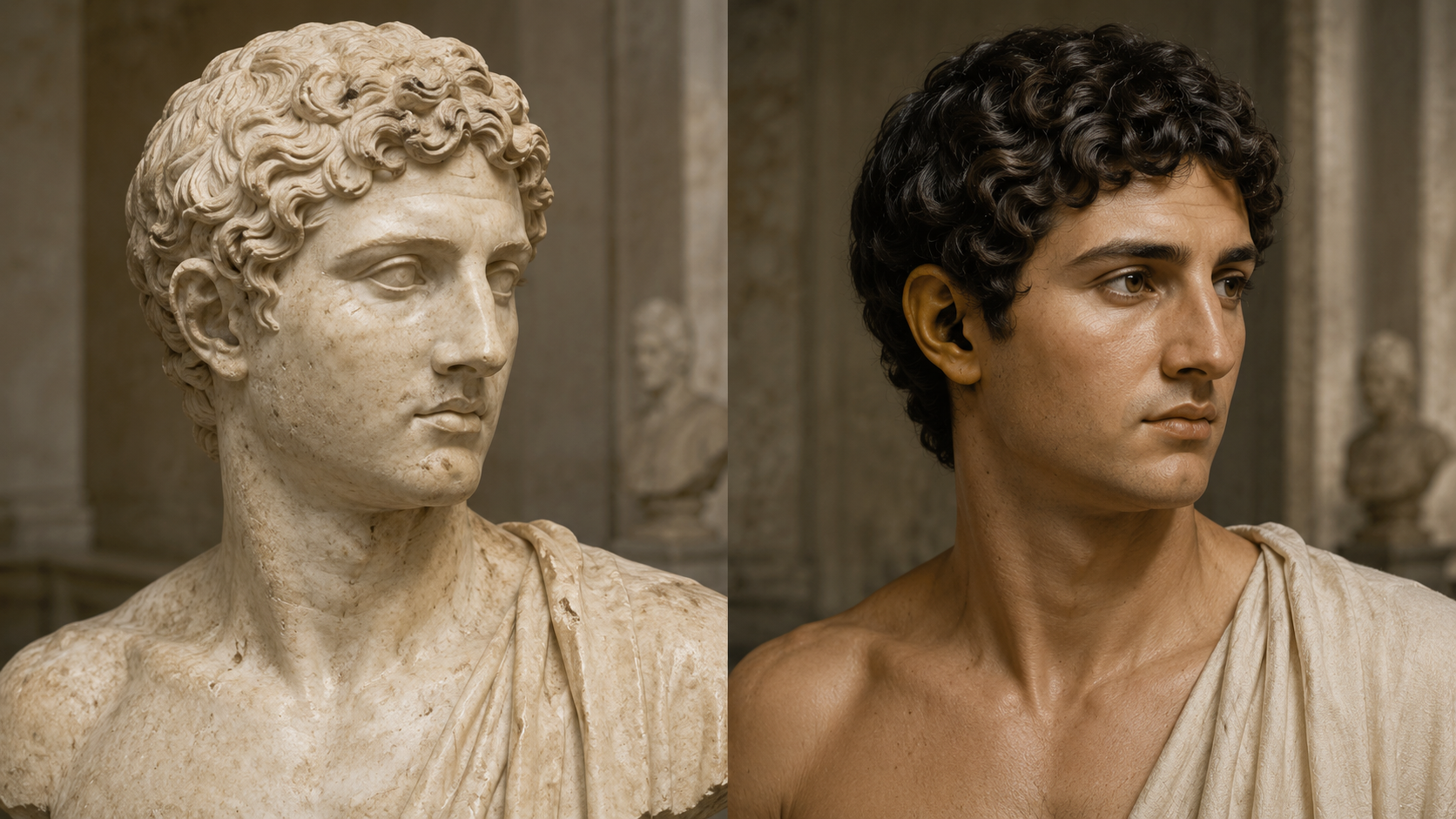
Greek sculpture provides useful evidence about hairstyles, clothing, grooming, and idealized facial proportions, but statues have important limitations.
Many surviving sculptures portray gods, heroes, athletes, rulers, or wealthy patrons. Their bodies and faces were often idealized. Sculptors were not necessarily trying to record the appearance of an average person walking through Athens.
Greek statues also did not originally look like the plain white marble figures displayed in many museums today.
Ancient sculptors frequently painted skin, hair, eyes, clothing, jewelry, and decorative details in vivid colors. Much of that paint disappeared over the centuries, leaving the false impression that Greeks deliberately created colorless white figures. Modern scientific analysis has detected surviving traces of these pigments on numerous sculptures.
A marble statue can therefore reveal facial proportions and artistic ideals, but its present color does not tell us the skin tone of the person represented.
The Famous 1935 Hermes Photograph
A widely shared black-and-white photograph shows a young Greek man standing beside a sculpture identified as Hermes. His profile appears remarkably similar to the statue.
Online accounts usually identify the man as Nikolaos Zafeiropoulos and the photographer as Vassilios Tsakirakis. The photograph is commonly dated to 1935.
The resemblance is certainly striking, but it should not be treated as proof that modern Greeks look exactly like ancient Greeks. A single person can, by coincidence, resemble a statue, especially when photographed from a carefully chosen angle.
The full story attached to the photograph is also difficult to verify through reliable museum, newspaper, or academic records. Most available versions appear on social media pages, forums, and reposted image collections.
The image works best as an intriguing illustration of possible continuity, not as scientific evidence.

Were Greek Statues Realistic Portraits?
Some were, but many were not.
Sculpture from the Classical period often emphasized balance, symmetry, youth, strength, and ideal beauty. Statues of gods and athletes were designed to embody perfection rather than ordinary human variation.
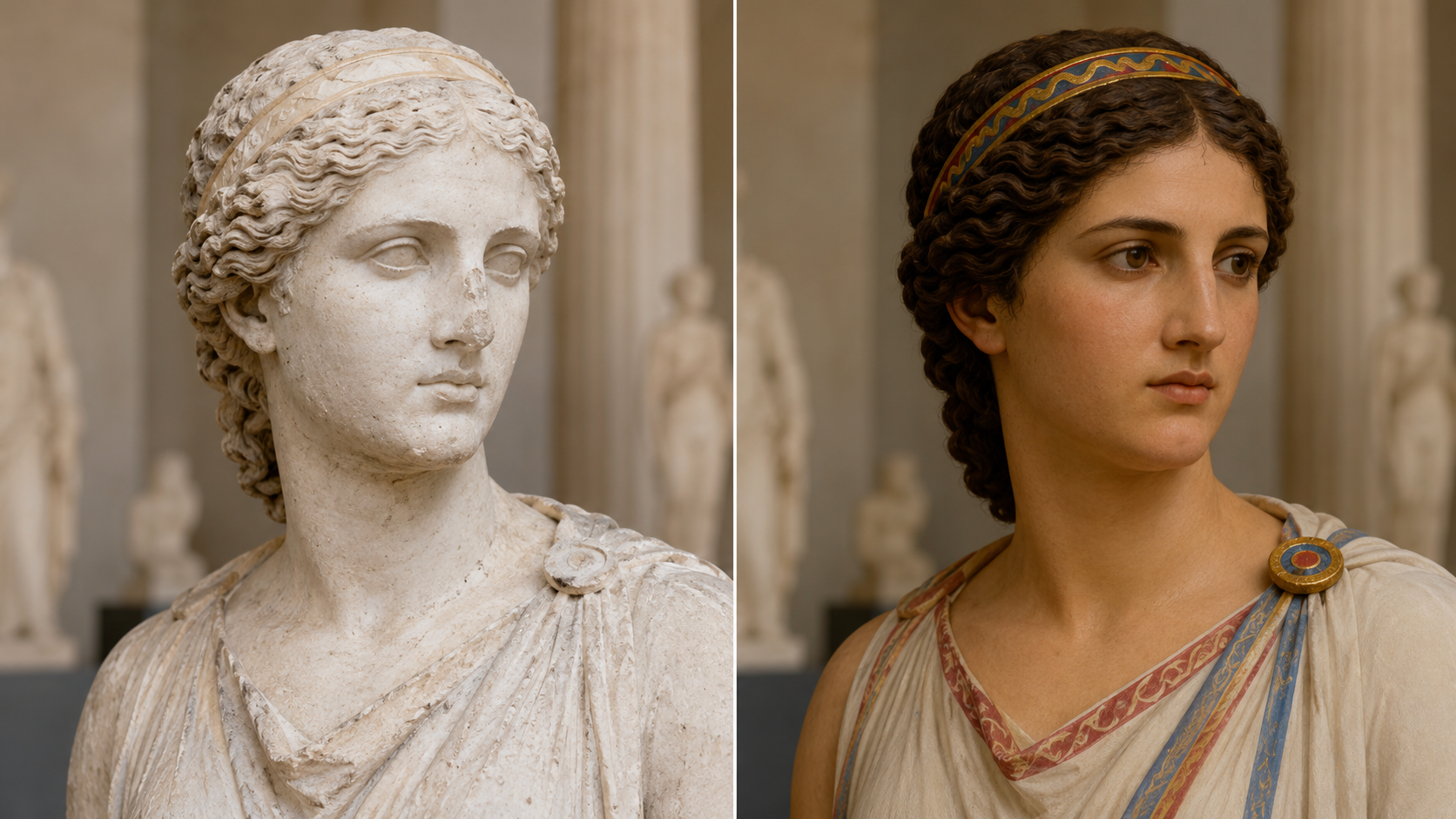
Portrait sculpture became more individualized during the Hellenistic and Roman periods. Artists increasingly depicted age, wrinkles, distinctive noses, receding hairlines, scars, and other personal characteristics.
Even realistic portraits could still flatter or communicate political messages. A ruler might be portrayed as youthful, powerful, calm, or divinely favored regardless of his actual appearance.
Comparing a modern person with an ancient statue is therefore interesting, but it cannot establish direct ancestry.
How Much Have Greeks Changed Since Antiquity?
Greek populations have changed, but not through a simple replacement of one people by another.
During the centuries after Classical antiquity, Greece formed part of the Roman, Byzantine, and Ottoman worlds. Slavic-speaking groups settled in parts of the Balkans during the early medieval period. Merchants, soldiers, refugees, craftspeople, and families also arrived from Anatolia, Italy, Albania, the eastern Mediterranean, and other neighboring regions.
At the same time, descendants of earlier Greek populations continued living throughout the region.
Modern Greeks consequently reflect both long-term local continuity and later migration. This is normal. No major population remains genetically frozen for thousands of years.
Physical characteristics also do not correspond neatly to national identity. Two people may look similar without being closely related, while close relatives can have noticeably different hair, eyes, complexions, or facial structures.
Did Evolution Significantly Change Greek Appearance?
Human populations can change over several thousand years, but the word “evolution” is often misused in discussions of ancient appearance.
DNA is not a complete visual recording of every ancestor. Genetic inheritance mixes and recombines with each generation. Some traits become more or less common through migration, natural selection, genetic drift, marriage patterns, and chance.
Two or three thousand years is enough time for population frequencies to change, particularly when migrations occur. However, it is not surprising that many people living in Greece today resemble people depicted in ancient Greek art.
A substantial portion of their ancestry comes from populations that lived in Greece and the surrounding Aegean during earlier historical periods.
Were Ancient Greeks Blond and Blue-Eyed?
Some ancient Greeks probably had blond or reddish hair and light-colored eyes, but there is no evidence that these traits defined the population as a whole.
Greek literature occasionally describes characters with words translated as blond, golden, tawny, or fair-haired. These descriptions prove that lighter hair was known, but they do not reveal how common it was.
Some of the individuals being described were also mythological heroes rather than documented historical people. Poetic vocabulary should not be treated as a population census.
The evidence as a whole suggests considerable variation, with darker hair and eyes likely common alongside less frequent lighter features.
Were Ancient Greeks Darker Than Modern Greeks?
It is impossible to reduce the comparison to a simple yes or no.
Ancient Greeks who spent much of their lives outdoors may have appeared more deeply tanned than many modern office workers. Farmers, sailors, soldiers, builders, and athletes were regularly exposed to intense Mediterranean sunlight.
Social class, occupation, sex, region, season, and personal ancestry could all affect appearance.
Modern Greece has also experienced migration and regional variation. Some modern Greeks may be lighter than particular ancient individuals, while others may be darker. There was no single ancient complexion against which every modern Greek can be measured.
Why Do Modern Greeks Sometimes Resemble Ancient Statues?
There are several possible reasons:
- Population continuity: Many modern Greeks descend partly from people who lived in the Aegean thousands of years ago.
- Regional ancestry: Traits common in eastern Mediterranean populations have remained present over long periods.
- Artistic selection: Greek sculptors chose facial proportions they considered familiar, attractive, heroic, or ideal.
- Coincidence: With millions of modern people and thousands of surviving artworks, striking resemblances are inevitable.
- Photography: Lighting, angle, hairstyle, pose, and facial expression can make a resemblance appear much stronger.
A photograph of one modern Greek beside a statue is visually compelling, but ancient DNA provides far stronger evidence of historical continuity.
Ancient Greeks Were More Diverse Than Popular Culture Suggests
Movies and television often give ancient Greece one standardized appearance. Some productions fill the population with uniformly pale northern Europeans, while others portray everyone according to a single dark Mediterranean stereotype.
Neither depiction captures the complexity of the ancient Greek world.
Greek communities stretched across several continents and stood at the center of maritime trade. Athens, Corinth, Rhodes, Alexandria, Syracuse, Ephesus, and other Greek-speaking cities attracted people from many regions.
Citizenship, language, family origin, legal status, and cultural participation could matter more than fitting into a single physical type.
Ancient Greek society was also unequal. Women, enslaved people, foreigners, colonists, merchants, and citizens experienced identity differently. Physical appearance alone could not determine whether someone was culturally or legally Greek.
So, Did Modern Greeks Look Like Ancient Greeks?
Many modern Greeks probably resemble ancient Greek populations in broad ways, and ancient DNA confirms a meaningful degree of shared ancestry.
However, the idea that all ancient Greeks shared one distinctive face is false.
Ancient Greeks varied in complexion, hair texture, hair color, eye color, height, and facial features. Modern Greeks are similarly diverse. Later migrations altered the genetic composition of Greece without erasing its older population history.
The most accurate conclusion is that modern Greeks show substantial biological and cultural continuity with ancient inhabitants of the Aegean, but both populations were shaped by movement, mixture, and regional diversity.
The famous photographs of modern people resembling ancient statues can be fascinating. Science, however, gives us a richer answer than resemblance alone: modern Greeks are connected to ancient Greeks, but Greece has always been part of an interconnected Mediterranean world.
Frequently Asked Questions
Are modern Greeks descended from ancient Greeks?
Yes, in significant part. Ancient-DNA studies indicate substantial genetic continuity between Bronze Age Aegean populations and modern Greeks. Modern Greeks also carry ancestry introduced through later migrations.
Did all ancient Greeks have olive skin?
No. Ancient Greeks likely had a range of complexions. Olive and tan skin tones were probably common, but lighter and darker individuals also existed.
Did ancient Greeks have blond hair?
Some probably did. Ancient literature mentions fair, golden, tawny, and reddish hair, although darker hair was likely more common.
Did ancient Greeks have blue eyes?
Some ancient Greeks may have had blue, gray, or green eyes. Brown and hazel eyes were probably more widespread.
Are Greek statues accurate portraits?
Some portrait statues included individual features, especially during the Hellenistic and Roman periods. Many Classical statues were idealized images of gods, heroes, rulers, and athletes.
Why are ancient Greek statues white?
Most surviving marble statues appear white because their original paint deteriorated. Ancient Greek sculpture was frequently painted in vivid colors.
Do modern Greeks look exactly like ancient Greeks?
No population remains physically identical over thousands of years. Modern Greeks retain many ancestral connections and likely share numerous features with ancient Greeks, but migration and natural variation prevent an exact one-to-one comparison.