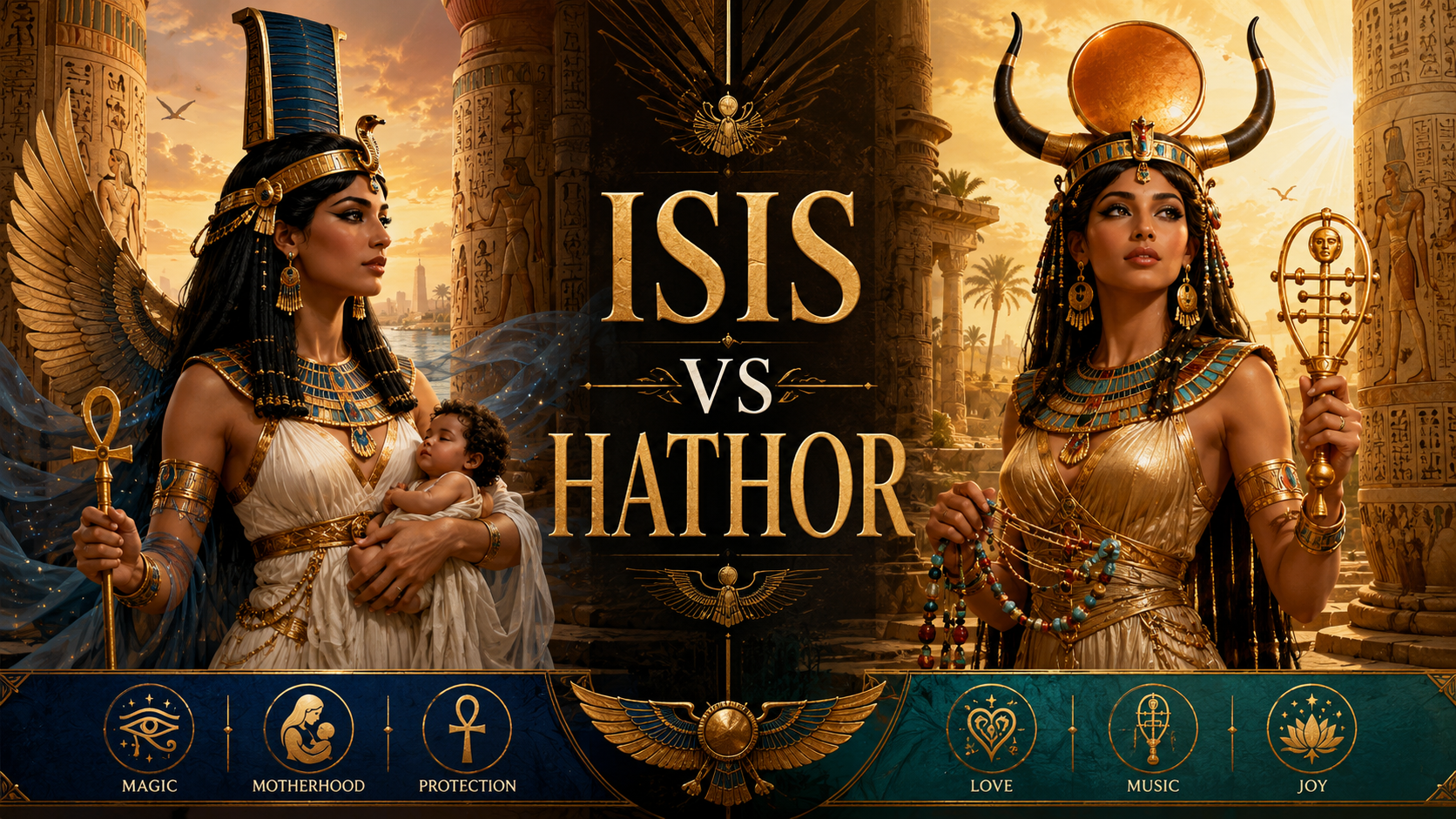
Isis and Hathor were two of the most important goddesses worshipped in ancient Egypt. Both were associated with motherhood, protection, royal women, magic, and the care of the dead, and both could be shown wearing cow horns surrounding a solar disk.
Despite these similarities, Isis and Hathor were not originally the same goddess. Isis was primarily associated with magic, mourning, motherhood, and the protection of her husband, Osiris, and her son, Horus. Hathor was an older and more broadly celestial goddess associated with love, beauty, music, joy, sexuality, motherhood, the sky, and the welcoming of the dead into the afterlife.
The easiest way to remember the difference is this: Isis was the devoted wife and protective mother at the center of the Osiris myth, while Hathor represented love, joy, feminine power, and the life-giving forces of the sky.
Isis vs. Hathor at a Glance
| Feature | Isis | Hathor |
|---|---|---|
| Egyptian name | Aset or Eset | Het-Hert or Hut-Hor |
| Name meaning | Often interpreted as “throne” or “seat” | “House of Horus” |
| Main roles | Magic, motherhood, mourning, protection and kingship | Love, beauty, music, joy, sexuality, motherhood and the sky |
| Important family relationships | Wife and sister of Osiris; mother of Horus | Often described as the daughter of Ra; relationships varied by period and location |
| Common headdress | Throne-shaped hieroglyph | Cow horns surrounding a solar disk |
| Animal association | Sometimes shown with wings or cow imagery | Cow or cow-headed woman |
| Important symbol | Throne, protective wings and tyet knot | Sistrum, menat necklace and cow horns |
| Major cult centers | Philae and Behbeit el-Hagar | Dendera |
| Role in the afterlife | Mourned and restored Osiris; protected the deceased | Welcomed the dead and provided food, drink, and renewal |
| Primary mythological identity | Wife of Osiris and mother of Horus | Celestial cow, daughter or Eye of Ra, and goddess of joy |
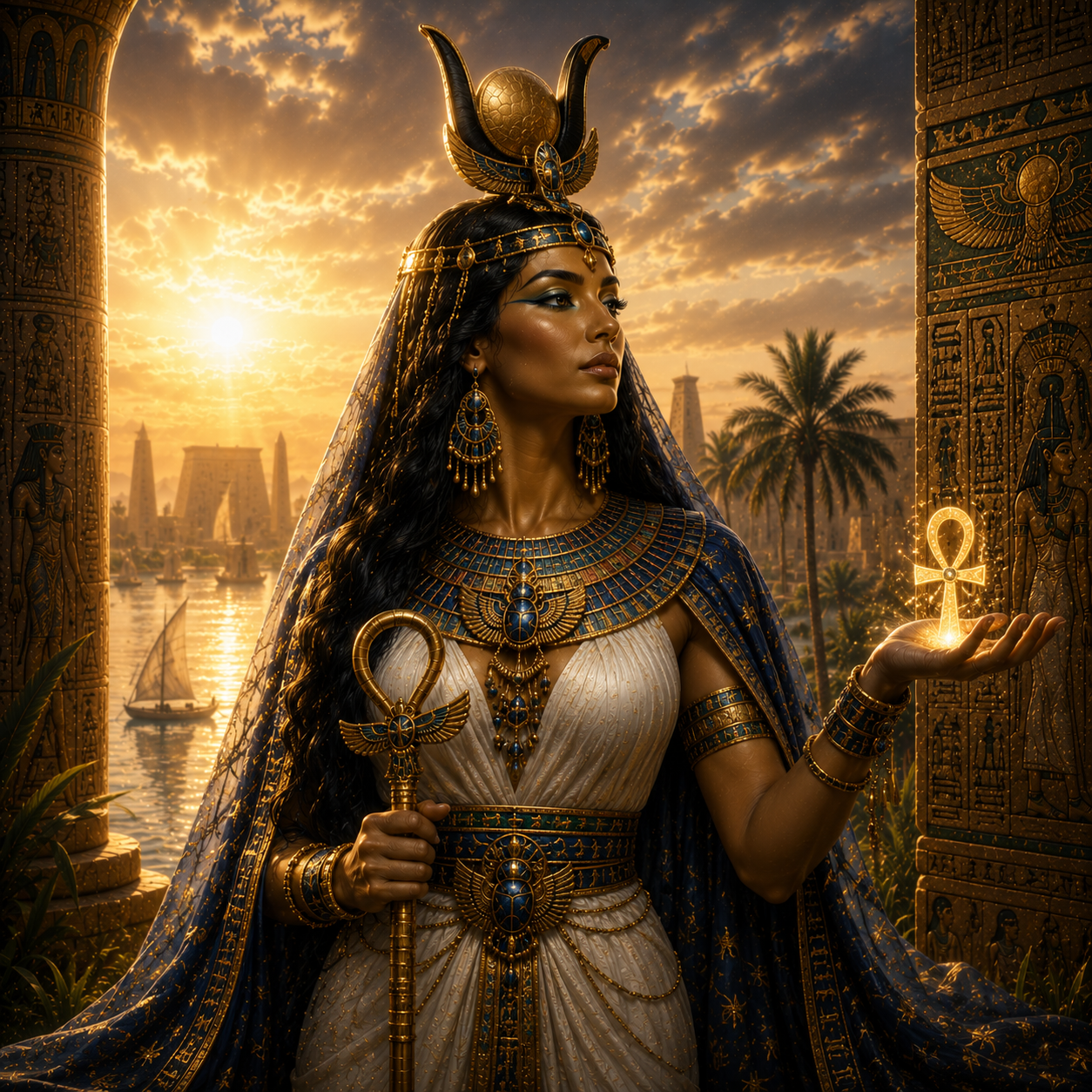
Who Was Isis?
Isis was one of the central figures in the Osiris myth, one of ancient Egypt’s most influential religious traditions. She was the sister and wife of Osiris, the mother of Horus, and the sister of Nephthys and Set.
According to the myth, Set murdered Osiris and scattered or concealed his remains. Isis searched for her husband, recovered his body, and used her magical abilities to restore him long enough to conceive their son, Horus.
Isis then protected Horus while he grew to adulthood and prepared to challenge Set for the Egyptian throne. Her success in preserving Osiris and protecting Horus made her an ideal divine wife, mother, mourner, healer, and magician.
She was also closely connected with Egyptian kingship. Horus represented the living king, while Osiris represented the deceased king. As the mother of Horus, Isis could therefore be understood as the divine mother and protector of the pharaoh.
The Egyptian name of Isis was Aset or Eset. Her name was written using a throne-shaped hieroglyph, which she often wore on her head. The name is commonly connected with the idea of a seat or throne, although the complete development of her identity was more complex than the translation alone suggests.
Her cult became increasingly important over time. The temple complex at Philae became one of the most significant centers devoted to Isis and Osiris in Upper Egypt and Nubia. Her worship later spread far beyond Egypt throughout the Mediterranean and Roman worlds.
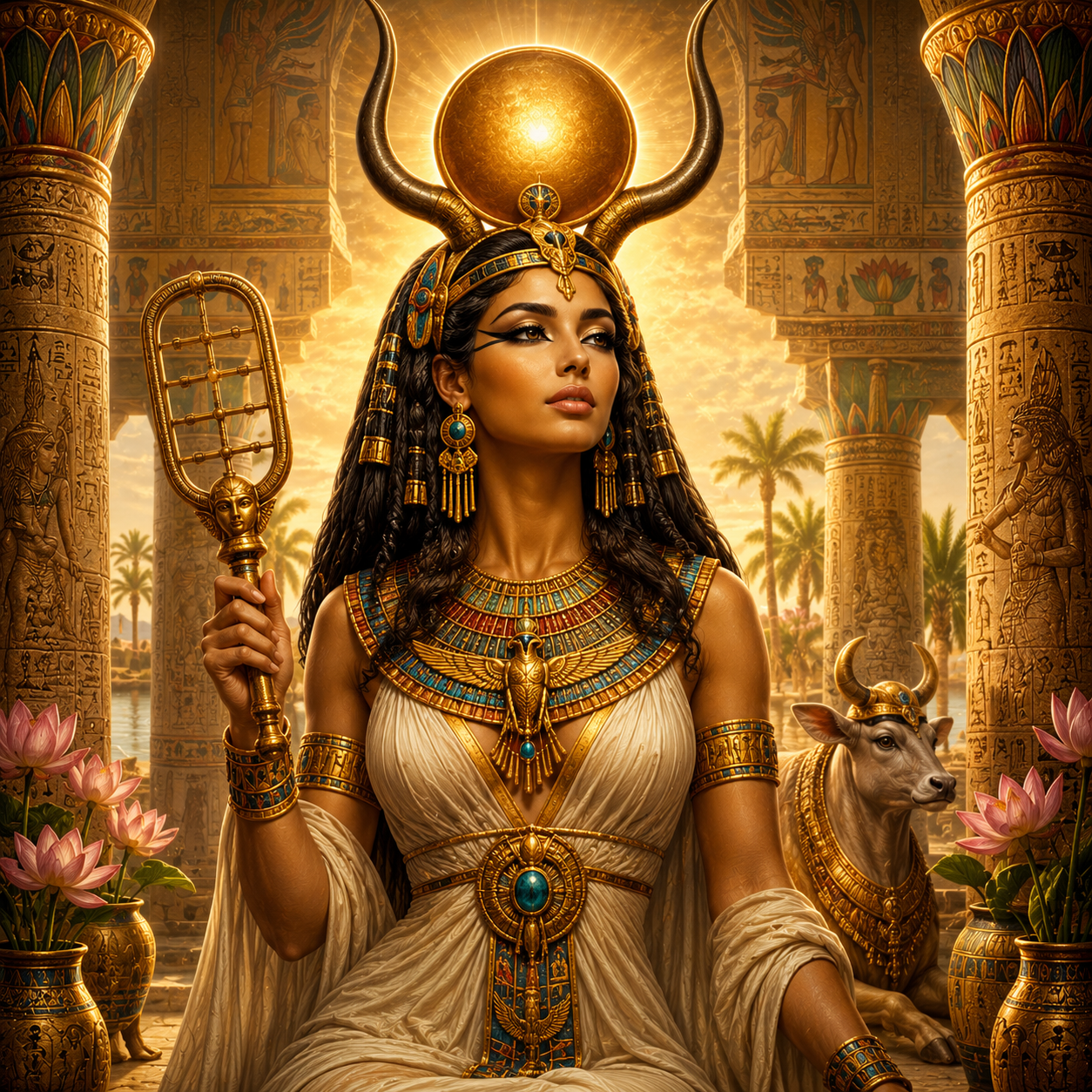
Who Was Hathor?
Hathor was one of Egypt’s oldest, most complex, and most widely worshipped goddesses.
Her Egyptian name, Het-Hert or Hut-Hor, is generally translated as “House of Horus.” This may have referred to the sky as the divine house through which the falcon god Horus traveled.
Hathor was associated with:
- Love and beauty
- Music and dancing
- Joy and celebration
- Sexuality and fertility
- Motherhood and childbirth
- The sky and the sun
- Foreign lands and valuable materials
- The protection of women
- Death and rebirth
She was commonly represented as a woman wearing cow horns surrounding a solar disk. She could also appear as a complete cow, a cow-headed woman, or a woman with cow ears.
The cow represented nourishment, motherhood and the life-giving sky. As a celestial cow, Hathor could carry the sun god across the heavens or shelter the king beneath her body.
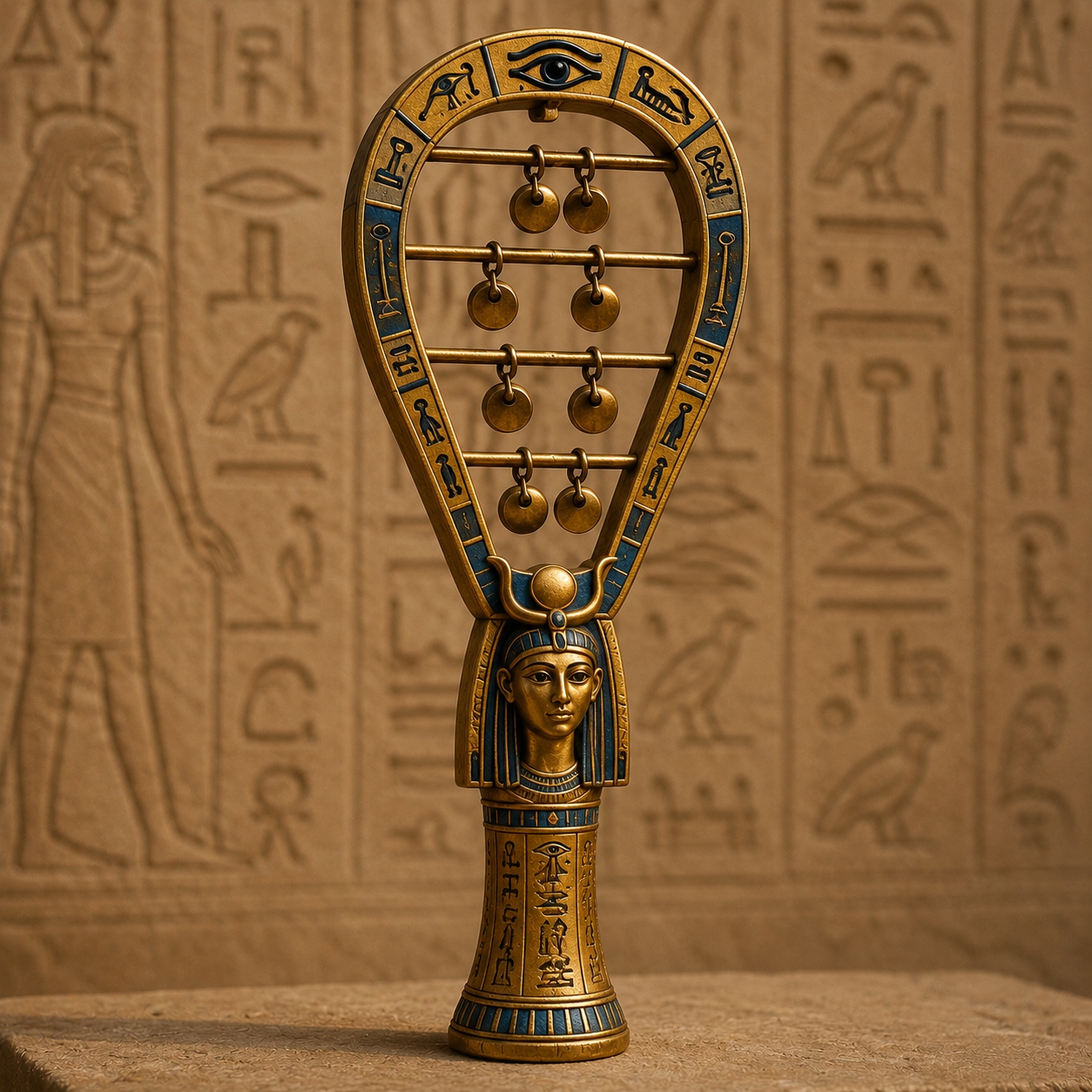
Hathor was strongly associated with music and ritual celebration. Two of her most recognizable attributes were the sistrum, a sacred rattle used during religious ceremonies, and the menat, a beaded necklace that could also function as a ritual instrument.
The sistrum was especially connected with Hathor, although it was also used in the worship of other goddesses, including Isis, Bastet and Sekhmet.
Hathor’s principal cult center was Dendera, where a large temple dedicated to her remains one of the best-preserved temple complexes in Egypt.
How Were Isis and Hathor Similar?
Isis and Hathor shared many attributes, which is why they are frequently confused.
Both were divine mothers
Isis was the mother of Horus and the model of the protective mother who defended her vulnerable child.
Hathor could also serve as the mother of Horus or of the king, depending on the religious tradition. Her cow imagery emphasized nourishment, maternal care, and the sustenance provided by divine motherhood.
Both goddesses could therefore protect the king as their divine son.
Both were associated with Egyptian queens
Egyptian queens could be linked with both Isis and Hathor.
A queen could be compared with Isis as the wife of the king and mother of his heir. She could also be identified with Hathor as the ideal embodiment of beauty, sexuality, fertility, and divine femininity.
Both protected the dead
Isis played an essential role in the resurrection of Osiris and became a powerful protector of the deceased. She and Nephthys were commonly depicted mourning beside coffins and sarcophagi, and in funerary scenes.
Hathor also had a major funerary role. She was known as the “Mistress of the West,” a reference to the western horizon where the sun sets and where many Egyptian cemeteries were located.
As the goddess of the western desert, Hathor could emerge from the cliffs to welcome the dead into the afterlife. She offered them refreshment, nourishment, protection and the promise of renewal.
Both had solar connections
Hathor was closely associated with the sun god Ra and could be described as his daughter, mother, wife or divine Eye, depending on the period and religious text.
Isis acquired stronger solar characteristics as her cult developed. She eventually adopted symbols and titles that had previously been more closely associated with Hathor.
Both could wear cow horns and a solar disk
The cow-horn crown was originally one of Hathor’s most recognizable emblems. From the Late Period onward, however, it was also widely used for Isis.
As a result, an image of a goddess wearing cow horns and a solar disk cannot automatically be identified as Hathor.
What Is the Main Difference Between Isis and Hathor?
The main difference is that Isis was defined primarily by her place within the family of Osiris and by her powers as a wife, mother, mourner and magician, while Hathor was a broader celestial goddess associated with love, beauty, music, sexuality, joy and the life-giving power of the sky.
Their central religious stories were also different.
Isis belonged to the Osiris myth. Her most important actions involved recovering Osiris, conceiving Horus, protecting her son, and helping secure his inheritance.
Hathor did not depend on one single mythological family story. She appeared in many religious traditions and could have different relationships with Ra, Horus, and other gods.
Isis Was Closely Connected with Osiris
Much of Isis’s identity centered on her relationship with Osiris. She was:
- His sister
- His wife
- His mourner
- His protector
- The magician who helped restore him
- The mother of his heir
Her story represented loyalty, legitimate succession, resurrection, and the continuation of the royal family. Hathor could participate in funerary religion, but she did not occupy Isis’s specific position as the wife who recovered and revived Osiris.
Hathor Was More Strongly Associated with Joy and Celebration
Hathor was called the “Mistress of Music,” “Lady of Jubilation,” and “Mistress of Drunkenness” in different religious settings.
Music, dance, beer, sexuality, and celebration were not considered trivial parts of life. They could restore harmony, awaken divine energy and encourage fertility and renewal.
Hathor could therefore represent pleasure and affection as sacred forces.
Isis was not primarily a goddess of music or festivity, although her later worship absorbed a wide range of attributes.
Isis Was Especially Famous for Magic
Many Egyptian deities used magic, but Isis became particularly famous for her intelligence, magical knowledge and verbal power.
She restored Osiris, protected Horus from dangerous animals and illnesses, and appeared in spells intended to heal or protect human beings.
In one well-known myth, Isis gained secret knowledge of Ra’s hidden name, increasing her magical authority.
Hathor possessed divine power and could have fierce magical forms, but magic was not as central to her identity as it was to Isis.
Hathor Had a Stronger Connection with Music and the Sistrum
Hathor was intimately connected with sacred music. The shaking of the sistrum was believed to please the goddess, calm dangerous divine powers, and create an atmosphere of joy during temple rituals.
Although Isis could also be associated with the sistrum, the instrument remained especially characteristic of Hathor and goddesses influenced by her cult.
Hathor Could Become Fierce and Destructive
Hathor was not merely a gentle goddess of romance and happiness.
She could also represent the Eye of Ra, the fierce feminine power sent to punish the enemies of the sun god.
In the story commonly known as the Destruction of Mankind, the solar Eye attacks rebellious humanity. The destructive goddess is often identified with Hathor or Sekhmet, depending on the version and interpretation. She is eventually pacified through beer colored to resemble blood.
This story reflects Hathor’s dual nature. She could bring love, nourishment and celebration, but she could also embody dangerous solar power.
Isis could be formidable and even threatening, particularly when protecting Horus, but Hathor’s identity as the raging Eye of Ra was a more pronounced part of her solar character.
Why Are Isis and Hathor Often Confused?
Isis and Hathor are confused because ancient Egyptian religion allowed gods and goddesses to share symbols, titles, roles, and even identities.
Egyptian deities were not always separated into rigid categories. A goddess could absorb characteristics from another deity or be worshipped in a combined form.
The confusion between Isis and Hathor is especially understandable because:
- Both were divine mothers.
- Both protected the king.
- Both were associated with queens.
- Both cared for the dead.
- Both possessed solar characteristics.
- Both could wear the cow-horn crown.
- Both could be associated with the sistrum.
- They were eventually worshipped in combined forms.
The British Museum describes Isis-Hathor as a syncretic deity who combined attributes of both goddesses. This does not mean Isis and Hathor had always been identical. It means their religious identities could overlap and merge under particular historical circumstances.
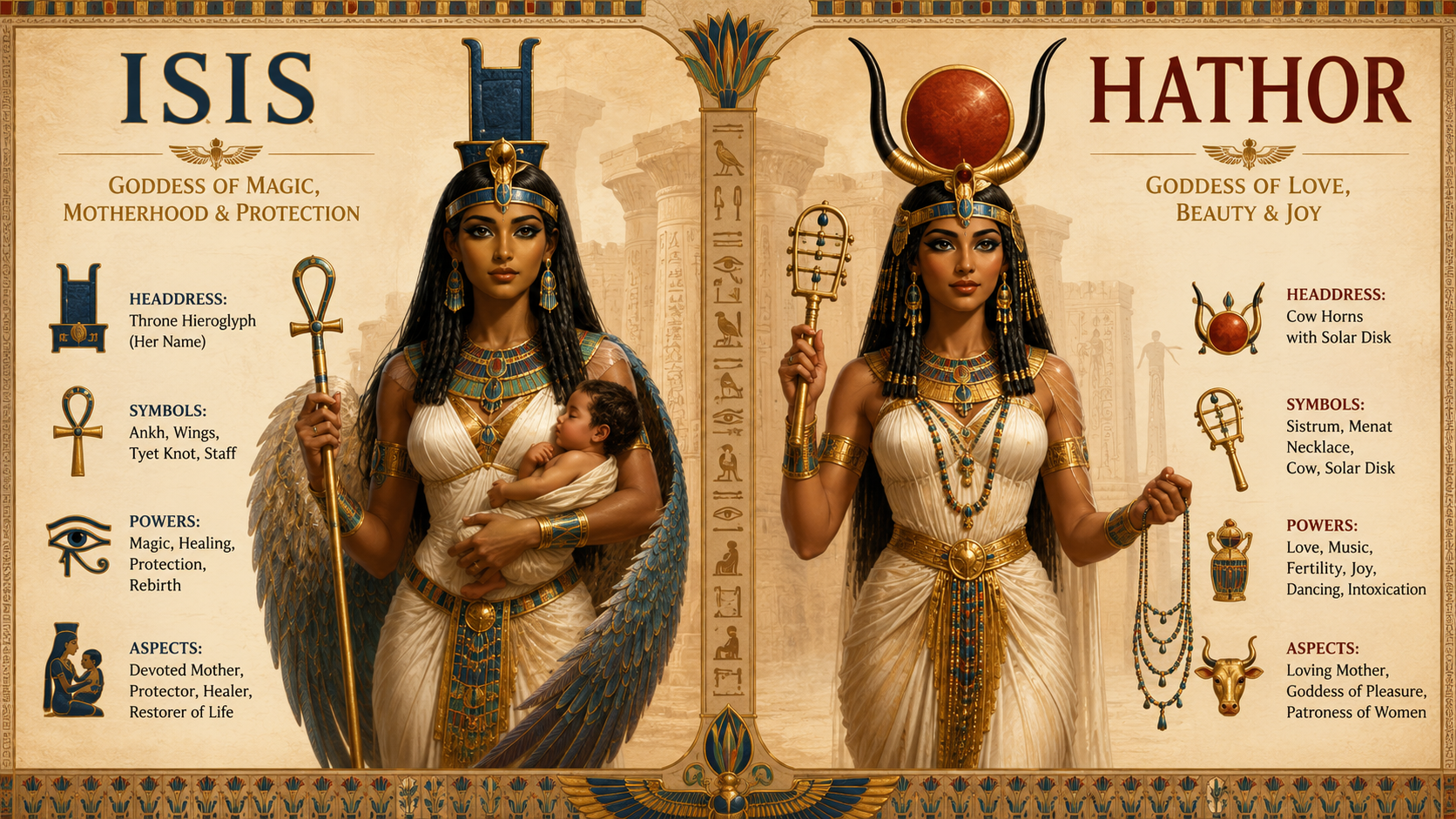
How Can You Tell Isis and Hathor Apart?
Isis and Hathor cannot always be distinguished by appearance alone.
Look for the throne hieroglyph
Isis’s most distinctive early headdress was the throne-shaped hieroglyph representing her name. When a goddess wears this symbol, she is usually identified as Isis.
Look for cow ears or a cow’s body
Hathor was frequently shown as a cow, a cow-headed woman or a woman with cow ears. These forms are much more strongly associated with Hathor than with Isis.
Look for the sistrum and menat
The sistrum and menat necklace are especially characteristic of Hathor.
However, the sistrum was not exclusive to her, so it should be considered alongside inscriptions and other attributes.
Look at the surrounding figures
A goddess shown beside Osiris, Horus or Nephthys may be Isis, particularly in scenes involving mourning, resurrection or the protection of Horus.
A goddess shown welcoming the dead from the western mountain, appearing as a celestial cow or participating in a musical celebration may be Hathor.
Read the inscription
The inscription is often the most reliable method of identification.
Egyptian artists reused divine crowns and symbols. A goddess’s name, title, companions and ritual setting may identify her more accurately than her headdress alone.
Did Isis Borrow Hathor’s Headdress?
Yes. The crown of cow horns surrounding a solar disk was originally associated especially with Hathor, but it became widely used for Isis during later periods of Egyptian history.
This borrowing reflected the growing overlap between the two goddesses.
As Isis became increasingly universal, she absorbed attributes connected with motherhood, the sky, solar power and divine queenship. Hathor’s crown visually expressed many of those qualities.
By the Late and Ptolemaic periods, the horned crown was so closely associated with Isis that modern viewers often assume it belonged to her from the beginning. British Museum records note that the Hathoric crown was largely used for Isis from the Late Period onward.
Were Isis and Hathor Ever Worshipped as the Same Goddess?
They could be worshipped in a combined form known as Isis-Hathor. This is an example of syncretism, the combination or close identification of two deities.
In this form, Isis could possess the maternal, celestial, musical and solar qualities of Hathor while retaining her identity as the wife of Osiris and mother of Horus.
The existence of Isis-Hathor does not prove that there was never any difference between the goddesses. Ancient Egyptian deities could be united in one religious context while remaining distinct in another.
A worshipper could recognize Isis, Hathor and Isis-Hathor without necessarily seeing those identities as contradictory.
Which Goddess Was Older?
Hathor appears to have been the older goddess. Her origins extend into Egypt’s earliest periods, although scholars continue to debate the identification of some early bovine goddesses and symbols.
Isis is securely attested later, becoming prominent in the religious literature of the Old Kingdom and gaining importance through her role in the Osiris myth.
Over time, Isis’s popularity grew dramatically. During the Ptolemaic and Roman periods, her worship spread throughout the Mediterranean world and eventually eclipsed many older Egyptian cults.
Hathor was therefore older as a distinct major goddess, while Isis became more widely known internationally in later antiquity.
Was Hathor the Mother of Horus?
Hathor could be described as the mother of Horus in certain traditions, while Isis was his mother in the Osiris myth.
This apparent contradiction reflects the flexible nature of Egyptian religion.
Horus existed in several forms and local traditions. Hathor’s name, “House of Horus,” connected her closely with him, and she could function as his mother, wife, or celestial dwelling. But many historians note that Hathor’s union is with Horus the Elder, not Horus (son of Isis).
In the Osiris tradition, however, Isis was the mother of Horus, having conceived him with the restored Osiris. The two traditions could coexist because Egyptian religion did not require every regional genealogy to agree.
Isis vs. Hathor: The Difference Explained
Isis and Hathor were separate goddesses whose identities gradually became closely connected.
Isis was the wife of Osiris, mother of Horus, and a powerful goddess of magic, protection, mourning, and royal succession. Her defining story concerned the death and restoration of Osiris and her efforts to protect their son.
Hathor was an older celestial and maternal goddess associated with love, beauty, sexuality, music, joy, the sun, the sky, and the welcoming of the dead. Her cow imagery represented nourishment, motherhood and cosmic protection.
Their roles overlapped because both goddesses protected mothers, children, kings, queens and the deceased. Isis eventually adopted Hathor’s horned solar crown, and the two could be worshipped together as Isis-Hathor.
The simplest distinction is that Isis represented the devoted magical mother and wife of the Osiris myth, while Hathor represented the joyful, sensual and life-giving feminine power of the sky.
Frequently Asked Questions
Are Isis and Hathor the same goddess?
No. Isis and Hathor were originally distinct goddesses with different mythological backgrounds and principal roles. Their identities later overlapped, and they could be combined as Isis-Hathor.
Why does Isis wear Hathor’s horns?
Isis adopted the cow horns and solar disk as her identity expanded and became increasingly connected with Hathor’s maternal, royal and solar characteristics.
Which goddess was associated with love?
Hathor was much more strongly associated with romantic love, sexuality, beauty, music, dancing and celebration.
Which goddess was associated with magic?
Isis was especially famous for magic, healing spells, protective knowledge and the power of divine speech.
Who was the mother of Horus, Isis or Hathor?
Isis was the mother of Horus in the Osiris myth. Hathor could also be called the mother of Horus in other local or theological traditions.
How can you identify Isis?
Isis can often be identified by the throne-shaped hieroglyph on her head, her association with Osiris and Horus, or an inscription naming her. In later art, she may also wear cow horns surrounding a solar disk.
How can you identify Hathor?
Hathor may appear as a cow, a cow-headed woman or a woman with cow ears. She is also associated with the cow-horn crown, the sistrum and the menat necklace. Inscriptions and context remain important because Isis later adopted several of her attributes.
Who was more powerful, Isis or Hathor?
Ancient Egyptians did not consistently rank their goddesses according to a single fixed scale of power. Both could be described as extremely powerful, universal, and essential within their respective cults.
