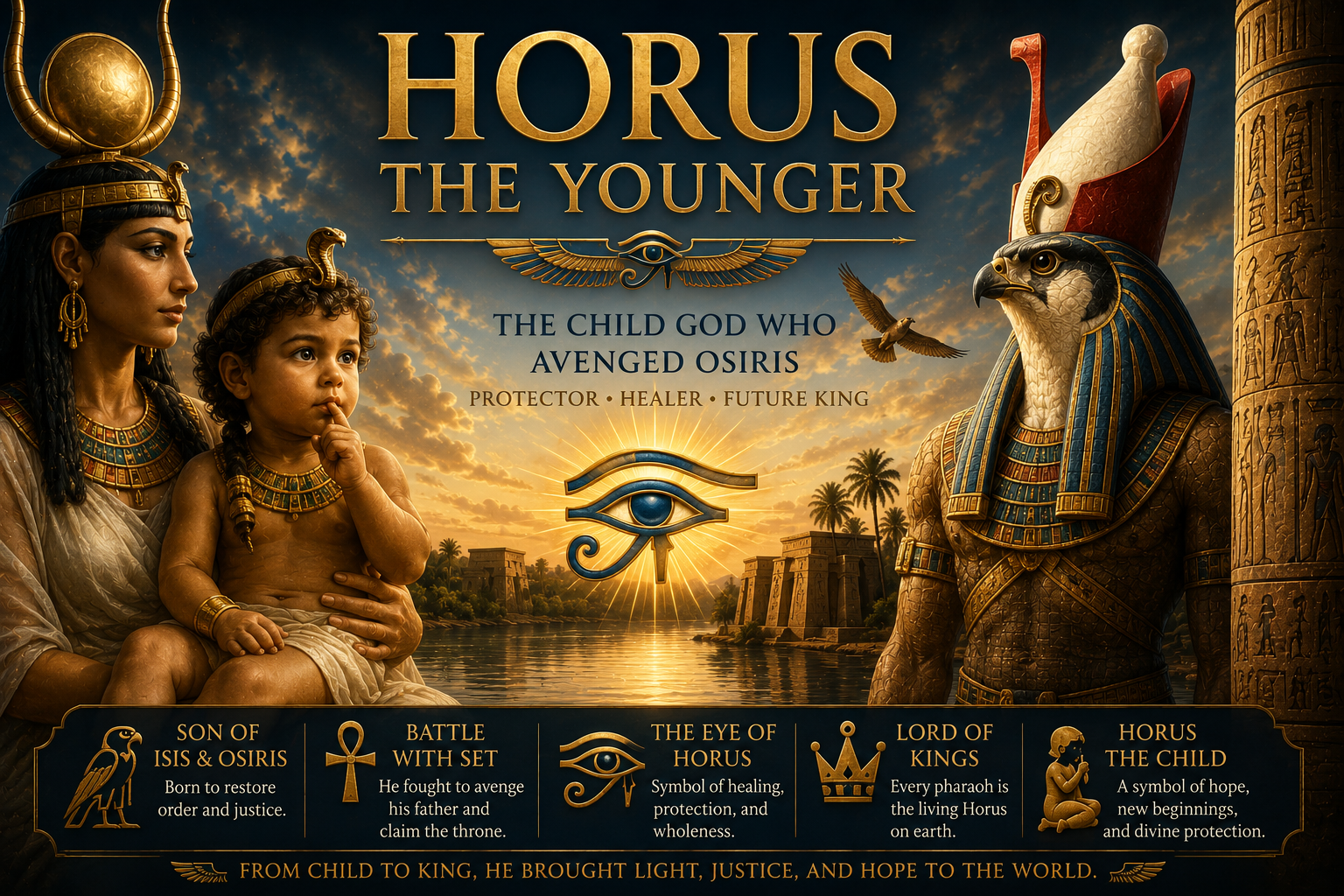
Horus the Younger was one of the most beloved and important gods in Ancient Egyptian mythology. He was the son of Osiris, god of the underworld, and Isis, goddess of magic and motherhood. Horus the Younger is best known for avenging his father’s murder and becoming the divine ruler of Egypt.
Although many people confuse him with Horus the Elder, Horus the Younger was a separate deity with his own myths, symbols, and religious significance. Over time, however, Horus the Younger absorbed many characteristics of Horus the Elder and eventually became the more widely worshipped of the two.
Ancient Egyptians regarded Horus the Younger as a symbol of kingship, protection, healing, and the triumph of order over chaos.
Horus the Younger vs. Horus the Elder
Modern readers often confuse Horus the Younger with Horus the Elder because both gods shared the name Horus and were represented as falcon deities.
However, the two gods originated separately.
- Horus the Elder was the son of Geb and Nut and belonged to the first generation of gods.
- Horus the Younger was the son of Osiris and Isis and belonged to a later generation.
While Horus the Elder was primarily a sky god, Horus the Younger became famous for his role in the Osiris myth and his struggle against Set.
Over time, the identities of the two gods gradually merged, which explains why some Egyptian myths seem contradictory.
Birth and Childhood of Horus
According to Egyptian mythology, Set murdered Osiris out of jealousy and seized the throne of Egypt.
Using her magical powers, Isis temporarily restored Osiris to life and conceived Horus. Fearing that Set would attempt to kill the child, Isis fled to the marshes of the Nile Delta to hide and raise her son in secret.
The childhood of Horus was filled with danger. Ancient magical texts describe numerous attempts by Set and other hostile forces to harm him.
In some stories, Horus was bitten by venomous snakes or stung by scorpions. Each time, Isis used powerful magic to save him.
Because he survived these dangers, Horus became a powerful symbol of protection, healing, and hope.
Parents often recited spells invoking Horus to protect their own children from illness and injury.
Horus the Child (Harpocrates)
One of the most popular forms of Horus the Younger was Horus the Child, known to the Greeks as Harpocrates.
Ancient Egyptians usually depicted Horus the Child as a young boy with a sidelock of youth, a hairstyle commonly worn by Egyptian children.
He was often shown placing one finger to his mouth. Contrary to popular belief, this gesture originally symbolized childhood rather than silence.
When the Greeks encountered these images, they misunderstood the gesture and interpreted Harpocrates as a god of silence, secrecy, and confidentiality.
This Greek interpretation became extremely influential during the Ptolemaic and Roman periods.
Numerous statues of Harpocrates were erected throughout Egypt and the Mediterranean world.
Horus and the Battle Against Set
After reaching adulthood, Horus challenged his uncle Set for the throne of Egypt.
Their struggle became one of the most important myths in Ancient Egyptian religion.
The conflict between Horus and Set lasted many years and involved a series of battles, contests, and judgments before the assembly of the gods.
During one famous encounter, Set tore out Horus’ left eye. The eye was later restored by either Thoth or Hathor, depending on the version of the story.
The restored eye became known as the Eye of Horus, one of Ancient Egypt’s most powerful symbols of protection, healing, and wholeness.
Eventually, the gods ruled in Horus’s favor, and he became the rightful king of Egypt.
His victory symbolized the triumph of order, justice, and legitimacy over chaos and disorder.
Horus and Egyptian Kingship
Ancient Egyptian pharaohs identified themselves with Horus.
Every living king was considered the earthly embodiment of Horus, while deceased kings became associated with Osiris.
This divine connection helped legitimize the pharaoh’s authority and reinforced the idea that the king ruled with the gods’ approval.
The pharaoh’s official titulary included a “Horus Name,” one of the oldest royal titles in Egyptian history.
As a result, Horus remained closely connected with kingship throughout the entire history of Ancient Egypt.
Appearance and Symbols
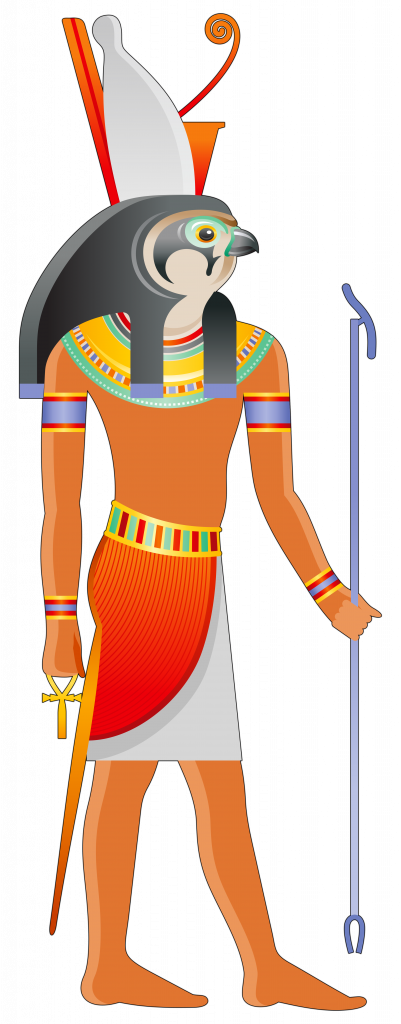
Horus the Younger was depicted in several different forms.
As an adult, he usually appeared as:
- A man with the head of a falcon.
- A complete falcon.
- A crowned king.
As Horus the Child, he was portrayed as:
- A young boy with a sidelock of youth.
- A child seated on his mother’s lap.
- A naked child with one finger touching his mouth.
Common symbols associated with Horus include:
- The falcon
- The Eye of Horus
- The Double Crown of Egypt
- The sun disk
- The morning sun
The morning sun, in particular, symbolized rebirth, hope, and renewal.
Horus, Isis, and the Roman World
The worship of Isis and Horus spread far beyond Egypt.
During the Ptolemaic and Roman periods, the cult of Isis became one of the most popular religions throughout the Mediterranean.
Images of Isis nursing the infant Horus became especially widespread. Many scholars have noted similarities between these depictions and later artistic representations of the Virgin Mary holding the infant Jesus.
However, historians caution that direct influence remains a subject of debate.
Regardless, the cult of Isis and Horus had an enormous impact on religious life throughout the Roman Empire.
Festivals of Horus
Ancient Egyptians celebrated numerous festivals honoring Horus.
One of the most important was the annual Festival of Victory held at the Temple of Horus at Edfu.
During this celebration, worshippers commemorated Horus’ triumph over Set through processions, religious ceremonies, hymns, and dramatic performances reenacting the mythological battle.
These festivals reinforced the central Egyptian belief that order would always prevail over chaos.
Legacy of Horus the Younger
Horus the Younger remained one of the most important deities in Egyptian religion for more than three thousand years.
As divine child, avenger of Osiris, protector of kings, and symbol of hope, Horus occupied a central place in Egyptian mythology and religious practice.
Today, Horus continues to fascinate historians and mythology enthusiasts as one of Ancient Egypt’s most recognizable and enduring gods.