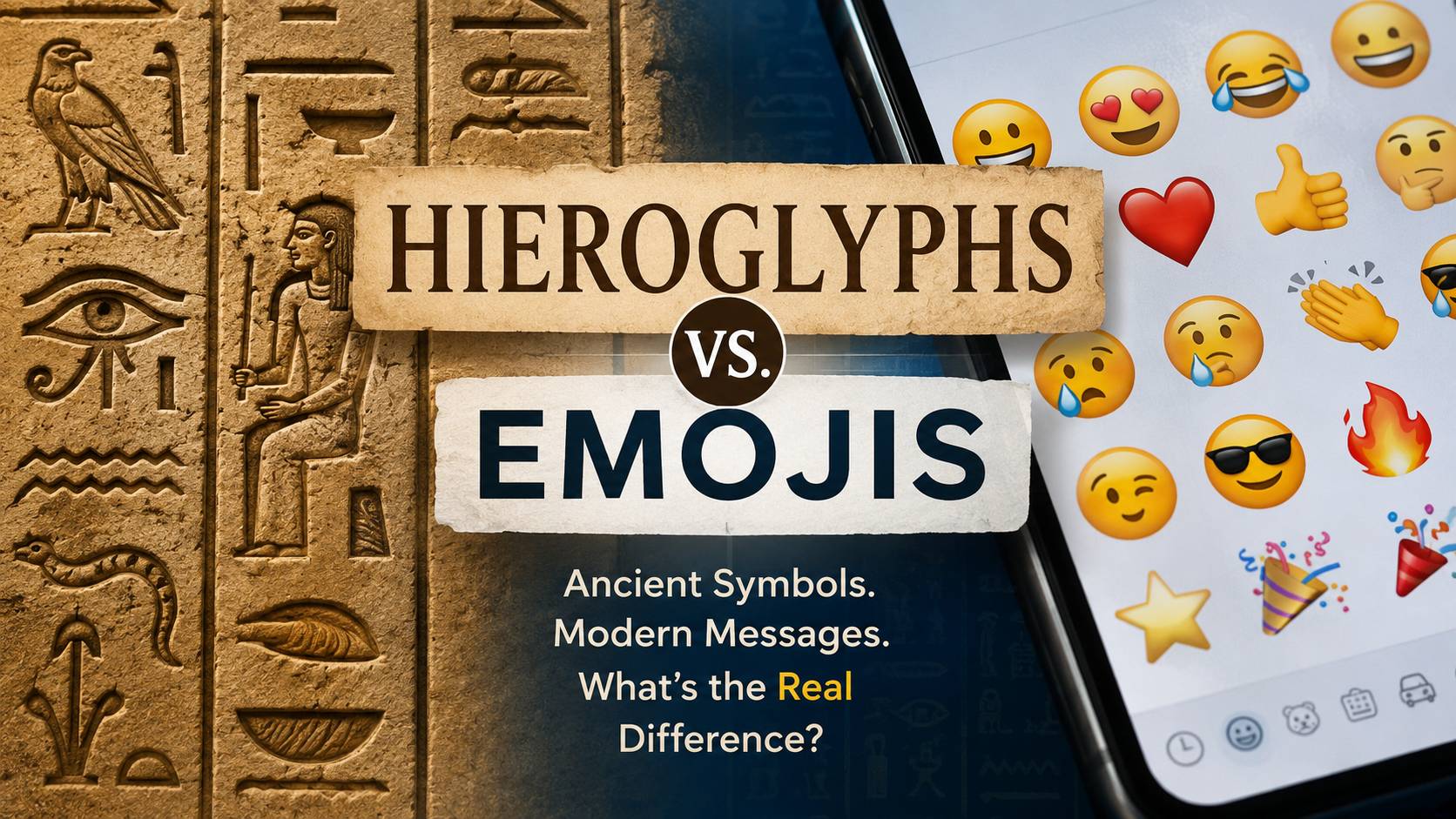
World Emoji Day is celebrated each year on July 17th, and it got me thinking. Were hieroglyphs really the emojis of ancient Egypt? The answer is more complicated than it looks. 👁️🐍☀️
Every day, people communicate with tiny pictures. A smiling face can soften a message. A heart can express affection without a sentence. A pair of eyes can suggest curiosity, suspicion, or silent attention. Emojis have become so familiar that many people compare them to one of history’s most famous picture-based scripts: ancient Egyptian hieroglyphs.
At first glance, the comparison seems obvious. Hieroglyphs include pictures of people, animals, plants, buildings, tools, food, and parts of the human body. Emojis also depict people, animals, plants, buildings, tools, food, and human expressions.
Were hieroglyphs simply the emojis of the ancient world? Not exactly.
Although hieroglyphs and emojis share some striking similarities, they work in fundamentally different ways. Emojis are pictorial symbols used within digital communication. Hieroglyphs were part of a complete writing system that represented the living language of ancient Egypt.
Why Hieroglyphs Look Like Emojis
The word “hieroglyph” comes from Greek words meaning “sacred carvings.” Ancient Egyptian hieroglyphs were highly detailed signs modeled on objects from the world around them.
A hieroglyph might depict an owl, a snake, a seated person, a loaf of bread, a house, a hand, or the sun. Because many of these images are still recognizable, hieroglyphic inscriptions can appear surprisingly familiar to modern viewers.
A row of hieroglyphs may look almost like a string of emojis carved across a temple wall.
That visual resemblance gives the comparison some value. Both hieroglyphs and emojis use recognizable images to communicate ideas. Both can be visually expressive, and both depend heavily on context.
A heart emoji, for example, may express love, friendship, gratitude, approval, or enthusiasm. Its meaning depends on who sends it, where it appears, and what accompanies it.
Hieroglyphs could also carry different meanings depending on their placement and function. The image of an object did not always refer directly to the object itself.
Hieroglyphs Could Represent Sounds
The greatest difference between hieroglyphs and emojis is that many hieroglyphs represented sounds.
An owl hieroglyph, for example, could represent the sound “m.” A water ripple could represent “n,” while a mouth could represent “r.” These signs functioned somewhat like letters, although the Egyptian system did not work exactly like the modern alphabet.
Some signs represented a single consonant. Others represented combinations of two or three consonants.
This allowed Egyptian scribes to spell names, verbs, titles, places, and abstract ideas that could not easily be shown with a simple picture.
An owl emoji typically means an owl, wisdom, nighttime, or a reference to a particular story or character. It does not ordinarily represent the sound of the letter “M” whenever it appears.
That distinction is essential. Hieroglyphs did not merely show readers what something looked like. They recorded how Egyptian words sounded.
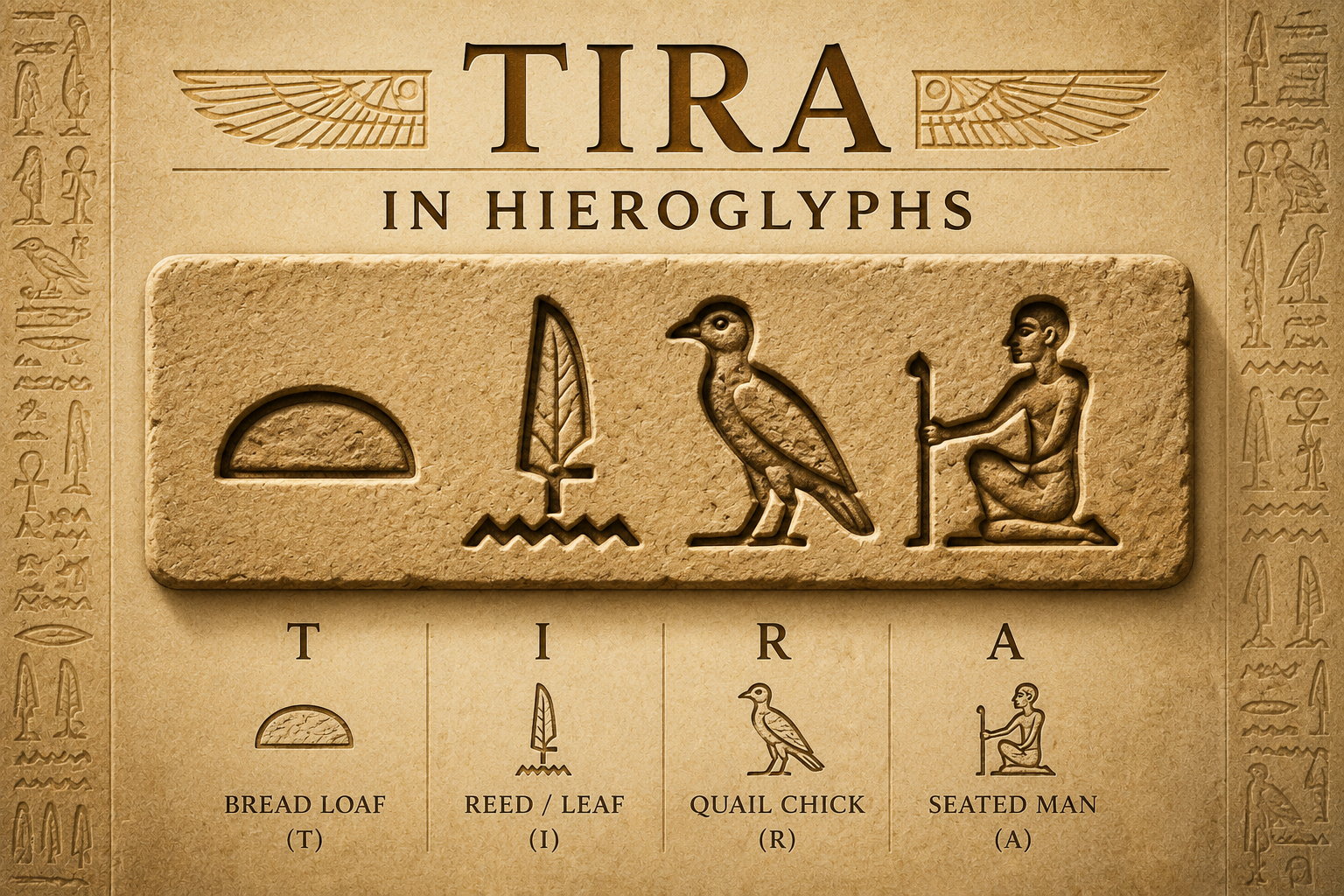
Emojis can’t tell you a person’s name. But hieroglyphs can. This is, for example, Tira. Notice the bread loaf is the T, whereas the bread emoji literally represents a loaf of bread. 🍞
Some Hieroglyphs Did Represent Whole Words
Other hieroglyphs functioned as word signs, sometimes called logograms or ideograms. A picture of the sun could represent the sun itself or the word associated with it. A plan of a simple building could represent a house. In these cases, the image and the word were directly connected.
This function comes closer to the way emojis operate.
A house emoji can mean “house,” “home,” “I am at home,” or “going home.” A sun emoji can mean the sun, warm weather, daytime, summer, or happiness.
Even here, however, the comparison has limits. Hieroglyphic word signs belonged to an organized writing system. Their meanings were established through scribal tradition and were combined with phonetic signs and grammatical structures.
Emoji meanings are much less regulated. Unicode standardizes emoji characters, but people and communities decide how they are used in everyday conversation. Unicode describes emojis as pictographs, generally displayed in color and used within lines of text.
Hieroglyphs Could Clarify Meaning
Ancient Egyptian writing also used signs known as determinatives. A determinative was usually placed at the end of a word. It was not pronounced aloud. Instead, it helped the reader understand what type of word had just been written.
For example, two Egyptian words might contain the same consonants but have different meanings. A final image could indicate whether the word referred to a person, an action, a place, an animal, or an abstract idea.
This is one area in which hieroglyphs and emojis have a genuinely interesting resemblance.
Consider the difference between these modern messages:
“I cannot believe you did that.”
“I cannot believe you did that 😂”
“I cannot believe you did that 😡”
“I cannot believe you did that ❤️”
The words remain the same, but the final emoji changes how the entire sentence is understood. It may signal laughter, anger, affection, teasing, or disbelief.
A determinative did not normally express the writer’s emotional reaction in this manner, but it could guide interpretation without being spoken. In both cases, a visual sign provides information beyond the sounds of the written words.
Could Egyptians Write Entire Messages in Hieroglyphs?
Yes. Hieroglyphs could express complete sentences and complicated ideas.
Ancient Egyptians used their language to record prayers, royal decrees, historical events, funerary spells, biographies, hymns, medical information, legal agreements, accounts, and literature.
The British Museum emphasizes that hieroglyphs were not merely decorative symbols. They represented a spoken language capable of conveying everything from poetry and international treaties to shopping lists and tax records.
Trying to communicate the same range of material entirely through emojis would be extremely difficult.
A person might use emojis to summarize a familiar fairy tale, describe a simple activity, or create a visual puzzle. But emojis lack the vocabulary, grammar, and phonetic precision required to independently record most complete conversations, laws, histories, or philosophical arguments.
They work best beside words. Hieroglyphs were the words.
Both Systems Depend on Shared Cultural Knowledge
Neither emojis nor hieroglyphs can be interpreted correctly without cultural context.
A modern reader may understand the basic image of a crown, snake, bird, or eye in an Egyptian inscription but miss its religious or political significance.
The Eye of Horus, for example, was more than an image of an eye. It carried associations with healing, restoration, protection, royal power, and Egyptian mythology.
Modern emojis also acquire meanings that extend beyond their literal appearance.
A skull may indicate death, but it can also mean that something is extremely funny. A goat may refer to the animal or to the “greatest of all time.” An eggplant and a peach often carry meanings unrelated to food.
These meanings are learned through culture rather than through the pictures alone.
A person from another time or society might recognize the objects but misunderstand the message. The same problem confronts modern people looking at Egyptian hieroglyphs without knowing the language or cultural conventions behind them.
Both Can Be Ambiguous
A picture may appear universal, but images are rarely as self-explanatory as they seem.
The meaning of an emoji can change between generations, communities, and countries. It can also change according to the surrounding words.
Even its appearance may vary. Unicode assigns emoji characters and sequences, but individual companies create their own visual versions. As a result, the same emoji may look slightly different on Apple, Google, Samsung, Microsoft, or another platform. Unicode’s emoji chart displays these variations across different vendors.
Hieroglyphs also varied in size, style, orientation, and artistic detail. Scribes could arrange signs to fit a particular space, and inscriptions might be read from right to left or left to right. Readers usually determine the direction by looking at the human figures and animals, which face toward the beginning of the text.
Despite these variations, hieroglyphic signs followed established linguistic conventions. Emoji usage remains far more flexible and open to personal interpretation.
Hieroglyphs Were Also Art
Egyptian hieroglyphs occupied a space between writing and art.
The signs were often carefully arranged to create balanced groups. They could be carved into stone, painted in tombs, incorporated into temple walls, or placed beside images of gods and kings.
The appearance of a text mattered as well as its meaning.
In some inscriptions, hieroglyphs interacted directly with the surrounding artwork. Figures might face one another, texts might be positioned beside particular gods, and the direction of the signs could complement the composition.
Emojis also add visual character to writing. They can break up blocks of text, draw attention to particular phrases, establish tone, and make a message feel friendlier or more expressive.
Yet the artistry of hieroglyphs was connected to Egyptian ideas about permanence, religion, and power. Writing a person’s name helped preserve that person’s identity. Recording offerings could help ensure they continued eternally. Sacred words and images were believed to possess power.
An emoji might bring a message to life figuratively.
For the ancient Egyptians, a hieroglyph could magically bring something to life.
Hieroglyphs Were Not Everyday Handwriting
The monumental hieroglyphs seen on temple and tomb walls were not the only form of Egyptian writing.
For ordinary documents, scribes often used faster, more cursive scripts. Hieratic developed as a handwritten form of Egyptian writing, while demotic later became common for administrative, legal, and everyday purposes.
Hieroglyphs were particularly suited to formal, monumental, and religious settings, although their use was not limited to these contexts.
This presents another contrast with emojis. Emojis are most strongly associated with casual, rapid communication. They appear in text messages, captions, comments, advertisements, and social media posts.
- Hieroglyphs often projected permanence.
- Emojis often capture the moment.
So Were Hieroglyphs Ancient Emojis?
Calling hieroglyphs “ancient emojis” is catchy, but it is historically misleading when taken literally.
Hieroglyphs were far more sophisticated as a method of recording language. They included signs for sounds, words, and categories of meaning. They could express grammar, names, actions, time, possession, commands, and complex religious or political ideas.
Emojis cannot normally perform those tasks without surrounding written language.
Still, the comparison can help modern audiences appreciate an important truth: human beings have always combined pictures and words.
Both hieroglyphs and emojis demonstrate the power of visual communication. Both rely on shared cultural understanding. Both can clarify meaning, introduce ambiguity, and transform the appearance of written language.
More than 5,000 years separate the earliest Egyptian hieroglyphs from today’s digital messages, but the desire behind them is recognizable.
People do not communicate through words alone. We also use pictures to convey identity, emotion, context, humor, belief, and ideas that words sometimes fail to capture.
The ancient Egyptians were not sending emojis across temple walls. But they certainly understood that a picture could say more than it seemed.
You can learn more about World Emoji Day, which is celebrated each year on July 17, here.