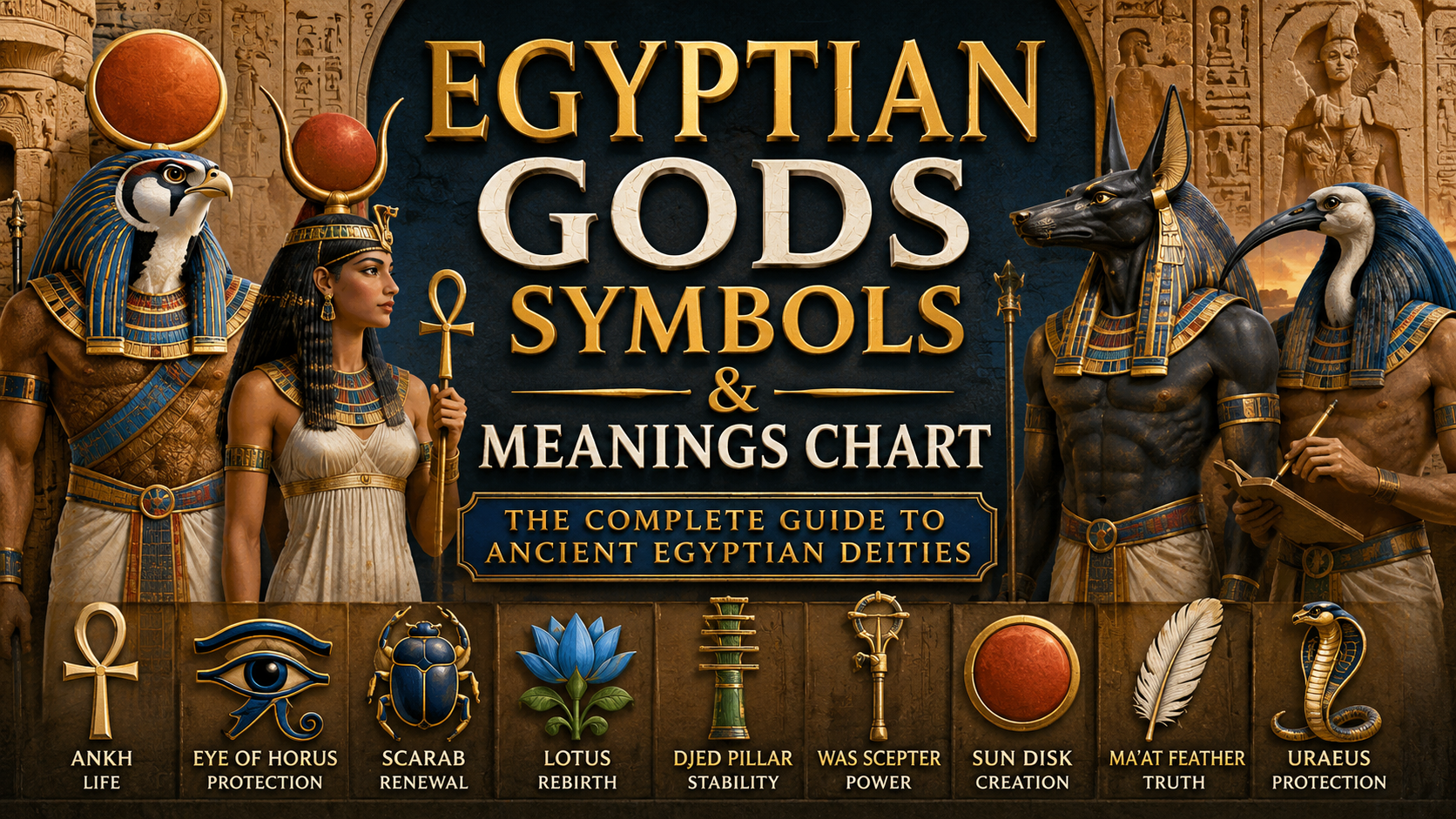
Ancient Egyptian religion was filled with powerful symbols that conveyed complex ideas about creation, kingship, life, death, protection, and the natural world. Every god and goddess possessed distinctive attributes that allowed worshippers to recognize them immediately in temple carvings, tomb paintings, statues, and papyrus manuscripts.
These symbols were far more than artistic decorations. They represented the divine powers of each deity and communicated their role within the Egyptian cosmos. A falcon represented divine kingship, a jackal signified protection of the dead, while the ankh symbolized eternal life. Even today, these ancient symbols remain among the most recognizable images from Egyptian civilization.
This guide explores the most important Egyptian gods, their sacred symbols, and what those symbols meant to the ancient Egyptians. Whether you’re studying Egyptian mythology, visiting a museum, or simply curious about ancient religion, this chart provides a quick reference to the gods and the meanings behind their most famous symbols.

Egyptian Gods Symbols and Meanings Chart
| Egyptian God | Main Symbol | Sacred Animal | What the Symbol Represents | Primary Domain |
|---|---|---|---|---|
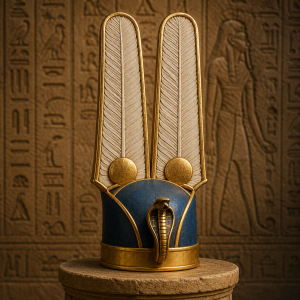
| Amun | Double Plumed Crown | Ram | Hidden power, divine authority | Creation, kingship |
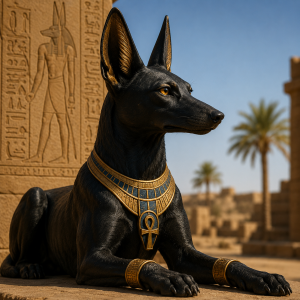
| Anubis | Jackal | Jackal | Protection of the dead | Mummification, cemeteries |
| Bastet | Sistrum | Cat | Protection, joy, motherhood | Home, fertility |
| Bes | Lion-like Face | Lion | Household protection | Families, childbirth |
| Geb | Goose | Goose | Fertility of the earth | Earth |
| Hapi | Papyrus and Lotus Plants | Human (fertility figure) | Prosperity from the Nile | Nile inundation |
| Hathor | Cow Horns and Sun Disk | Cow | Love, motherhood, music | Joy and fertility |
| Horus | Falcon | Falcon | Kingship and victory | Sky, pharaoh |
| Horus the Elder | Falcon | Falcon | Celestial authority | Primeval sky god |
| Isis | Throne Hieroglyph | Kite | Magic and royal motherhood | Healing, protection |
| Khonsu | Moon Disk and Crescent | Falcon | Time and renewal | Moon |
| Ma’at | Ostrich Feather | Ostrich | Truth and justice | Cosmic order |
| Mut | Double Crown | Vulture | Divine motherhood | Queenship |
| Nephthys | House and Basket Hieroglyph | Kite | Mourning and protection | Funerary rites |
| Nut | Star-Covered Body | Sow | Protection of the heavens | Sky |
| Osiris | Crook and Flail | Bull (Apis associations) | Resurrection and legitimate rule | Afterlife |
| Ptah | Djed Staff | Bull | Creation through craftsmanship | Craftsmen and architects |
| Ra | Solar Disk | Falcon | Creation and life | Sun |
| Sekhmet | Solar Disk | Lioness | Divine power and destruction | War and healing |
| Set | Set Animal | Set Animal | Chaos and storms | Desert, conflict |
| Shu | Ostrich Feather | Lion | Air and separation | Atmosphere |
| Sobek | Crocodile | Crocodile | Military strength and fertility | Nile |
| Tefnut | Lioness | Lioness | Moisture and balance | Rain and humidity |
| Thoth | Ibis and Writing Palette | Ibis | Wisdom and knowledge | Writing and learning |
Why Did Egyptian Gods Have Symbols?
Unlike many modern religions, ancient Egyptian religion relied heavily on visual imagery. Many people could recognize a deity instantly simply by looking at a carving or statue, even without reading the accompanying hieroglyphs.
A god’s symbols communicated their identity, powers, and responsibilities.
For example:
- A falcon immediately identified a sky deity connected with kingship.
- A jackal represented guardianship over cemeteries and the dead.
- A lioness symbolized destructive power capable of protecting Egypt from its enemies.
- A crocodile reflected the dangerous yet life-giving nature of the Nile.
- A feather represented truth, justice, and cosmic balance.
These symbols appeared everywhere in Egyptian life, from temple walls and royal tombs to jewelry, amulets, coffins, and ceremonial objects.
Many gods also carried sacred objects such as the ankh, the was scepter, or the djed pillar. These symbols were shared among multiple deities because they represented universal divine powers rather than a single god.
Understanding Egyptian God Symbols
Not every Egyptian god was identified by only one symbol. Most possessed several sacred attributes that worked together to express different aspects of their character.
These usually fell into four categories:
Sacred Animals
Many deities were associated with particular animals admired for their natural abilities. For example:
- Falcons symbolized sharp vision, dominance, and the heavens.
- Jackals were associated with cemeteries because they wandered desert burial grounds.
- Cats protected grain stores by hunting rodents, making them symbols of household protection.
- Crocodiles embodied both fearsome strength and the life-giving waters of the Nile.
These animals were considered earthly manifestations of divine power rather than the gods themselves.
Sacred Objects
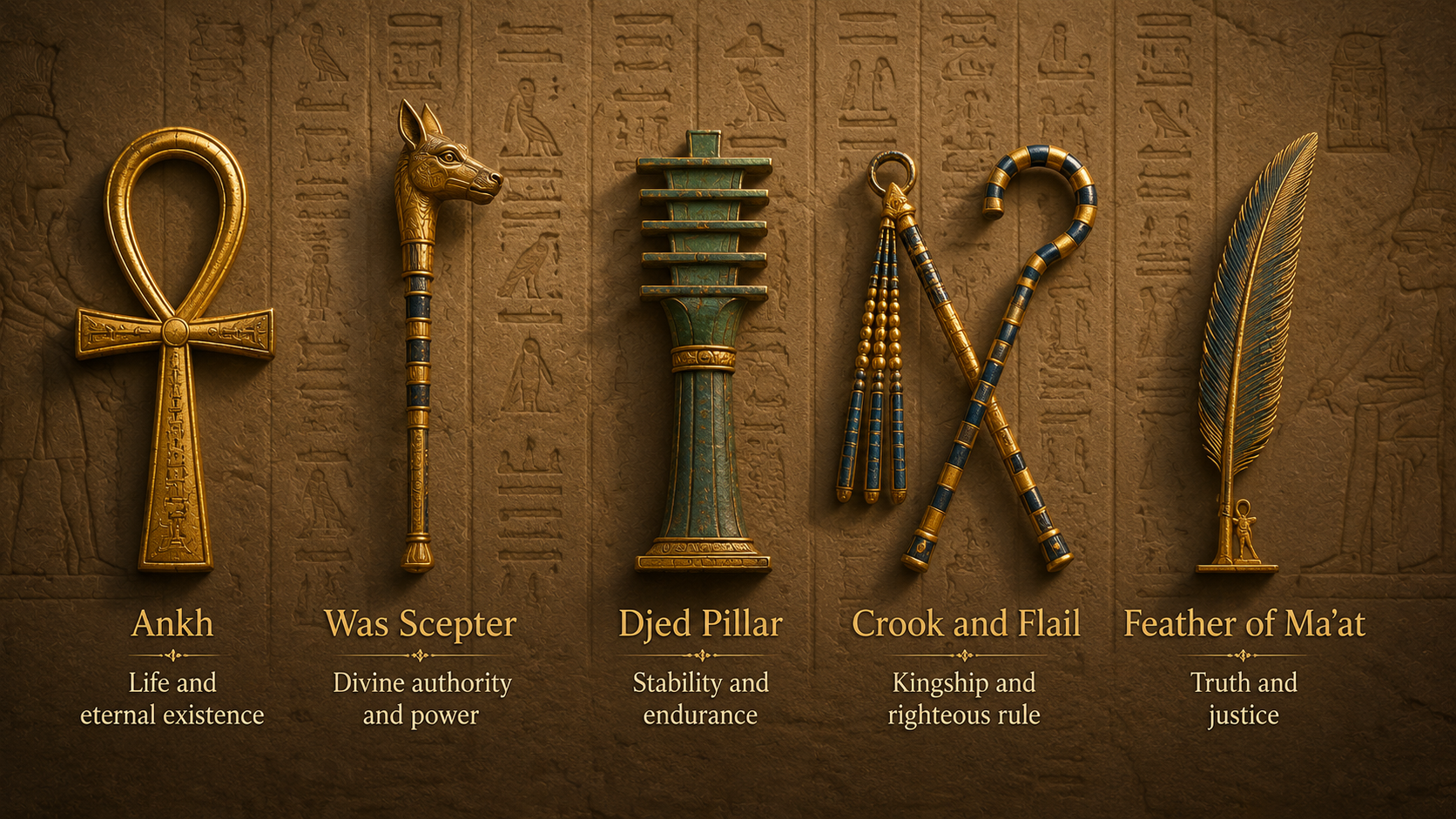
Many gods carried symbolic objects that represented universal concepts. Some of the most common include:
- Ankh – Life and eternal existence
- Was Scepter – Divine authority and power
- Djed Pillar – Stability and endurance
- Crook and Flail – Kingship and righteous rule
- Feather of Ma’at – Truth and justice
These symbols frequently appear in Egyptian art regardless of which deity is depicted.
Crowns and Headdresses
The elaborate crowns worn by Egyptian gods often reveal their identity before anything else.
Examples include:
- Ra’s solar disk
- Hathor’s cow horns embracing the sun
- Amun’s tall double plumes
- Khonsu’s crescent moon and lunar disk
- Mut’s double crown symbolizing rule over Upper and Lower Egypt
Because these crowns rarely changed, they remain one of the easiest ways to identify Egyptian deities in ancient artwork.
Colors
Ancient Egyptian artists also used color symbolically.
- Green represented rebirth, vegetation, and new life.
- Black symbolized fertility and the rich soil left behind by the Nile flood.
- Gold represented the eternal flesh of the gods.
- Blue reflected the heavens, the Nile, and creation.
- Red represented both chaos and protective power depending on the context.
Understanding these colors helps explain why Osiris is frequently shown with green skin or why many divine objects are painted gold.
Why Symbols Were So Important in Ancient Egypt
For the ancient Egyptians, symbols were believed to possess genuine power.
A carved ankh was not simply a picture of life; it invoked the concept of life itself. A protective image of Bes placed inside a home was thought to actively ward off evil spirits. Amulets bearing the Eye of Horus were worn because they were believed to offer real protection from illness, injury, and misfortune.
This belief extended to temples and tombs. Every carved figure, painted scene, and sacred emblem contributed to maintaining ma’at, the universal order established by the gods. Destroying a person’s image or erasing a deity’s symbols could symbolically diminish their power, while preserving and displaying them helped sustain divine harmony.
Because of this, Egyptian art followed remarkably consistent conventions for more than three thousand years. The symbols of the gods became a visual language that every Egyptian could understand.
In the sections below, we’ll explore each of the major Egyptian gods individually, explaining the meaning behind their sacred animals, symbols, crowns, and attributes, along with how to recognize them in ancient Egyptian art.
Egyptian Gods and Their Symbols
Amun: The Hidden King of the Gods
Main Symbols
- Double plumed crown
- Ram
- Goose
- Was scepter
- Ankh
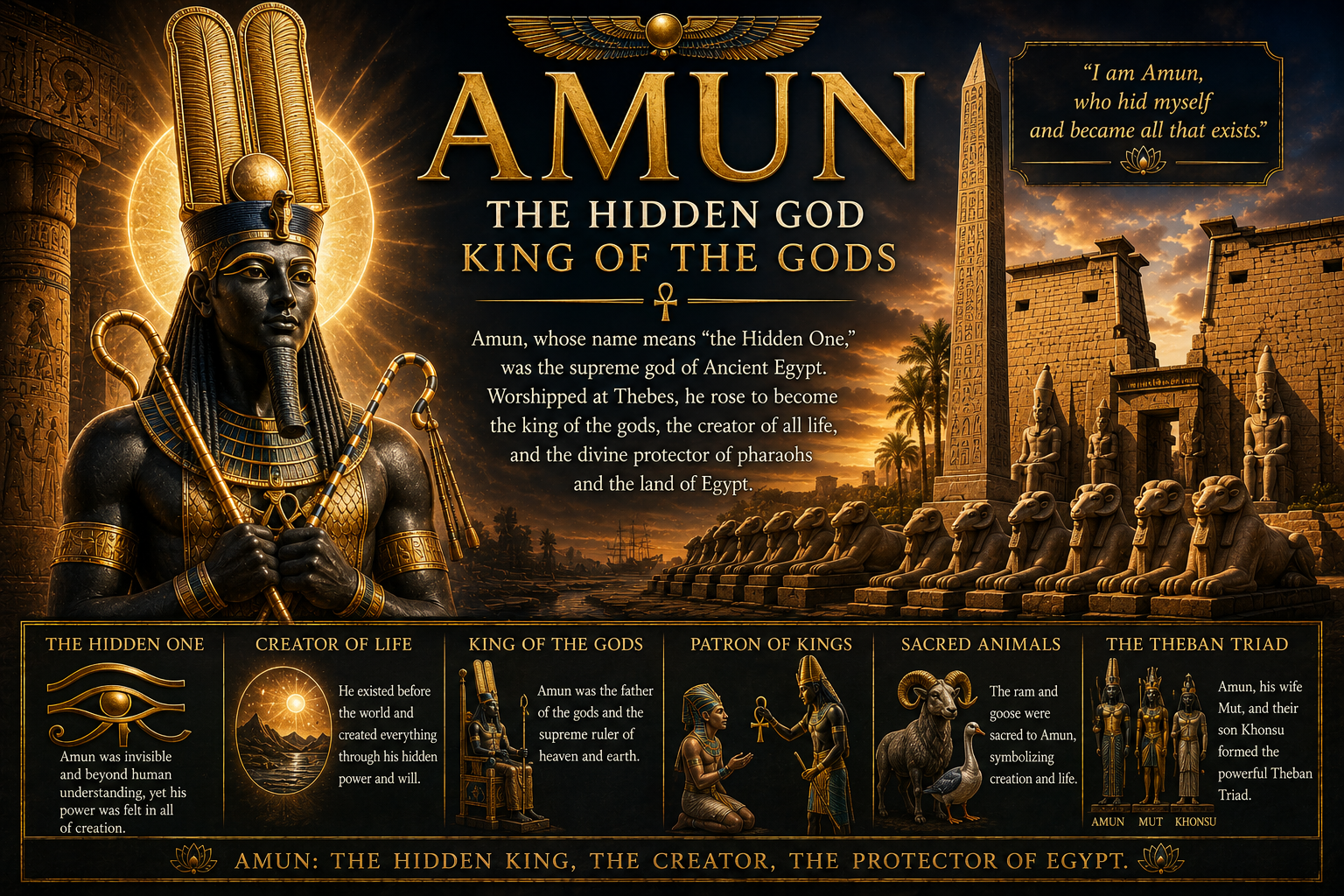
Amun was one of the most powerful gods in Ancient Egypt, particularly during the New Kingdom when he became the chief deity of the Egyptian pantheon. His name means “The Hidden One,” reflecting his invisible yet all-encompassing divine presence.
His most recognizable symbol is the tall double-plumed crown, often worn above a close-fitting cap. The two towering feathers symbolize his supreme authority and connection with the heavens. Pharaohs frequently associated themselves with Amun to reinforce their divine right to rule.
Amun was also closely linked to the ram, an animal admired for its strength, fertility, and leadership. Along the avenues leading to Karnak Temple, magnificent ram-headed sphinxes guarded the sacred precincts, proclaiming Amun’s protective power.
In Egyptian art, Amun usually appears as a bearded man wearing the double plumes while holding the ankh, representing life, and the was scepter, symbolizing divine authority.
How to identify Amun: Look for a human figure wearing two tall feathers, often accompanied by a ram or ram-headed sphinx.
Anubis: Guardian of the Dead
- Jackal
- Mummy wrappings
- Flail
- Embalming table
- Ankh
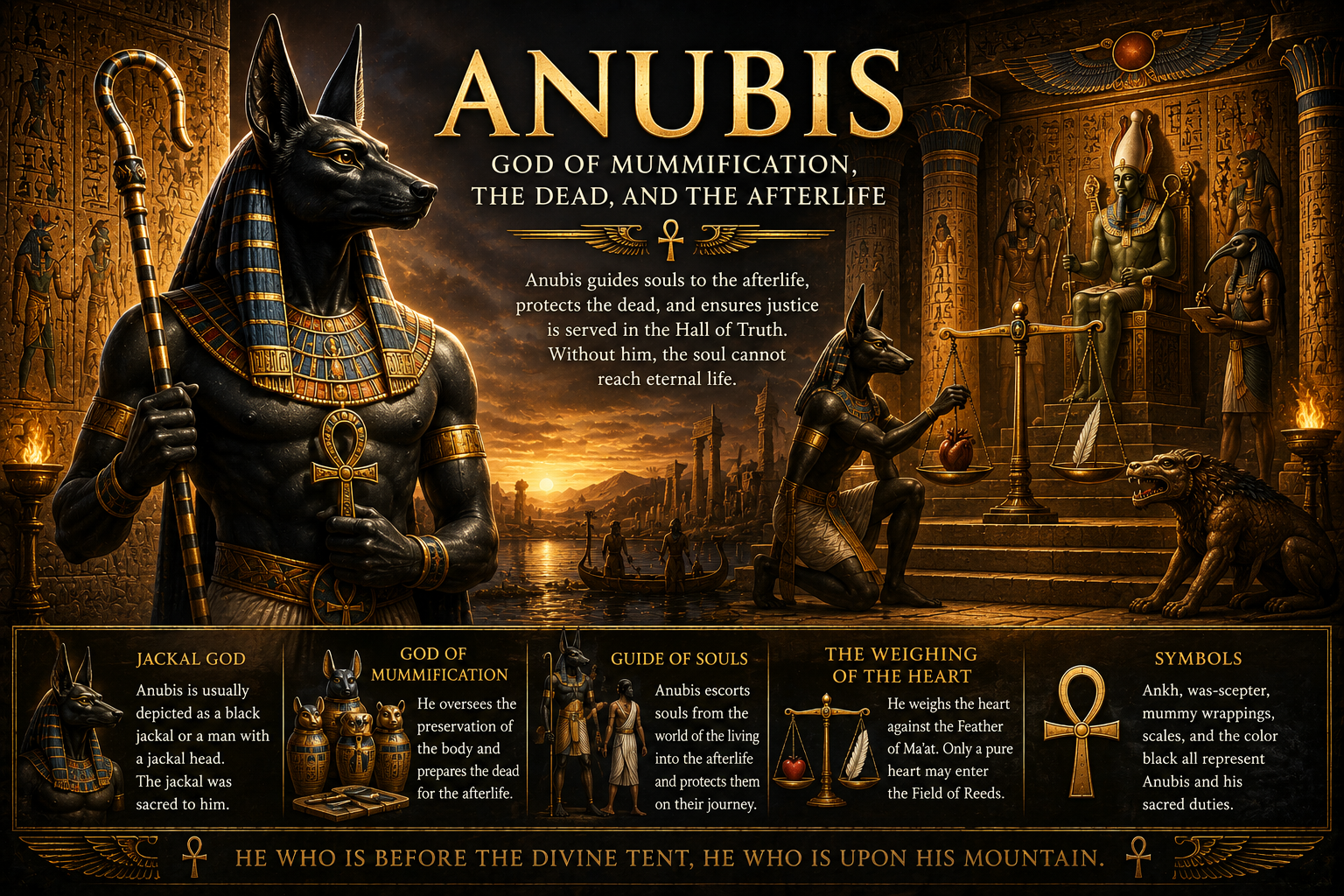
Anubis served as the protector of cemeteries and overseer of mummification. His role was to guide souls safely into the afterlife and ensure the deceased received proper burial.
His most famous symbol is the black jackal. Wild jackals frequently roamed desert cemeteries, so the Egyptians transformed this feared scavenger into a divine guardian who protected rather than disturbed the dead.
The black color of Anubis carries special meaning. While black can represent death, it also symbolizes the fertile soil deposited by the Nile, making it a color of rebirth and regeneration.
Anubis is commonly depicted bending over a mummy during embalming or supervising the Weighing of the Heart, in which the deceased’s heart is weighed against the Feather of Ma’at.
How to identify Anubis: A black jackal or jackal-headed man standing beside a mummy or funerary scene.
Bastet: Goddess of Home and Protection
Main Symbols
- Cat
- Sistrum
- Lioness
- Basket
- Ankh
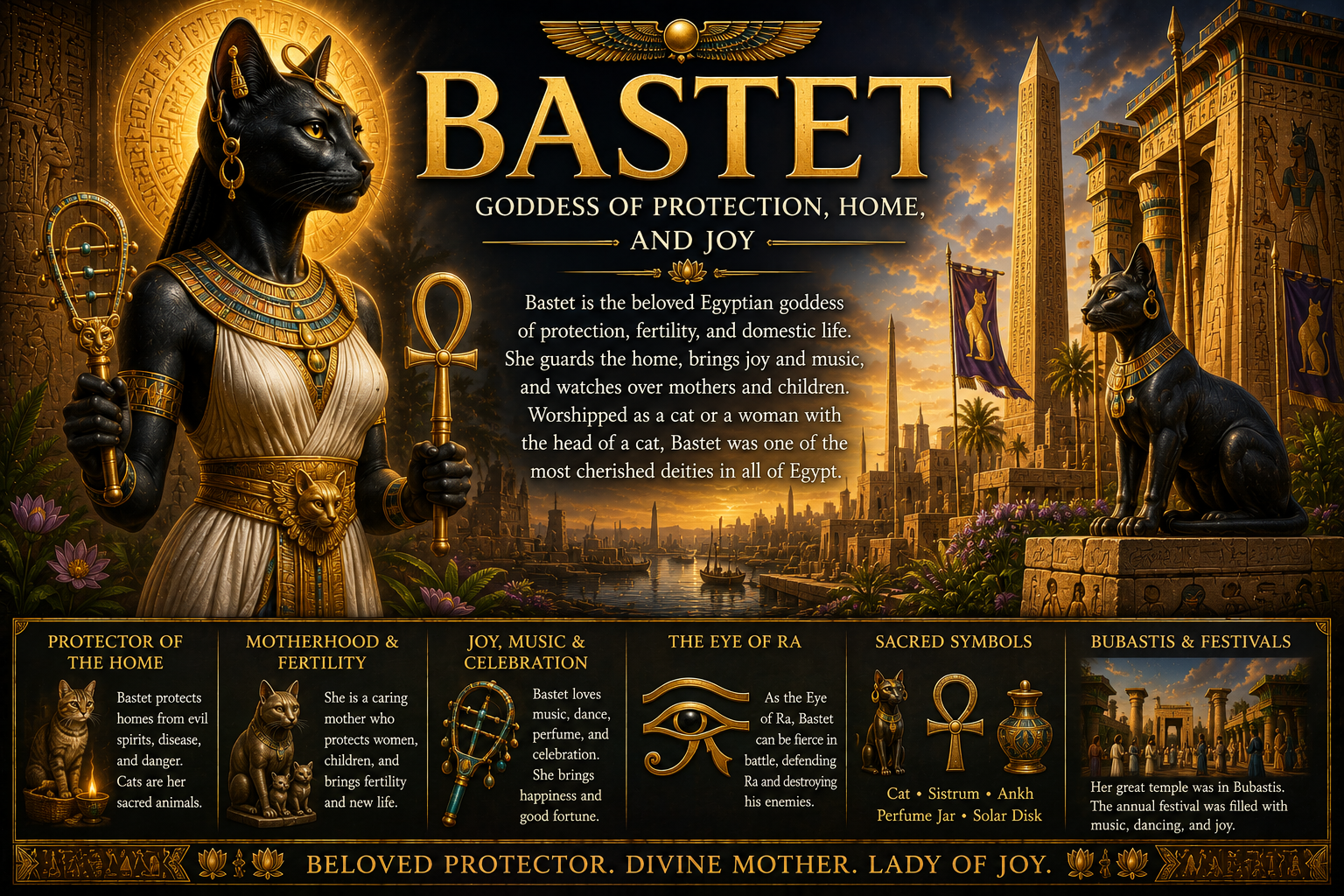
Bastet began as a fierce lioness goddess before gradually becoming associated with domestic cats. She protected homes, mothers, children, and families while also serving as a goddess of music, joy, and celebration.
The cat became her defining symbol because cats defended grain stores by hunting rodents and snakes. Their protective behavior made them natural guardians of Egyptian households.
Bastet is frequently shown carrying a sistrum, a sacred musical instrument used during temple rituals. Music, dancing, and celebration formed important parts of her worship.
Although she usually appears with the head of a domestic cat, some earlier depictions portray her as a lioness, reflecting her more warlike origins.
How to identify Bastet: A woman with a cat’s head holding a sistrum or accompanied by kittens.
Isis: Goddess of Magic and Motherhood
Main Symbols
- Throne hieroglyph
- Kite
- Cow horns and solar disk
- Ankh
- Tyet Knot (Knot of Isis)
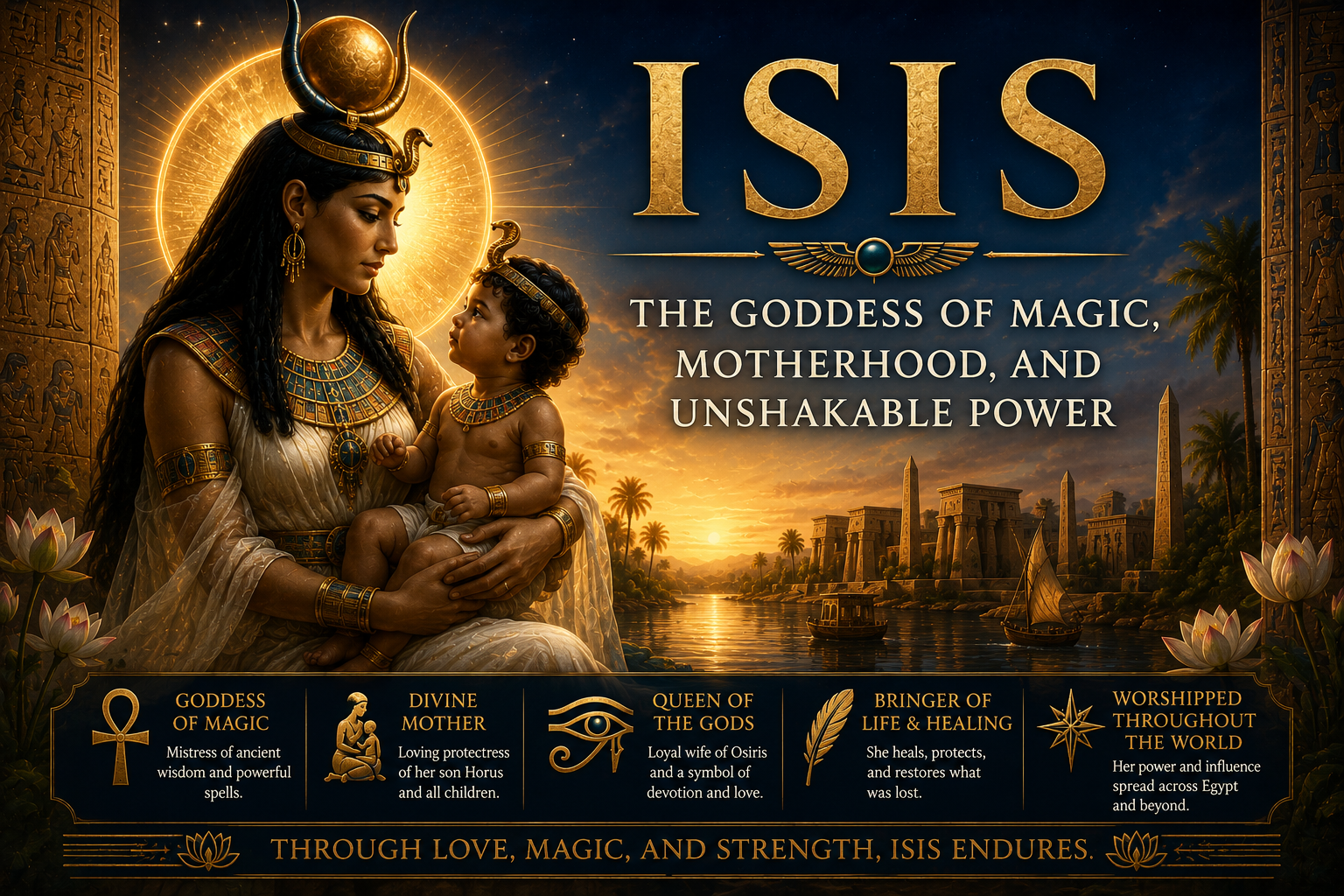
Isis was one of the most beloved and influential goddesses in Ancient Egypt. Revered as the ideal mother, devoted wife, and powerful magician, she protected kings, healed the sick, and guided the dead into the afterlife. Her worship eventually spread throughout the Mediterranean world during the Greek and Roman periods.
Her most distinctive symbol is the throne hieroglyph, which she wears on her head. In fact, her Egyptian name literally means “throne,” emphasizing her role as the divine protector of kingship. As the mother of Horus, she symbolized the royal lineage from which every pharaoh claimed legitimacy.
Later depictions often show Isis wearing cow horns surrounding a solar disk, a headdress she shares with Hathor. This reflects the close relationship between the two goddesses and highlights Isis’s role as a nurturing mother.
Another important symbol associated with Isis is the Tyet Knot, sometimes called the Knot of Isis. Frequently carved into red stone amulets and placed among mummy wrappings, it symbolized divine protection, healing, and the life-giving power of the goddess.
Isis is also closely linked with the kite, a bird of prey whose mournful cries became associated with the goddess’s grief as she searched for the body of Osiris.
How to identify Isis: A woman wearing the throne hieroglyph or cow horns with a solar disk, often holding an ankh or nursing the infant Horus.
Khonsu: God of the Moon
Main Symbols
- Crescent moon
- Lunar disk
- Falcon
- Crook and flail
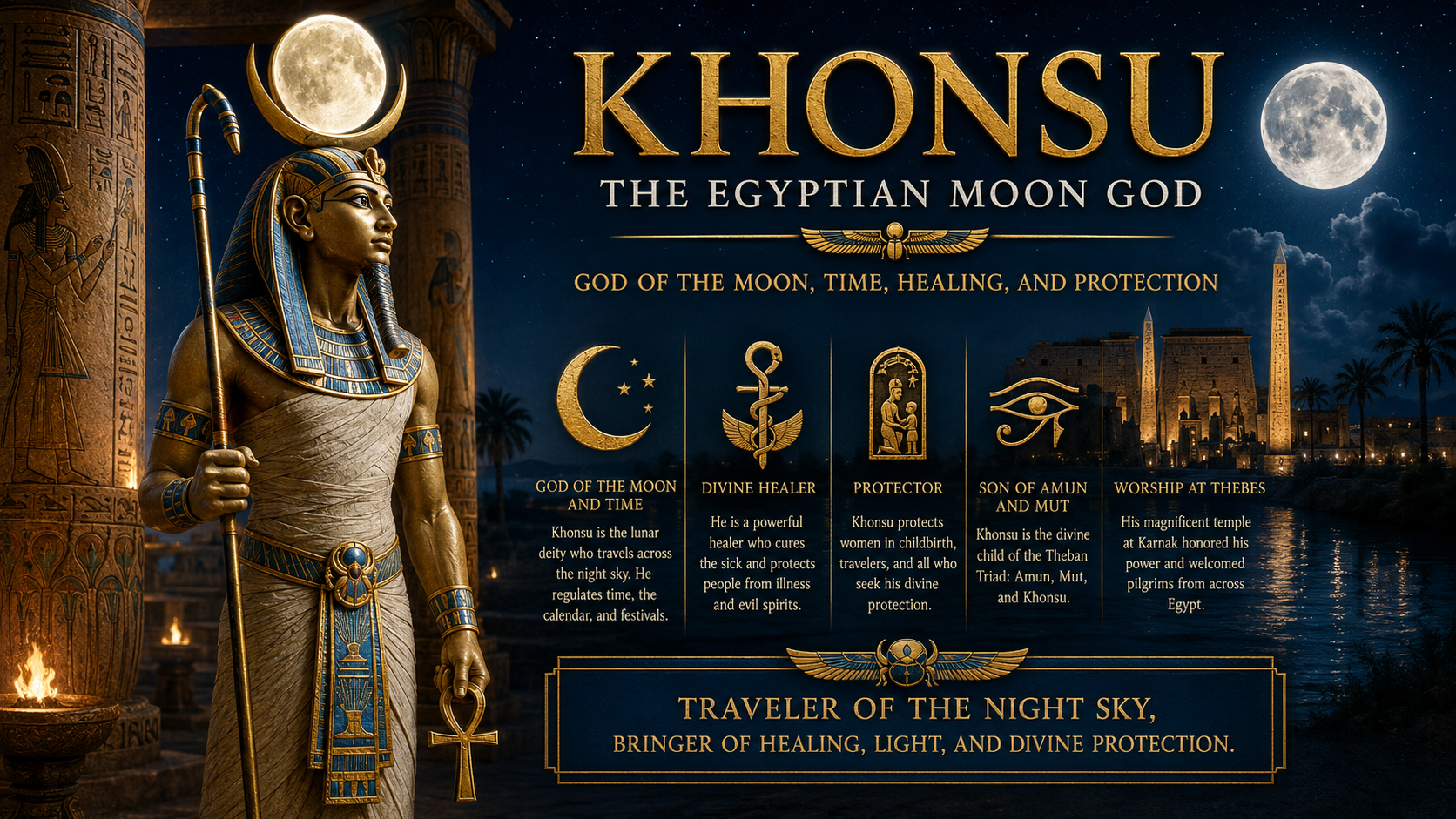
Khonsu was the moon god of Thebes and the son of Amun and Mut. His name means “The Traveler,” referring to the moon’s nightly journey across the sky.
His most recognizable symbols are the crescent moon supporting a full lunar disk, worn atop his head. These immediately distinguish him from other Egyptian gods.
Khonsu often appears as a youthful, mummiform figure wearing a sidelock of youth while holding the crook and flail, symbols more commonly associated with Osiris. This reflects his role in renewal and the cyclical nature of time.
Ancient Egyptians also believed Khonsu possessed remarkable healing powers. Temple inscriptions describe him curing illnesses and driving away harmful spirits.
How to identify Khonsu: A youthful mummiform figure wearing a crescent moon and full lunar disk.
Ma’at: Goddess of Truth and Justice
Main Symbols
- Ostrich feather
- Feathered headdress
- Scales
- Ankh
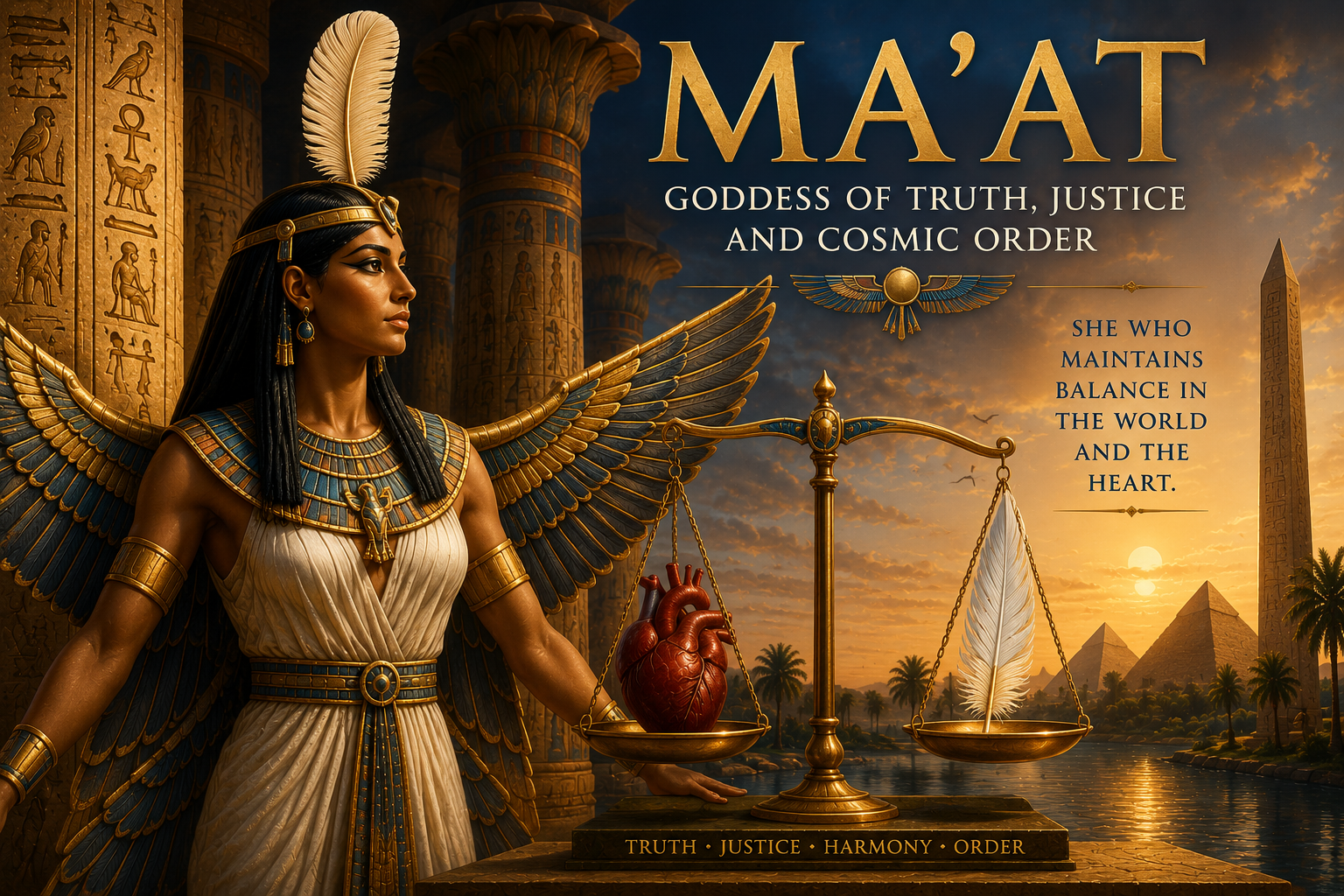
Ma’at personified truth, justice, harmony, and the cosmic order that governed both the universe and Egyptian society. Rather than representing a single aspect of nature, she embodied the principles upon which creation itself depended.
Her defining symbol is the ostrich feather, worn upon her head. This feather became the universal symbol of truth throughout Ancient Egypt.
During the famous Weighing of the Heart, the deceased’s heart was weighed against Ma’at’s feather. If the heart balanced with the feather, the individual was judged worthy of entering the afterlife. If it proved heavier due to wrongdoing, it was consumed by the fearsome Ammit.
Because every pharaoh was responsible for maintaining Ma’at throughout Egypt, images of the goddess frequently appear in temples, royal inscriptions, and scenes of divine judgment.
How to identify Ma’at: A woman wearing a single ostrich feather or represented by the feather itself.
Mut: The Great Mother Goddess
Main Symbols
- Double Crown
- Vulture
- Lioness
- Ankh
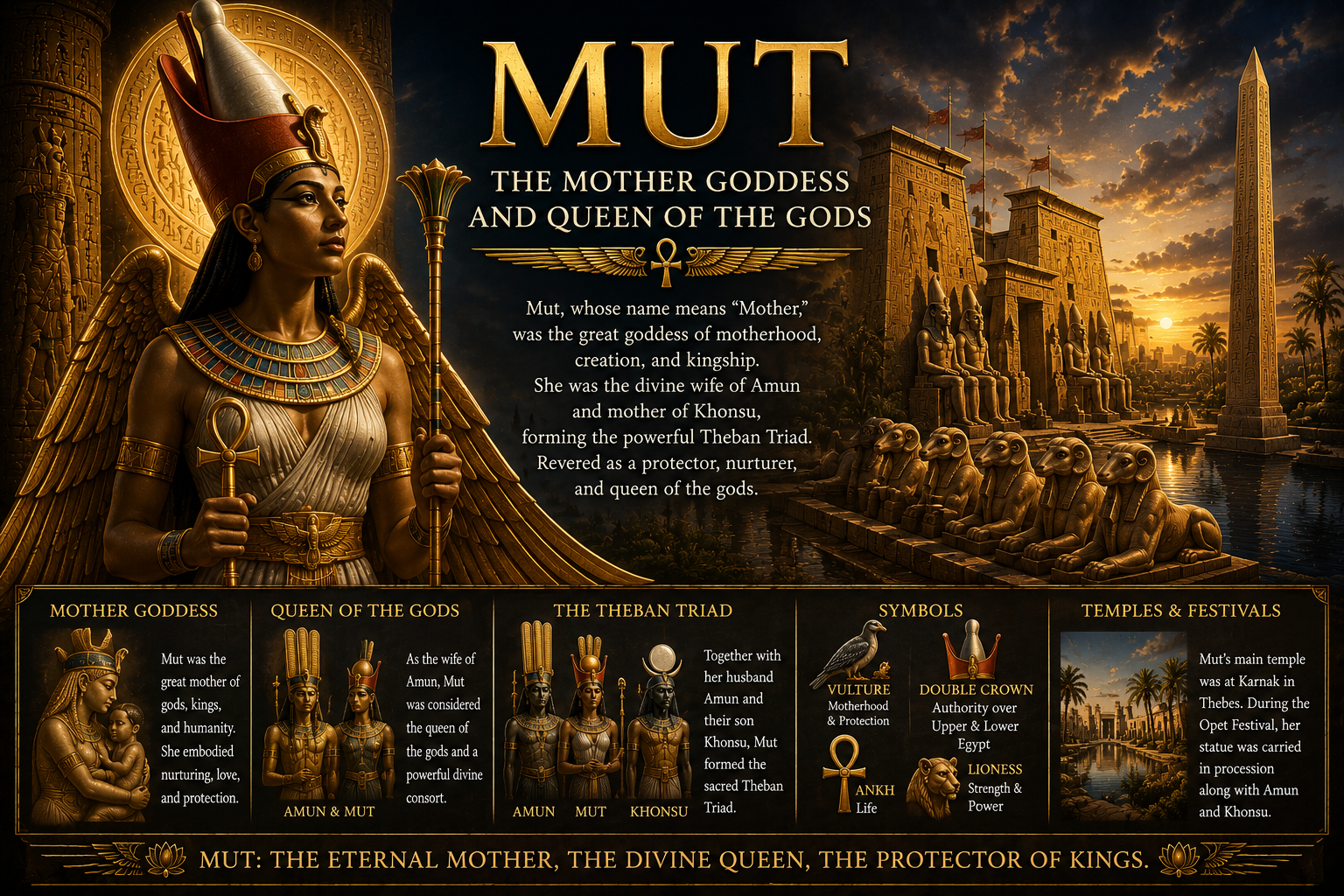
Mut served as the divine mother within the Theban Triad alongside Amun and Khonsu. Her name simply means “Mother,” emphasizing her role as the universal maternal deity.
She is most easily recognized by the Double Crown of Upper and Lower Egypt, signifying her authority over the united kingdom and her close association with royal power.
The vulture was sacred to Mut because Egyptians viewed it as a fiercely protective mother. As a result, vulture imagery frequently decorated royal crowns and ceremonial garments to symbolize maternal guardianship.
Although generally depicted as a peaceful queen, Mut could also assume the form of a lioness, demonstrating that motherhood included both nurturing and fierce protection.
How to identify Mut: A queenly woman wearing the Double Crown, sometimes accompanied by vultures.
Nephthys: Goddess of Mourning and Protection
Main Symbols
- House and basket hieroglyph
- Kite
- Wings
- Funerary vessels
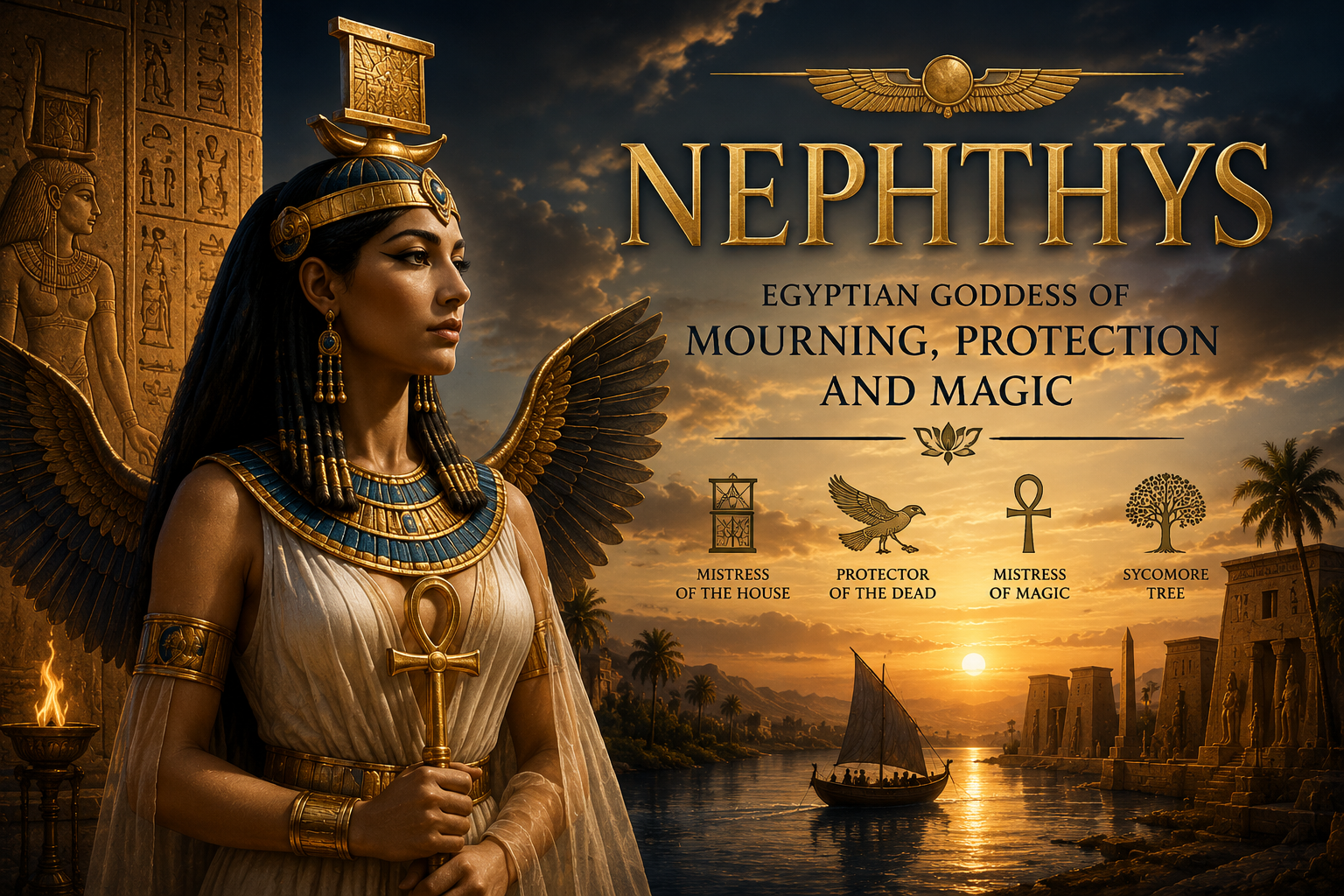
Nephthys was the sister of Isis and Osiris and the wife of Set. While she rarely occupied the center of Egyptian mythology, she played an essential role in funerary rituals and the protection of the deceased.
Her most distinctive symbol is the pair of hieroglyphs spelling her name, consisting of a basket resting atop the outline of a house. These symbols are worn as her crown in nearly every artistic depiction.
Like Isis, Nephthys was associated with the kite, whose haunting cries became linked with mourning and lamentation. The two sisters were frequently shown standing beside Osiris’s body, mourning his death and assisting in his resurrection.
Many coffins and sarcophagi depict Isis and Nephthys spreading their wings around the deceased, symbolically protecting the soul.
How to identify Nephthys: A woman wearing the house-and-basket hieroglyph upon her head, often with outstretched protective wings.
Nut: Goddess of the Sky
Main Symbols
- Star-covered body
- Sky
- Heavenly cow
- Water jar
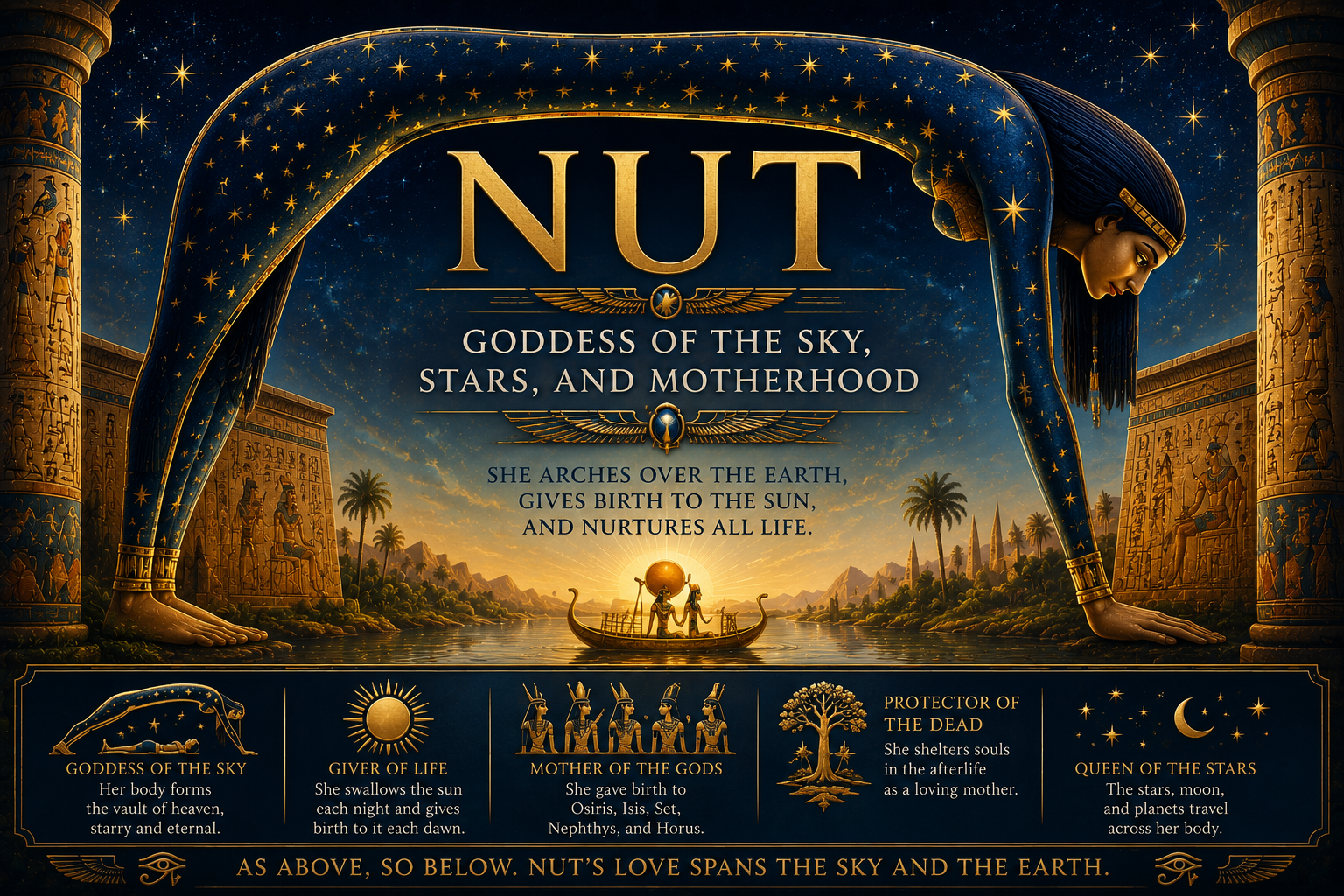
Nut personified the heavens and protected the world beneath her. According to Egyptian mythology, she arched over the earth while Geb lay below, separated by the air god Shu.
Her most famous representation shows her body covered with stars, stretching gracefully from horizon to horizon. This image symbolizes the night sky itself.
Each evening Nut swallowed the setting sun, carried it through her body during the night, and gave birth to it again at dawn. This daily cycle represented continual renewal and rebirth.
Some traditions also associate Nut with the heavenly cow, whose body supports the sky and carries the sun across the heavens.
How to identify Nut: A woman whose body arches over the earth and is decorated with stars.
Osiris: Lord of the Afterlife
Main Symbols
- Crook and flail
- Atef Crown
- Green skin
- Djed Pillar
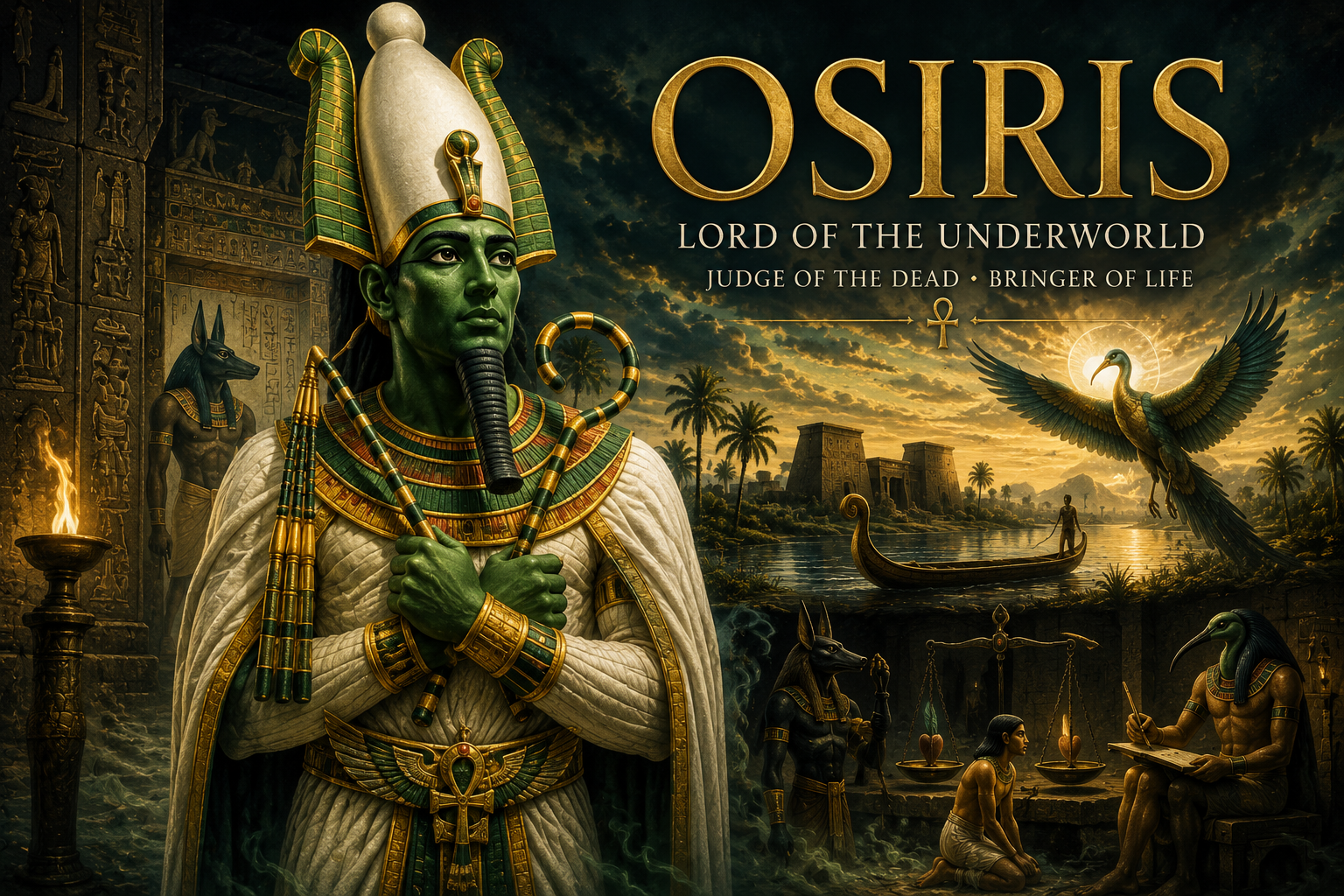
Osiris ruled the afterlife and symbolized resurrection, eternal life, and legitimate kingship. His murder by Set and resurrection through Isis became one of the central myths of Egyptian religion.
His most recognizable symbols are the crook and flail, traditional emblems of kingship representing guidance and authority.
Osiris also wears the distinctive Atef Crown, a tall white crown flanked by ostrich feathers, immediately distinguishing him from other gods.
Perhaps his most famous characteristic is his green skin, symbolizing vegetation, fertility, and rebirth rather than literal appearance. In some artistic traditions, his skin appears black, representing the fertile soil left behind by the Nile flood.
The Djed Pillar, representing stability and endurance, became closely associated with Osiris and was one of the most important religious symbols in Ancient Egypt.
How to identify Osiris: A green-skinned mummiform king wearing the Atef Crown and holding the crook and flail.
Ptah: Creator and Divine Craftsman
Main Symbols
- Djed pillar
- Was scepter
- Ankh
- Skullcap

Ptah was the patron god of craftsmen, builders, sculptors, and architects. Egyptians believed he created the universe through thought and speech, making him one of the earliest creator deities.
Ptah typically appears as a mummiform man wearing a close-fitting blue skullcap and holding a unique staff that combines the ankh, was scepter, and djed pillar into a single object. Together, these symbols represent life, authority, and stability.
As patron of artisans, Ptah was especially revered by those responsible for constructing temples, monuments, and statues throughout Egypt.
How to identify Ptah: A wrapped figure wearing a blue cap while holding the combined ankh, was scepter, and djed staff.
Ra: Supreme Sun God
Main Symbols
- Solar disk
- Falcon
- Uraeus cobra
- Solar barque
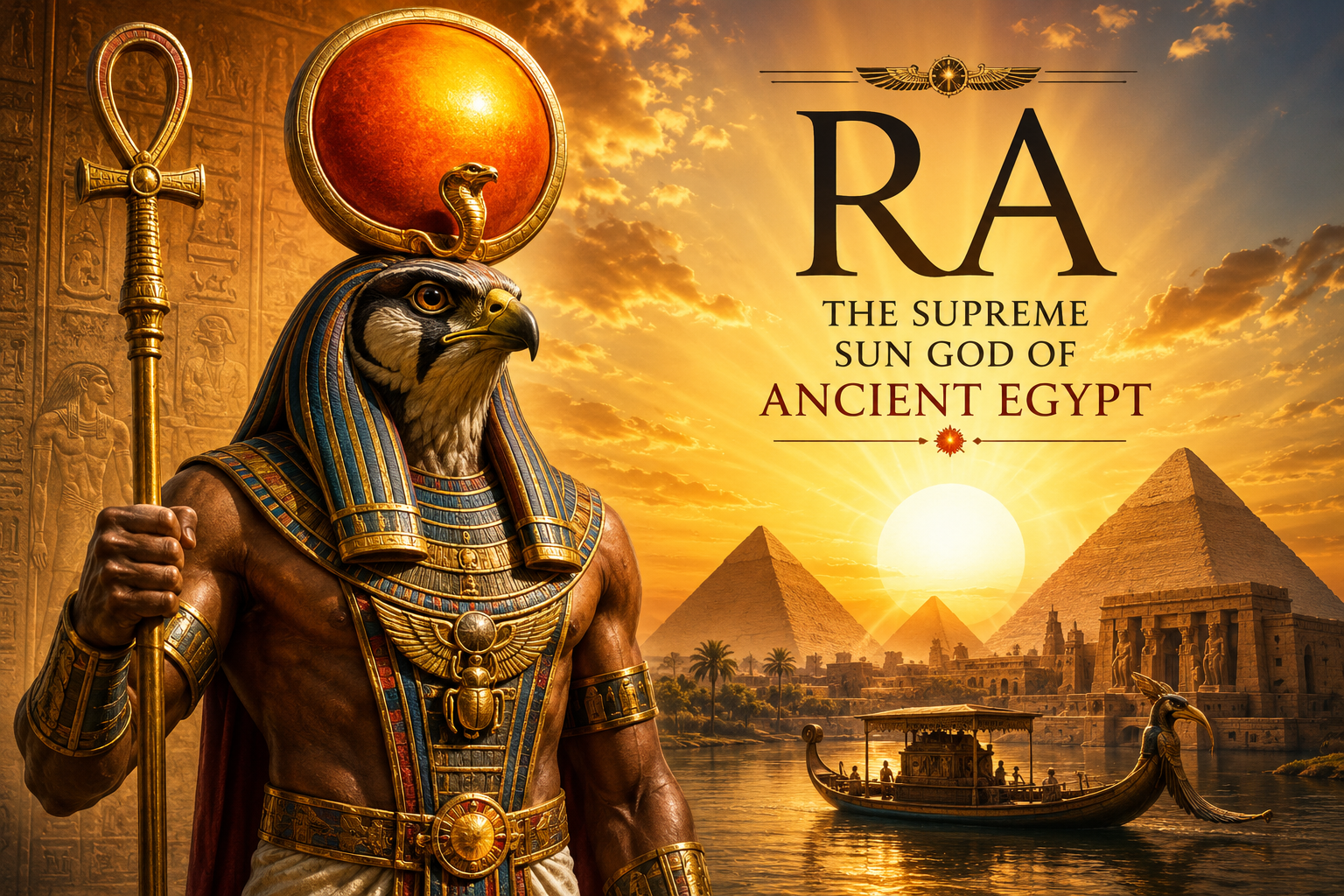
Ra was the great sun god and one of the most influential deities in Egyptian religion. The Egyptians believed he sailed across the sky each day in his solar barque, bringing light and life to the world before traveling through the underworld each night.
His defining symbol is the brilliant solar disk, often encircled by the protective uraeus cobra. The cobra represents divine authority and royal protection.
Ra is usually shown with the head of a falcon, emphasizing his dominion over the heavens. Throughout Egyptian history, many other gods became associated with Ra, including Amun-Ra and Ra-Horakhty.
How to identify Ra: A falcon-headed man crowned with a solar disk encircled by a cobra.
Sekhmet: Goddess of War and Healing
Main Symbols
- Lioness
- Solar disk
- Uraeus cobra
- Ankh
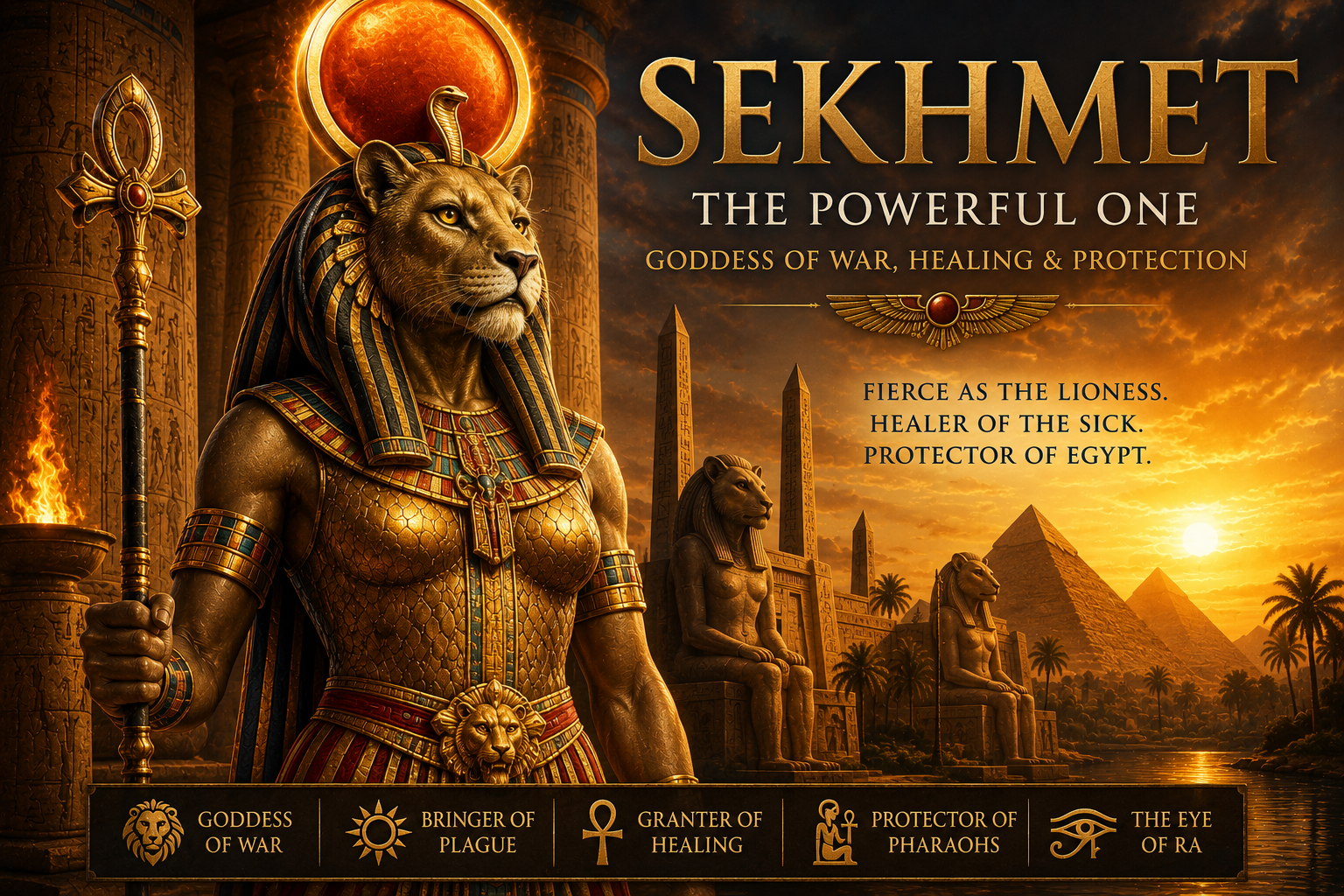
Sekhmet embodied both destructive power and healing. Egyptians believed she could unleash devastating plagues yet also cure the illnesses she inflicted.
The lioness perfectly represented her fierce nature. As one of Africa’s most formidable predators, the lioness symbolized strength, courage, and protection.
Sekhmet usually wears a solar disk with a uraeus cobra, demonstrating her close relationship with Ra. Despite her fearsome appearance, priests invoked her blessings for healing and protection throughout Egypt.
How to identify Sekhmet: A lioness-headed woman wearing a solar disk and cobra.
Set: God of Chaos and Storms
Main Symbols
- Set animal
- Was scepter
- Desert
- Lightning
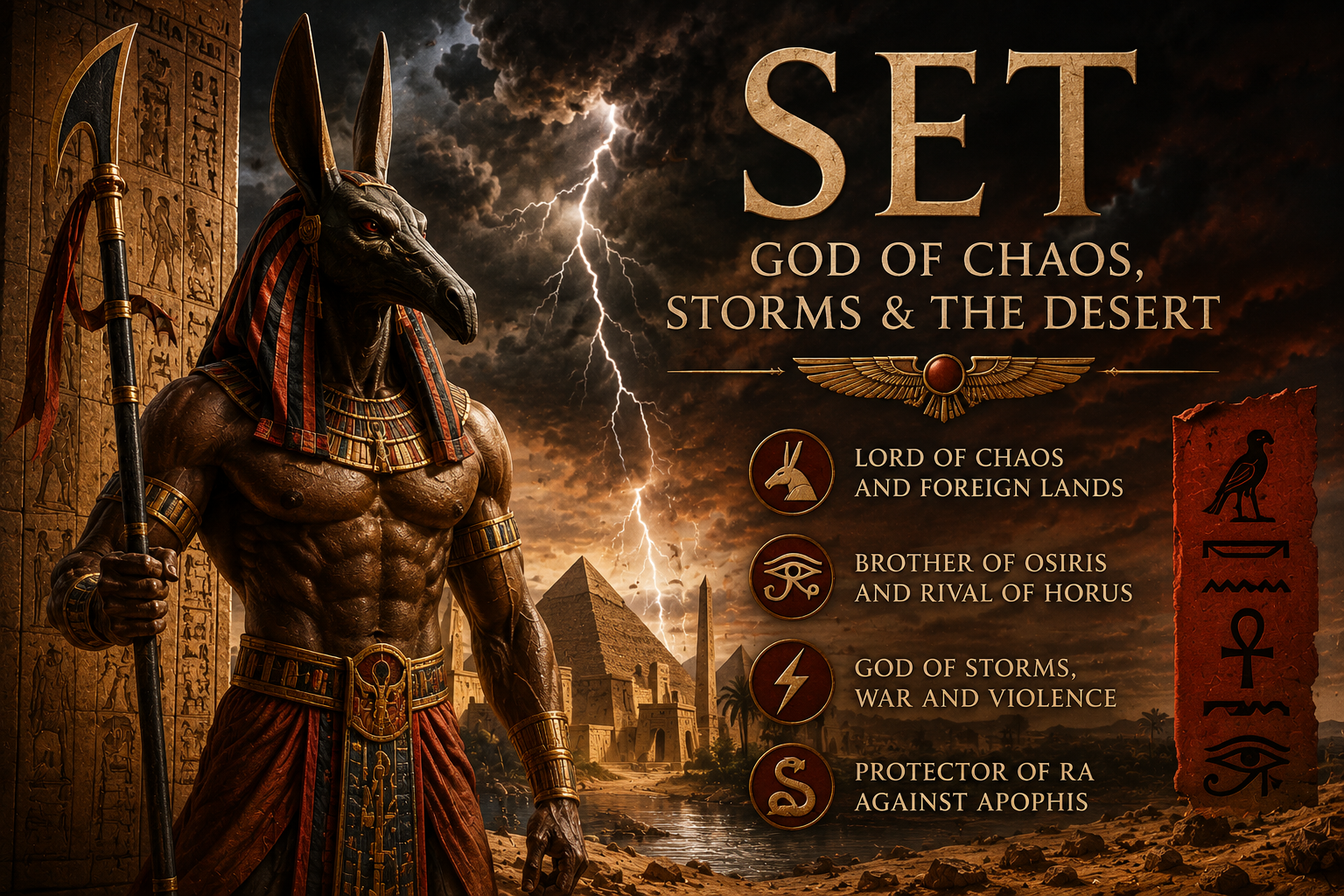
Set ruled deserts, storms, violence, and foreign lands. Although often portrayed as the villain in the Osiris myth, he also defended Ra by battling the serpent Apophis each night.
His defining symbol is the mysterious Set animal, a creature unlike any known species. With its curved snout, square ears, forked tail, and slender body, the Set animal remains one of Ancient Egypt’s greatest artistic mysteries.
Set is frequently shown carrying the was scepter, symbolizing his immense supernatural power.
How to identify Set: A man with the unmistakable head of the mysterious Set animal.
Shu: God of Air
Main Symbols
- Ostrich feather
- Upraised arms
- Lion
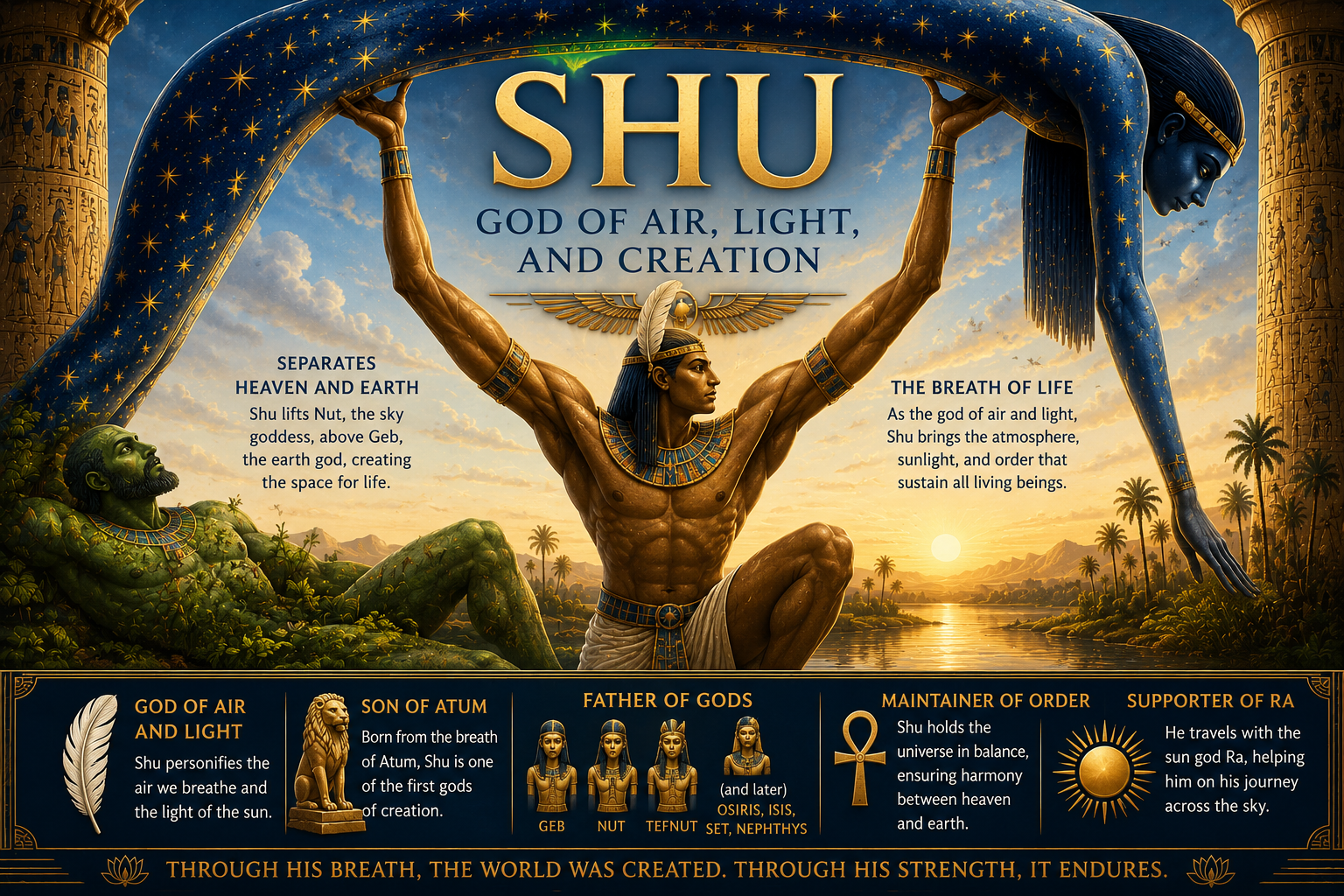
Shu personified the air and atmosphere that separated the earth from the sky. According to Egyptian creation mythology, he physically held Nut above Geb, creating the space in which life could exist.
His principal symbol is the ostrich feather, representing lightness and air. Many depictions show Shu raising both arms to support the sky goddess overhead.
Although less commonly emphasized, lions were also associated with Shu because of his strength and protective role.
How to identify Shu: A man holding the sky above his head while wearing an ostrich feather.
Sobek: God of the Nile
Main Symbols
- Crocodile
- Solar disk
- Nile water
- Ankh

Sobek embodied the strength, unpredictability, and life-giving power of the Nile River.
The crocodile served as his unmistakable symbol. Although greatly feared, crocodiles also commanded respect for their dominance within the Nile ecosystem.
Sobek often wears a solar disk with plumes, reflecting his connection with the sun god during later periods of Egyptian history.
Ancient Egyptians prayed to Sobek for military success, fertility, and protection from the dangers lurking within the Nile.
How to identify Sobek: A crocodile-headed man, often wearing a solar disk.
Tefnut: Goddess of Moisture
Main Symbols
- Lioness
- Solar disk
- Cobra
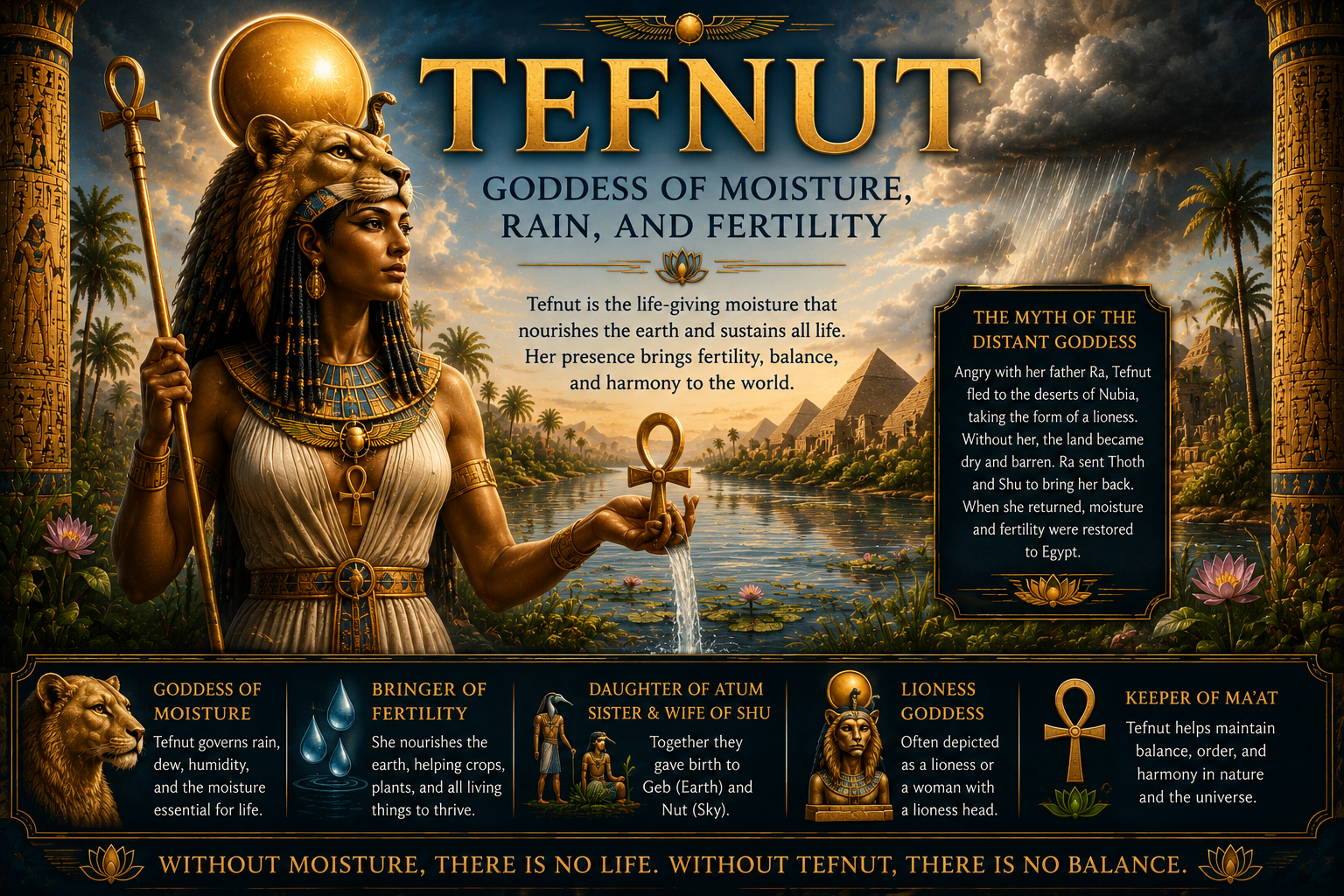
Tefnut personified moisture, dew, rain, and humidity. Together with Shu, she formed one of the first divine pairs created by Ra.
Like Sekhmet, Tefnut commonly appears as a lioness-headed woman wearing a solar disk. While Sekhmet represented destructive fire, Tefnut symbolized the moisture necessary for life.
She played a vital role in maintaining the natural balance that allowed vegetation and civilization to flourish.
How to identify Tefnut: A lioness-headed goddess wearing a solar disk, often appearing alongside Shu.
Thoth: God of Wisdom and Writing
Main Symbols
- Ibis
- Baboon
- Writing palette
- Crescent moon
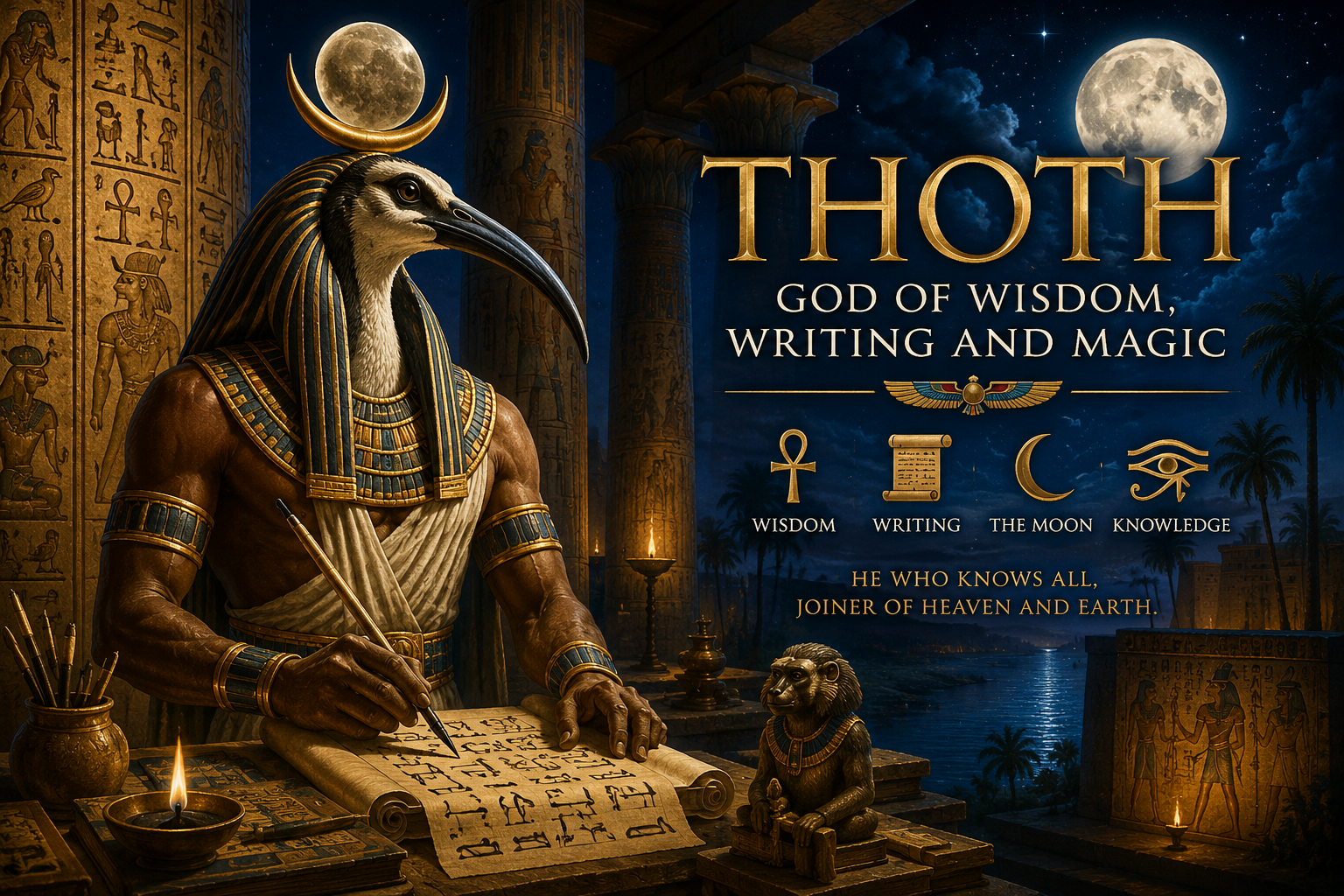
Thoth was the god of wisdom, writing, mathematics, science, and divine knowledge. Egyptian scribes regarded him as their heavenly patron.
His most recognizable symbol is the ibis, whose long curved beak resembled the shape of a scribe’s writing reed. He also appears as a baboon, an animal associated with intelligence and observation.
Thoth frequently carries a writing palette and reed pen, emphasizing his role as the inventor of hieroglyphic writing and recorder of divine judgment during the Weighing of the Heart.
Because of his association with calculating time, Thoth also maintained close ties to the moon.
How to identify Thoth: An ibis-headed man carrying a writing palette or a sacred baboon.
Common Egyptian Religious Symbols and Their Meanings
While every Egyptian god had unique attributes, many sacred symbols were shared among multiple deities. These powerful emblems represented universal concepts such as life, protection, kingship, justice, and eternity. They appear throughout Egyptian temples, tombs, jewelry, statues, and religious texts.
Understanding these symbols makes it much easier to recognize Egyptian artwork and appreciate the deeper meanings behind ancient religious scenes.
The Ankh: Symbol of Life
The ankh is undoubtedly the most recognizable symbol from Ancient Egypt. Shaped like a cross with a loop at the top, it represented life, vitality, and eternal existence.
Gods are frequently shown holding the ankh by its loop or presenting it to pharaohs, symbolizing the divine gift of life. In temple reliefs, deities sometimes hold the ankh near a king’s nose, representing the breath of life bestowed by the gods.
Because it symbolized eternal life, the ankh was also placed inside tombs and worn as an amulet to help ensure a successful journey into the afterlife.
Associated with:
- Ra
- Isis
- Osiris
- Anubis
- Amun
- Hathor
- Nearly every major deity
The Eye of Horus (Wedjat)
The Eye of Horus, also known as the Wedjat Eye, symbolizes protection, healing, restoration, and good health.
According to Egyptian mythology, Horus lost one of his eyes while battling Set for the throne of Egypt. The eye was later restored through divine magic, making it a powerful symbol of wholeness and recovery.
The Eye of Horus became one of Egypt’s most popular protective amulets. Sailors painted it on ships for safe voyages, while individuals wore it as jewelry to guard against illness and misfortune.
The symbol was also used in mathematics, where different parts of the eye represented fractional values.
Associated with:
- Horus
- Healing
- Protection
- Safe travel
- Good fortune
The Eye of Ra
Although it resembles the Eye of Horus, the Eye of Ra carries a very different meaning.
Rather than representing healing, the Eye of Ra symbolizes the sun god’s immense power, royal authority, and ability to punish the enemies of order. In mythology, Ra could send his Eye into the world as a fierce goddess such as Sekhmet or Hathor to destroy those who threatened cosmic harmony.
The Eye of Ra therefore represents both protection and divine wrath.
Today, the Eye of Horus and Eye of Ra are often confused, but they served distinct religious functions in Ancient Egypt.
Associated with:
- Ra
- Sekhmet
- Hathor
- Royal authority
- Divine protection
The Was Scepter
The was scepter represents power, authority, dominion, and divine control.
It consists of a long staff topped with the head of the mysterious Set animal and ending in a forked base. Nearly every major god carries a was scepter in temple art.
The staff symbolized a deity’s ability to govern both the natural and supernatural worlds. Pharaohs also carried versions of the was scepter to emphasize their divine authority.
Associated with:
- Amun
- Ptah
- Ra
- Set
- Numerous Egyptian gods
The Djed Pillar
The djed pillar symbolizes stability, endurance, permanence, and resurrection.
Although associated most closely with Osiris, the djed eventually became a universal symbol of strength and eternal life.
Some scholars believe the pillar originally represented a bundle of reeds, while others interpret it as the backbone of Osiris. Regardless of its exact origin, Egyptians regarded it as one of their most sacred religious symbols.
During important festivals, priests performed the Raising of the Djed, a ceremony celebrating renewal, stability, and the triumph of life over death.
Associated with:
- Osiris
- Ptah
- Resurrection
- Eternal stability
The Crook and Flail
The crook and flail became the traditional symbols of Egyptian kingship.
Originally shepherd’s tools, they came to represent the ideal qualities of a ruler.
The crook symbolized guidance and protection, while the flail represented authority, discipline, and the responsibility to provide for the people.
Osiris almost always appears holding these two symbols crossed over his chest, and pharaohs later adopted them to reinforce their legitimacy.
Associated with:
- Osiris
- Egyptian pharaohs
- Divine kingship
The Feather of Ma’at
The single ostrich feather worn by Ma’at symbolizes truth, justice, balance, and cosmic order.
No image better represents Egyptian ideas of morality.
During the judgment of the dead, each person’s heart was weighed against this feather. A heart made heavy by wrongdoing failed the test, while a heart in balance with Ma’at entered the afterlife.
Because every pharaoh was expected to uphold Ma’at, the feather appears throughout royal temples and inscriptions.
Associated with:
- Ma’at
- Justice
- Truth
- Judgment
The Shen Ring
The shen ring is a simple circle of rope with no beginning or end, representing eternity, completeness, and divine protection.
Egyptians believed anything enclosed within the ring received the gods’ protection.
Over time, the elongated form of the shen ring evolved into the royal cartouche, which enclosed the names of pharaohs to safeguard them for eternity.
Associated with:
- Ra
- Horus
- Royal names
- Eternal protection
The Scarab Beetle
The scarab beetle symbolizes rebirth, transformation, and the rising sun.
Egyptians observed scarab beetles rolling balls of dung across the ground and compared this action to the sun’s daily journey across the sky.
This behavior connected the scarab with the creator god Khepri, who represented the morning sun and continual renewal.
Scarab amulets became some of the most popular protective charms in Ancient Egypt and were often placed inside tombs.
Associated with:
- Khepri
- Rebirth
- Sunrise
- Transformation
The Lotus Flower
The blue lotus represents creation, rebirth, purity, and the rising sun.
Because lotus flowers close at night and bloom each morning, Egyptians viewed them as symbols of daily renewal.
Creation myths describe the first lotus emerging from the primordial waters before opening to reveal the infant sun god.
Lotus flowers frequently appear in temple decoration, funerary art, and royal banquets.
Associated with:
- Ra
- Nefertem
- Creation
- Rebirth
The Papyrus Plant
The papyrus plant symbolizes Lower Egypt, life, prosperity, and the fertile Nile Delta.
Papyrus provided Egyptians with writing material, boats, baskets, mats, and countless everyday objects, making it one of the civilization’s most valuable natural resources.
Artists often paired papyrus with the lotus flower to symbolize the unification of Upper and Lower Egypt.
Associated with:
- Hapi
- Lower Egypt
- Prosperity
The Uraeus Cobra
The uraeus is the rearing cobra worn on the crowns of gods and pharaohs.
It symbolizes divine kingship, protection, and royal authority.
Egyptians believed the cobra could spit fire at the king’s enemies, making it both a protective emblem and a warning to those who challenged royal power.
Many deities, including Ra, Sekhmet, Wadjet, and Isis, are shown wearing the uraeus.
Associated with:
- Ra
- Wadjet
- Sekhmet
- Egyptian pharaohs
The Solar Disk
The solar disk represents the life-giving power of the sun and the creative force of the universe.
It appears on the crowns of several Egyptian deities, including Ra, Hathor, Sekhmet, Tefnut, and Isis.
Although the disk always symbolizes divine power, the surrounding elements help identify the specific deity. Cow horns indicate Hathor or Isis, while a falcon head points to Ra.
Associated with:
- Ra
- Hathor
- Isis
- Sekhmet
- Tefnut
Why So Many Gods Share the Same Symbols
One aspect of Egyptian religion that often surprises modern readers is that many gods carry the same sacred objects.
This was intentional.
Symbols such as the ankh, was scepter, and solar disk represented universal divine powers rather than individual gods. Each deity expressed these concepts in different ways depending on their role within Egyptian mythology.
For example:
- The ankh represents life whether held by Ra, Isis, or Osiris.
- The was scepter symbolizes divine authority regardless of which god carries it.
- The solar disk always represents the sun’s creative power, even though several deities wear it.
- The cobra consistently symbolizes protection and royal legitimacy.
Instead of identifying a god by a single object, ancient Egyptians recognized deities by considering their head, crown, sacred animal, clothing, posture, and accompanying symbols together. This visual language allowed artists to depict complex religious ideas in ways that were immediately recognizable across thousands of years of Egyptian history.
How to Identify Egyptian Gods in Ancient Art
One of the easiest ways to recognize Egyptian gods is by looking at their most distinctive symbols rather than trying to read hieroglyphic inscriptions. Ancient Egyptian artists followed strict artistic conventions, so each deity was depicted consistently for centuries.
If you know what to look for, you can often identify a god within seconds.
| If you see… | It’s probably… | Why? |
|---|---|---|
| A falcon-headed man wearing the Double Crown | Horus | The falcon represents the sky and kingship. |
| A black jackal-headed figure beside a mummy | Anubis | Jackals guarded cemeteries and symbolize protection of the dead. |
| A woman with a cat’s head holding a sistrum | Bastet | Cats protected homes, while the sistrum symbolizes music and joy. |
| A lioness-headed goddess wearing a solar disk | Sekhmet | The lioness represents divine strength, war, and healing. |
| A crocodile-headed man | Sobek | Crocodiles symbolize the dangerous yet life-giving Nile. |
| A green-skinned mummiform king holding a crook and flail | Osiris | Green skin represents rebirth and vegetation. |
| A woman wearing a throne-shaped crown | Isis | The throne hieroglyph is the symbol from which Isis gets her name. |
| A man wearing two tall feathers | Amun | The double-plumed crown is unique to Amun. |
| An ibis-headed man carrying a writing palette | Thoth | The ibis and writing tools symbolize wisdom and writing. |
| A woman wearing a single ostrich feather | Ma’at | The feather represents truth, justice, and cosmic order. |
| A youthful mummy wearing a crescent moon and lunar disk | Khonsu | Lunar symbols identify the moon god. |
| A woman whose body is covered with stars | Nut | She personifies the heavens. |
| A reclining man beneath the sky goddess with a goose nearby | Geb | The goose is Geb’s sacred animal and symbolizes the earth. |
| A strange animal with a curved snout and forked tail | Set | The mysterious Set animal is unique to the god of chaos. |
| A dwarf-like figure facing forward with a lion-like face | Bes | Bes was depicted front-facing to frighten away evil spirits. |
Remember that Egyptian artists often combined several identifying features. A god’s head, crown, sacred animal, posture, and symbols all worked together to communicate their identity.
Frequently Asked Questions
What is the most famous Egyptian god symbol?
The ankh is generally considered the most famous symbol of Ancient Egypt. It represents life, eternal existence, and divine power, and is carried by many Egyptian gods and goddesses.
Which Egyptian god is represented by a falcon?
The falcon is most closely associated with Horus, the god of kingship and the sky. However, Ra also appears with a falcon’s head because of his role as the sun god.
Why do Egyptian gods have animal heads?
The animal heads were symbolic rather than literal. Each animal represented qualities associated with the deity.
For example:
- Falcons symbolized keen vision and heavenly authority.
- Jackals represented protection of cemeteries.
- Cats symbolized guardianship of the home.
- Crocodiles represented strength and the Nile.
- Lionesses embodied power and protection.
The Egyptians did not believe their gods were simply animals. Instead, animals expressed divine characteristics that humans admired or feared.
What is the difference between the Eye of Horus and the Eye of Ra?
Although they look similar, they have different meanings.
The Eye of Horus symbolizes healing, restoration, protection, and wholeness.
The Eye of Ra represents royal authority, the destructive power of the sun, and divine vengeance against the enemies of order.
Which Egyptian god carries the ankh?
Many gods carry the ankh because it represents life itself rather than belonging to one specific deity.
Gods commonly shown holding the ankh include:
- Ra
- Isis
- Osiris
- Amun
- Hathor
- Anubis
- Ptah
Which Egyptian god is shown with green skin?
Osiris is almost always shown with green or black skin.
Green symbolizes vegetation, renewal, and resurrection, while black represents the fertile soil left behind by the Nile’s annual flood. Both colors reinforce Osiris’s role as the god of rebirth and the afterlife.
Which Egyptian goddess wears cow horns?
Both Hathor and Isis are commonly shown wearing cow horns surrounding a solar disk.
Originally, this headdress belonged primarily to Hathor. During later periods of Egyptian history, Isis adopted the same crown as her worship became increasingly widespread.
Why is Anubis black?
Anubis is traditionally shown as black because black symbolized rebirth, regeneration, and the fertile soil of the Nile Valley.
Although wild jackals are brown rather than black, the color emphasized Anubis’s connection to resurrection and eternal life rather than his natural appearance.
Which Egyptian god wears the Double Crown?
Several deities appear wearing the Double Crown of Upper and Lower Egypt, including Horus, Horus the Elder, and Mut.
The crown symbolizes sovereignty over a united Egypt and is also worn by pharaohs in royal art.
What is the oldest Egyptian religious symbol?
Some of the oldest known Egyptian religious symbols include the ankh, the was scepter, the djed pillar, and the solar disk. These symbols appear throughout Egyptian history and remained important for more than three thousand years.
The Enduring Legacy of Egyptian Symbols
The symbols of Ancient Egypt remain instantly recognizable thousands of years after the last pharaoh ruled the Nile Valley. Whether carved into temple walls, painted inside royal tombs, or worn as protective amulets, these sacred images communicated ideas that lay at the heart of Egyptian civilization.
The ankh represented life. The feather of Ma’at stood for truth and justice. The Eye of Horus promised healing and protection, while the solar disk embodied the creative power of the sun. Together with the sacred animals, crowns, and ceremonial objects of the Egyptian gods, these symbols formed a visual language that conveyed complex religious beliefs without the need for words.
Even today, these ancient images continue to inspire artists, historians, archaeologists, and travelers from around the world. Learning to recognize them not only makes Egyptian art easier to understand but also offers a deeper appreciation of one of history’s most remarkable civilizations.
Whether you are exploring temple reliefs at Karnak, admiring treasures in a museum, or reading about Egyptian mythology, understanding the symbols of the gods provides a fascinating window into the beliefs, values, and imagination of the ancient Egyptians.
The next time you spot a falcon-headed king, a jackal guarding a tomb, or an ankh held in the hand of a god, you’ll know that these are far more than decorative images. They are enduring symbols of a civilization that expressed its deepest religious ideas through art that has survived for more than four millennia.