Ramesses II had more than a hundred sons, but his favorite was Prince Khaemwese, whom he appointed High Priest of Ptah at Memphis. Khaemwese was famous for his learning and his fascination with the ancient past. Even a thousand years after his death, the Egyptians were still telling stories about him, portraying him as the wisest of magicians.
One such story tells how Prince Setna Khaemwese discovered the hiding place of the Book of Thoth. The Book of Thoth contained the most powerful magic in existence, but also the most terrible dangers. Yet that did not deter the royal magician.
One day, while the royal court was at Memphis, Setna went to his father and asked permission to open one of the royal tombs in the City of the Dead. The entire court was shocked by such a request, but Setna explained that the Book of Thoth was hidden in the tomb of Prince Neferkaptah.
Pharaoh tried hard to persuade his son to abandon such a reckless plan, but when he saw that Setna was determined, he reluctantly gave permission. Ramesses knew that he could not protect his son forever and that Setna would have to learn respect for the powers of the dead.
Setna asked Anhurerau, the bravest of his younger brothers, to accompany him, and together they led a gang of workmen into the City of the Dead.
When they reached the ancient tomb of Neferkaptah, the workmen shoveled away the sand that had drifted against the entrance. Gradually, a wooden door was revealed. Setna broke the seals and ordered the workmen to hack through the ancient wood. Reluctantly, they obeyed.
After only a few blows, the rotten wood crumbled away, and the tomb stood open.
Setna and Anhurerau waited for several minutes to allow fresh air to seep into the tomb before a torch was lit. None of the workmen would enter the black doorway, so the two brothers went in alone, Anhurerau carrying the torch and Setna walking a pace ahead.
They proceeded cautiously down a narrow passageway and through a shadowy hall carved with scenes from Prince Neferkaptah’s funeral. Beyond lay a maze of twisting corridors and small chambers.
As they ventured deeper into the tomb, the stale air and oppressive heat became suffocating. Anhurerau’s torch barely penetrated the darkness, and all around them came rustlings and scratchings.
“It’s only bats,” Setna whispered, trying to reassure his brother.
But his voice echoed through the tomb and, above them, dozens of bats suddenly erupted into flight. As Anhurerau ducked, the beating of their wings extinguished his torch and darkness swallowed them.
Setna froze. They would have to retreat if only he could remember the way. There was no use shouting for help. None of the workmen would dare enter the tomb.
Suddenly, Anhurerau gripped his brother’s arm.
“Look!”
Ahead of them glowed a faint light. As the brothers moved toward it, the glow steadily brightened. They crept around a corner and found themselves staring into the burial chamber itself.
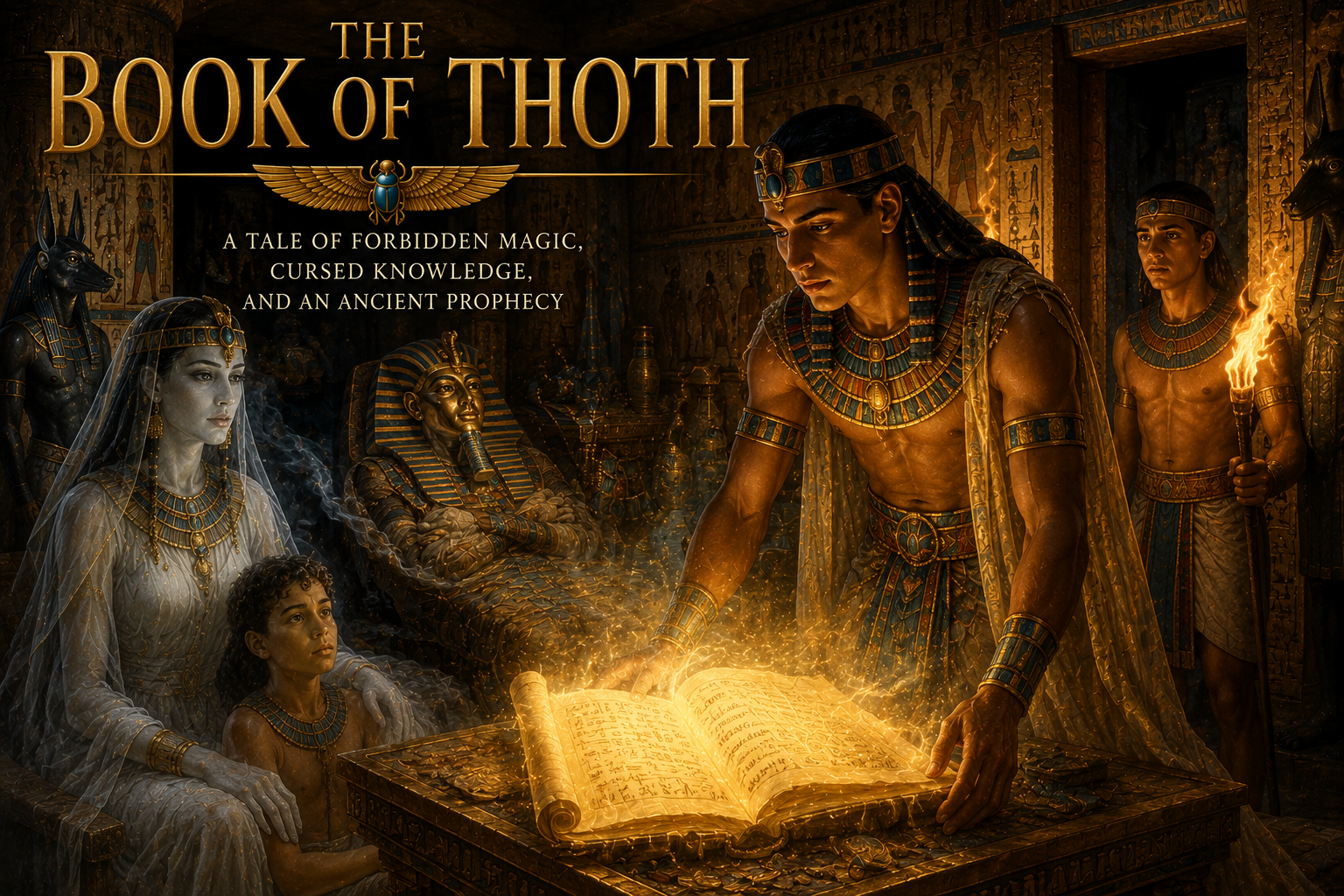
The room was crammed with treasures: ebony thrones, alabaster vases, stools draped with leopard skins, and ivory caskets. Upon a golden couch lay the mummy of Neferkaptah, wrapped in fine linen and covered by a glittering mask.
Beside the couch sat a beautiful woman, pale as a white lotus, with a little boy huddled at her feet.
Light streamed from a scroll of papyrus resting upon a table nearby, and Setna knew immediately that he was gazing upon the Book of Thoth.
Anhurerau trembled in the doorway, but Setna boldly stepped into the chamber and saluted the lady.
The hand she raised in greeting was almost transparent, yet her voice was low and sweet.
“Setna Khaemwese, why do you disturb the rest of the dead?”
“If you will give me the Book of Thoth,” Setna replied, trying not to reveal his fear, “I will leave you in peace.”
The lovely lady shook her head.
“Setna, if you take the Book of Thoth, it will bring you nothing but disaster. I can see from your face that you do not believe me. Therefore, I shall tell you my story, and then you will understand the danger.”
“My name is Ahwere. I was the only daughter of the King of Upper and Lower Egypt, and I loved my brother Neferkaptah more than anything in the world. We married, and a splendid feast was held in our honor. Before long, a son was born to us, and we named him Merib.”
Ahwere reached down to touch the little boy beside her, and he smiled as though awakening from a dream.
“My husband was very much like you, Setna. He loved to wander among the tombs and temple libraries, studying ancient texts. Although he was already a skilled magician, he was always searching for more powerful spells.
“One day, while attending a festival in the temple of Ptah, Neferkaptah overheard an old priest laughing at him.
“‘Why do you laugh at me?’ my husband demanded.
“‘I laugh because you waste your time reading such trivial spells,’ replied the old priest. ‘I know where a book written by Thoth himself is hidden.’
“The priest then described the extraordinary powers contained within the book and explained that it lay hidden near Coptos, sealed inside seven nested boxes and guarded by deadly serpents and scorpions.
“Although I begged Neferkaptah not to seek the book, he would not listen. His mind was consumed by it.”
Ahwere sighed sadly.
“The king provided us with a magnificent ship, and together with our son Merib, we sailed south to Coptos. There, my husband fashioned a crew from pure wax, brought them to life with magic, and sent them to row our ship to the place where the Book of Thoth was hidden.
“At last, we reached the correct place in the river. Neferkaptah parted the waters and descended to the riverbed. There he confronted countless snakes and scorpions, and finally a gigantic serpent that no spell could bind.
“Three times he cut the serpent in half, and three times it rejoined itself. At last, inspired by desperation, he threw sand between the severed halves. Unable to rejoin, the serpent died.
“Neferkaptah then opened the seven boxes and found the Book of Thoth.
“He read the first spell and understood the speech of every creature. Then he dared to read the second spell and saw the Sun, Moon, stars, and gods in their true forms.
“But Thoth was furious that his sacred book had been stolen. He appealed to Ra, and Ra decreed that we would never safely return to Memphis.
“First, our son Merib drowned. Then I, too, was claimed by the Nile. Finally, overcome with grief, Neferkaptah bound the Book of Thoth to his body and cast himself into the river.
“Our bodies were eventually returned to Memphis and buried in this tomb. The Book of Thoth cost us our lives, Setna. It can never be yours.”
Setna was deeply shaken by Ahwere’s tale, yet the radiance of the Book of Thoth dazzled him.
“Give me the book,” he insisted, “or I shall take it by force.”
At those words, the mummy of Neferkaptah slowly sat upright, and a voice emerged from behind the golden mask.
“Setna Khaemwese, if you refuse to heed Ahwere’s warning, then take the Book of Thoth if you can. Or perhaps you would prefer to play a game of draughts with me. If you win, the book shall be yours.”