Ancient Egypt was one of the longest-lasting and most successful civilizations in human history. The civilization emerged around 3100 BC with the unification of Upper and Lower Egypt and continued for more than 3,000 years until the Roman period.
Because ancient governments did not conduct modern censuses, determining exactly how many people lived in Ancient Egypt is impossible. Nevertheless, archaeologists, historians, and demographers have developed methods to estimate Egypt’s ancient population by studying settlement sizes, agricultural capacity, tax records, and archaeological remains.
Although the exact numbers remain uncertain, experts generally agree that Ancient Egypt supported millions of people at its peak.
Why Is It Difficult to Estimate Ancient Egypt’s Population?
Estimating the population of Ancient Egypt presents several challenges.
Unlike modern nations, Ancient Egypt did not maintain detailed population records covering the entire country. While some local tax and census records survive, they provide only a partial picture.
In addition, the population fluctuated dramatically over time due to factors such as:
- Floods and droughts
- Famine
- Disease outbreaks
- Warfare and invasions
- Political instability
- Immigration and trade
- Territorial expansion
As a result, the population of Ancient Egypt varied considerably from one period to another.
Population Estimates by Historical Period
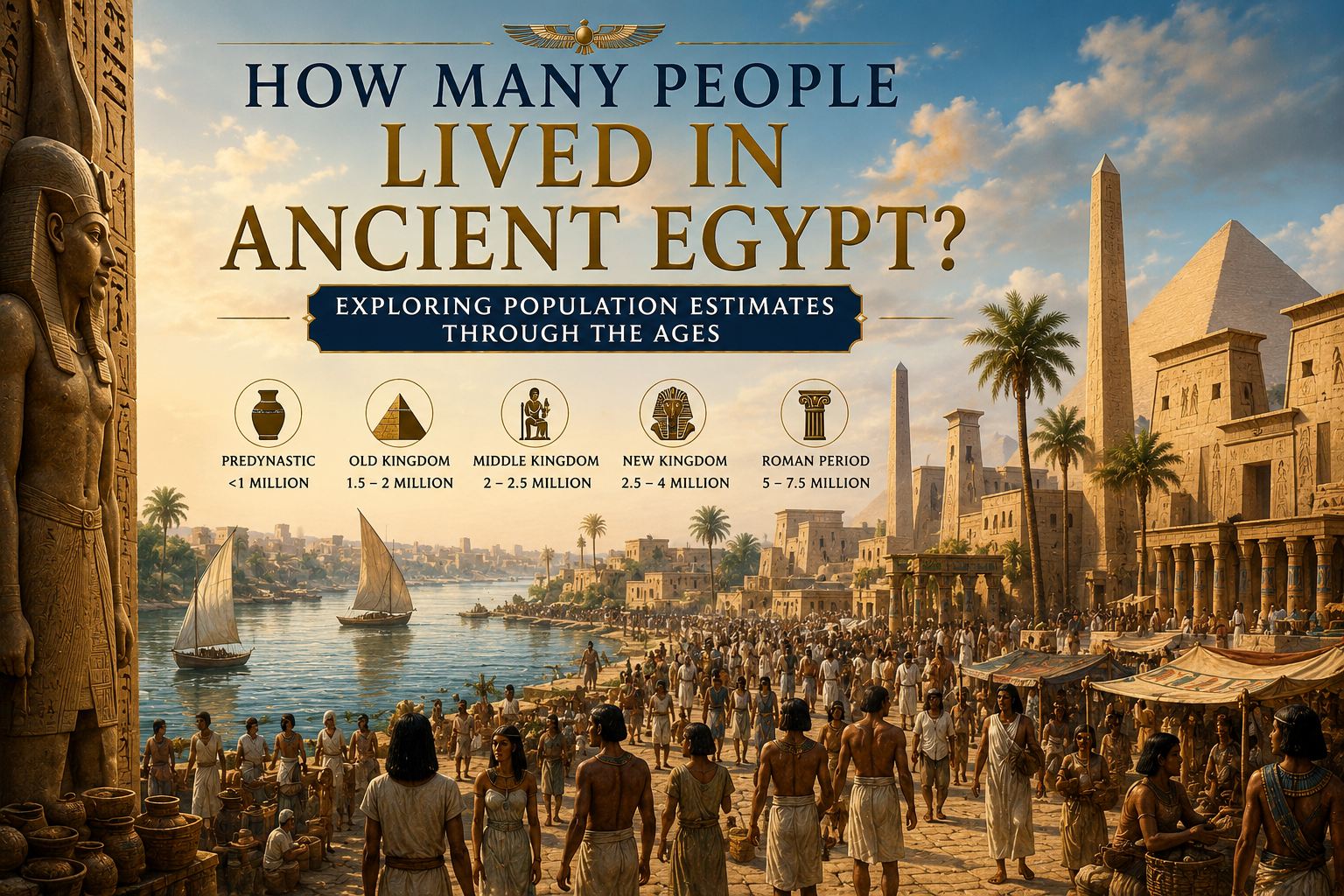
Although scholars disagree on exact figures, most estimates suggest the following approximate populations:
| Historical Period | Approximate Population |
|---|---|
| Predynastic Period (c. 6000-3100 BC) | 500,000 to 1 million |
| Early Dynastic Period (c. 3100-2686 BC) | Around 1 million |
| Old Kingdom (c. 2686-2181 BC) | 1.5 to 2 million |
| Middle Kingdom (c. 2055-1650 BC) | 2 to 2.5 million |
| New Kingdom (c. 1550-1069 BC) | 2.5 to 4 million |
| Late Period (c. 664-332 BC) | 3 to 5 million |
| Ptolemaic and Roman Egypt (332 BC-AD 395) | 5 to 7.5 million |
These figures are estimates and continue to be revised as new archaeological evidence emerges.
Three Experts on the Population of Ancient Egypt
Guillemette Andreu
French Egyptologist Guillemette Andreu estimated that Egypt’s population reached approximately 2 million people by around 1800 BC during the Middle Kingdom.
Karl Butzer
Geographer and archaeologist Karl Butzer suggested that Ancient Egypt had a population of roughly 1 million people during the Predynastic and Early Dynastic periods. According to his estimates, the population grew to between 2.5 and 3 million people during the New Kingdom.
Butzer also argued that Egypt’s population continued to grow during the Greco-Roman period, eventually surpassing 5 million.
David O’Connor
Egyptologist David O’Connor estimated that Egypt’s population during the New Kingdom ranged between approximately 2.9 and 4 million people.
He further suggested that the population may have reached as many as 7.5 million people during the Ptolemaic and Roman periods.
Factors That Affected Population Growth
The Nile River
The Nile River was by far the most important factor influencing population growth in Ancient Egypt.
Virtually all Egyptian settlements were located along the Nile because the river provided:
- Fresh drinking water
- Fertile farmland
- Fish and wildlife
- Transportation routes
- Trade opportunities
Each year, the Nile flooded and deposited nutrient-rich silt along its banks. This fertile soil allowed Egyptian farmers to grow abundant crops and support a large population despite living in an otherwise harsh desert environment.
It is no coincidence that nearly all major Egyptian cities developed along the Nile Valley and the Nile Delta.
Agriculture and Food Production
Ancient Egypt’s ability to produce food directly determined how many people the land could support.
During years of good harvests, the population generally increased. However, periods of poor flooding often led to crop failures, famine, and population decline.
Some historians believe that prolonged droughts contributed to the collapse of the Old Kingdom around 2200 BC.
Warfare and Conquest
Military campaigns also influenced population growth.
As Egypt expanded its empire during the New Kingdom, conquered peoples were sometimes brought back to Egypt as prisoners, laborers, or slaves. Foreign merchants, diplomats, and craftsmen also settled in Egyptian cities, increasing the population.
At the same time, wars could devastate local communities and reduce population levels.
Disease and Epidemics
Like all ancient civilizations, Egypt suffered from disease outbreaks.
Limited medical knowledge meant that illnesses could spread rapidly, especially in densely populated cities. Malnutrition and poor harvests could further weaken the population and increase mortality rates.
Although Ancient Egyptian medicine was remarkably advanced for its time, epidemics still posed a major threat.
Population During the Roman Period
Egypt experienced significant population growth during the Greek and Roman periods.
After Alexander the Great conquered Egypt in 332 BC, the country entered the Ptolemaic Period, followed by Roman rule beginning in 30 BC.
Large cities such as Alexandria became major centers of trade, culture, and learning. Increased trade and improved administration likely contributed to population growth.
Many historians estimate that Egypt’s population may have reached between 5 and 7.5 million people during this period, making it one of the most populous regions in the ancient Mediterranean world.
Where Did Most Egyptians Live?
The overwhelming majority of Ancient Egyptians lived within a few kilometers of the Nile River.
Modern estimates suggest that more than 95 percent of the population lived in the Nile Valley and Delta, while the surrounding deserts remained sparsely inhabited.
Most people lived in small farming villages, although major urban centers such as Memphis, Thebes, and Alexandria housed tens of thousands, or even hundreds of thousands, of inhabitants.
No one knows exactly how many people lived in Ancient Egypt. However, most experts agree that the population grew from fewer than one million people during the Predynastic Period to as many as 7.5 million during the Greek and Roman periods.
As archaeological discoveries continue and new technologies become available, historians will likely refine these estimates even further. For now, Ancient Egypt remains one of the most populous and successful civilizations of the ancient world.