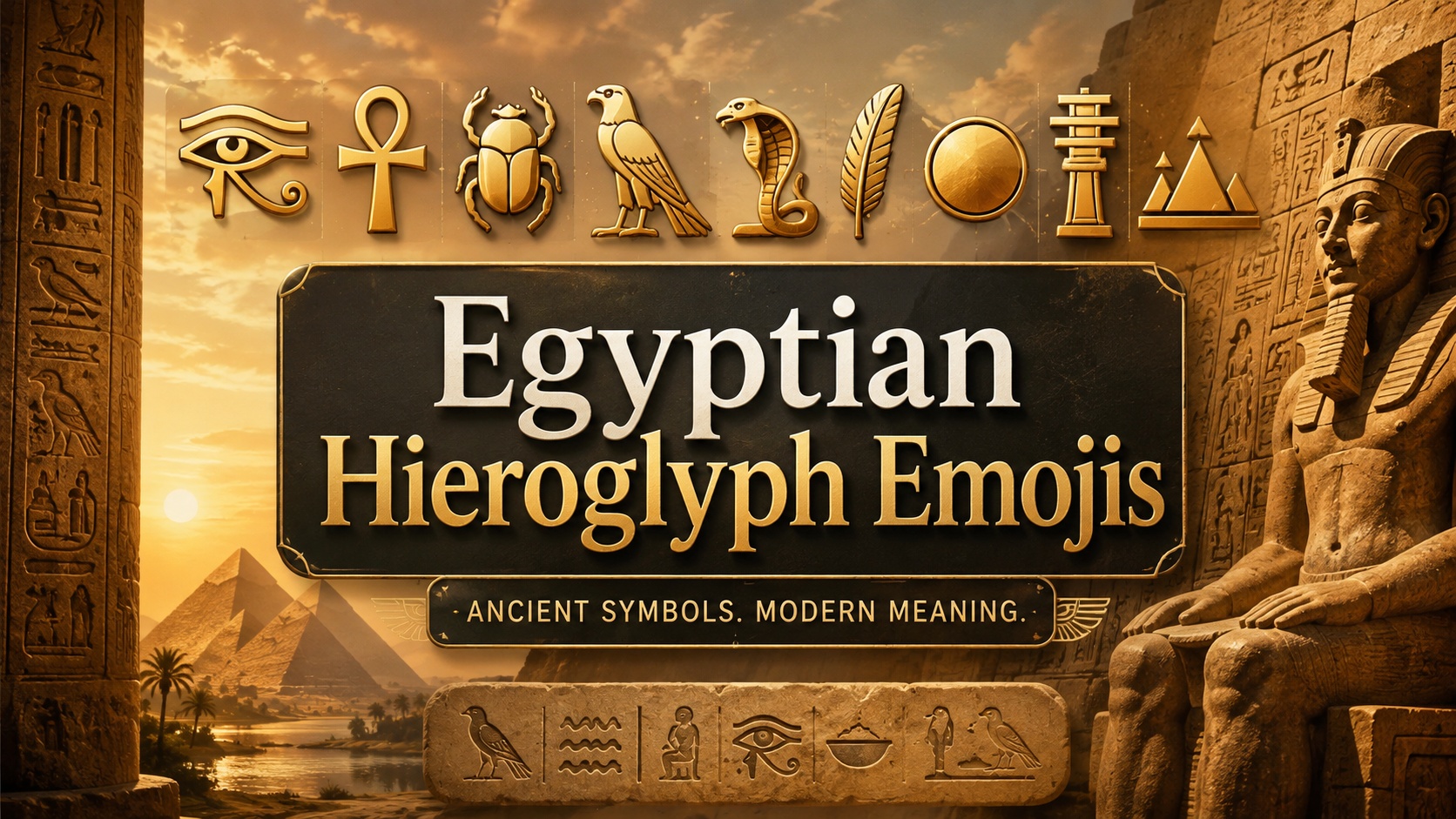
Looking for Egyptian hieroglyph emojis that you can copy and paste?
Although there is no complete set of ancient Egyptian emojis, Unicode includes hundreds of genuine Egyptian hieroglyphic characters. These symbols can be copied into social media posts, usernames, captions, messages, documents, and website content.
Some of the most popular Egyptian symbols include:
𓂀 𓋹 ☥ 𓆣 𓅃 𓆗 𓆄 𓊽 𓇳 𓉴
You can copy any symbol on this page and paste it into a message, document, social media post, or profile.
On an iPhone or iPad: Press and hold the symbol until the selection menu appears. Adjust the selection handles if necessary, then tap Copy. Press and hold where you want to place the symbol and tap Paste.
On an Android phone or tablet: Press and hold the symbol, adjust the selection handles if needed, and tap Copy. Press and hold inside the destination text field and select Paste.
On a Windows computer: Highlight the symbol with your mouse, then right-click and select Copy. You can also press Ctrl + C. To paste it, right-click and select Paste or press Ctrl + V.
On a Mac: Highlight the symbol, then right-click and select Copy, or press Command + C. To paste it, press Command + V.
Egyptian Hieroglyph Emojis to Copy and Paste
These characters may look like emojis, but most are Egyptian hieroglyphs encoded as Unicode characters. Here is a quick collection of popular ancient Egyptian symbols:
𓂀 𓋹 ☥ 𓆣 𓅃 𓆗 𓆄 𓊽 𓇳 𓉴 𓉶 𓁐 𓀭 𓆌 𓃯 𓆸 𓇽 𓊛 𓏞
Are Egyptian Hieroglyphs Really Emojis?
Technically, Egyptian hieroglyphs and emojis are not the same thing.
An emoji is a character designed for modern digital communication, often displayed as a colorful image. Egyptian hieroglyphs are characters from an ancient writing system that have been added to Unicode so they can be represented digitally.
Unicode contains a dedicated Egyptian Hieroglyphs block beginning at U+13000. It also provides special formatting controls that allow supported software to arrange hieroglyphs horizontally, vertically, or within traditional grouped compositions.
However, most people searching for “Egyptian hieroglyph emojis” simply want ancient Egyptian symbols they can copy and paste. For that reason, this guide includes both genuine emojis and Unicode hieroglyphs.
Popular Egyptian Symbols and Their Meanings
𓂀 Eye of Horus
Copy: 𓂀
The Eye of Horus, also known as the Wedjat or Wadjet Eye, is one of the most recognizable symbols from ancient Egypt.
It was associated with protection, healing, restoration, royal power, and well-being. According to Egyptian mythology, the god Horus lost or injured his eye during his conflict with Seth. The restored eye became a symbol of healing and completeness.
People commonly use 𓂀 in spiritual posts, protective messages, jewelry designs, usernames, and content about ancient Egypt.
𓋹 Ankh
Copy: 𓋹
The ankh represented life and was closely associated with divine power and eternal existence.
Egyptian gods were frequently shown holding an ankh or extending it toward the nose of a king, symbolically giving him the breath of life.
A similar modern symbol is:
☥
Although ☥ resembles an ankh and is often used as one, it belongs to a different Unicode symbol category. Both versions are commonly used online to represent ancient Egypt, life, spirituality, and immortality.
𓆣 Scarab Beetle
Copy: 𓆣
The scarab was associated with Khepri, the god connected with the rising sun.
Ancient Egyptians observed scarab beetles rolling balls across the ground and connected this behavior with the movement of the sun across the sky. Scarab amulets became symbols of transformation, renewal, protection, and rebirth.
𓅃 Horus Falcon
Copy: 𓅃
The falcon was closely associated with Horus, the god of the sky and divine kingship.
Horus was commonly represented as a falcon or as a man with a falcon’s head. The reigning pharaoh was considered the earthly embodiment of Horus, making the falcon a powerful symbol of royalty, authority, and protection.
𓆗 Cobra
Copy: 𓆗
The upright cobra is often associated with the uraeus, a royal emblem worn on the forehead of Egyptian kings and some deities.
It represented divine protection, royal authority, and the destructive power of the gods against their enemies. The uraeus was particularly associated with Wadjet, the cobra goddess of Lower Egypt.
𓆄 Feather
Copy: 𓆄
The feather is commonly associated with Ma’at, the ancient Egyptian principle and goddess of truth, justice, balance, and cosmic order.
In the judgment of the dead, a person’s heart was weighed against the feather of Ma’at. A balanced heart showed that the deceased had lived in accordance with order and truth.
𓊽 Djed Pillar
Copy: 𓊽
The djed pillar represented stability, endurance, and continuity.
It became closely associated with Osiris and was sometimes interpreted as the backbone of the god. Raising the djed was an important ritual symbolizing the restoration of order and the renewal of royal power.
𓇳 Sun Disk
Copy: 𓇳
The sun disk represented the sun, daylight, and solar power.
The sun was central to Egyptian religion and was associated with gods such as Ra, Aten, and Ra-Horakhty. Solar symbols could represent creation, divine kingship, rebirth, and the daily renewal of the world.
𓉴 Pyramid
Copy: 𓉴
This hieroglyph represents a pyramid.
Pyramids were monumental royal tombs constructed to support the king’s transformation and continued existence after death. Today, the pyramid is one of the most widely recognized symbols of ancient Egypt.
𓉶 Obelisk
Copy: 𓉶
The obelisk was a tall stone monument associated with the sun.
Its pointed top may have represented a ray of sunlight or the sacred benben stone connected with Egyptian creation traditions. Obelisks were commonly erected in pairs at the entrances of temples.
Egyptian God and Goddess Symbols
𓀭 Seated God
Copy: 𓀭
This seated divine figure was used in writing as a determinative connected with male gods or divine beings.
A determinative was a hieroglyph placed near the end of a word to help identify its meaning. It was not normally pronounced.
𓁐 Seated Goddess
Copy: 𓁐
This seated female figure could identify the name or title of a goddess.
It may be useful in modern posts about Isis, Hathor, Sekhmet, Nephthys, Nut, Ma’at, Bastet, and other Egyptian goddesses, although the character does not represent one specific goddess by itself.
𓆌 Crocodile
Copy: 𓆌
The crocodile was associated with Sobek, a powerful god linked with the Nile, fertility, military strength, protection, and royal authority.
Crocodiles were dangerous animals, but their strength also made them suitable symbols of divine power.
𓃯 Hippopotamus
Copy: 𓃯
The hippopotamus had both protective and dangerous associations in ancient Egypt.
Female hippopotamus imagery was connected with Taweret, a protective goddess of pregnancy and childbirth. Male hippopotami could represent danger, disorder, or the enemies of the gods.
𓆃 Vulture
Copy: 𓆃
The vulture was associated with Nekhbet, the protective goddess of Upper Egypt.
Nekhbet was one of the Two Ladies who protected the king and represented the united lands of Egypt. Vulture imagery could also symbolize motherhood and divine protection.
Egyptian Animal Hieroglyphs
Copy and paste these ancient Egyptian animal symbols:
| Symbol | Common identification | Association |
|---|---|---|
| 𓅃 | Falcon | Horus, kingship and the sky |
| 𓆃 | Vulture | Nekhbet, protection and Upper Egypt |
| 𓆌 | Crocodile | Sobek, strength and the Nile |
| 𓃯 | Hippopotamus | Taweret, protection or dangerous power |
| 𓆗 | Cobra | Royalty and divine protection |
| 𓆙 | Viper | A phonetic sign representing a consonant sound |
| 𓆣 | Scarab | Khepri, transformation and rebirth |
| 𓆟 | Fish | Nile life and regeneration |
| 𓅭 | Goose | Birds, offerings and divine associations |
| 𓃒 | Bull | Strength, fertility and royal power |
| 𓃝 | Ram | Khnum, Amun and creative power |
| 𓃹 | Hare | A phonetic sign used in Egyptian writing |
The meaning of a hieroglyph depends on how it is used. A sign might represent an object, convey a sound, clarify the category of a word, or perform several of these functions in different contexts.
Egyptian Plant and Nature Symbols
𓆸 Lotus Flower
Copy: 𓆸
The lotus was associated with creation, rebirth, beauty, and the sun.
Because the flower closes at night and opens again during the day, Egyptians connected it with solar renewal and regeneration.
𓇅 Papyrus Stem
Copy: 𓇅
Papyrus grew abundantly in the marshes of the Nile Delta.
It became associated with Lower Egypt, fertility, vegetation, youth, and flourishing life. Papyrus was also used to make writing material, ropes, baskets, sandals, and boats.
𓇚 Palm Branch
Copy: 𓇚
Palm branches were associated with time and the counting of years.
Deities connected with time and royal jubilees were sometimes shown holding notched palm ribs representing long life and the passage of years.
𓇽 Star
Copy: 𓇽
The star sign could represent stars, constellations, nighttime, and the celestial realm.
The ancient Egyptians carefully observed the night sky. Stars were connected with calendars, temple orientation, religious rituals, and beliefs about the afterlife.
𓇹 Crescent Moon
Copy: 𓇹
The crescent moon represented lunar cycles, months, nighttime, and lunar deities.
Moon gods included Khonsu and Iah, while Thoth also had strong lunar associations.
𓈗 Water
Copy: 𓈗
This pattern represents rippling water.
It was also an important phonetic sign generally transliterated as n. Its appearance in a word does not always mean that the word is specifically about water.
Egyptian Royal Crowns and Clothing
Copy these symbols connected with Egyptian royalty and ceremonial dress:
| Symbol | Description |
|---|---|
| 𓋖 | White Crown associated with Upper Egypt |
| 𓋗 | Red Crown associated with Lower Egypt |
| 𓋘 | Combined Double Crown |
| 𓋚 | Atef-style crown |
| 𓋙 | Blue Crown or khepresh |
| 𓋛 | Royal headdress |
| 𓋜 | Broad collar or pectoral |
| 𓋦 | Kilt or garment |
| 𓋲 | Sandal |
The exact visual appearance of these characters can vary by font and device.
Egyptian Weapons and Military Symbols
| Symbol | Description |
|---|---|
| 𓌽 | Shield |
| 𓌿 | Curved weapon |
| 𓌗 | Bow |
| 𓌙 | Throwing stick |
| 𓌏 | Harpoon |
| 𓌦 | Mace |
| 𓋤 | Quiver |
Weapons in Egyptian art could represent warfare, hunting, royal strength, divine victory, or the defeat of disorder.
Egyptian Boats and Travel Symbols
𓊛 Boat
Copy: 𓊛
Boats were essential for transportation, trade, fishing, warfare, ceremonies, and funerals.
The Nile acted as Egypt’s primary transportation route. Boats also had religious importance because gods traveled in sacred barks and the sun god crossed the sky in a solar vessel.
Other boat-related characters include:
𓊜 𓊝 𓊟 𓊡 𓊤
These can represent different vessels, a sail, or an oar.
Egyptian Writing and Tool Symbols
𓏞 Scribe’s Palette
Copy: 𓏞
The scribal palette represented writing and the profession of the scribe.
Egyptian scribes used reed brushes and pigments, commonly black and red, to write on papyrus, wood, pottery, linen, and other surfaces.
𓍛 Adze
Copy: 𓍛
An adze was a woodworking tool. A ritual adze was also used during the Opening of the Mouth ceremony, which was intended to restore the deceased person’s ability to breathe, speak, see, hear, and receive offerings.
𓌪 Chisel or Cutting Tool
Copy: 𓌪
Cutting tools were essential to craftspeople who carved statues, reliefs, temple inscriptions, tomb decorations, and monumental hieroglyphs.
Egyptian Food and Drink Symbols
| Symbol | Common identification |
|---|---|
| 𓏏 | Loaf of bread |
| 𓏐 | Bread or offering loaf |
| 𓃾 | Meat |
| 𓅰 | Prepared bird |
| 𓇄 | Vegetable bundle |
| 𓎺 | Bowl or vessel |
Bread and beer were staples of the Egyptian diet. Food signs also appeared in offering lists created to provide nourishment for gods and the dead.
Egyptian Number Symbols
Ancient Egyptians used different hieroglyphs for powers of ten.
| Symbol | Number |
|---|---|
| 𓏲 | 100 |
| 𓆼 | 1,000 |
| 𓂭 | 10,000 |
| 𓆾 | 100,000 |
| 𓀼 | 1,000,000 |
The symbol for one million shows a person with raised arms. It could also suggest an extremely large or countless quantity.
Hieroglyphs Used as Sounds
Egyptian hieroglyphs were not simply pictures standing for complete ideas. Many signs represented consonant sounds.
Here are several commonly taught one-consonant signs:
| Symbol | Transliteration | Approximate value |
|---|---|---|
| 𓄿 | ꜣ | A consonant often simplified as A |
| 𓇋 | i | I or Y |
| 𓂝 | ꜥ | A deep throat consonant |
| 𓅱 | w | W or U |
| 𓃀 | b | B |
| 𓊪 | p | P |
| 𓆑 | f | F |
| 𓅓 | m | M |
| 𓈖 | n | N |
| 𓂋 | r | R |
| 𓉔 | h | H |
| 𓎛 | ḥ | Emphatic H |
| 𓐍 | ḫ | Kh |
| 𓄡 | ẖ | A softer Kh |
| 𓋴 | s | S |
| 𓊃 | z | Z or S |
| 𓈙 | š | Sh |
| 𓈎 | q | Q |
| 𓎡 | k | K |
| 𓎼 | g | G |
| 𓏏 | t | T |
| 𓍿 | ṯ | Tj or Ch |
| 𓂧 | d | D |
| 𓆓 | ḏ | Dj or J |
These are approximations. Ancient Egyptian pronunciation changed over thousands of years, and many of its consonants do not correspond perfectly to modern English sounds.
Modern Emojis Associated With Ancient Egypt
A small number of ordinary emojis can be used to represent Egyptian gods, animals, objects, or natural forces.
| Emoji | Possible Egyptian association |
|---|---|
| ☀️ | Ra, Aten or the sun |
| 🐈⬛ | Bastet and domestic cats |
| 🦁 | Sekhmet or royal power |
| 🪶 | Ma’at and the weighing of the heart |
| 🐊 | Sobek |
| 🐍 | Wadjet, uraeus or serpent deities |
| 🪲 | Scarabs and Khepri |
| 🦅 | Horus, Nekhbet or sacred birds |
| 🌙 | Khonsu, Iah or lunar religion |
| ⭐ | The night sky and celestial afterlife |
| 🏺 | Egyptian pottery, offerings or canopic containers |
| ⚖️ | Judgment and the balance of Ma’at |
| 👁️ | The Eye of Horus or Eye of Ra |
| 🔥 | Sekhmet, divine wrath or solar heat |
| ⛵ | Nile travel or a sacred bark |
These are modern associations rather than literal translations of ancient Egyptian writing.
Egyptian Emoji Combinations
Here are a few combinations for captions, bios, and social media posts.
Ancient Egypt
𓂀 𓋹 𓆣 𓇳
Protection
𓂀 𓆗 𓋹
Life and Rebirth
𓋹 𓆣 𓆸
Ma’at and Justice
𓆄 ⚖️ 𓋹
Horus
𓅃 𓂀 ☀️
Bastet
🐈⬛ 𓋹 🌙
Sekhmet
🦁 ☀️ 🔥
Sobek
🐊 𓆌 𓋹
Osiris
𓊽 𓆣 𓋹
Egyptian Royalty
𓆗 𓋘 𓅃
The Nile
𓈗 𓊛 𓇳
Egyptian Afterlife
𓂀 𓊽 𓇽 𓋹
How to Copy and Paste Egyptian Hieroglyphs
To use one of the symbols:
- Highlight the hieroglyph you want.
- Select Copy.
- Open your social media app, document, message, or profile.
- Select Paste.
On a phone, press and hold the symbol until the copy option appears.
Why Can’t I See Some Egyptian Hieroglyphs?
Not every operating system, browser, website, or font displays Egyptian hieroglyphs correctly.
A symbol may appear as:
- An empty square
- A rectangle containing an X
- A question mark
- A blank space
- A simplified black-and-white character
This usually means the device or application does not have a font that supports that Unicode character.
Unlike most familiar emojis, Egyptian hieroglyphs are generally rendered as monochrome text characters. Their shape and level of detail can differ depending on the font.
Can Egyptian Hieroglyphs Be Used in Usernames?
Some websites allow Egyptian hieroglyphs in display names, biographies, captions, and posts. Fewer platforms allow them in account handles or permanent usernames.
Even when a platform accepts the character, other users may not see it properly if their device lacks support. Using one or two recognizable signs is usually more reliable than creating a name from a long sequence of hieroglyphs.
Can You Translate English Into Hieroglyphs With These Symbols?
Not accurately by replacing each English letter with a hieroglyph.
Ancient Egyptian did not use the English alphabet, and its writing system included:
- Signs representing one consonant
- Signs representing two consonants
- Signs representing three consonants
- Word signs
- Phonetic complements
- Determinatives that clarified meaning
Egyptian writing also usually omitted vowels. A letter-for-letter “hieroglyph alphabet” can be entertaining for names and decorative designs, but it is not the same as translating a word into ancient Egyptian.
Frequently Asked Questions
Is there an official ankh emoji?
There is no standard colorful ankh emoji comparable to the heart or smiley-face emojis. However, users can copy the hieroglyph 𓋹 or the ankh-like symbol ☥.
Is there an Eye of Horus emoji?
There is no dedicated colorful Eye of Horus emoji. The Unicode Egyptian hieroglyph 𓂀 is commonly copied and used online as an Eye of Horus symbol.
Is there a pyramid emoji?
There is no standard Egyptian pyramid emoji. However, the Unicode hieroglyph 𓉴 represents a pyramid and can be copied and pasted on supported devices.
Is there a scarab emoji?
The modern beetle emoji 🪲 is sometimes used as a scarab. The Egyptian hieroglyph 𓆣 is a more specifically Egyptian scarab symbol.
Is there a pharaoh emoji?
There is no official pharaoh emoji. People sometimes combine symbols such as 𓋘 𓆗 𓅃 to suggest Egyptian kingship.
What does 𓂀 mean?
The symbol 𓂀 is commonly identified as the Eye of Horus or Wedjat Eye. It is associated with protection, healing, restoration, and well-being.
What does 𓋹 mean?
The symbol 𓋹 is the ankh, an ancient Egyptian sign associated with life and continued existence.
What does 𓆣 mean?
The symbol 𓆣 represents a scarab beetle. Scarabs were associated with Khepri, the rising sun, transformation, and rebirth.
Why do Egyptian hieroglyphs face different directions?
Egyptian hieroglyphs could be written from right to left or left to right. Human and animal figures generally face toward the beginning of the text, helping readers determine the correct reading direction.
Final Egyptian Hieroglyph Copy-and-Paste List
𓂀 𓋹 𓆣 𓅃 𓆗 𓆄 𓊽 𓇳 𓉴 𓉶
𓀭 𓁐 𓆌 𓃯 𓆃 𓆸 𓇅 𓇚 𓇽 𓇹
𓈗 𓋖 𓋗 𓋘 𓋚 𓋙 𓋛 𓋜 𓋲 𓌽
𓌿 𓌗 𓌙 𓌏 𓌦 𓊛 𓊜 𓊝 𓊟 𓊡
𓊤 𓏞 𓍛 𓌪 𓏏 𓃾 𓅰 𓏲 𓆼 𓂭
𓆾 𓀼 𓄿 𓇋 𓂝 𓅱 𓃀 𓊪 𓆑 𓅓
𓈖 𓂋 𓉔 𓎛 𓐍 𓄡 𓋴 𓊃 𓈙 𓈎
𓎡 𓎼 𓏏 𓍿 𓂧 𓆓
These symbols can add an ancient Egyptian appearance to a caption, profile, username, design, or educational post. Remember that they were originally parts of a sophisticated writing system, not decorative pictures. Their meanings can change according to spelling, grammar, direction, and context.