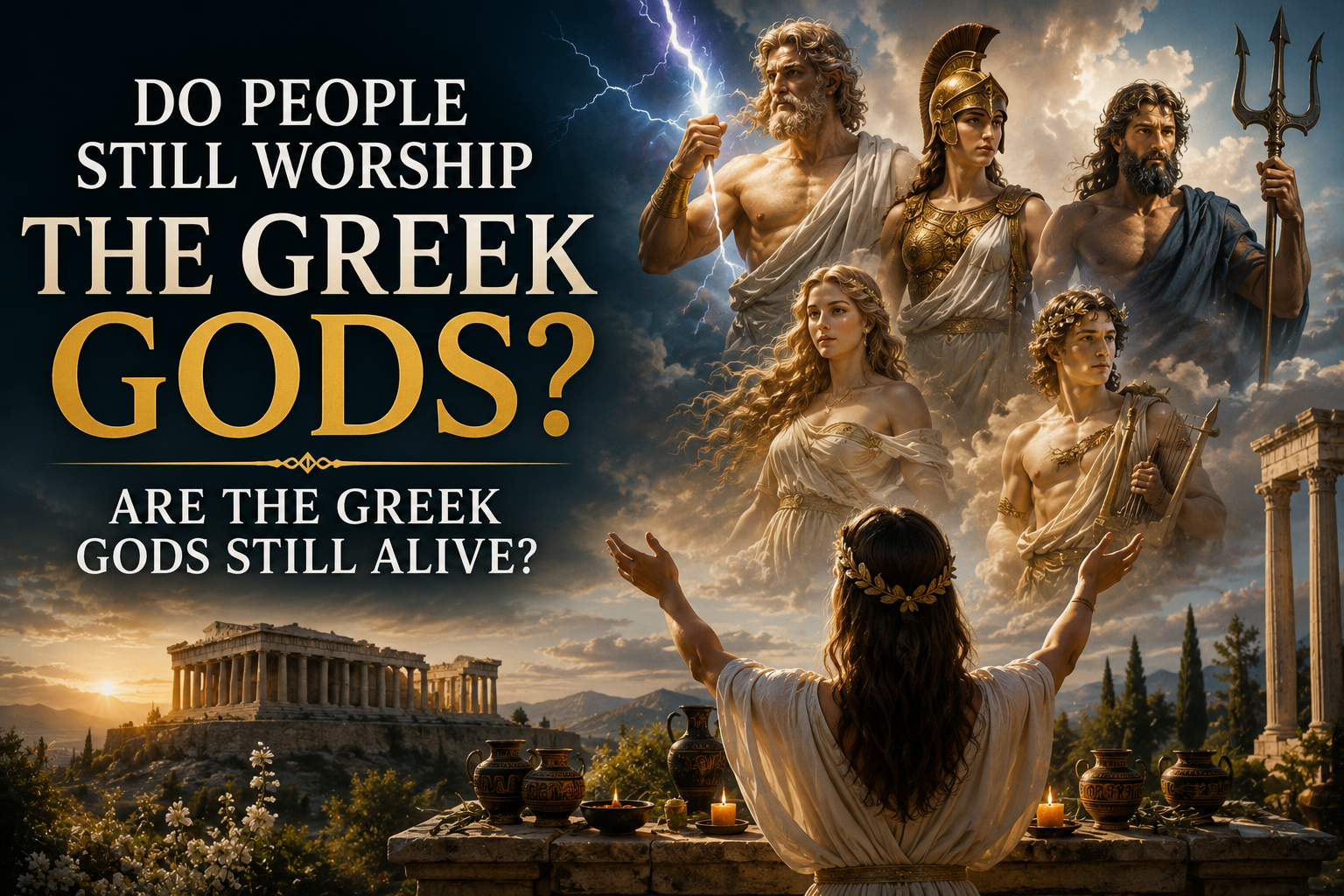
The gods of ancient Greece, including Zeus, Athena, Apollo, and Poseidon, have fascinated people for thousands of years. While many consider Greek mythology to be part of history, others continue to practice the ancient religion today. This raises an interesting question: Do people still worship the Greek gods?
The answer is yes. Although ancient Greek religion declined many centuries ago, modern followers continue to honor and worship the Greek deities through a religious movement known as Hellenism or Hellenic Polytheism.
Do People Still Worship the Greek Gods?
Yes, people still worship the Greek gods in the modern world.
Followers of the ancient Greek religion are often known as Hellenists or Hellenic Polytheists. They worship many of the same deities honored in antiquity, including:
- Zeus, king of the gods
- Hera, goddess of marriage
- Athena, goddess of wisdom
- Apollo, god of prophecy and music
- Artemis, goddess of the hunt
- Poseidon, god of the sea
- Aphrodite, goddess of love
- Dionysus, god of wine and celebration
Modern practitioners perform prayers, make offerings, celebrate religious festivals, and attempt to revive ancient Greek religious traditions as faithfully as possible.
What Is Hellenism?
Hellenism, also called Hellenic Polytheism, is the modern revival of the religious practices of ancient Greece.
Ancient Greek religion flourished for well over a thousand years, from the Bronze Age until the rise of Christianity in the Roman Empire. Beginning in the fourth century CE, pagan worship gradually declined as Christianity became the dominant religion.
In the late twentieth century, interest in reviving the ancient faith grew, leading to the establishment of modern Hellenic religious communities in Greece, Europe, North America, and other parts of the world.
Today, Hellenism is recognized as a legitimate religion in Greece. In 2017, the Greek government officially recognized the Hellenic ethnic religion, granting it legal status after centuries during which public pagan worship had largely disappeared.
How Many People Worship the Greek Gods Today?
It is difficult to determine exactly how many people worship the Greek gods because there is no central religious authority.
Estimates vary widely, but thousands of people around the world identify as practitioners of Hellenic Polytheism. Communities can be found in:
- Greece
- The United States
- Canada
- The United Kingdom
- Australia
- Various European countries
Many practitioners gather both in person and online to discuss rituals, theology, and ancient traditions.
Ancient Temples and Sacred Sites
Visitors to Greece can still see many of the magnificent temples dedicated to the Olympian gods. Some of the most famous include:
- The Parthenon in Athens, dedicated to Athena
- The Temple of Olympian Zeus in Athens
- The Sanctuary of Apollo at Delphi
- The Temple of Poseidon at Cape Sounion
Although these sites are primarily archaeological monuments today, they remain spiritually important to many modern Hellenists.
Festivals Still Celebrated by Modern Hellenists
Many followers continue to celebrate ancient Greek religious festivals, often adapting them for modern life. Some of the most well-known festivals include:
Anthesteria
A festival honoring Dionysus and celebrating wine, renewal, and the coming of spring.
Dionysia
One of ancient Athens’ most important festivals dedicated to Dionysus, featuring theatrical performances and celebrations.
Lenaia
Another festival dedicated to Dionysus that included dramatic competitions.
Thargelia
A festival honoring Apollo and Artemis that focused on purification and thanksgiving.
Kronia
A harvest festival dedicated to the Titan Cronus.
Aphrodisia
A celebration in honor of Aphrodite, goddess of love and beauty.
Panathenaea
The Panathenaea was among the most important festivals of ancient Athens, held in honor of Athena. Modern Hellenists often commemorate this festival because of its historical significance.
| Ancient Hellenism | Modern Hellenism |
|---|---|
| State religion | Personal religion |
| Public temples | Home shrines |
| Animal sacrifice | Food and libation offerings |
| City festivals | Community gatherings |
| Priests appointed by city | Independent religious groups |
Are the Greek Gods Still Alive?
Whether the Greek gods are still alive depends largely on one’s personal religious beliefs.
For followers of Hellenism, the answer is yes. Hellenists believe that the Olympian gods continue to exist and can still interact with humanity. They pray to the gods, offer libations and gifts, and seek divine guidance in their daily lives.
From a historical and academic perspective, the Greek gods are generally viewed as mythological figures and cultural symbols rather than living beings.
Ultimately, whether the Greek gods are still alive is a matter of faith.
Why Do People Still Worship the Greek Gods?
Modern followers are drawn to Hellenism for many reasons, including:
- A spiritual connection with the ancient gods
- An appreciation for Greek culture and philosophy
- A desire to revive traditional religious practices
- Personal experiences they interpret as divine encounters
- Interest in polytheistic spirituality
For many practitioners, Hellenism is not merely an interest in mythology but a deeply meaningful religious path.
So, do people still worship the Greek gods? Absolutely. Although the ancient temples no longer dominate Greek society, modern Hellenists continue to honor Zeus, Athena, Apollo, and the other Olympian deities.
As for whether the Greek gods are still alive, the answer depends on one’s beliefs. For many modern worshippers, the gods remain active and worthy of devotion, while historians view them primarily as part of humanity’s rich cultural and mythological heritage.