Prince Setna Khaemwese and his wife Mehusekhe had two beautiful daughters, but they longed for a son. Year after year they heaped the altars of the gods with rich offerings, yet their prayers remained unanswered.
At many Egyptian temples it was customary for the sick and barren to sleep within the sacred precincts. Each night they lay down in the hope that a god would appear to them in a dream and reveal how they might be cured.
At last, in desperation, Setna took his wife to spend the night in the temple of Osiris.
They arrived at dusk to find the building reserved for the sick already crowded, while many others were unrolling their bedding in the temple courtyard. Because of her high rank, a small room was found for Mehusekhe, though it was little more than a narrow cubicle with thin walls.
Setna kissed his wife goodbye and departed. Mehusekhe lay down upon the unfamiliar bed and closed her eyes. From every side came the groans of the sick and the tearful prayers of barren women. She was certain she would never be able to sleep in such a place, but after murmuring prayers to Isis and Osiris, she eventually drifted into slumber.
Just before dawn, Mehusekhe awoke with the certainty that a god had spoken to her in her sleep. She could not remember the deity’s appearance, but she clearly remembered the mysterious voice:
“Wife of Setna, tomorrow you must go to the place where your husband bathes. The pool is overhung by a melon vine. Break off a branch with its fruit, cut it up, grind it finely, mix it with water, and drink it. Then embrace your husband, and you will conceive a son.”
Mehusekhe made a thank offering, left the temple, and hurried to find the pool and the melon vine. She did exactly as the god had commanded, and before long she knew that she was with child.
When she told Setna, he was overjoyed yet anxious. He hung a powerful amulet around her neck and recited protective spells over both mother and unborn child.
One night a god appeared to Setna in a dream and said:
“Setna Khaemwese, your wife carries a son. When the boy is born, you must call him Sa-Osiris, and he shall perform many wonders in Egypt.”
Setna awoke happier than ever and impatient for the months of waiting to pass.
In due time, Mehusekhe gave birth to a fine boy, and Setna named him Sa-Osiris.
It soon became clear that this was no ordinary child. At the age of one, strangers often mistook him for a boy of two. At two years old, people thought him three. Setna watched over his son with pride and loved him dearly.
Sa-Osiris was sent to school at an age when most children could scarcely speak. He learned to read and write so quickly that within a few months he knew more than the elderly scribe who taught him.
Next, the boy was taken to the temple of Ptah, where his father served as High Priest, and placed in the care of the wise men of the House of Life. There, priests studied astronomy, mathematics, medicine, and magic while copying sacred texts.
Sa-Osiris proved to be the most brilliant pupil they had ever known. He learned the proper ritual for every god in every temple on every day of the year. He learned to name the stars and determine which days were fortunate and which were unlucky. He mastered spells for curing sickness and protecting both the living and the dead.
By the age of seven, he knew every book in the temple library by heart.
Everyone who met him marveled at the boy’s wisdom, and Setna eagerly anticipated the day when he could present his extraordinary son at court.
Late one afternoon, Sa-Osiris and his father were dressing for a banquet in their house at Memphis. Suddenly Setna heard loud wailing outside. Looking down from his window, he saw the funeral procession of a wealthy man.
A gilded coffin mounted on a sledge was dragged by a pair of oxen and surrounded by weeping women. With bare feet, unbraided hair, and torn clothing, the mourners beat their breasts and wailed as though Osiris himself had died again.
Behind them walked servants carrying ebony chairs, ivory caskets filled with jewels, ostrich-feather fans, chests of fine linen, and many other treasures destined to be buried with the dead man in his magnificent tomb.
Following behind came another funeral.
Wrapped in a simple mat, a poor man who had died homeless and friendless was being dragged toward a shallow grave in the desert sand. No mourners followed him. He possessed not even a single pot or string of beads to accompany him into death.
“By Ptah!” exclaimed Setna. “How much happier this rich man is, even in death, than that poor wretch.”
Sa-Osiris came to stand beside his father at the window.
“Do you truly think so?” he asked quietly. “I only wish that you may share the fate of that poor man.”
Setna stared at him in surprise and hurt.
“How can you say such a thing?”
“If you wish, Father, I will show you what has become of both men. Come with me.”
With a mysterious smile, Sa-Osiris took his father’s hand and led him into the street. Together they crossed the Nile by ferry and entered the City of the Dead on the edge of the western desert.
Among the ancient tombs, Sa-Osiris uttered a spell of terrible power that shattered the barrier between the worlds of the living and the dead.
Setna suddenly felt the weight of his body vanish. At dizzying speed, the young magician carried his father through the gates of the Underworld.
Setna glimpsed shadowy demons brandishing long knives, but Sa-Osiris knew the proper spells to appease the Guardians of the Gateways.
They journeyed deeper into the Underworld until at last their speed slowed.
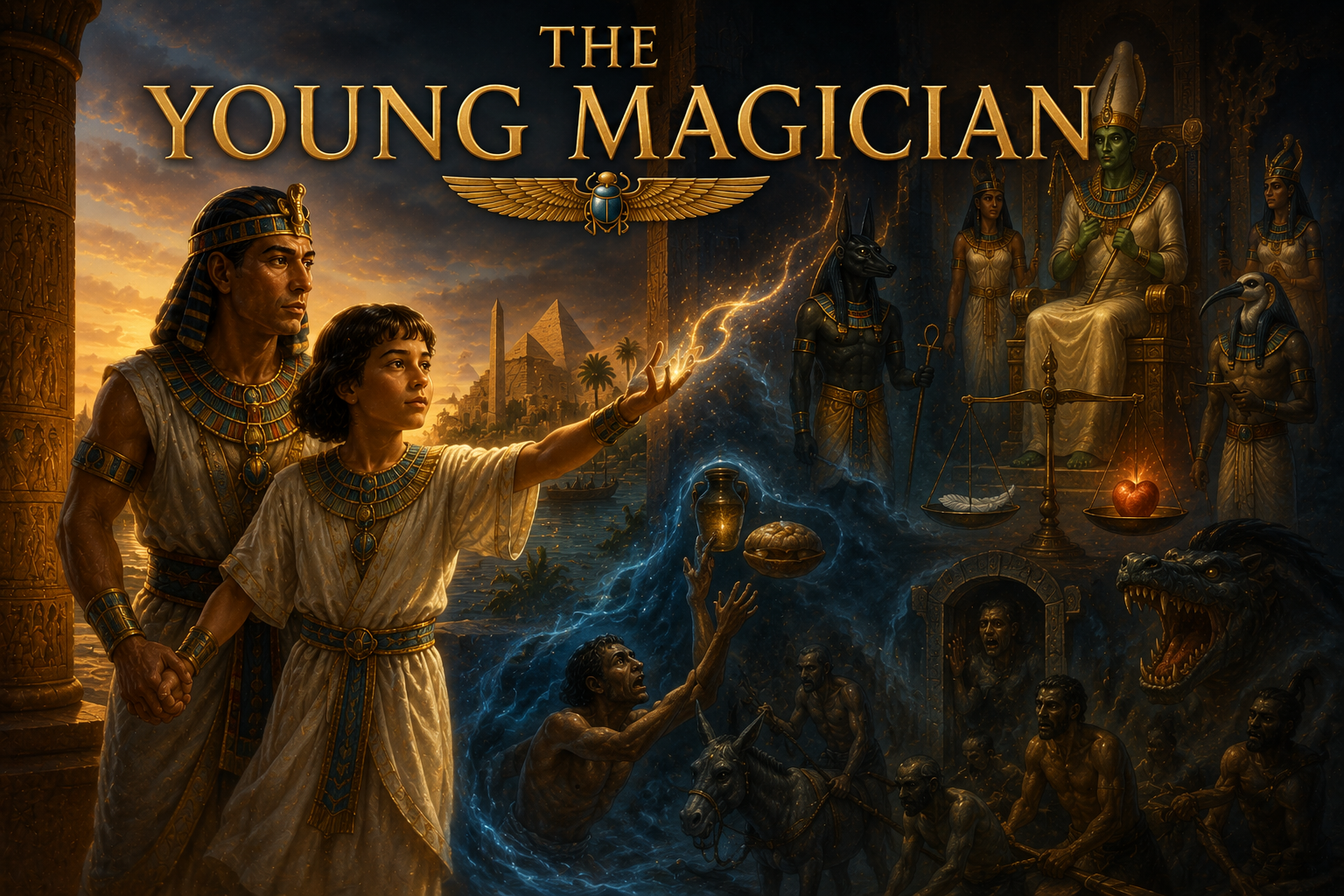
Setna found himself looking down upon a group of men seated on the floor of a gloomy hall, endlessly plaiting straw into ropes. Their fingers were raw and bleeding, yet their labor could never be completed, for a donkey stood beside each man, devouring the ropes as quickly as they were made.
Elsewhere in the hall stood men reduced to skin and bone by hunger. They desperately struggled to reach loaves of bread and jars of water suspended above their heads. Whenever they seemed close to success, demons dug pits beneath their feet, causing them to fall before they could grasp the food.
The miserable souls wept and cursed in their torment.
The next hall contained souls pleading for mercy. The pivot of a great door had been fixed in the eye of a man who wailed without ceasing. Each time the door swung open, the unfortunate soul screamed in agony.
Setna shuddered as Sa-Osiris swept him onward.
In another hall, demons recorded the sins of the newly dead before the Forty-Two Judges.
Finally, they entered a vast chamber where Setna was dazzled by the majestic presence of the King of the Dead himself.
Shrouded in white linen, green-skinned Osiris sat beneath a golden canopy, holding the crook and flail, symbols of kingship. Brave Isis and gentle Nephthys stood behind him. Before him stood jackal-headed Anubis, guardian of the dead, and ibis-headed Thoth, scribe of the gods.
The great hall was filled with the blessed dead, and at its center stood the scales upon which human hearts were weighed against the Feather of Truth.
Lurking in the shadows crouched a monstrous creature, part lion, part crocodile, and part hippopotamus: the Devourer, who consumed wicked souls.
Sa-Osiris whispered to his astonished father:
“Do you see that blessed spirit clothed in golden garments, wearing the feathers of Truth in his hair and standing close to the throne of Osiris? That spirit belongs to the poor man whom you saw carried to a beggar’s grave without mourners.
“When his spirit entered the Underworld, he was brought before the Forty-Two Judges. His heart was weighed against Truth, and his good deeds were found to outweigh his evil ones. Therefore Osiris himself decreed that the poor man should receive all the goods buried with the rich man and dwell among the blessed dead.”
Setna gazed in amazement.
“As for the rich man whose splendid funeral you witnessed,” continued Sa-Osiris, “his many opportunities to show generosity and mercy were wasted. His evil deeds greatly exceeded his good ones. Osiris condemned him to imprisonment in the Underworld.
“He is the wretched soul you saw suffering with the pivot fixed in his eye.
“When I said that I wished you to share the poor man’s fate, Father, I meant only that I wished you to understand these truths.”
Setna now realized that he had misunderstood his son and humbly asked him to explain the other marvels they had seen.
“The men you saw plaiting ropes that could never be finished, and those striving endlessly for food they could never reach, are wicked souls condemned to eternal torment.
“Take this lesson to heart, Father. If you are kind, gentle, and generous on earth, the King of the Dead will show kindness to you. But if you are evil, evil shall be done to you. This is the law of the gods for all eternity.”
Setna bowed his head.
Sa-Osiris then led his father back out of the Underworld by strange paths. They passed through fire and water before emerging once more into the western desert.
As they walked hand in hand back toward Memphis, Setna marveled at the wisdom and power of his son.
“He is almost like a god,” he thought, “and yet, when people ask who he is, I can say, ‘This is my son.'”
Even so, Setna quietly murmured protective spells against the demons of the Underworld, for he was afraid.
He had seen what no living man had ever seen before, and he knew that even the son of a pharaoh must fear the Judgment of the Dead.