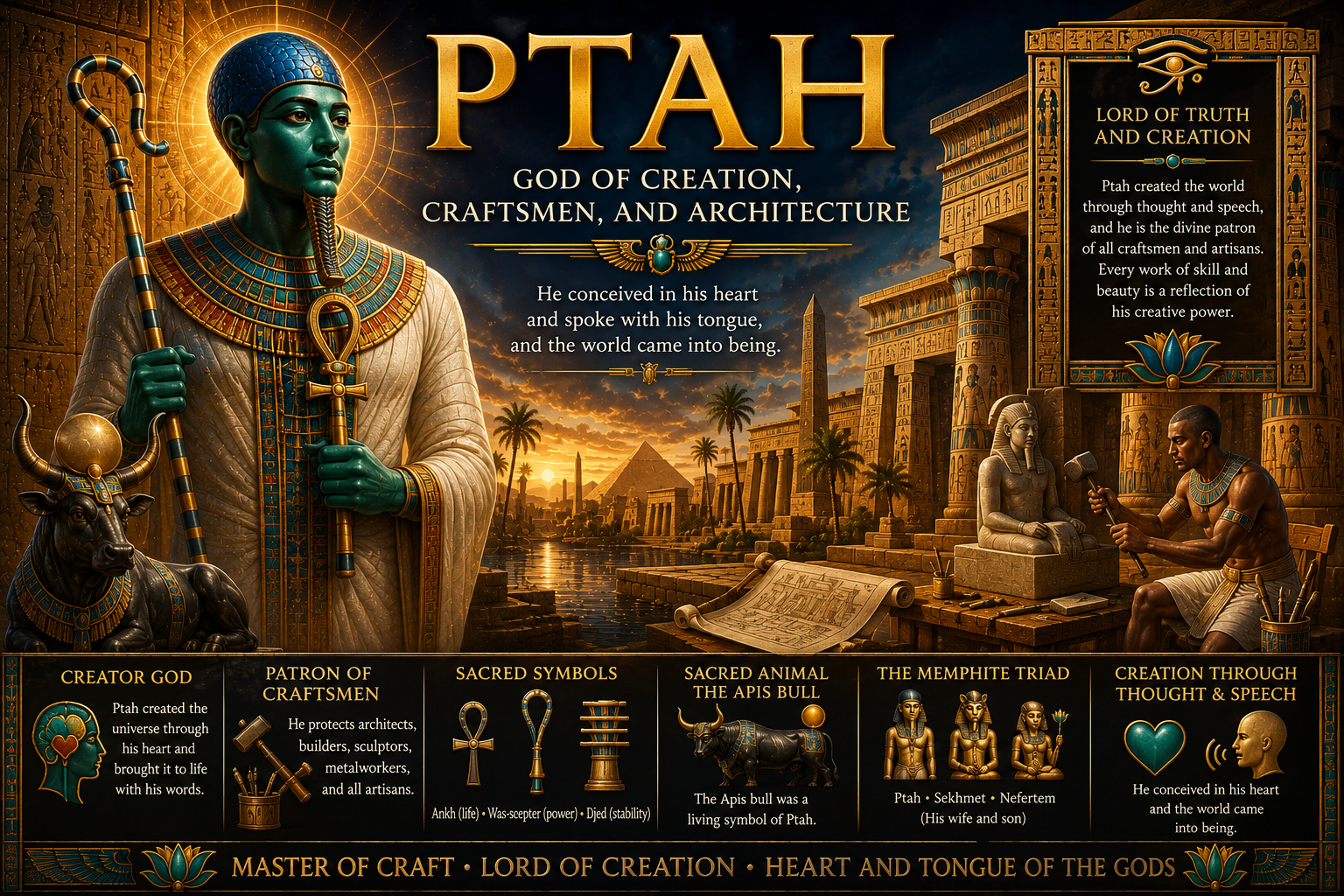
Ptah was one of the most important creator gods in Ancient Egyptian mythology. He was the god of creation, craftsmen, architects, builders, sculptors, metalworkers, and artisans. Revered as the divine patron of all skilled labor, Ptah was believed to have conceived the world through thought and brought it into existence through speech.
Although deities such as Ra and Atum are often more familiar to modern audiences, Ptah occupied an equally significant place in Egyptian religion. He was the chief god of Memphis, one of Ancient Egypt’s oldest and most influential cities, and remained an important deity throughout Egypt’s long history.
Ancient Egyptians believed that every temple, monument, statue, and work of art existed because of Ptah’s creative power.
Origins and Family
Ptah’s origins stretch back to the earliest periods of Egyptian civilization.
Unlike many Egyptian gods, Ptah was often considered self-created and eternal. In the Memphite Theology, one of Egypt’s most important religious texts, Ptah existed before creation itself.
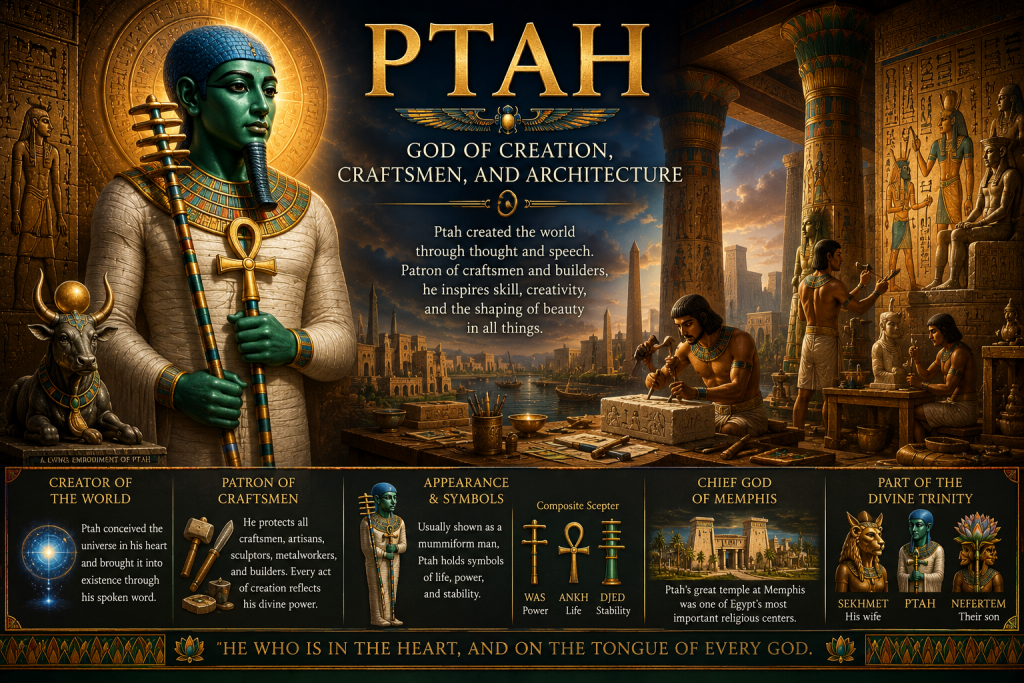
Ptah formed part of the Memphite Triad alongside:
- Sekhmet, goddess of war and healing, who served as his wife.
- Nefertem, god of perfume, healing, and the lotus flower, who was their son.
As head of this divine family, Ptah was regarded as one of the supreme gods of Memphis.
Ptah as a Creator God
Ptah’s role as creator distinguished him from nearly every other Egyptian deity.
According to the Memphite Theology, preserved on the famous Shabaka Stone, Ptah created the world not through physical actions, but through the power of his mind and speech.
Ancient Egyptians believed that Ptah first conceived all things within his heart, which they regarded as the seat of thought and intelligence. He then brought creation into existence simply by speaking the names of everything that was to exist.
This remarkable concept made Ptah one of the earliest known examples of creation through divine word.
The text states that all gods, humans, animals, cities, and even the principles of justice and order came into being through Ptah’s thoughts and speech.
Because of this, many scholars consider Ptah to be one of Egypt’s most sophisticated theological concepts.
God of Craftsmen and Artisans
Ptah was especially revered as the patron god of craftsmen. Stone masons, sculptors, carpenters, metalworkers, jewelers, architects, and artists all regarded Ptah as their divine protector.
Ancient Egyptians believed that every act of craftsmanship reflected Ptah’s original act of creation. Artisans often prayed to Ptah before beginning important projects, seeking his guidance and inspiration.
The workers who built Egypt’s magnificent temples, statues, and pyramids likely honored Ptah as the divine source of their skill.
Because Memphis was an important center of artistic production, Ptah’s cult flourished there for thousands of years.
Ptah and Architecture
As patron of architects and builders, Ptah held a special place in Egyptian society.
The construction of temples, pyramids, tombs, and monuments was central to Egyptian civilization, and Ptah was believed to oversee all such endeavors.
Some scholars have suggested that Imhotep, the famous architect of Djoser’s Step Pyramid, may have enjoyed a particularly close association with Ptah. In later periods, Imhotep himself was deified and frequently worshipped alongside Ptah.
To the ancient Egyptians, every building project was ultimately an expression of divine creativity.
Appearance and Symbols
Ptah possessed one of the most distinctive appearances in Egyptian art.
He was usually depicted as a mummiform man, tightly wrapped in a shroud, leaving only his hands exposed.
Ptah commonly carried a composite scepter combining three important symbols:
- The was-scepter, symbolizing power and dominion.
- The ankh, symbolizing life.
- The djed pillar, symbolizing stability and endurance.
Other features often associated with Ptah include:
- A close-fitting skullcap.
- A straight ceremonial beard.
- A broad collar.
- Green skin in some depictions, symbolizing regeneration.
Unlike many Egyptian gods, Ptah was rarely portrayed with an animal head.
Sacred Animals and Symbols
Ptah was associated with several sacred symbols and animals, including:
- The Apis Bull
- The djed pillar
- The ankh
- The was-scepter
- Craftsman’s tools
The sacred Apis Bull, worshipped at Memphis, was considered a living manifestation of Ptah.
Upon the death of an Apis Bull, elaborate funerary ceremonies were performed, and another sacred bull was chosen as its successor.
Worship of Ptah
Ptah’s principal cult center was Memphis, the ancient capital of Egypt.
The city’s great Temple of Ptah was one of the most important religious centers in the country. Pilgrims traveled from across Egypt to honor the creator god and seek his blessings.
Because craftsmen existed in every town and city, Ptah’s worship spread throughout Egypt.
He remained widely venerated from the Early Dynastic Period until the Roman era.
Ptah and the Afterlife
Although Ptah is best known as a creator and patron of craftsmen, he also possessed funerary associations.
Over time, Ptah became linked with the underworld god Sokar and the creator god Osiris, resulting in the composite deity Ptah-Sokar-Osiris.
This combined god represented creation, death, resurrection, and eternal life.
Statues of Ptah-Sokar-Osiris were commonly placed inside tombs to aid the deceased in achieving rebirth.
The Festival of Ptah
Ancient Egyptians celebrated numerous festivals in Ptah’s honor.
One of the most important events occurred during the coronation ceremonies of pharaohs, reflecting Ptah’s close connection to kingship and creation.
Other festivals involved processions of sacred statues, offerings, music, and communal celebrations. These ceremonies reinforced Ptah’s role as protector of Egypt and divine source of creativity.
Legacy of Ptah
Ptah remained one of Egypt’s most important gods for more than three thousand years.
As creator of the universe, patron of craftsmen, and guardian of artistic and architectural achievement, Ptah profoundly influenced Egyptian religion and culture.
Today, Ptah continues to fascinate historians, archaeologists, and mythology enthusiasts as the divine architect whose thoughts and words brought the universe into existence.