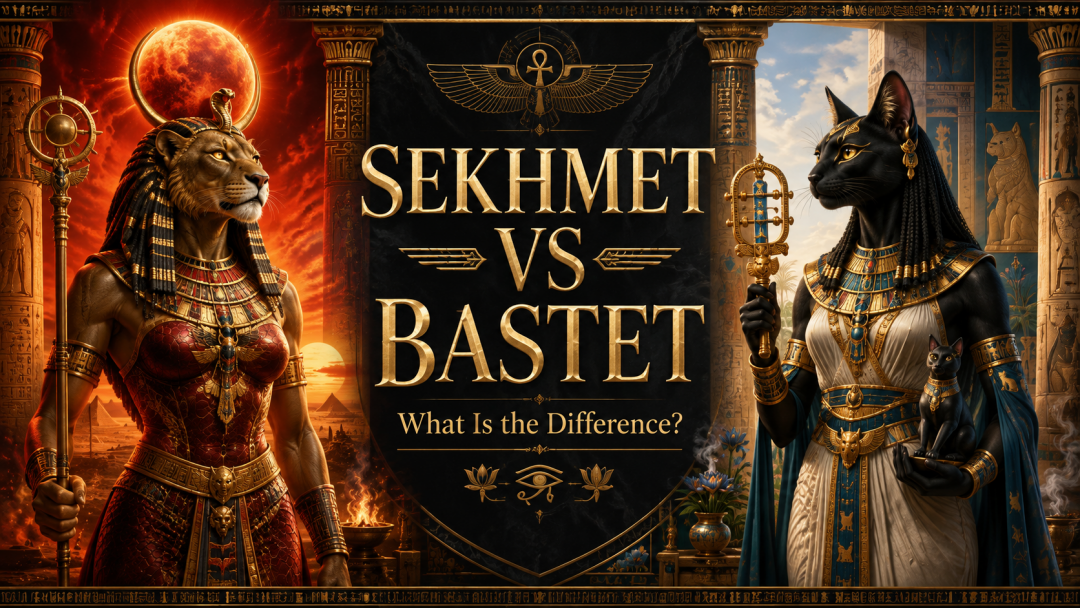
Sekhmet vs. Bastet: What Is the Difference?
Sekhmet and Bastet were both powerful feline goddesses in ancient Egyptian religion. Both could protect people, both were connected to the sun god Ra, and both could display fierce and benevolent qualities. Their similarities were strong enough that the two goddesses could sometimes overlap or be treated as contrasting manifestations of divine feline power.
Despite those similarities, Sekhmet and Bastet were not simply two names for the same goddess. Sekhmet was primarily a lioness goddess associated with destructive solar power, warfare, disease, healing, and royal protection. Bastet was also originally a fierce lioness goddess, but over time she became increasingly associated with the domestic cat, fertility, motherhood, protection, music, celebration, and a gentler form of feline power.
The easiest way to remember the difference is: Sekhmet represented the dangerous power of the lioness, while Bastet increasingly represented the protective and nurturing power of the cat.
Sekhmet vs. Bastet at a Glance
| Feature | Sekhmet | Bastet |
|---|---|---|
| Egyptian name | Sekhmet | Bastet or Bast |
| Name meaning | “The Powerful One” | Meaning uncertain |
| Primary animal | Lioness | Originally a lioness; later strongly associated with the domestic cat |
| Main roles | War, destruction, disease, healing, royal protection | Protection, fertility, motherhood, music, celebration, and domestic cats |
| Solar connection | Powerful manifestation of the Eye of Ra | Solar feline goddess with connections to Ra |
| Typical appearance | Lioness-headed woman | Lioness-headed in earlier periods; later commonly cat-headed or shown as a cat |
| Common headdress | Solar disk and uraeus | Various forms; later cat-headed images are especially common |
| Important symbols | Lioness, solar disk, uraeus, ankh, papyrus scepter | Cat, sistrum, aegis, kittens, basket |
| Major cult center | Memphis | Bubastis |
| Temperament | Fierce, destructive, protective, healing | Protective and potentially fierce, but increasingly associated with gentler qualities |
| Major misconception | She was only a goddess of war | She was always a domestic cat goddess |
Who Was Sekhmet?
Sekhmet was one of ancient Egypt’s most powerful and potentially dangerous goddesses.
Her name means “The Powerful One.” She was normally represented as a woman with the head of a lioness, often wearing a solar disk and uraeus cobra. Surviving statues also show her holding the ankh and papyrus-shaped scepter.
Sekhmet represented the fierce and destructive power of the sun.
She could function as the Eye of Ra, a divine feminine force through which the sun god attacked his enemies and defended cosmic order. The British Museum describes Sekhmet as the fiery Eye of Ra sent against the sun god’s enemies.
Her lioness form suited this identity. The lioness was one of the most formidable predators known to the Egyptians. Sekhmet therefore embodied overwhelming strength, ferocity, and royal power.
But Sekhmet was not simply a goddess of destruction. She was also associated with disease and healing.
The same goddess believed capable of sending epidemics or dangerous forces could also be invoked to prevent them. Priests of Sekhmet were associated with healing, and rituals were performed to appease her dangerous power.
This apparent contradiction was not unusual in Egyptian religion. A divine force capable of causing harm could also possess the greatest ability to control that harm.
Sekhmet therefore represented both the threat and the remedy.
Who Was Bastet?
Bastet was another major feline goddess, best known today for her association with cats. However, the familiar image of Bastet as a gentle domestic cat goddess represents only part of her long history.
In earlier Egyptian religion, Bastet was a lioness goddess. The American Research Center in Egypt notes that from her earliest attestations until later in the New Kingdom, she was represented as a lioness. Her famous association with the domestic cat developed later.
As her iconography changed, Bastet increasingly appeared as:
- A woman with a cat’s head
- A complete domestic cat
- A cat accompanied by kittens
- A goddess holding a sistrum
- A goddess holding an aegis or other ritual objects
The Metropolitan Museum of Art describes Bastet as a powerful protective goddess associated with fertility who could appear with either a lioness head or a cat head. The lioness emphasized her fierce qualities, while the cat emphasized her peaceful characteristics.
Bastet eventually became strongly associated with:
- Protection
- Fertility
- Motherhood
- Childbirth
- Music
- Celebration
- Joy
- Cats
Her principal cult center was Bubastis, known in Egyptian as Per-Bastet, in the eastern Nile Delta. The British Museum identifies Bubastis as Bastet’s principal cult center.
How Were Sekhmet and Bastet Similar?
Sekhmet and Bastet shared more than simply being feline goddesses. Their identities overlapped in several important ways.
Both were feline goddesses
Sekhmet was overwhelmingly associated with the lioness. Bastet was also originally represented as a lioness before becoming increasingly associated with the domestic cat.
This means the popular modern distinction of: Sekhmet = lion and Bastet = cat is useful for later Egyptian imagery, but it does not accurately describe their entire history.
Both were powerful protectors
Sekhmet protected the king and Egypt from enemies.
Bastet also possessed strong protective qualities and could defend against dangerous forces. The Metropolitan Museum describes Bastet as a powerful protective figure as well as a fertility goddess.
Protection did not necessarily mean gentleness. Egyptian protective deities could destroy whatever threatened the people or places under their care.
Both had solar associations
Sekhmet’s solar character was especially pronounced because she could serve as the Eye of Ra. Bastet also belonged to the larger group of Egyptian feline and solar goddesses whose identities could overlap with the Eye of Ra tradition.
Both therefore embodied aspects of dangerous or protective solar femininity.
Both could be connected with music and ritual
The sistrum is particularly famous in connection with Hathor and Bastet, but it was not exclusive to them. The British Museum notes that the sacred instrument was associated with the worship of several Egyptian goddesses, including Hathor, Isis, Bastet, and Sekhmet.
Music could have a ritual function, particularly in soothing dangerous divine power.
Both could protect against illness
Sekhmet was deeply connected with disease and its prevention. Bastet could likewise possess protective qualities related to health and well-being. The important distinction is that Sekhmet’s relationship with disease was especially explicit: she could both unleash dangerous forces and be appeased to restrain them.
What Is the Main Difference Between Sekhmet and Bastet?
The main difference is that Sekhmet retained a strongly leonine identity tied to destructive solar power, warfare, disease, and healing, while Bastet gradually developed from a lioness goddess into a more peaceful, cat-associated goddess of protection, fertility, motherhood, and celebration.
This difference became especially visible in their later iconography.
- Sekhmet was generally shown as a lioness-headed woman.
- Bastet increasingly appeared as a domestic cat or cat-headed woman.
That visual distinction reflected a broader theological contrast between ferocious feline power and controlled, protective feline power.
Sekhmet Represented the Fierce Power of the Lioness
Sekhmet’s lioness identity was central to her nature. She could destroy enemies, punish rebellion, spread disease, and protect the king. The British Museum explains that Sekhmet’s lioness appearance may have reflected Egyptian observations of lionesses as hunters.
Her name itself emphasized power. Sekhmet was not a passive guardian. Her protection could be aggressive. Threatening the king or divine order meant encountering the force capable of destroying that threat.
Bastet Became Associated with the Domestic Cat
Bastet’s transformation is one of the most important details for understanding the difference between the two goddesses. Early Bastet was not primarily a house cat. She was leonine.
Her domestic-cat imagery became increasingly prominent later in Egyptian history. By the Late Period, bronze cats associated with Bastet had become extremely common religious objects.
The famous Gayer-Anderson Cat in the British Museum represents Bastet in feline form and dates to Egypt’s Late Period. The domestic cat offered a particularly appropriate symbol for Bastet’s later character.
Cats could be:
- Affectionate
- Maternal
- Protective
- Graceful
- Playful
- Effective hunters
A domestic cat might appear calm but could become extremely dangerous when protecting itself or its young. Bastet therefore remained a powerful protector even when expressed through a gentler animal.
Sekhmet Was Associated with War and Destruction
Sekhmet is often described as an Egyptian goddess of war. That description is accurate, but incomplete. Her destructive power extended beyond warfare.
She could represent:
- The burning heat of the sun
- Divine punishment
- Disease
- Epidemic
- Royal vengeance
- The destruction of enemies
Her ferocity was ultimately protective because it defended Ra, the king, and cosmic order. Sekhmet therefore represented violence under divine authority rather than uncontrolled chaos.
Bastet Was Associated with Fertility and Motherhood
Bastet developed increasingly strong associations with fertility, motherhood, and childbirth. Cat statuettes associated with the goddess sometimes show kittens gathered around a mother cat, visually emphasizing fertility and maternal abundance.
A British Museum figure of Bastet depicts kittens and identifies fertility, festivity, and intoxication among the goddess’s associations.
These maternal qualities helped distinguish later Bastet from Sekhmet. But they did not make Bastet weak. Her nurturing and protective characteristics existed alongside the older memory of her leonine nature.
Bastet Was Strongly Associated with Music and Celebration
Bastet also became closely associated with music, dancing, festivity, and ritual celebration. One of her most characteristic objects was the sistrum, a sacred rattle.
Representations of Bastet frequently show her holding a sistrum, sometimes accompanied by an aegis, basket, or menat-like jewelry. Her great festival at Bubastis became famous in later descriptions for music, celebration, and large crowds.
This festive identity contrasted sharply with Sekhmet’s more fearsome image.
Sekhmet Was Also a Goddess of Healing
Calling Sekhmet merely a goddess of war misses one of the most fascinating aspects of her character. She was also associated with medicine and healing. The logic was deeply Egyptian: the deity powerful enough to cause disease was also powerful enough to prevent or cure it. Appeasing Sekhmet therefore became an important religious activity.
This helps explain the extraordinary number of Sekhmet statues commissioned during the reign of Amenhotep III. Numerous monumental statues of the lioness goddess survive, including examples now in the British Museum. These were not simply monuments celebrating violence. They were part of a broader religious effort to invoke and pacify Sekhmet’s tremendous power.
Why Are Sekhmet and Bastet Often Confused?
Sekhmet and Bastet are confused because their identities genuinely overlap. This confusion isn’t simply a modern mistake.
Both goddesses:
- Had feline forms
- Could appear as lionesses
- Were protective
- Had solar characteristics
- Could be associated with Ra
- Could display dangerous qualities
- Could be connected with health
- Could participate in similar ritual traditions
Some ancient objects are even difficult for modern scholars to identify confidently as one goddess or the other.
The British Museum has artifacts cataloged as Sekhmet or Bastet because a lion-headed goddess without sufficient inscription or contextual information cannot always be identified securely.
That is important. The modern rule that “lioness means Sekhmet and cat means Bastet” works surprisingly well for much later imagery, but it is not universally reliable.
Were Sekhmet and Bastet the Same Goddess?
Not exactly. Sekhmet and Bastet were distinct goddesses with different names, cult centers, traditions, and characteristic roles.
However, ancient Egyptian religion frequently allowed gods to overlap, merge, or represent different manifestations of related divine forces.
Sekhmet and Bastet could therefore be treated as closely related or complementary feline powers.
The Metropolitan Museum notes traditions in which ritual music could transform or pacify the dangerous Sekhmet into Bastet, her more benign feline counterpart.
This does not mean Egyptians universally believed Sekhmet literally became Bastet. Rather, it illustrates a recurring theological idea: divine feminine power could move between dangerous and peaceful states.
Sekhmet embodied that power when enraged. Bastet could embody it when pacified.
Is Bastet the Gentle Version of Sekhmet?
This is a useful shorthand, but it is an oversimplification. The British Museum describes Bastet as a more benign or gentler counterpart to Sekhmet.
However, that does not mean Bastet was simply created as “nice Sekhmet.” Bastet was an ancient goddess with her own cult and history.
Most importantly, early Bastet herself was leonine and potentially fierce. Her domestic cat identity developed later.
A more historically accurate way to describe the relationship is: Sekhmet and Bastet could represent contrasting expressions of feline divine power, but each goddess had an independent religious identity.
Did Sekhmet Turn Into Bastet?
Not in the simple way this is sometimes presented online. Egyptian mythology did contain the idea that a dangerous lioness goddess could be pacified and transformed into a gentler divine presence.
Ritual texts and later interpretations could connect this transition with Sekhmet and Bastet.
But there was no single universal Egyptian story in which Sekhmet permanently transformed into Bastet and ceased to exist.
Both goddesses continued to be worshipped separately.
It is better to understand the idea as a theological contrast between:
rage and pacification
lioness and cat
destruction and protection
rather than as a literal origin story for Bastet.
Were Sekhmet and Bastet Both the Eye of Ra?
Both could participate in traditions surrounding the Eye of Ra, although Sekhmet’s association with the destructive Eye was particularly strong.
The Eye of Ra was not simply a physical eye.
It could function as an independent feminine divine power sent forth by the sun god.
Several goddesses could embody this role, including:
- Sekhmet
- Hathor
- Bastet
- Tefnut
- Wadjet
The identity of the Eye varied according to myth, temple, period, and theological context. Sekhmet represented one of its most terrifying manifestations.
Bastet could represent a feline solar power in a calmer or more protective state.
How Can You Tell Sekhmet and Bastet Apart?
The easiest distinction usually comes from the type of feline head.
Sekhmet normally has a lioness head
Sekhmet is usually depicted as a woman with a lioness head.
Her features typically include:
- Broad feline muzzle
- Rounded lion ears
- Lioness facial structure
- Solar disk
- Uraeus cobra
British Museum statues of Sekhmet consistently show her in this lioness-headed form.
Later Bastet usually has a domestic cat head
Later representations of Bastet frequently show a narrower feline face with pointed ears resembling a domestic cat.
The Metropolitan Museum has numerous Late Period and Ptolemaic statuettes depicting Bastet this way.
Bastet may appear as a complete cat
A seated bronze cat is often associated with Bastet, particularly in Late Period religious contexts. However, context and inscriptions remain important.
Look for Bastet’s ritual objects
Bastet is frequently shown holding combinations of objects such as:
- Sistrum
- Aegis
- Basket
- Kittens
These can help identify her.
Look for Sekhmet’s solar disk
Sekhmet frequently wears a solar disk and uraeus above her lioness head. However, the solar disk alone does not identify her because many Egyptian goddesses could wear solar crowns.
Read the inscription
As with many Egyptian deities, an inscription is often more reliable than appearance alone. This is especially important for early lioness-headed forms of Bastet, which can resemble Sekhmet closely.
Which Goddess Was Older, Sekhmet or Bastet?
Bastet is attested very early in Egyptian history and appears to have ancient roots extending back into the Early Dynastic Period. Sekhmet also belonged to an old tradition of dangerous lioness and solar goddesses, although her identity becomes especially prominent in later royal and theological contexts.
It is therefore misleading to imagine Bastet as a later goddess invented from Sekhmet. The two developed within Egypt’s much broader tradition of feline goddesses. Their identities became increasingly interconnected because Egyptian theology frequently linked deities that shared similar animals, powers, or cosmic roles.
Why Did Egyptians Worship So Many Feline Goddesses?
Egyptian religion did not generally assume that one animal species had to correspond to only one god.
Different qualities of the same animal could inspire different divine identities.
The lioness could represent:
- Ferocity
- Solar heat
- Royal power
- Motherhood
- Territorial protection
- Destruction of enemies
The domestic cat could represent:
- Protection of the household
- Fertility
- Motherhood
- Grace
- Hunting ability
- Controlled aggression
Sekhmet and Bastet therefore expressed different aspects of a larger Egyptian understanding of feline power. Other Egyptian goddesses could also take feline or leonine forms. This shared imagery was a feature of Egyptian religion rather than a contradiction.
Was Bastet the Goddess of Cats?
Yes, particularly during the later periods of Egyptian history. But saying only that Bastet was “the goddess of cats” leaves out much of her history. She began as a powerful lioness goddess and retained protective and potentially dangerous characteristics even after domestic cat imagery became dominant. The domestic cat eventually became one of her most famous sacred animals, and enormous numbers of cat statuettes and cat mummies became associated with her cult. The association became so influential that Bastet is now probably the deity most strongly linked with ancient Egypt’s famous reverence for cats.
Was Sekhmet Evil?
No. Sekhmet could be terrifying, destructive, and dangerous, but those qualities did not make her evil. Her violence served divine order. She destroyed enemies, protected the king, defended Ra, and controlled dangerous forces. She could also heal. Ancient Egyptian religion did not divide gods neatly into modern categories of good and evil. Sekhmet’s power could be dangerous to humanity, but it was also necessary for the preservation of cosmic order.
Who Was More Powerful, Sekhmet or Bastet?
Ancient Egyptian religion did not consistently rank the two goddesses according to a universal scale of power. Sekhmet was particularly famous for overwhelming destructive force. Her very name identified her as “The Powerful One,” and her role as the destructive Eye of Ra made her one of the most formidable deities in Egyptian religion.
Bastet possessed a different form of power. She protected, nurtured, guarded, promoted fertility, and could still draw upon the fierce feline qualities of her earlier lioness identity. Rather than imagining one goddess defeating the other, it is more accurate to see them as representing different expressions of divine feline power.
Sekhmet vs. Bastet: The Difference Explained
Sekhmet and Bastet were both ancient Egyptian feline goddesses associated with protection and solar power, but they developed distinct religious identities. Sekhmet remained closely associated with the lioness. She represented destructive solar force, warfare, disease, healing, and the violent protection of the king and cosmic order.
Bastet was originally a lioness goddess as well, but over time her identity shifted increasingly toward the domestic cat. She became strongly associated with protection, fertility, motherhood, music, celebration, and the gentler side of feline power.
Their identities could overlap, and they could be understood as complementary manifestations of divine feminine power. The simplest distinction is: Sekhmet represented the unleashed power of the lioness, while Bastet increasingly represented feline power brought under control, protective, nurturing, and capable of joy.
Frequently Asked Questions
Are Sekhmet and Bastet the same goddess?
No. Sekhmet and Bastet were separate Egyptian goddesses with different cult centers and characteristic roles, although their identities could overlap.
What is the difference between Sekhmet and Bastet?
Sekhmet was primarily a lioness goddess of destructive solar power, warfare, disease, healing, and protection. Bastet developed from an early lioness goddess into a goddess strongly associated with domestic cats, fertility, motherhood, protection, music, and celebration.
Was Bastet originally a lioness?
Yes. Early Bastet was represented as a lioness. Her famous domestic-cat form became prominent later in Egyptian history.
Was Sekhmet a cat goddess?
Sekhmet was a feline goddess, but her animal was specifically the lioness rather than the domestic cat.
Did Sekhmet become Bastet?
Not literally in one universal Egyptian myth. They could represent dangerous and pacified forms of feline divine power, but both continued to exist as separate goddesses.
Which goddess was associated with cats?
Bastet became the Egyptian goddess most strongly associated with domestic cats, especially during later periods.
Which goddess was associated with lions?
Sekhmet was strongly associated with the lioness, although early Bastet could also appear in lioness form.
Was Sekhmet the goddess of war?
Sekhmet was associated with warfare and the destruction of enemies, but she was also a goddess of disease, healing, solar power, and royal protection.
Was Bastet a goddess of fertility?
Yes. Bastet was associated with fertility and motherhood, particularly in her later cat-associated form.
Were Sekhmet and Bastet connected to Ra?
Yes. Both possessed solar associations and could participate in traditions surrounding the feminine Eye of Ra.
How can you tell Sekhmet and Bastet apart?
Sekhmet normally has the head of a lioness, often with a solar disk. Later Bastet usually has the head of a domestic cat or appears as a complete cat. Early Bastet can be harder to distinguish because she was also represented as a lioness.
Who was stronger, Sekhmet or Bastet?
Sekhmet was especially associated with overwhelming destructive force, but ancient Egyptians did not consistently rank the goddesses in a simple hierarchy of strength.
Share this:
- Share on Facebook (Opens in new window) Facebook
- Share on Pinterest (Opens in new window) Pinterest
- Share on X (Opens in new window) X
- Share on Telegram (Opens in new window) Telegram
- Share on WhatsApp (Opens in new window) WhatsApp
- Share on Reddit (Opens in new window) Reddit
- Share on LinkedIn (Opens in new window) LinkedIn
- Share on Tumblr (Opens in new window) Tumblr
- Print (Opens in new window) Print