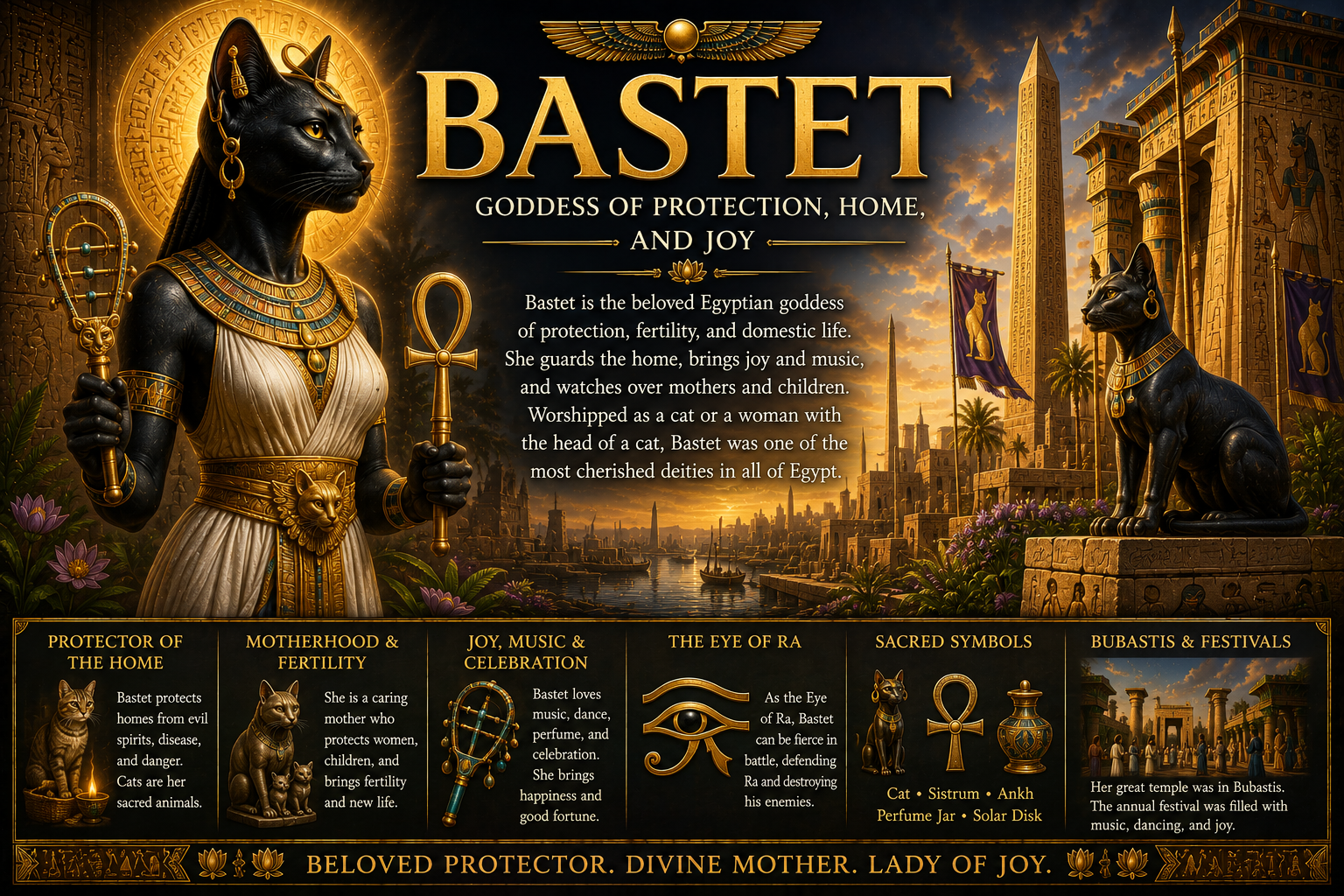
Bastet was one of the most beloved goddesses in Ancient Egyptian mythology. Best known as the cat goddess, Bastet was associated with protection, fertility, motherhood, domestic life, pleasure, music, and joy. Throughout Egyptian history, she evolved from a fierce lioness warrior deity into a gentler feline protector of the home and family.
Ancient Egyptians revered Bastet as both a nurturing mother and a powerful defender against evil. She protected households from disease, venomous creatures, and malicious spirits while also presiding over love, beauty, music, dance, and celebration.
Because of her compassionate nature and close association with cats, Bastet became one of the most widely worshipped deities in Ancient Egypt.
Origins and Early Worship
Bastet’s origins stretch back to Egypt’s earliest dynasties.
She first appeared during the Early Dynastic Period (c. 3100 to 2686 BCE) and was initially worshipped as a fierce lioness goddess similar to Sekhmet. During these early periods, Bastet served as a protector of Lower Egypt and a guardian of the king.
Over time, as domestic cats became increasingly important in Egyptian society, Bastet gradually transformed from a lioness deity into a gentler cat goddess.
By the Middle Kingdom and New Kingdom, Bastet was most commonly depicted as a domestic cat or a woman with the head of a cat.
What Does the Name Bastet Mean?
The exact meaning of Bastet’s name remains uncertain.
Scholars have proposed several interpretations, including “She of the Ointment Jar” because of her association with perfumes and cosmetics.
In earlier texts, her name often appears as Bast. The ending “-et” was added later, possibly to emphasize pronunciation.
Ancient Egyptians referred to Bastet by numerous titles, including:
- Lady of Bubastis
- Eye of Ra
- Lady of the East
- Mistress of Perfumes
- Lady of Protection
Bastet as Protector of the Home
Bastet was especially revered as a protector of households.
Ancient Egyptians believed that she safeguarded homes from:
- Evil spirits
- Disease
- Misfortune
- Venomous snakes
- Scorpions
Families frequently kept cats because they protected grain stores from rodents and homes from dangerous animals. Since cats provided such valuable services, they naturally became associated with Bastet.
Amulets depicting Bastet were extremely popular and were often worn to ensure protection and good fortune.
Goddess of Motherhood and Fertility
Bastet was also closely associated with motherhood, fertility, and childbirth.
Women often prayed to Bastet for:
- Fertility
- Safe pregnancies
- Protection during childbirth
- The health of children
Because mother cats are exceptionally protective of their young, Bastet became a symbol of maternal devotion and nurturing care.
Small amulets depicting Bastet with kittens were particularly popular among women seeking fertility and family blessings.
Bastet and the Eye of Ra
Like several Egyptian goddesses, Bastet was sometimes regarded as an aspect of the Eye of Ra.
In this role, she represented the protective and occasionally destructive power of the sun god. Earlier traditions portray Bastet as a fierce lioness warrior who defended Ra against the forces of chaos.
Over time, these aggressive qualities became increasingly associated with Sekhmet, while Bastet developed a more benevolent and domestic character.
Nevertheless, Bastet never entirely lost her fierce side. Ancient Egyptians believed that she could still unleash her wrath against those who threatened her followers.
Appearance and Symbols
Bastet was depicted in several different forms throughout Egyptian history.
She most commonly appeared as:
- A domestic cat.
- A woman with the head of a cat.
- In earlier periods, a lioness.
Bastet often carried:
- A sistrum, a sacred musical instrument.
- An ankh, symbolizing life.
- A basket or kittens, emphasizing motherhood.
Common symbols associated with Bastet include:
- Cats
- Lionesses
- The sistrum
- Perfume jars
- Kittens
- The solar disk
Cats themselves became sacred animals throughout Egypt because of their association with Bastet.
The Sacred Cats of Egypt
Cats occupied a unique position in Egyptian society. Because they were sacred to Bastet, harming or killing a cat, even accidentally, could carry severe penalties.
Many households kept cats as beloved companions and protectors. When a family cat died, owners often mourned deeply and sometimes shaved their eyebrows as a sign of grief.
Millions of cats were eventually mummified and offered to Bastet at temples dedicated to the goddess. These mummified cats served as votive offerings intended to secure the goddess’s favor.
The Temple of Bastet at Bubastis
Bastet’s principal cult center was the city of Bubastis in the eastern Nile Delta.
The magnificent Temple of Bastet became one of Ancient Egypt’s most important pilgrimage destinations.
The Greek historian Herodotus described the annual festival at Bubastis as one of the largest and most joyful celebrations in all of Egypt.
Hundreds of thousands of pilgrims reportedly traveled to the city to honor Bastet through music, dancing, feasting, and religious ceremonies.
Archaeologists have uncovered vast cat cemeteries near Bubastis containing millions of mummified cats dedicated to the goddess.
Festivals of Bastet
The Festival of Bastet was among the most popular celebrations in Ancient Egypt.
During these festivities, worshippers traveled by boat along the Nile while singing, dancing, playing music, and making offerings.
The celebrations included:
- Music and dancing
- Feasting
- Drinking
- Processions
- Religious rituals
The festival reflected Bastet’s close association with joy, pleasure, and communal celebration.
Bastet in the Greco-Roman World
During the Greco-Roman Period, Bastet remained widely worshipped.
The Greeks identified Bastet with Artemis, their goddess of hunting and protection.
Despite the spread of foreign influence, Bastet retained her distinctly Egyptian identity and remained enormously popular until the decline of traditional Egyptian religion.
Legacy of Bastet
For more than three thousand years, Bastet served as one of Egypt’s most beloved goddesses.
As protector of the home, guardian of mothers and children, and patroness of joy and celebration, Bastet touched nearly every aspect of daily life.
Today, Bastet remains one of the most recognizable figures of Ancient Egyptian mythology and continues to captivate historians, archaeologists, and cat lovers around the world.