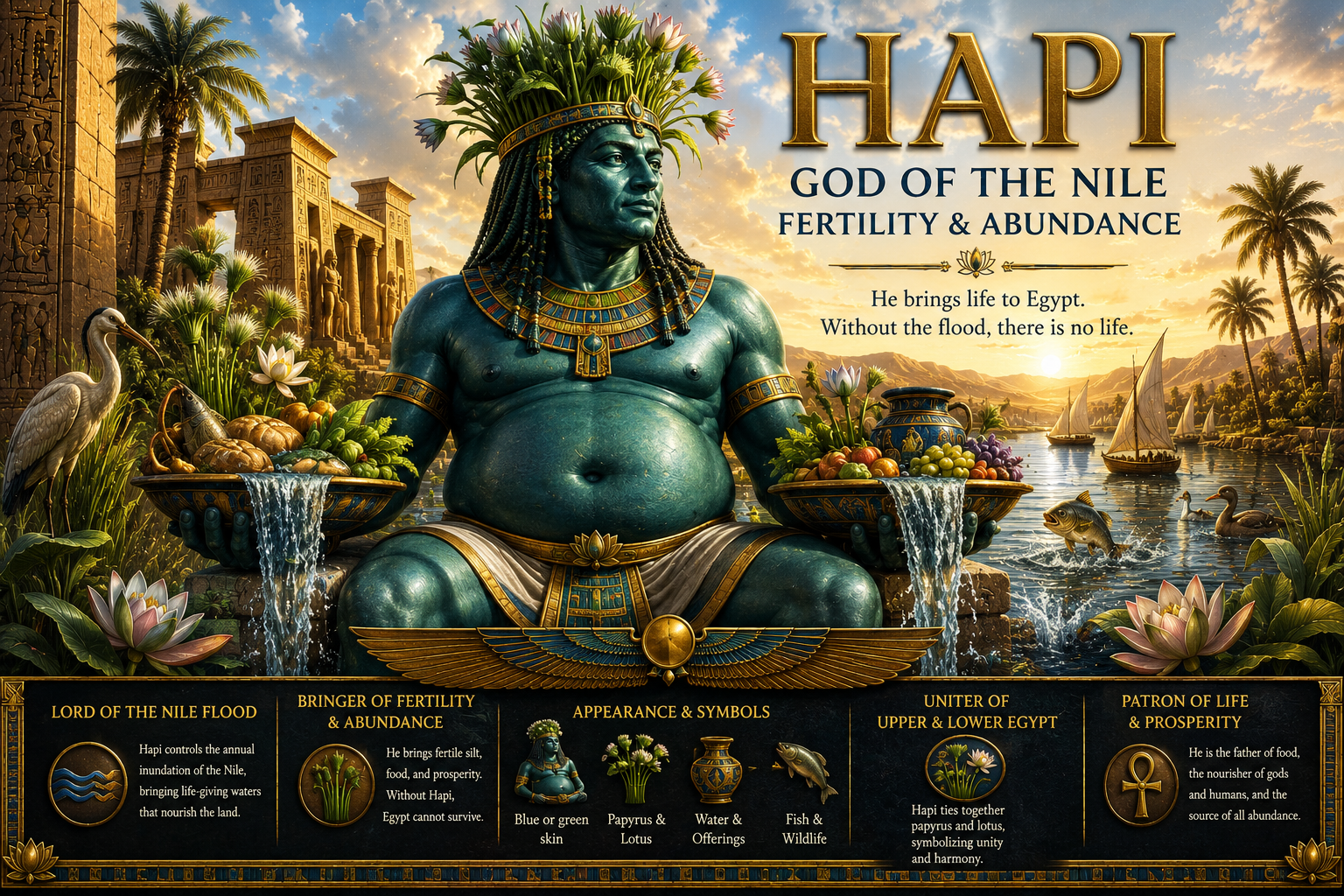
Hapi was the ancient Egyptian god of the Nile River’s annual inundation, fertility, abundance, and prosperity. Unlike many Egyptian gods associated with war, kingship, or the afterlife, Hapi represented the life-giving floodwaters that sustained all of Egyptian civilization.
The annual flooding of the Nile was the single most important natural event in Ancient Egypt. Each year, the river overflowed its banks, depositing rich black silt across the surrounding farmland. This fertile soil allowed crops to grow and ensured the survival of the Egyptian people. Because of this, Hapi became one of the most beloved and widely revered deities in Egypt.
Ancient Egyptians often referred to Hapi as the “Lord of the River Bringing Vegetation” and the “Lord of Fish and Birds of the Marshes.”
Origins and Early Worship
Hapi’s origins date back to the earliest periods of Egyptian history.
Unlike many deities whose worship centered around a single city, Hapi was revered throughout Egypt because the Nile affected every aspect of daily life. Evidence suggests that his cult existed as early as the Predynastic Period (before 3100 BCE).
Although Hapi was worshipped throughout the country, important cult centers developed near the Nile’s source regions, particularly at Elephantine Island near Aswan.
The Egyptians believed that the floodwaters emerged from subterranean caverns near Elephantine, guarded by the creator god Khnum.
What Does the Name Hapi Mean?
The exact meaning of Hapi’s name remains uncertain.
Some scholars believe it simply referred to the Nile inundation itself, while others suggest that the name may be connected to concepts of flooding and abundance.
The ancient Egyptians used the word Hapy to refer both to the deity and the annual inundation that brought fertility to the land.
Because Egypt’s prosperity depended entirely on the Nile, Hapi was considered one of the nation’s most important gods.
God of the Nile Flood
Hapi’s primary responsibility was overseeing the annual inundation of the Nile.
Each summer, floodwaters originating in the Ethiopian Highlands traveled northward into Egypt. When the waters receded, they left behind nutrient-rich soil ideal for farming.
Ancient Egyptians divided the year into three seasons:
- Akhet – The season of inundation.
- Peret – The season of emergence and planting.
- Shemu – The season of harvest.
Hapi governed the first of these seasons, Akhet.
A successful flood meant prosperity and abundance. A weak flood could bring famine, while excessive flooding could destroy homes and crops. For this reason, Egyptians regularly prayed to Hapi for balanced and beneficial inundations.
Bringer of Fertility and Abundance
Because the Nile flood sustained Egyptian agriculture, Hapi became strongly associated with fertility, abundance, and nourishment.
Ancient hymns praise Hapi as:
- The giver of food.
- The creator of grain.
- The bringer of prosperity.
- The nourisher of gods and humans.
Without Hapi’s blessings, Egyptian civilization could not survive.
Offerings of bread, beer, flowers, fruits, and precious goods were frequently presented to the god in hopes of ensuring plentiful harvests.
Appearance and Symbols
Hapi possessed one of the most distinctive appearances in Egyptian art.
He was usually depicted as a man with:
- A large belly.
- Pendulous breasts.
- Blue or green skin.
- Papyrus and lotus plants on his head.
These features symbolized fertility, nourishment, and abundance. The combination of masculine and feminine traits emphasized Hapi’s role as a universal provider capable of nurturing all life.
Hapi often carries trays overflowing with food, jars of water, fish, and agricultural produce.
Common symbols associated with Hapi include:
- The Nile River.
- Water jars.
- Papyrus plants.
- Lotus flowers.
- Fish and waterfowl.
- Offerings of food.
Hapi and the Unification of Egypt
Hapi was closely connected with the unity of Upper and Lower Egypt. In many temple scenes, two images of Hapi are shown tying together the papyrus plant of Lower Egypt and the lotus plant of Upper Egypt around a central symbol.
This motif, known as the sema-tawy, symbolized the unification of Egypt.
Because the Nile flowed through both regions, Hapi naturally became a symbol of national unity and harmony.
Hapi and Other Egyptian Gods
Although Hapi was immensely important, he was rarely considered a creator god. Instead, he often worked alongside other deities.
The god Khnum, for example, was believed to control the Nile’s source and regulate its waters. Osiris was also closely linked to agricultural fertility and vegetation.
Hapi himself was sometimes described as the father of the gods because his waters nourished all creation. Despite these associations, Hapi maintained a unique identity throughout Egyptian history.
Worship of Hapi
Hapi was worshipped throughout Egypt by both common people and the state. Temples and shrines dedicated to Hapi existed along the Nile, and many important religious festivals celebrated the annual flood.
Priests performed rituals and made offerings to encourage favorable inundations. The beginning of the inundation season was a time of celebration, thanksgiving, and religious devotion.
Ancient hymns dedicated to Hapi survive to this day and provide valuable insight into how essential the Nile was to Egyptian life.
One famous hymn proclaims:
“Hail to you, Hapi, who comes forth from the earth and comes to nourish Egypt.”
Hapi in the Greco-Roman Period
Hapi remained widely worshipped during the Greco-Roman Period. Greek and Roman visitors to Egypt quickly recognized the central importance of the Nile and often associated Hapi with their own river deities.
Even after foreign conquest, Hapi continued to symbolize Egypt’s prosperity and agricultural wealth.
Legacy of Hapi
For thousands of years, Hapi represented the life-giving power of the Nile River. As god of the inundation, fertility, abundance, and prosperity, Hapi stood at the very heart of Egyptian civilization.
Without the Nile, there could have been no Ancient Egypt, and without Hapi, the Egyptians believed that the Nile itself could not fulfill its sacred role.
Today, Hapi remains one of the most fascinating Egyptian deities, embodying the intimate relationship between humanity, nature, and divine power.