Sobek: The Egyptian Crocodile God of the Nile, Fertility, and Power
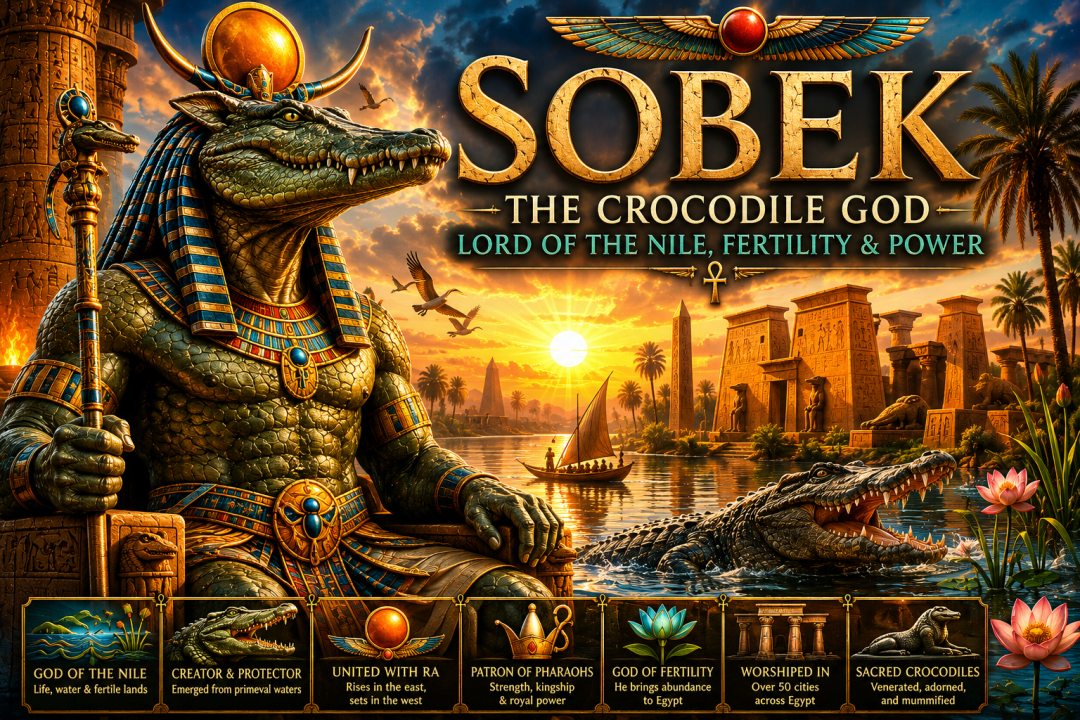
Sobek was one of the most fascinating and powerful gods in Ancient Egyptian mythology. Usually depicted as a crocodile or as a man with the head of a crocodile, Sobek was the god of the Nile, fertility, military prowess, and royal authority. Although he began as a local deity, Sobek eventually became one of the most important gods in the Egyptian pantheon and was worshipped throughout Egypt for thousands of years.
Ancient Egyptians both feared and revered crocodiles. These massive reptiles were among the most dangerous creatures inhabiting the Nile River, and Sobek embodied both their terrifying power and their life-giving connection to the river.
Origins of Sobek
Sobek is one of the earliest known Egyptian deities. Archaeologists have discovered references to the crocodile god dating back to the Early Dynastic Period (c. 3100-2686 BC).
One of the earliest possible depictions of Sobek appears on the sealings of King Narmer, the ruler traditionally credited with unifying Upper and Lower Egypt and founding Egypt’s First Dynasty. These early depictions suggest that Sobek was already an established deity at the dawn of Egyptian civilization.
Initially, Sobek was primarily worshipped as a local god in the Faiyum region, where crocodiles were abundant. His principal cult center was the city of Shadet, known to the Greeks as Crocodilopolis, meaning “City of the Crocodile.”
Sobek and the Nile
The Nile River was the lifeblood of Ancient Egypt, providing water, transportation, fertile soil, and food.
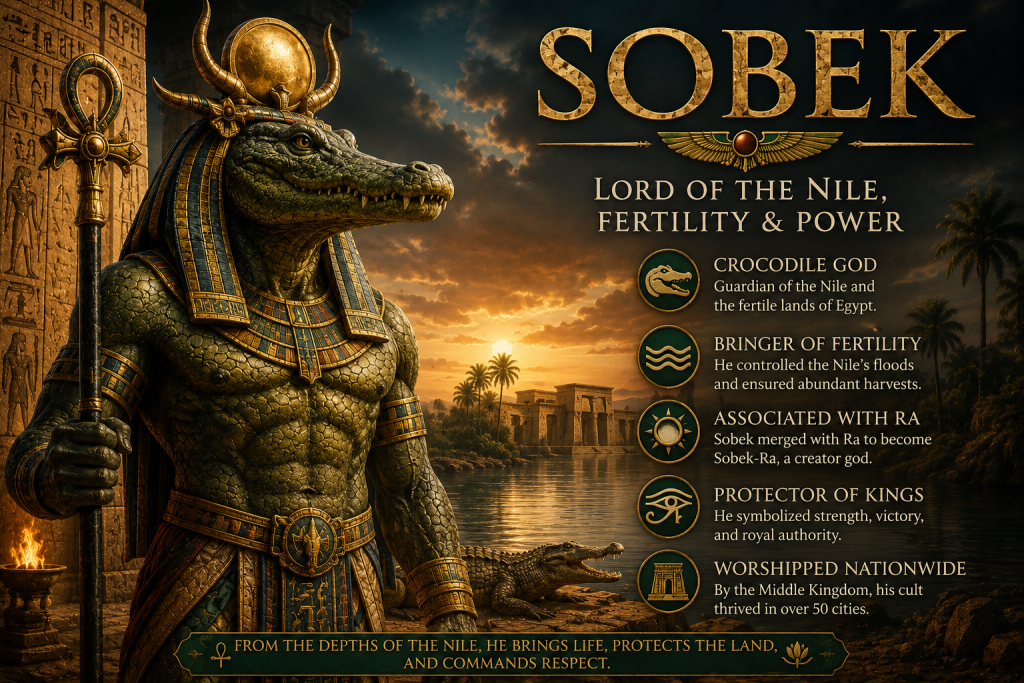
Because crocodiles inhabited the Nile and its marshes, Sobek became closely associated with the river itself. Egyptians believed that Sobek controlled the Nile’s waters and ensured the fertility of the surrounding farmland.
The annual flooding of the Nile deposited nutrient-rich silt across Egypt, allowing crops to flourish. As a result, Sobek was viewed not merely as a dangerous predator but also as a god of fertility, abundance, and agricultural prosperity.
Farmers often prayed to Sobek for successful harvests and protection from the river’s dangers.
Sobek as a Creator God
During the Middle Kingdom (c. 2055-1650 BC), Sobek’s status rose dramatically.
Many religious texts from this period portray Sobek as a creator deity who emerged from the primordial waters of Nun at the beginning of creation. Some hymns describe Sobek as having helped shape the world and bring order out of chaos.
The exact nature of Sobek’s role in creation varied depending on the region and religious tradition. Nevertheless, these myths elevated Sobek from a local crocodile god to one of Egypt’s most important divine figures.
Sobek and Ra
Sobek’s growing prestige eventually led to his association with the sun god Ra.
During the Middle Kingdom, the two deities were merged into a composite god known as Sobek-Ra or Sobek-Re. In this form, Sobek acquired solar attributes and became closely linked with kingship and divine creation.
An inscription found in the tomb of the official Daga refers to Sobek as “the one who rises in the east and sets in the west,” clearly reflecting his connection to the sun’s daily journey.
As Sobek-Ra, the crocodile god, became part of the elite group of deities associated with the creator god Ra.
Sobek and the Pharaohs
Sobek was strongly associated with royal power.
Ancient Egyptian rulers admired the crocodile’s strength, aggression, and dominance. Pharaohs often invoked Sobek’s protection in battle and identified themselves with his power.
Several Middle Kingdom kings, particularly those of the Twelfth Dynasty, actively promoted Sobek’s worship. The most famous example is Pharaoh Amenemhat III, who extensively developed the Faiyum region and greatly expanded Sobek’s cult.
Texts sometimes refer to Sobek as “Lord of the Palace” and “Lord of the Crown,” emphasizing his close relationship with kingship.
Because the pharaoh was considered the earthly representative of the gods, associating the king with Sobek reinforced royal authority.
Sobek and Horus
In some traditions, Sobek became associated with Horus, the falcon-headed god of kingship.
The combined deity Sobek-Horus symbolized divine kingship and royal legitimacy. Scholars believe this merger may have helped strengthen the connection between the pharaoh and the crocodile god.
By associating Sobek with Horus, Egyptian rulers could emphasize both their divine origins and their political authority.
Appearance and Symbols
Sobek was most commonly depicted in one of two forms:
- As a full crocodile.
- As a man with the head of a crocodile.
In artistic representations, Sobek often wore:
- A solar disk
- A pair of ram’s horns
- The Atef crown
- The double crown of Upper and Lower Egypt
His primary symbols included:
- Crocodiles
- The Nile River
- Water and marshes
- The solar disk
- Royal crowns
Living crocodiles were sometimes kept in temples dedicated to Sobek and were treated as sacred animals.
Worship of Sobek
Sobek’s principal cult center was Shadet (Crocodilopolis) in the Faiyum Oasis. There, priests maintained sacred crocodiles adorned with jewelry and precious ornaments.
Another major center of Sobek worship was Kom Ombo in Upper Egypt. The famous Temple of Kom Ombo was jointly dedicated to Sobek and Horus the Elder.
By the late Middle Kingdom, Sobek’s cult had spread widely throughout Egypt. Historians estimate that temples or shrines dedicated to Sobek existed in more than fifty Egyptian cities.
The widespread popularity of Sobek demonstrates just how important the crocodile god became in Egyptian religion.
Sacred Crocodiles
Ancient Egyptians sometimes kept live crocodiles in temple enclosures as manifestations of Sobek.
These sacred animals were fed by priests, adorned with gold and jewels, and carefully cared for throughout their lives. When they died, they were mummified and buried with great honor.
Thousands of mummified crocodiles have been discovered by archaeologists, providing remarkable evidence of Sobek’s enduring popularity.
Legacy of Sobek
Sobek remained an important deity from the earliest periods of Egyptian history until the Roman era.
His unique combination of danger and protection perfectly reflected the ancient Egyptians’ relationship with the Nile itself: a river capable of both sustaining life and causing destruction.
Today, Sobek continues to fascinate historians and mythology enthusiasts as the powerful crocodile god who embodied the might, fertility, and mystery of Ancient Egypt.