Ma’at was one of the most important concepts and deities in Ancient Egyptian religion. She was the goddess of truth, justice, balance, harmony, law, morality, and cosmic order. Ancient Egyptians believed that Ma’at regulated both the physical universe and human society, ensuring that order prevailed over chaos.
Unlike many other Egyptian gods, Ma’at was not merely a deity with a specific domain. She also represented an abstract principle, the very foundation upon which Egyptian civilization rested. The concept of Ma’at influenced every aspect of Egyptian life, from religion and government to law and personal morality.
Although Ma’at is first clearly attested during the Old Kingdom (c. 2613 to 2181 BC), scholars believe that the concept existed much earlier and likely formed part of Egyptian religion from its very beginnings.
What Does Ma’at Mean?
The name Ma’at is usually translated as “truth,” “justice,” “order,” or “that which is right.”
Ancient Egyptians believed that the universe functioned properly only when Ma’at was maintained. Without Ma’at, the world would descend into Isfet, the Egyptian concept of chaos, injustice, violence, and disorder.
Everything from the annual flooding of the Nile to the movement of the stars depended upon Ma’at. Even the gods themselves were expected to uphold her principles.
For ordinary Egyptians, living according to Ma’at meant:
- Speaking truthfully
- Acting honestly
- Respecting others
- Maintaining social harmony
- Following the law
- Avoiding greed and injustice
As a result, Ma’at served as the moral and ethical foundation of Ancient Egyptian society.
Origins of Ma’at
According to Egyptian mythology, Ma’at came into existence at the moment of creation.
When the creator god Ra emerged from the primordial waters of Nun and brought order to the cosmos, Ma’at was born alongside creation itself. Some myths describe Ra as creating Ma’at through the power of Heka, the divine force of magic.
Because Ma’at embodied universal order, she existed from the beginning of time. Ancient Egyptians believed that as long as Ma’at endured, creation itself would survive.
Pharaohs were expected to preserve Ma’at on Earth just as the gods preserved it in heaven.
Appearance and Symbols
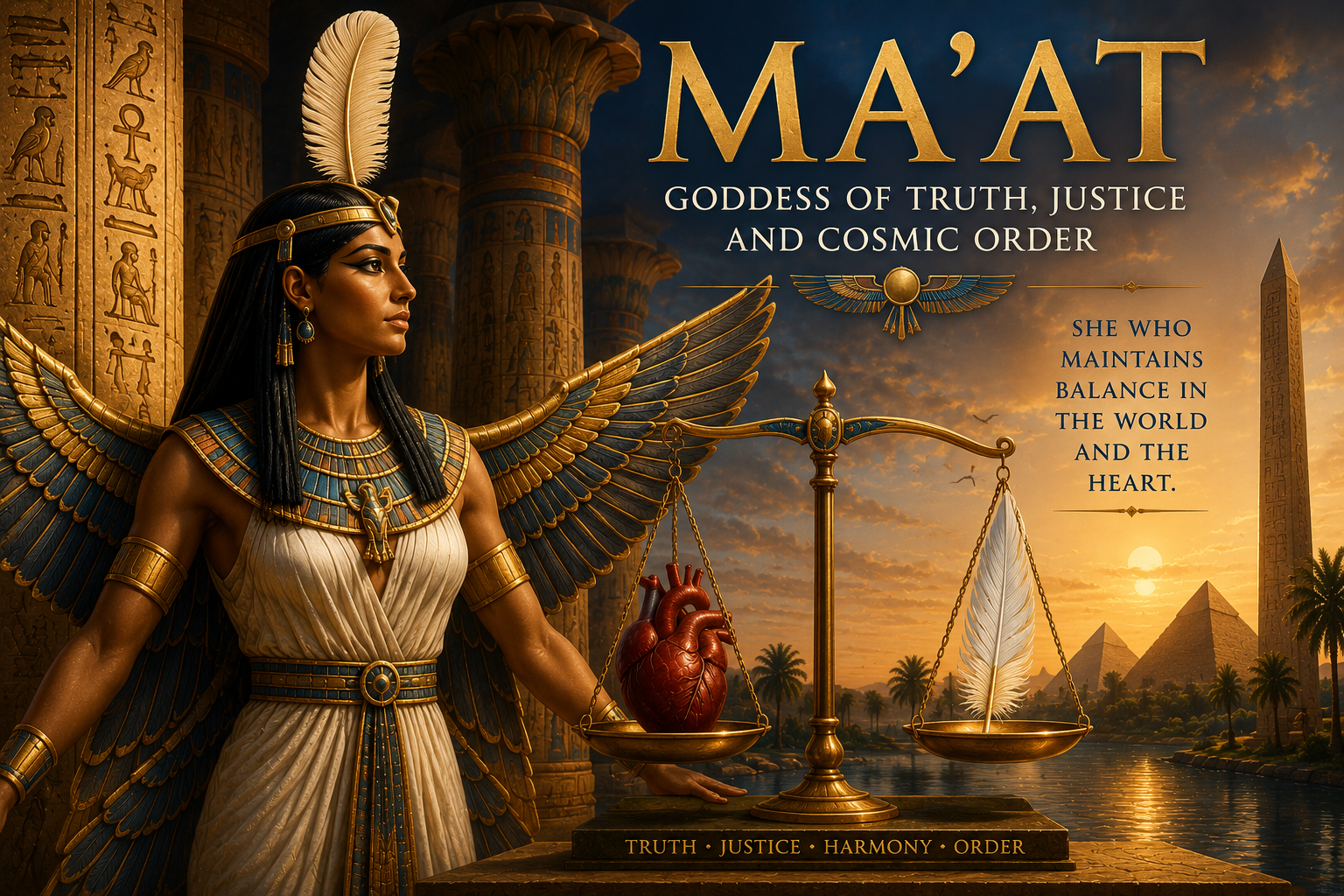
Ma’at was almost always depicted as a beautiful woman wearing an ostrich feather upon her head. Sometimes she was shown with large outstretched wings, symbolizing protection and divine authority.
In some representations, Ma’at herself appears only as a single ostrich feather, which became one of the most recognizable symbols in Egyptian religion.
Her primary symbols included:
- The ostrich feather
- Outstretched wings
- The throne or pedestal
- The balance scales used in the afterlife
The feather of Ma’at became synonymous with truth and righteousness throughout Egyptian history.
Ma’at and the Weighing of the Heart
One of Ma’at’s most famous roles was in the Egyptian afterlife.
After death, a person’s heart was brought before the divine tribunal in the Hall of Ma’at. There, the god Anubis weighed the deceased person’s heart against the Feather of Ma’at.
The heart represented a person’s conscience and the sum of their earthly actions.
If the heart balanced perfectly against the feather, the deceased was judged worthy and allowed to enter the eternal paradise known as the Field of Reeds.
If the heart proved heavier than the feather due to sin and wrongdoing, it was devoured by the terrifying creature Ammit, resulting in the permanent destruction of the soul.
The god Thoth recorded the outcome of this judgment while Osiris presided over the tribunal.
This ceremony encouraged Egyptians to live moral lives and remains one of the best-known aspects of Egyptian religion.
Ma’at and Ra
Ma’at shared a particularly close relationship with the sun god Ra.
Ancient Egyptians believed that Ra carried Ma’at with him as he traveled across the sky in his solar barque. Together with other gods, she helped protect Ra from the giant serpent Apophis, who embodied chaos and sought to destroy creation.
In many temple scenes, pharaohs are shown offering a small figure of Ma’at to Ra or other gods. These offerings symbolized the king’s commitment to maintaining cosmic order.
Without Ma’at, Ra could not complete his daily journey, and the universe itself would cease to function.
Ma’at and the Pharaohs
The pharaoh’s primary duty was to uphold Ma’at throughout Egypt.
Ancient Egyptians believed that the king ruled by divine authority and was responsible for preserving justice, enforcing laws, maintaining religious rituals, and protecting Egypt from foreign enemies.
A successful reign was seen as evidence that Ma’at prevailed, while famine, invasion, or civil unrest could be interpreted as signs that Ma’at had been disrupted.
Many royal inscriptions describe pharaohs as “Beloved of Ma’at” or “Living in Ma’at.”
Did Ma’at Have Temples?
Unlike major deities such as Amun, Osiris, or Isis, Ma’at had relatively few temples dedicated exclusively to her worship.
Nevertheless, shrines to Ma’at existed within many larger temple complexes. Priests and priestesses served her, and special chapels dedicated to Ma’at were often attached to temples dedicated to other gods.
The goddess held such an important place in Egyptian religion that her presence permeated virtually every temple and religious ceremony.
Ma’at and Isfet
The opposite of Ma’at was Isfet, the force of chaos, falsehood, injustice, and disorder.
Ancient Egyptians viewed the struggle between Ma’at and Isfet as a constant cosmic battle. Every day, the gods and humanity worked together to preserve order and prevent chaos from overwhelming the world.
This conflict is especially evident in the nightly battle between Ra and the serpent Apophis, who personified Isfet.
By living morally and participating in religious rituals, Egyptians believed they were helping to strengthen Ma’at and preserve creation itself.
Legacy of Ma’at
Few religious concepts have had as profound an impact on a civilization as Ma’at did on Ancient Egypt.
For more than three thousand years, Ma’at shaped Egyptian law, government, ethics, and religion. Her principles influenced how Egyptians treated one another, how kings governed, and how individuals prepared for the afterlife.
Today, Ma’at remains one of the most fascinating and influential concepts in Ancient Egyptian thought, representing the eternal struggle to maintain truth, justice, and harmony in the world.