Set: The Egyptian God of Chaos, Storms, and the Desert
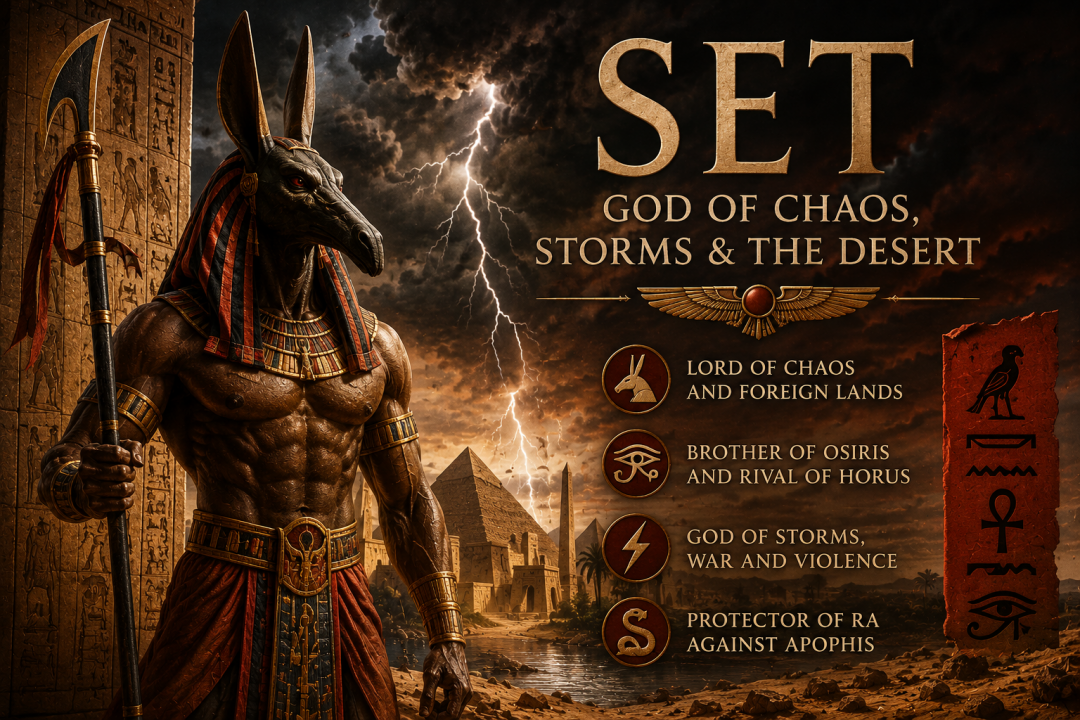
Set, also known as Seth, was one of the most complex and controversial gods in Ancient Egyptian mythology. He was the god of chaos, storms, deserts, violence, foreign lands, and warfare. Although modern audiences often remember Set as the villain who murdered Osiris, the ancient Egyptians viewed him in a far more complicated way.
Throughout Egyptian history, Set could be both a protector and a destroyer, a defender of cosmic order and a force of chaos. His character evolved over thousands of years, making him one of the most fascinating deities in the Egyptian pantheon.
Set was one of the five children born to the sky goddess Nut and the earth god Geb. His siblings were:
- Osiris, god of the underworld
- Isis, goddess of magic and motherhood
- Nephthys, goddess of mourning and protection
- Horus the Elder, in some traditions
In the Heliopolitan tradition, Set married his sister Nephthys. Although their marriage produced no children in most myths, some traditions identify the jackal-headed god Anubis as their son, while others name Osiris as Anubis’ father.
Set was also associated with several other goddesses, including the hippopotamus goddess Tawaret and the Canaanite goddess Anat during later periods.
What Does the Name Set Mean?
The exact meaning of Set’s name remains uncertain. Egyptologists have proposed several interpretations, including “instigator of confusion,” “pillar of stability,” or “one who dazzles.”
Whatever its original meaning, Set became strongly associated with disorder, storms, violence, and the untamed wilderness beyond Egypt’s fertile Nile Valley.
His most common titles included:
- Lord of the Desert
- Lord of Foreign Lands
- Great of Strength
- Ruler of Upper Egypt
- Lord of Chaos
Appearance and Symbols
Set possessed one of the most unusual appearances in Egyptian art.
He was commonly depicted as a man with the head of the mysterious “Set animal.” This creature had:
- A long, curved snout
- Tall square-tipped ears
- A forked tail
- A slender canine-like body
The exact animal that inspired Set’s appearance remains unknown. Scholars have suggested that it may have been based on an aardvark, jackal, donkey, saluki, okapi, or a purely mythical creature.
Set was also associated with several animals, including:
- Donkeys
- Hippopotamuses
- Crocodiles
- Pigs
- Serpents
- Griffins
The color red was sacred to Set because it symbolized the desert’s red sands and the destructive power of storms.
Set and the Murder of Osiris
Set is best known for his role in the central myth of Egyptian religion: the murder of Osiris.
According to the myth, Osiris ruled Egypt during a golden age of peace and prosperity. Jealous of his brother’s popularity and power, Set devised a plan to kill him.
During a banquet, Set presented an ornate chest and announced that whoever fit inside it perfectly could keep it. When Osiris lay down inside, Set slammed the lid shut, sealed the chest, and cast it into the Nile.
In some versions of the story, Set later dismembered Osiris’ body and scattered the pieces throughout Egypt.
Osiris’ wife Isis, aided by Nephthys, searched for the missing pieces, reassembled his body, and temporarily restored him to life through magic. Their union resulted in the conception of Horus.
Eventually, Horus grew to adulthood and challenged Set for the throne of Egypt. Their struggle became one of the defining conflicts of Egyptian mythology.
Set and Horus
The conflict between Horus and Set symbolized the struggle between order and chaos.
The two gods fought numerous battles for control of Egypt. In one famous encounter, Set tore out Horus’ eye, while Horus damaged Set’s testicles.
After many contests and judgments before the divine tribunal, Horus was ultimately declared the rightful king of Egypt.
Despite his defeat, Set was not destroyed. Instead, he continued to perform an essential cosmic function.
Set as Protector of Ra
Although Set murdered Osiris, he also played a heroic role in Egyptian mythology.
Every night, the sun god Ra traveled through the underworld aboard his solar barque. During this journey, Ra faced the monstrous serpent Apophis, who sought to plunge creation into eternal darkness.
Set often stood at the prow of Ra’s boat and defended the sun god by spearing Apophis.
Because of this role, many Egyptians regarded Set as a powerful protector who defended the universe against complete chaos.
During the Early Dynastic Period and the Old Kingdom, Set was often viewed as a benevolent and protective deity rather than a villain.
Why Did Set Become Evil?
Historians believe that Set’s reputation gradually changed over time for several reasons.
Because Set was associated with deserts and foreign lands, periods of invasion by foreign powers may have contributed to his increasingly negative image.
The Hyksos rulers of Egypt, who governed during the Second Intermediate Period, particularly favored Set. After the Hyksos were expelled, some Egyptians may have associated Set with foreign domination.
During the New Kingdom and especially the Late Period, myths increasingly emphasized Set’s role as Osiris’ murderer and enemy of Horus.
Even so, Set never became entirely evil. He continued to receive worship in certain regions and remained an important divine protector.
Worship of Set
Set was worshipped throughout much of Egyptian history.
His principal cult centers included:
- Ombos (Naqada)
- Avaris in the Nile Delta
- Sepermeru
Several pharaohs honored Set, and some even incorporated his name into their royal titles.
Perhaps the most famous example was Pharaoh Seti I, whose name means “Man of Set.” His son, Seti II, also bore the god’s name.
The fact that powerful rulers proudly used Set’s name demonstrates that the god remained respected despite his controversial reputation.
Set and Greek Mythology
The ancient Greeks identified Set with Typhon, the monstrous adversary of Zeus.
Like Set, Typhon represented destructive forces and challenged divine authority. However, the comparison is imperfect because Set retained many positive qualities that Typhon lacked.
Legacy of Set
Set remains one of the most misunderstood gods of Ancient Egypt.
Although modern portrayals often depict him solely as a god of evil, the ancient Egyptians viewed him as both destructive and necessary. He represented the dangerous yet essential forces of nature, the chaos beyond civilization, and the constant struggle required to preserve cosmic order.
Today, Set continues to fascinate historians and mythology enthusiasts as one of Ancient Egypt’s most powerful and enigmatic deities.