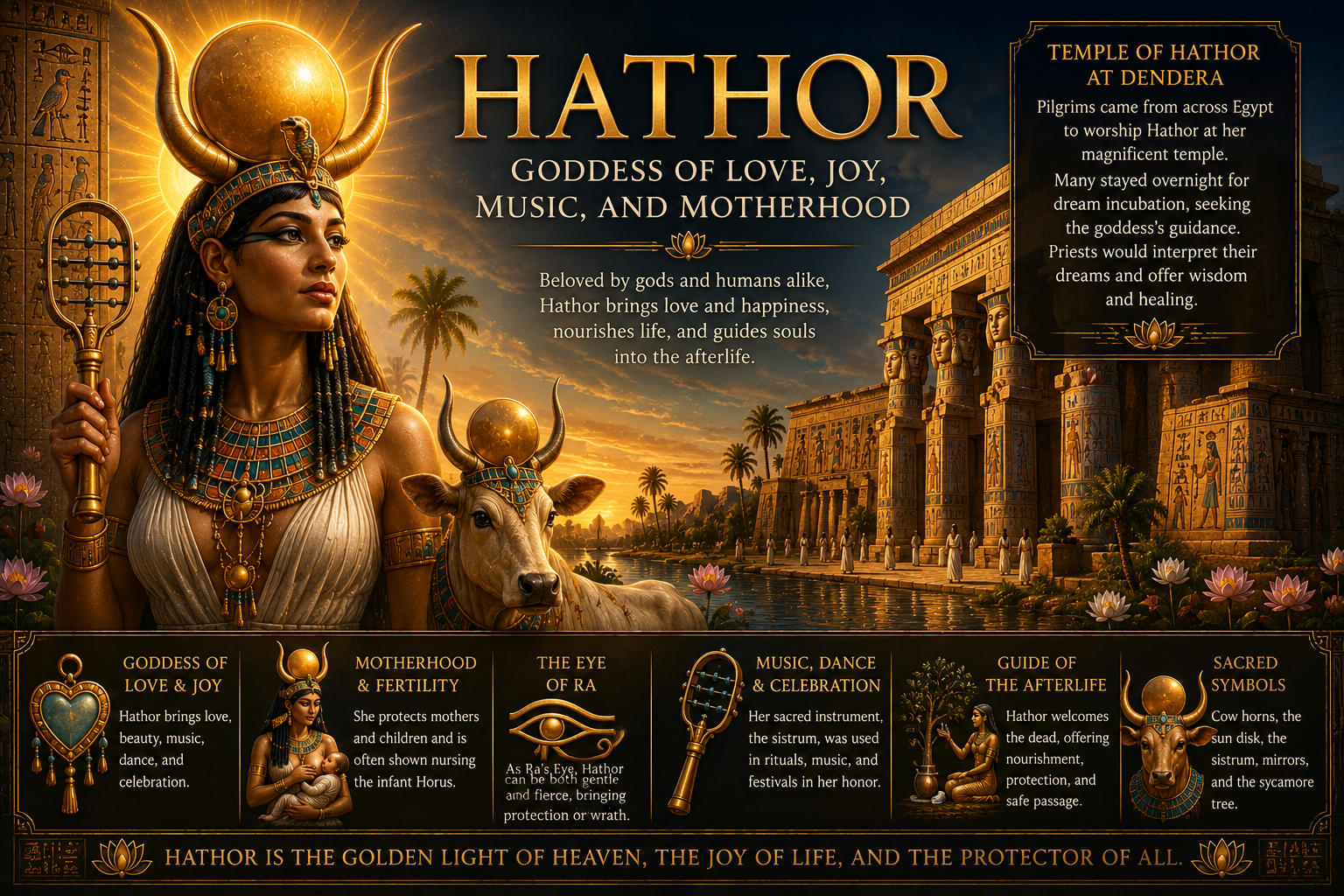
Hathor was one of the most important and beloved goddesses in Ancient Egyptian mythology. She was the goddess of love, beauty, music, dance, joy, motherhood, fertility, and the sky. Over the course of Egyptian history, Hathor became associated with numerous other aspects of life, including foreign lands, drunkenness, childbirth, and the afterlife.
The ancient Egyptians viewed Hathor as a nurturing and protective deity who brought happiness and abundance to both gods and humans. Her influence was so widespread that she was worshipped throughout Egypt for more than three thousand years.
Because of her many roles, Hathor became known by numerous titles, including “Mistress of Heaven,” “Lady of the Stars,” “The Golden One,” and “Mistress of Turquoise.”
Origins and Family
The origins of Hathor are extremely ancient and somewhat uncertain.
Some scholars believe Hathor may have originally been a sky goddess worshipped during Predynastic times. Over time, she absorbed the attributes of several local goddesses and grew into one of Egypt’s most important deities.
In many traditions, Hathor was regarded as the daughter of the sun god Ra and was closely associated with his divine Eye. In other myths, she was considered the wife of Horus the Elder, particularly at Edfu, where the two gods were celebrated during elaborate annual festivals.
Because Egyptian religion evolved over thousands of years, Hathor’s family relationships often changed depending on the region and historical period.
What Does the Name Hathor Mean?
The name Hathor comes from the ancient Egyptian Het-Heru, meaning “House of Horus.” This title refers to the sky itself, which the Egyptians imagined as the celestial home of Horus, the falcon god.
As a sky goddess, Hathor was believed to embrace and protect both the gods and humanity.
Goddess of Love and Joy
Hathor was primarily known as the goddess of love, beauty, pleasure, music, and celebration.
Ancient Egyptians turned to Hathor for happiness, romance, and emotional fulfillment. Festivals dedicated to Hathor often featured:
- Music
- Singing
- Dancing
- Feasting
- Drinking
- Processions
Because she presided over joy and celebration, Hathor became one of the most popular deities among ordinary Egyptians.
People prayed to Hathor for success in love, fertility, and family life.
Goddess of Motherhood and Fertility
Hathor was also a powerful mother goddess.
Ancient Egyptian women frequently invoked Hathor during pregnancy and childbirth, believing that she protected mothers and newborn children.
She was sometimes called “The Divine Mother” and was associated with nursing, nurturing, and maternal care.
Many pharaohs claimed that Hathor had nursed them as infants, emphasizing her role as a protector of kingship.
In artistic depictions, Hathor often appears breastfeeding either the infant Horus or the reigning pharaoh.
Hathor and the Eye of Ra
One of Hathor’s most important roles was as the Eye of Ra.
According to Egyptian mythology, Ra sent his divine Eye to punish humanity after people rebelled against him. In some versions of this myth, Hathor transformed into the fierce lioness goddess Sekhmet and nearly destroyed humankind.
Realizing that Sekhmet’s wrath threatened all life, Ra tricked her into drinking beer dyed red to resemble blood. After becoming intoxicated, the enraged goddess calmed down and once again became the gentle Hathor.
This myth illustrates Hathor’s dual nature as both a loving mother and a formidable force of divine power.
Hathor and the Afterlife
Hathor played an important role in Egyptian beliefs about the afterlife.
Ancient Egyptians believed that Hathor welcomed the deceased into the next world and provided them with food, drink, and protection.
She was often depicted emerging from a sycamore tree, offering water and nourishment to the dead.
Many tombs contain images of Hathor because Egyptians hoped she would guide and protect them on their journey through the underworld.
She was especially associated with the western horizon, where the sun set and where many Egyptians believed the entrance to the afterlife was located.
Appearance and Symbols
Hathor was depicted in several forms throughout Egyptian history.
Most commonly, she appeared as:
- A woman wearing a solar disk between a pair of cow horns.
- A complete cow.
- A woman with cow ears.
- A beautiful woman wearing an elaborate headdress.
The cow was Hathor’s sacred animal because it symbolized motherhood, nourishment, and fertility.
Common symbols associated with Hathor include:
- Cow horns
- The solar disk
- The sistrum (a musical instrument)
- Mirrors
- Menat necklaces
- The sycamore tree
The sistrum, a sacred rattle used in temple ceremonies, became particularly associated with Hathor and her worship.
Worship of Hathor
Hathor was worshipped throughout Egypt, but her principal cult center was located at Dendera in Upper Egypt. The magnificent Temple of Hathor at Dendera remains one of the best-preserved temple complexes in Egypt today.
Her worship also spread far beyond Egypt’s borders, reaching Nubia, the Sinai Peninsula, and parts of the Mediterranean world. Because Hathor was associated with mining and foreign trade, miners and travelers frequently sought her protection.
Festivals of Hathor
The Egyptians celebrated numerous festivals in Hathor’s honor. One of the most famous was the Beautiful Festival of the Reunion, during which Hathor traveled from Dendera to visit Horus at Edfu.
This festival symbolized divine love, fertility, and the renewal of life. Large crowds gathered to participate in music, feasting, processions, and religious ceremonies.
The Festival of Drunkenness was another important celebration connected with Hathor and commemorated the myth in which she was pacified after nearly destroying humanity.
Hathor and Dream Incubation
Hathor was not only a goddess of love and joy but also a deity associated with dreams, healing, and divine guidance.
Many ancient Egyptians believed that the gods could communicate with humans through dreams. At Hathor’s great temple complex at Dendera, worshippers sometimes practiced what modern scholars call dream incubation.
During this ritual, pilgrims would travel to Hathor’s temple seeking answers to important questions about their health, relationships, future, or personal problems. After making offerings and participating in purification rituals, they would spend the night sleeping within designated sacred areas of the temple.
The worshippers hoped that Hathor would appear to them in dreams or send symbolic visions containing divine advice. Priests attached to the temple may then have helped interpret these dreams and explain their meaning.
Dreams held enormous significance in Ancient Egypt, and many people believed that sleeping in Hathor’s sanctuary allowed them to come into direct contact with the goddess. This practice further strengthened Hathor’s reputation as a compassionate deity who guided, healed, and protected her followers.
The Temple of Hathor at Dendera became one of the most important religious pilgrimage sites in Egypt, attracting visitors from across the country who sought the goddess’s wisdom and blessings.
Legacy of Hathor
Hathor remained one of Ancient Egypt’s most beloved goddesses for over three thousand years. As goddess of love, motherhood, joy, music, and the afterlife, she touched nearly every aspect of Egyptian life.
Today, Hathor continues to fascinate historians, archaeologists, and mythology enthusiasts as one of the most compassionate, complex, and enduring deities of Ancient Egypt.