Shu was one of the oldest and most important gods in Ancient Egyptian mythology. He was the god of air, light, peace, and the atmosphere that separates heaven from earth. As one of the first deities created at the beginning of time, Shu played a crucial role in maintaining the structure of the universe.
Ancient Egyptians believed that without Shu, the world could not exist. It was Shu who separated the sky goddess Nut from the earth god Geb, creating the space in which all life could flourish. Because of this act, Shu was regarded as a god of creation, order, and life itself.
Although he is often overshadowed by more famous deities such as Ra, Osiris, and Isis, Shu occupied a central place in Egyptian religion and cosmology for thousands of years.
Origins and Family
According to the Heliopolitan creation myth, Shu was one of the first gods to come into existence.
The creator god Atum brought Shu into being at the beginning of creation. Some versions of the myth state that Atum created Shu and his sister Tefnut by spitting them out, while others claim that they emerged from Atum’s breath.
Shu and Tefnut became the first divine couple and produced two children:
- Geb, the god of the Earth
- Nut, the goddess of the sky
Through their children, Shu and Tefnut became the grandparents of some of Egypt’s most important deities, including:
Because of his position in the divine family tree, Shu was considered one of the great ancestral gods of the Egyptian pantheon.
Shu and the Creation of the World
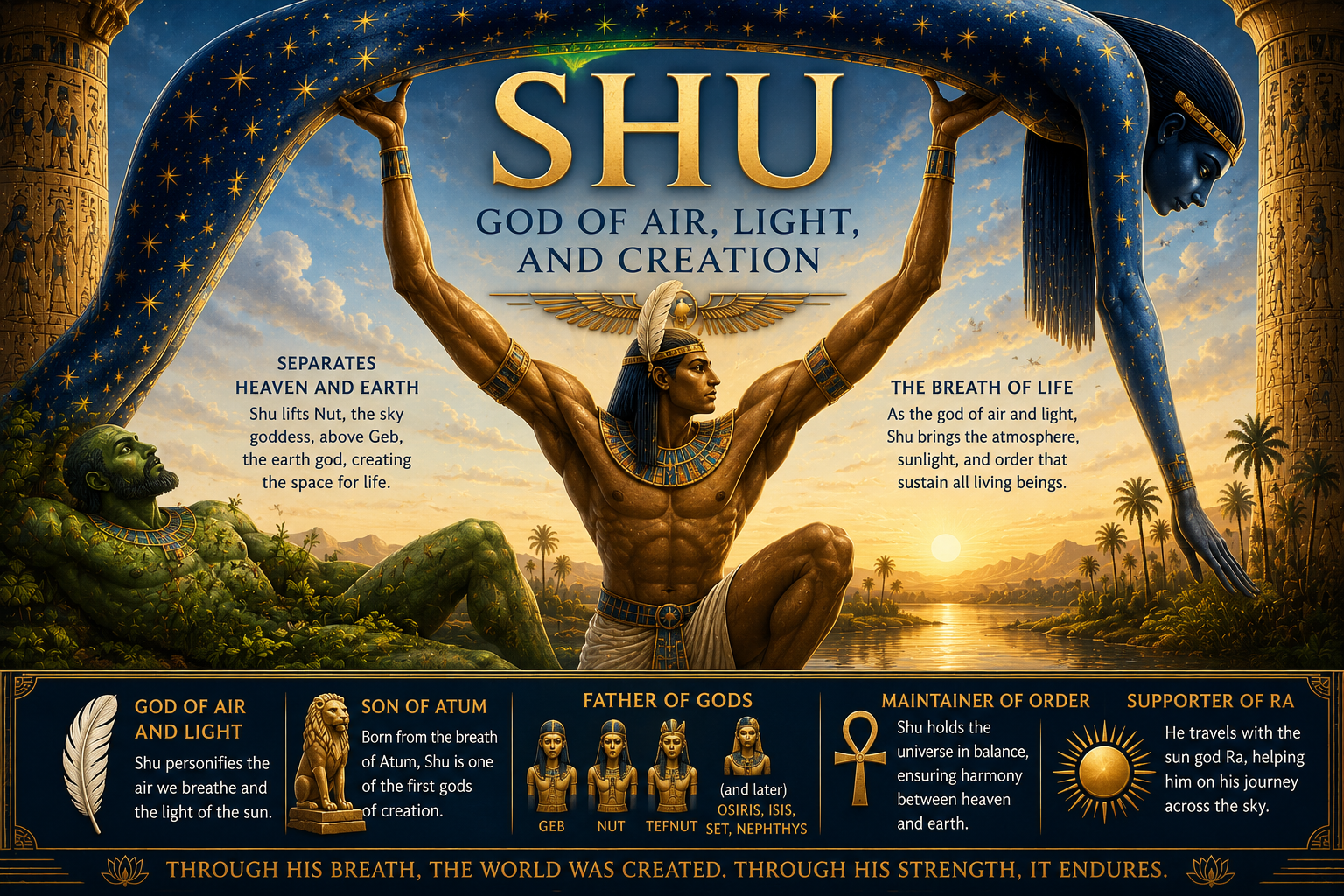
Shu is best known for separating Nut and Geb.
In the beginning, the sky goddess Nut and the earth god Geb were tightly locked together in an embrace. There was no room for life to exist between them.
To create the world, Shu lifted Nut high above Geb and held her in place.
This act created the atmosphere and the space between heaven and earth, allowing humans, animals, and plants to live.
Ancient Egyptian artists frequently depicted Shu standing upright with his arms raised, supporting the arched body of Nut above him while Geb lay beneath.
This became one of the most iconic images in Egyptian art, symbolizing the order of the cosmos.
God of Air and Light
Shu was primarily the god of air. Ancient Egyptians believed that he personified the atmosphere, wind, and the life-giving air that all living creatures breathe.
His name may derive from an Egyptian word meaning “emptiness” or “he who rises up.”
Shu was also associated with:
- Sunlight
- Dryness
- Peace
- Purity
- The atmosphere
- Cosmic order
Because he represented dry air, Shu complemented his sister and wife, Tefnut, who represented moisture and humidity.
Together, they maintained the balance of nature.
Shu and the Sun God Ra
Shu shared a particularly close relationship with the sun god Ra.
As a deity of light and air, Shu helped support Ra during his daily journey across the heavens.
In some traditions, Shu was regarded as the son of Ra, while in others he was considered an aspect or manifestation of the creator god Atum-Ra.
Texts occasionally describe Shu as the eye, heart, or breath of Ra.
Because sunlight passes through the atmosphere, the connection between Shu and the solar deity was especially strong.
Shu as King of the Gods
Some Egyptian myths state that Shu once ruled the world as king of both gods and humans.
He inherited the throne from his father Atum and governed during a mythical age when gods still walked among humanity.
Eventually, Shu grew weary of ruling and passed kingship to his son Geb.
These stories helped establish the concept of divine kingship, which later Egyptian pharaohs claimed to inherit.
Appearance and Symbols
Shu was usually depicted as a man wearing an ostrich feather on his head.
This feather symbolized lightness, air, and emptiness.
In artistic representations, Shu often appears:
- Standing between Nut and Geb while holding up the sky.
- Wearing a feathered headdress.
- Carrying a scepter and an ankh.
- Kneeling while supporting the heavens.
His principal symbols included:
- The ostrich feather
- Air and wind
- Sunlight
- The atmosphere
- The lion
Shu and Tefnut were sometimes depicted as a pair of lions guarding the eastern and western horizons.
Worship of Shu
Although Shu was one of the most important cosmic deities, he did not possess as many major temples as gods such as Amun or Osiris.
Nevertheless, he was widely worshipped throughout Egypt, particularly at Heliopolis, the center of the solar cult.
At Heliopolis, Shu formed part of the Ennead, the group of nine creator gods central to Egyptian theology.
Priests regularly invoked Shu during religious rituals concerning creation, kingship, and cosmic order.
Shu in the Afterlife
Shu also played a role in Egyptian beliefs about death and the afterlife.
As the god who maintained order in the cosmos, Shu helped preserve the harmony necessary for the deceased to achieve eternal life.
Funerary texts often invoke Shu to provide fresh air and protection to the dead during their journey through the underworld.
The ability to breathe was considered essential for survival in the afterlife, making Shu an important protective deity.
Legacy of Shu
Shu remained an important deity throughout the entire history of Ancient Egypt.
As the god of air, light, and the atmosphere, he represented the invisible forces that sustain life. His separation of heaven and earth was one of the defining moments of Egyptian creation mythology.
Today, Shu continues to fascinate historians and mythology enthusiasts as the powerful creator god who literally held the sky above the earth and made life possible.