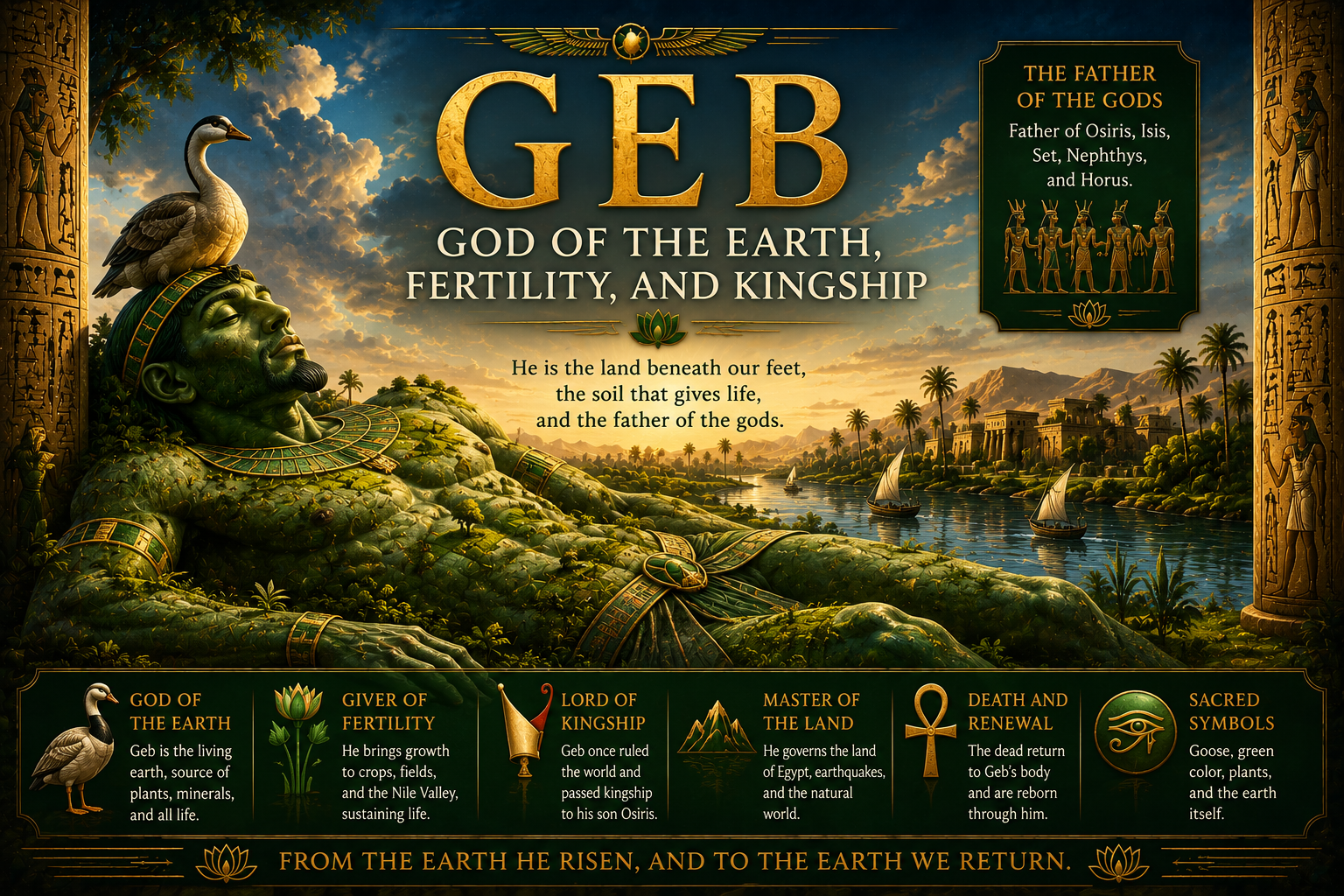
Geb was the ancient Egyptian god of the Earth, fertility, agriculture, and kingship. As the personification of the Earth itself, Geb played a central role in Egyptian creation myths and was considered one of the most important deities in the Egyptian pantheon.
Ancient Egyptians believed that all life emerged from Geb. Plants grew upon his body, rivers flowed across him, and humans depended upon the fertile land he provided. Because of this, Geb was closely associated with abundance, growth, and the renewal of life.
As the father of Osiris, Isis, Set, and Nephthys, Geb also occupied an important position within the divine family of Ancient Egypt. Through his descendants, he became the ancestor of many of the most powerful gods in Egyptian mythology.
Origins and Family
According to the Heliopolitan creation myth, Geb was the son of Shu, the god of air, and Tefnut, the goddess of moisture.
Geb married his sister Nut, the goddess of the sky. Together, they produced some of the most important gods in Egyptian religion:
- Osiris, god of the underworld
- Isis, goddess of magic and motherhood
- Set, god of chaos and storms
- Nephthys, goddess of mourning and protection
- Horus the Elder, in some traditions
Because of his role as the father of these deities, Geb was regarded as one of the great patriarchs of the Egyptian pantheon.
Geb and the Creation of the World
One of the most famous myths involving Geb concerns his separation from Nut.
In the beginning, Geb and Nut were locked together in a loving embrace. However, their father Shu separated them, lifting Nut high above Geb to form the sky.
This separation created the world as humans know it by making space between heaven and earth.
Ancient Egyptian artists frequently depicted this myth. In these scenes, Geb lies stretched across the ground while Nut arches above him, her body covered with stars. Shu stands between them, supporting the sky.
This image symbolized the creation and order of the cosmos.
God of the Earth
Geb was primarily worshipped as the god and personification of the Earth.
Unlike many other earth deities from ancient cultures, who were female, Geb was male. Ancient Egyptians viewed the Earth as masculine and the sky as feminine, reversing the pattern found in many other mythologies.
As the Earth god, Geb governed:
- Fertility
- Agriculture
- Crops and vegetation
- Minerals and precious stones
- Earthquakes
- The land of Egypt
Ancient Egyptians believed that plants and crops sprang from Geb’s body, making him essential for the survival and prosperity of Egypt.
Geb and Fertility
Because all vegetation grew from the earth, Geb was strongly associated with fertility and abundance.
Farmers often prayed to Geb for rich harvests and fertile land. His blessings ensured that crops flourished and that the annual inundation of the Nile produced abundant food.
Egyptians frequently referred to Egypt itself as “The House of Geb,” emphasizing the god’s intimate connection with the land.
In some myths, Geb’s laughter was believed to cause earthquakes.
Geb and Kingship
Geb was closely associated with royal authority.
Ancient Egyptian kings claimed to inherit their right to rule through Geb. According to mythology, Geb once ruled the world after succeeding his father Shu.
Eventually, he passed the throne to Osiris, establishing the divine line of kingship.
The Egyptian throne itself was sometimes called the “Seat of Geb.”
In many myths, Geb acted as a judge among the gods, settling disputes and determining rightful succession.
Most famously, Geb presided over the conflict between Horus and Set, ultimately declaring Horus the legitimate ruler of Egypt.
Geb and the Underworld
Although Osiris became the principal ruler of the dead, Geb also maintained important connections with the underworld.
Because the dead were buried in the earth, Egyptians believed that they returned to Geb after death.
Funerary texts often describe the deceased entering Geb’s body and being reborn through his power.
As a result, Geb became associated with both death and regeneration.
This dual role reflected the agricultural cycle, in which seeds are buried in the earth before sprouting into new life.
Appearance and Symbols
Geb was usually depicted as a reclining man lying beneath the sky goddess Nut.
He was commonly shown:
- Reclining on the ground.
- With green or dark skin representing fertile vegetation.
- Wearing the White Crown of Upper Egypt or other royal crowns.
- With geese upon his head.
The goose was Geb’s sacred animal, and he was sometimes referred to as the “Great Cackler.”
According to some traditions, the cosmic egg from which the sun emerged was laid by Geb in the form of a celestial goose.
Common symbols associated with Geb include:
- The goose
- Vegetation and plants
- The Earth
- Snakes
- The fertile Nile Valley
Worship of Geb
Although Geb did not possess as many dedicated temples as deities such as Amun or Osiris, he was worshipped throughout Egypt.
His cult was particularly important at Heliopolis, where he formed part of the Great Ennead.
Because agriculture was central to Egyptian life, Geb’s influence permeated nearly every aspect of society.
Priests frequently invoked Geb in religious ceremonies concerning fertility, kingship, and the afterlife.
Geb in Egyptian Literature
Geb appears throughout Egyptian religious texts, including the Pyramid Texts, Coffin Texts, and the Book of the Dead.
These writings portray him as a creator god, divine king, and protector of the deceased.
Many spells invoke Geb’s power to aid the dead in achieving rebirth and eternal life.
His importance in funerary literature demonstrates his enduring significance throughout Egyptian history.
Legacy of Geb
Geb remained one of Ancient Egypt’s most important deities for more than three thousand years.
As the personification of the Earth, father of the gods, and source of fertility and kingship, Geb played a fundamental role in Egyptian religion and mythology.
Today, Geb continues to fascinate historians and mythology enthusiasts as the ancient god whose body formed the very ground beneath the feet of the Egyptians.