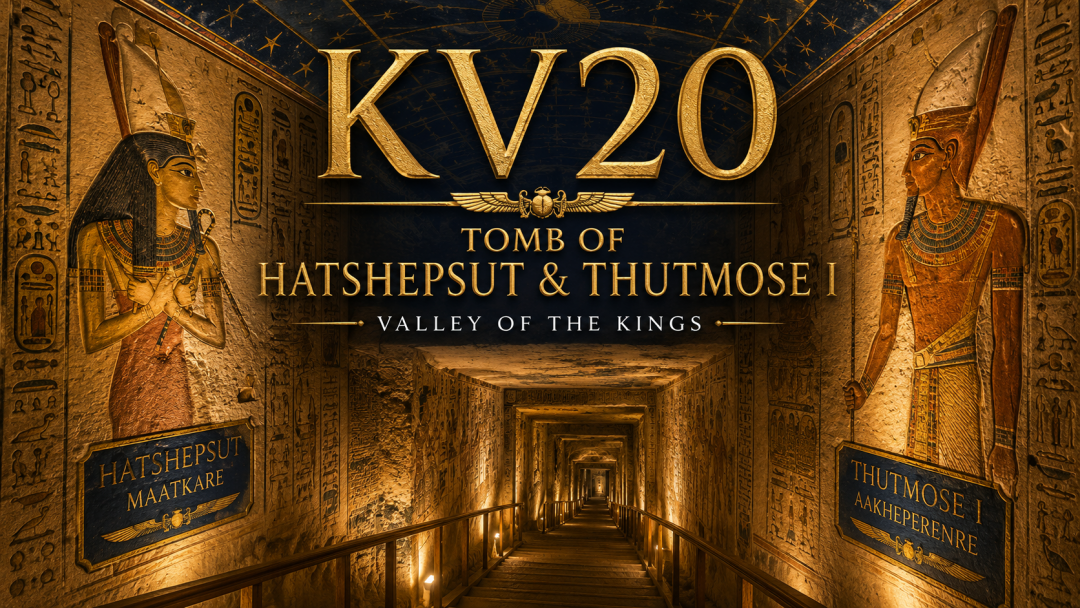
KV20: The Tomb of Hatshepsut and Thutmose I
KV20 is one of the oldest, deepest, and most unusual royal tombs in the Valley of the Kings. Associated with Pharaoh Hatshepsut and her father, Thutmose I, it may have been the first royal tomb excavated within the Valley. Its extraordinary twisting corridors descend more than 200 meters into the limestone cliffs, creating a difficult and ambitious monument unlike any other tomb in the royal necropolis.
The history of KV20 remains the subject of scholarly debate. Some Egyptologists believe the tomb was first begun for Thutmose I and later enlarged by Hatshepsut so that she and her father could be buried together. Others argue that the monument was primarily created for Hatshepsut after she became pharaoh and that she subsequently transferred her father’s burial into it. Whatever its original sequence, the discovery of sarcophagi prepared for both rulers confirms that KV20 was intended to hold two royal burials.
Although KV20 lacks the extensive painted decoration found in later royal tombs, it preserves some of the earliest evidence for the use of the Amduat in a royal burial. Its remarkable architecture, complex history, and association with one of ancient Egypt’s most famous female pharaohs make it one of the most important monuments in the Valley of the Kings.
Structure: KV20
Location: Valley of the Kings, East Valley, Thebes West Bank, Luxor
Owners: Hatshepsut and Thutmose I
Site Type: Royal Tomb
KV20 is situated in the easternmost branch of the Valley of the Kings, near KV19, KV43, and KV60. Its entrance is cut into the base of a cliff and opens onto a steeply descending system of corridors and stairways.
Unlike the straighter layouts of most later royal tombs, KV20 follows a sharply curving, clockwise route through the mountain. Its unusual plan has sometimes been described as resembling a corkscrew. The corridors repeatedly change direction as they descend toward an irregular antechamber and the pillared burial chamber.
The tomb extends for approximately 210 meters and reaches a vertical depth of about 97 meters beneath the surface. Its narrow passages, steep gradients, poor air circulation, and unstable stone made excavation extremely difficult for ancient workmen and modern archaeologists alike.
The burial chamber is irregularly shaped and contains three pillars, along with several small side chambers. Two royal sarcophagi were discovered there, one associated with Hatshepsut and another prepared for Thutmose I.
An Unusual Tomb Plan
The design of KV20 is unique within the Valley of the Kings. Instead of following a relatively direct path into the mountain, its passages curve toward the east and then south.
One theory proposes that the builders attempted to position Hatshepsut’s burial chamber beneath or near her mortuary temple at Deir el-Bahari on the opposite side of the Theban mountain. Although the tomb does not actually reach the temple, its general direction has encouraged speculation that the two monuments were symbolically connected.
The difficult geology may also explain the changing direction of the corridors. Ancient builders sometimes altered the course of a tomb when they encountered unstable or unsuitable rock.
How KV20 Compares with Other Royal Tombs
- KV20: approximately 210 m
- KV17: approximately 137 m
- KV22: approximately 127 m
- KV14: approximately 112 m
- KV6: approximately 105 m
Decoration
KV20 contains very little conventional wall decoration. Much of the monument was cut through poor-quality limestone and shale that could not easily support carved or painted scenes.
Instead of decorating the rough walls directly, the ancient craftsmen prepared limestone slabs bearing passages and figures from the Amduat, the funerary text describing the sun god Ra’s twelve-hour journey through the underworld. The surviving fragments were drawn primarily in red and black ink and represent one of the earliest known royal versions of this important composition.
The Amduat provided the deceased ruler with knowledge of the underworld’s regions, gates, gods, and supernatural beings. By accompanying Ra through the darkness, the king or queen could overcome death and be reborn with the rising sun.
The limited decoration of KV20 reflects early Eighteenth Dynasty practice. Later royal tombs would eventually cover entire corridors and chambers with elaborate painted and carved funerary texts.
The Sarcophagi of Hatshepsut and Thutmose I
Two royal stone sarcophagi were discovered inside KV20. One was prepared for Hatshepsut, while the other had originally been made for her and was later altered to receive the burial of her father, Thutmose I.
Their presence provides strong evidence that Hatshepsut intended KV20 to serve as a shared royal burial place. Reuniting herself with Thutmose I may have reinforced her legitimacy as pharaoh by emphasizing her descent from a recognized king.
A stone canopic chest inscribed for Hatshepsut was also found in the tomb. Such chests held the containers in which the embalmed internal organs of the deceased were placed.
No intact royal burial remained when the tomb was excavated in modern times.
Was KV20 the First Tomb in the Valley of the Kings?
KV20 is frequently described as the earliest royal tomb in the Valley of the Kings, but its precise position in the development of the necropolis remains debated.
The disagreement centers on KV20 and KV38. Both monuments have been associated with Thutmose I, and scholars continue to debate which was constructed first. One interpretation holds that Thutmose I was initially buried in KV20 before Hatshepsut enlarged it and arranged for their shared burial. Thutmose III may later have transferred his grandfather to KV38.
Another possibility is that KV20 was primarily Hatshepsut’s tomb and that she brought her father’s mummy there from an earlier burial. The surviving evidence does not allow the complete sequence of events to be reconstructed with certainty.
Despite this uncertainty, KV20 unquestionably belongs to the earliest period of royal tomb construction in the Valley.
Hatshepsut and Thutmose I
Thutmose I was one of the great warrior kings of the early Eighteenth Dynasty. His military campaigns extended Egyptian influence into Nubia and the Near East, while his building projects contributed to the growing importance of Karnak.
His daughter Hatshepsut first ruled as regent for the young Thutmose III before adopting full pharaonic titles. During her reign, she commissioned major monuments, organized trading expeditions, and constructed her magnificent terraced mortuary temple at Deir el-Bahari.
By preparing KV20 for herself and Thutmose I, Hatshepsut created a powerful connection between her own kingship and that of her father.
Site History
KV20 was known to Europeans by the time of the Napoleonic Expedition in 1799, although its steep, debris-filled corridors prevented early explorers from reaching its deepest chambers.
James Burton attempted to investigate the tomb during the nineteenth century but was unable to clear it completely. Howard Carter undertook the first thorough excavation between 1903 and 1904 while working for Theodore M. Davis.
Carter’s work was exceptionally difficult. The corridors were filled with hardened debris, water had accumulated in the lower passages, and the oppressive heat and poor air circulation made prolonged work dangerous. After reaching the burial chamber, his team discovered the two royal sarcophagi, Hatshepsut’s canopic chest, and fragments of limestone panels bearing sections of the Amduat.
The tomb had already been robbed and cleared of nearly all valuable burial equipment in antiquity.
What Happened to the Royal Mummies?
Thutmose I did not remain in KV20 permanently. He appears to have been transferred to KV38, although the precise date and circumstances of this relocation remain disputed. His body was later moved again during the reorganization of royal burials near the end of the New Kingdom.
Hatshepsut’s mummy was also absent from KV20. A female mummy recovered from nearby KV60 has been identified by some researchers as Hatshepsut, although aspects of that identification have continued to attract scholarly discussion.
The removal of royal mummies from their original tombs was common. Priests transferred many kings and queens to hidden caches in an attempt to protect their remains from tomb robbers.
Noteworthy Features
KV20 is notable for several reasons:
- It may be the earliest royal tomb constructed in the Valley of the Kings.
- It was intended for Hatshepsut and her father, Thutmose I.
- Its winding, clockwise layout is unique within the royal necropolis.
- The tomb extends approximately 210 meters into the mountain.
- It reaches a depth of about 97 meters below the surface.
- Two royal sarcophagi were found in its burial chamber.
- Limestone panels contained one of the earliest royal versions of the Amduat.
- Its passages appear to curve generally toward Hatshepsut’s mortuary temple at Deir el-Bahari.
Dating
KV20 was used during the following period:
- New Kingdom, Dynasty 18, reigns of Thutmose I and Hatshepsut
The movement of the royal burials and later intrusion into the tomb probably occurred during subsequent phases of the New Kingdom.
Conservation History
The tomb was cleared by Howard Carter during the early twentieth century, but its depth, narrow passages, unstable geology, and vulnerability to water have made access and conservation extremely difficult.
Modern documentation has focused on mapping the complex architecture, recording surviving artifacts, and monitoring the rock’s condition. The objects recovered from KV20 have also required conservation because many were damaged by moisture and prolonged burial.
Site Condition
KV20 is in poor and unstable condition. Its steep corridors are difficult to enter, while the lower portions are vulnerable to debris, water infiltration, and deterioration of the surrounding stone.
The tomb is not normally accessible to the public. Most of its original burial equipment was removed or destroyed in antiquity, and little decoration remains on its walls. Nevertheless, its architecture and surviving objects continue to provide invaluable information about the beginnings of royal burial in the Valley of the Kings.
Interesting Facts About KV20
- KV20 was prepared for two pharaohs, Hatshepsut and Thutmose I.
- Hatshepsut was one of the few women to rule ancient Egypt as pharaoh.
- The monument may be the oldest royal tomb in the Valley of the Kings.
- Its corridors twist deep beneath the mountain rather than following a conventional straight or curved axis.
- The tomb is more than 200 meters long.
- Howard Carter excavated KV20 nearly twenty years before discovering Tutankhamun’s tomb.
- One of Hatshepsut’s sarcophagi was altered for the reburial of her father.
- The tomb contained early passages from the Amduat written on limestone slabs.
- Neither ruler’s mummy remained inside when the tomb was excavated.
- KV20 is one of the most difficult royal tombs in the Valley to explore.