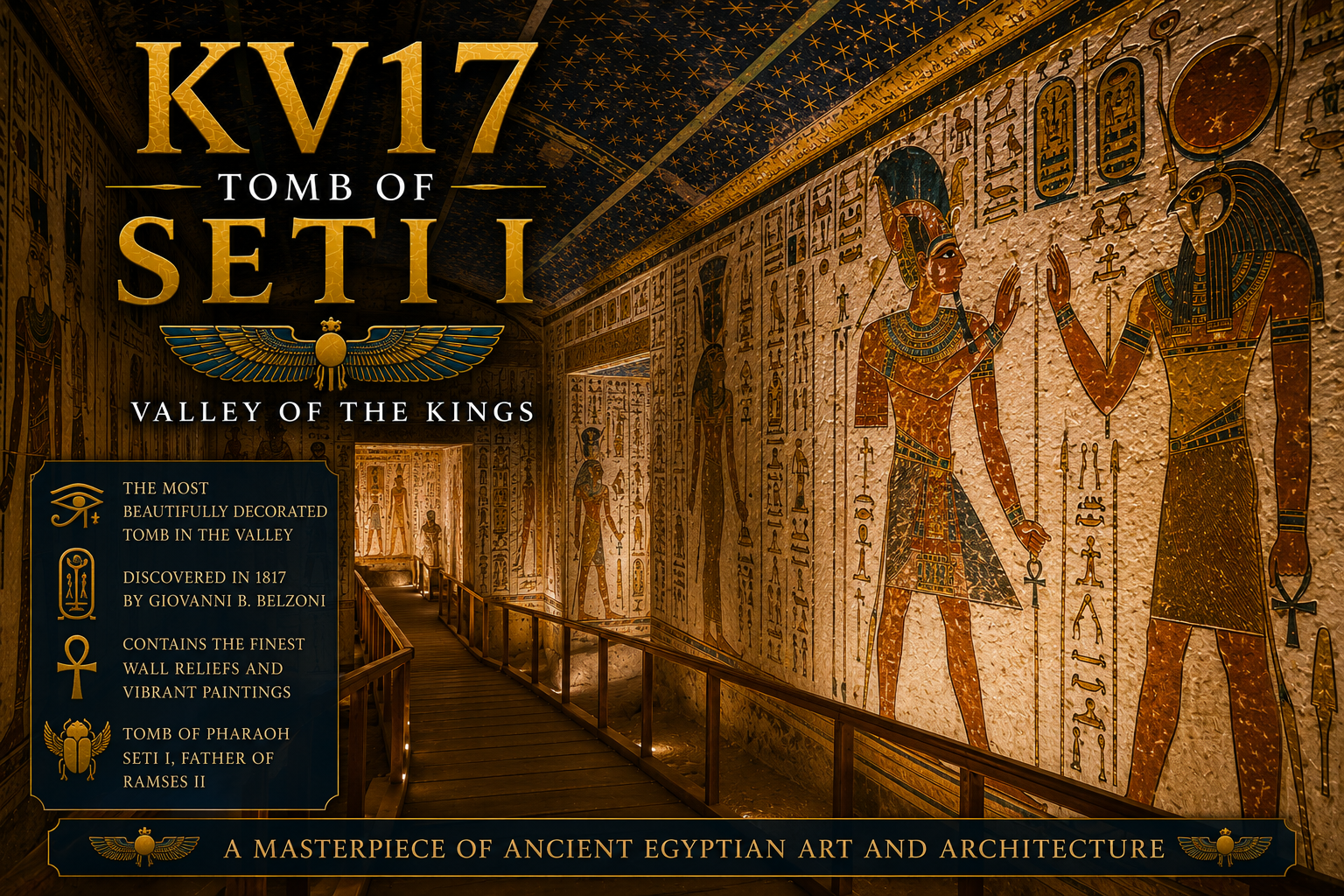
KV17 is widely regarded as the finest royal tomb ever discovered in the Valley of the Kings. Built for Pharaoh Seti I, the second ruler of Egypt’s Nineteenth Dynasty and father of Ramesses II, it is celebrated for its breathtaking wall paintings, exceptional craftsmanship, and remarkable state of preservation. Stretching deep beneath the cliffs of the Valley, KV17 is the longest and one of the most beautifully decorated royal tombs ever constructed in ancient Egypt.
Discovered by the Italian explorer Giovanni Battista Belzoni in 1817, the tomb astonished the world with its vibrant colors and exquisitely carved reliefs. Nearly every surface is covered with religious texts and scenes depicting the king’s journey through the underworld, making KV17 one of the most important monuments for understanding ancient Egyptian beliefs about the afterlife.
Although the tomb was robbed in antiquity and suffered damage from flooding, tourism, and early excavation methods, it remains one of the greatest masterpieces of ancient Egyptian art and architecture.
- Structure: KV17
- Location: Valley of the Kings, East Valley, Thebes West Bank, Luxor
- Owner: Seti I
- Other Designations: Belzoni’s Tomb, Tomb of Psammis (historically), Tomb of Apis (historically)
- Site Type: Royal Tomb
KV17 is located in the East Valley of the Valley of the Kings and extends approximately 137 meters (449 feet) into the limestone cliffs, making it the longest royal tomb in the Valley.
The tomb follows a bent-axis design and consists of multiple stairways, long corridors, pillared halls, wells, storerooms, and a magnificent burial chamber. Beyond the burial chamber lies an even deeper passage that descends toward an unfinished corridor, whose purpose remains uncertain. Some scholars believe it symbolized the mysterious depths of the underworld.
The burial chamber originally housed Seti I’s magnificent alabaster sarcophagus, one of the finest ever discovered. The sarcophagus was removed in the nineteenth century and is now displayed in Sir John Soane’s Museum in London.
Decoration
The decoration of KV17 represents the pinnacle of New Kingdom funerary art. Every corridor and chamber is covered with exquisitely carved sunk reliefs, carefully painted in vivid colors.
The tomb contains scenes from many of ancient Egypt’s most important religious compositions, including:
- The Litany of Ra
- The Book of Gates
- The Amduat
- The Book of the Heavenly Cow
- The Book of the Dead
- The Opening of the Mouth ritual
- Astronomical texts
- Representations of Seti I before numerous Egyptian deities
The quality of the carving is extraordinary. Unlike many later tombs that relied primarily on painted plaster, KV17 features deeply carved reliefs that remain among the finest examples of Egyptian stone carving ever produced.
The astronomical ceiling of the burial chamber is particularly spectacular, depicting the heavens through which the sun god Ra traveled each night before his rebirth at dawn.
KV17 is notable for several reasons:
- It is the tomb of Pharaoh Seti I.
- It is the longest royal tomb in the Valley of the Kings.
- It contains some of the finest wall reliefs ever created in ancient Egypt.
- The tomb preserves an exceptionally complete collection of funerary texts.
- It contained the famous translucent alabaster sarcophagus of Seti I.
- An unfinished descending passage extends beyond the burial chamber.
- It is widely considered the artistic masterpiece of the Valley of the Kings.
Site History
Construction of KV17 began shortly after Seti I became pharaoh and continued throughout his reign. The tomb reflects the prosperity and artistic achievement of the early Nineteenth Dynasty, when royal craftsmen reached an extraordinary level of technical skill.
Following Seti I’s death, he was buried in KV17, but, like nearly every royal burial in the Valley of the Kings, it was robbed in antiquity. During the Twenty-first Dynasty, priests removed the king’s mummy for protection and eventually reburied it in the royal cache at Deir el-Bahari (DB320), where it was rediscovered in 1881.
The tomb was rediscovered in October 1817 by Giovanni Battista Belzoni. His discovery generated enormous excitement throughout Europe because the paintings remained astonishingly fresh and colorful. Unfortunately, early visitors removed portions of the decoration, and increasing tourism caused further deterioration.
Modern conservation projects have stabilized many of the damaged walls and continue to preserve one of Egypt’s greatest archaeological treasures.
Seti I: One of Egypt’s Greatest Pharaohs
Seti I was one of the greatest rulers of the New Kingdom. During his reign, he restored Egyptian authority in Canaan and Syria, expanded monumental building projects across Egypt, and commissioned masterpieces such as the Great Hypostyle Hall at Karnak alongside his son Ramesses II.
His reign marked the beginning of one of Egypt’s greatest artistic periods, and KV17 stands as perhaps the finest expression of that cultural achievement.
Discovery by Belzoni
The discovery of KV17 in 1817 transformed the study of ancient Egypt.
Explorer Giovanni Battista Belzoni spent weeks clearing the entrance before uncovering corridor after corridor filled with brilliantly preserved paintings. The discovery became one of the greatest archaeological sensations of the nineteenth century.
Belzoni carefully documented much of the tomb before removing Seti I’s magnificent alabaster sarcophagus. Today, many of his drawings remain valuable records of decorations that have since deteriorated.
Dating
This site was used during the following periods:
- New Kingdom, Dynasty 19, reign of Seti I
- Twenty-first Dynasty (removal of the royal mummy)
- Graeco-Roman Period
- Byzantine (Coptic) Period
Conservation History
KV17 has undergone extensive conservation over the past several decades. Specialists have stabilized cracked ceilings, reinforced weakened rock, cleaned painted reliefs, monitored humidity, and restricted visitor access to slow further deterioration.
High-resolution digital recording projects continue to document every decorated surface, ensuring that the tomb’s extraordinary artwork is preserved for future generations.
Site Condition
Although KV17 has suffered damage from flooding, early explorers, and centuries of tourism, it remains one of the best-preserved and most spectacular royal tombs in Egypt. Many reliefs retain their original colors, while the carved stonework continues to demonstrate the extraordinary skill of the craftsmen who created it more than 3,200 years ago.
Interesting Facts About KV17
- KV17 is the tomb of Pharaoh Seti I.
- It is the longest royal tomb in the Valley of the Kings at approximately 137 meters (449 feet).
- Many Egyptologists consider it the most beautiful tomb in the Valley.
- It was discovered by Giovanni Battista Belzoni in 1817.
- Seti I’s famous translucent alabaster sarcophagus is now housed in Sir John Soane’s Museum in London.
- The tomb contains one of the most complete collections of New Kingdom funerary texts.
- An unfinished descending corridor extends beyond the burial chamber, and its purpose remains uncertain.
- The quality of the carved reliefs is widely regarded as the finest in ancient Egyptian art.