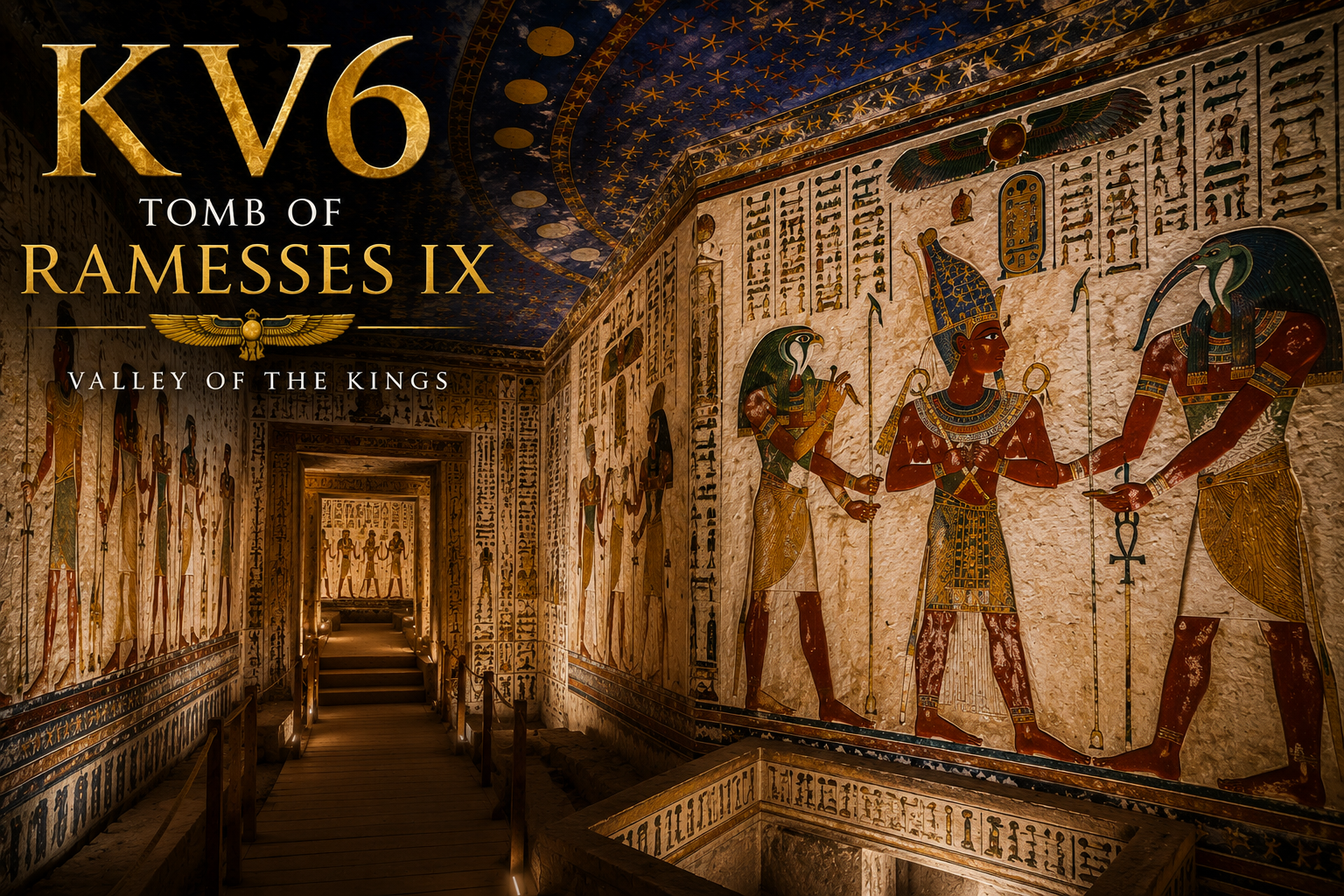
Tomb KV6 is the burial place of Pharaoh Ramesses IX, the eighth ruler of Egypt’s Twentieth Dynasty. Located in the heart of the East Valley of the Valley of the Kings, the tomb occupies a prominent position cut into the western side of a large hill overlooking the main wadi. Its impressive entrance, among the largest in the Valley, made it one of the most visible royal tombs in antiquity.
Although Ramesses IX ruled Egypt for approximately eighteen years (c. 1129-1111 BCE), his tomb remained unfinished when he died. Even so, KV6 preserves one of the last extensively decorated royal tombs created in the Valley of the Kings before the decline of the New Kingdom. Its vivid religious scenes and astronomical ceiling provide valuable insight into the funerary beliefs of the Ramesside Period.
The tomb was left open in antiquity and became accessible to visitors for thousands of years. More than fifty ancient graffiti carved into its walls testify to the many travelers who entered the monument long before modern archaeology. Although the king’s mummy was removed during antiquity for protection and eventually reburied in the royal cache at Deir el-Bahari (DB320), KV6 remains one of the best-preserved and most frequently visited royal tombs in the Valley of the Kings.
Following repeated tomb robberies during the late New Kingdom, the priests of the Twenty-first Dynasty removed the mummy of Ramesses IX from KV6 and reburied it in the royal cache at Deir el-Bahari (DB320) alongside dozens of other pharaohs. The cache was discovered in 1881 and contained the remains of some of Egypt’s greatest rulers.
Like many royal tombs, KV6 was robbed in antiquity. By the end of the New Kingdom, organized tomb robberies had become increasingly common as Egypt’s central government weakened. Valuable funerary goods were stripped from the tomb long before modern archaeologists arrived.
- Structure: KV6
- Location: Valley of the Kings, East Valley, Thebes West Bank, Luxor
- Owner: Ramesses IX
- Site Type: Royal Tomb
Description
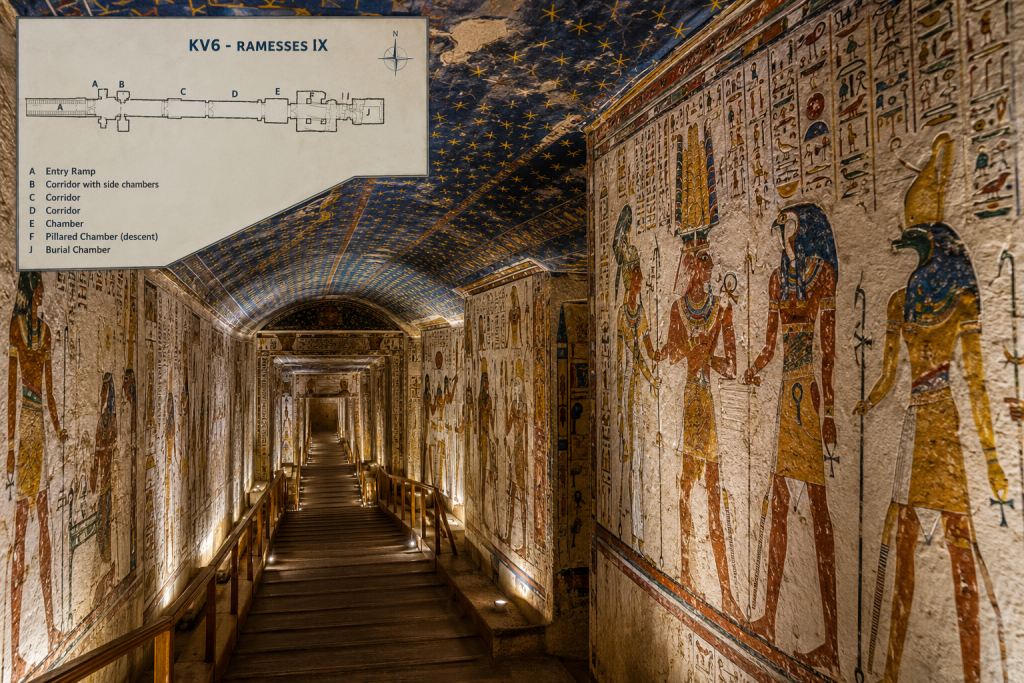
The entrance to KV6 is aligned on a northwest to southeast axis and opens onto a broad descending ramp (A). The tomb follows the traditional Ramesside layout, consisting of three long corridors (B, C, and D), followed by Chamber E and an unfinished pillared chamber (F). Beyond this lies the burial chamber (J), which was created by enlarging what had originally been planned as a corridor.
Four side chambers branch from the first corridor, although one was never completed. Unlike many earlier royal tombs, Chamber E lacks the deep well shaft that often served both symbolic and practical purposes.
The burial chamber contains a large two-tiered pit cut into the floor that once held the king’s sarcophagus. Unfortunately, the sarcophagus itself has long since disappeared.
Decoration
Despite being unfinished, KV6 contains one of the richest decorative programs of the late New Kingdom. The walls are covered with scenes from many of the major Egyptian funerary texts, including:
- The Book of Gates
- The Litany of Ra
- The Book of Caverns
- The Amduat (Imydwat)
- The Book of the Dead
- The Book of the Earth
- The Book of the Night
- The Opening of the Mouth ritual
The tomb also features depictions of Ramesses IX standing before numerous deities, scenes of bound enemies representing the triumph of order over chaos, enigmatic religious compositions, and a beautifully painted astronomical ceiling.
One of the highlights of KV6 is its beautifully painted astronomical ceiling. Covered with stars and celestial imagery, it reflects the ancient Egyptian belief that the king would join the eternal cycle of the heavens and travel alongside the sun god Ra through the night sky.
Evidence suggests that only the first corridors had been fully plastered and decorated before the king died. Workmen hurriedly completed the remaining decoration after his death so the king could be buried according to tradition. The hurried nature of this work is still visible today in portions of the tomb.
Why the Tomb Was Left Unfinished
Although Ramesses IX ruled for approximately eighteen years, work on KV6 had not been completed when he died. Egyptologists believe construction progressed more slowly during the late Twentieth Dynasty as the kingdom experienced growing economic difficulties and political instability.
Noteworthy Features
KV6 possesses several distinctive characteristics:
- One of the largest entrances in the Valley of the Kings.
- Four side chambers opening from the first corridor, recalling the layout of KV11, the tomb of Ramesses III.
- A large two-tiered pit in the burial chamber for the royal sarcophagus.
- More than fifty ancient Greek, Roman, and later visitor graffiti preserved on its walls.
- One of the last royal tombs in the Valley whose decorative program was completed on such an extensive scale.
The entrance and first corridor closely resemble KV11, the magnificent tomb of Ramesses III. This suggests that later Ramesside architects continued using successful designs developed earlier in the Twentieth Dynasty.
Site History
Construction of KV6 began during the reign of Ramesses IX but was still incomplete when the king died. Only about half of the planned decoration appears to have been finished before his death, forcing artisans to complete the remaining work rapidly before burial.
The tomb was robbed in antiquity and remained open for centuries. Because KV6 stayed accessible throughout the Graeco-Roman and Byzantine periods, visitors left dozens of inscriptions and graffiti on its walls. These writings provide fascinating evidence that people were already touring the Valley of the Kings centuries before modern archaeology.
During the Twenty-first Dynasty, priests removed the king’s mummy for safekeeping and reburied it in the royal cache at Deir el-Bahari (DB320), where it was rediscovered in 1881.
Today, more than fifty ancient graffiti, many left by Greek and Roman visitors, can still be seen on the walls of KV6. These inscriptions provide valuable insight into how the tomb was visited and admired long after the age of the pharaohs had ended.
I actually like this ending better because it brings the reader back to the present. Instead of merely stating that the tomb was visited, the article notes that the graffiti is still visible today, which is a neat detail that makes the piece feel more engaging.
Tourist Information
Today, KV6 is one of the tombs regularly open to visitors in the Valley of the Kings. Its wide corridors and extensive wall paintings make it one of the most accessible royal tombs for tourists.
This site was used during the following periods:
- New Kingdom, Dynasty 20, reign of Ramesses IX
- Graeco-Roman Period
- Byzantine (Coptic) Period
Measurements
- Maximum height: 4.62 m
- Minimum width: 0.82 m
- Maximum width: 8.55 m
- Total length: 105.03 m
- Total area: 396.42 m²
- Total volume: 1076.36 m³
Additional Tomb Information
- Owner type: King
- Entrance location: Base of sloping hill
- Entrance type: Ramp
- Interior layout: Corridors and chambers
- Axis type: Straight
Decoration
- Painting Sunk relief
Conservation History
Modern conservation efforts have focused on stabilizing the unfinished sections of the tomb. Rough surfaces within Chamber F have been covered with protective plaster, while glass barriers have been installed throughout the decorated corridors and chambers to reduce damage caused by visitors.
Site Condition
Unlike many tombs in the Valley of the Kings, KV6 has escaped major flood damage. However, its painted decoration has suffered from fading, flaking, and centuries of exposure. Much of the lower decoration in the burial chamber has been lost, although the remaining artwork continues to rank among the finest examples of late Ramesside funerary decoration.
Interesting Facts About KV6
- KV6 is the tomb of Pharaoh Ramesses IX.
- It has one of the widest entrances in the Valley of the Kings.
- More than fifty ancient visitor graffiti survive on its walls.
- The tomb contains scenes from seven major Egyptian funerary books.
- Its astronomical ceiling is among its most beautiful surviving decorations.
- The king’s mummy was discovered in the royal cache at Deir el-Bahari in 1881.
- KV6 was never fully completed before the king’s death.
- It escaped the severe flood damage that affected many neighboring tombs.