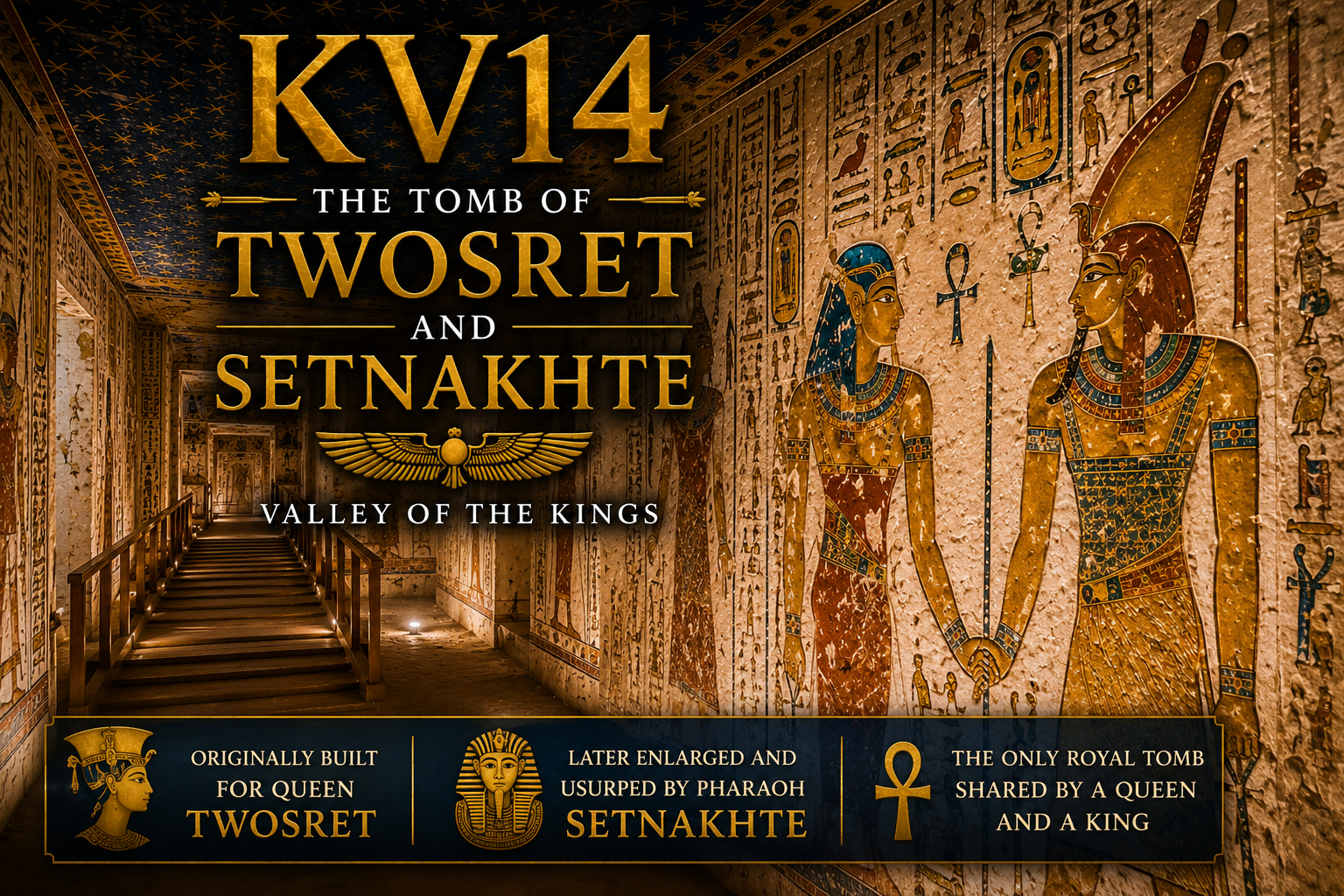
KV14 is one of the most unusual royal tombs in the Valley of the Kings. Originally constructed for Queen Twosret, the last ruler of Egypt’s Nineteenth Dynasty, the monument was later enlarged and appropriated by Pharaoh Setnakhte, founder of the Twentieth Dynasty. As a result, KV14 became the first royal tomb in the Valley of the Kings to be shared by both a queen and a king.
The tomb reflects one of the most turbulent periods in ancient Egyptian history. Political instability followed the deaths of Merneptah, Seti II, Siptah, and Twosret, ultimately leading to the rise of Setnakhte and the beginning of a new dynasty. Rather than abandoning the nearly completed tomb of his predecessor, Setnakhte expanded and modified it for his own burial.
Today, KV14 is one of the longest and most architecturally complex tombs in the Valley of the Kings. Its walls preserve evidence of two separate reigns, making it a fascinating monument for understanding royal succession, tomb usurpation, and the transition between Egypt’s Nineteenth and Twentieth Dynasties.
- Structure: KV14
- Location: Valley of the Kings, East Valley, Thebes West Bank, Luxor
- Original Owner: Twosret
- Later Owner: Setnakhte
- Other Designations: KV14
- Site Type: Royal Tomb
KV14 is located in the East Valley of the Valley of the Kings. Originally designed for Queen Twosret, the tomb was later dramatically enlarged after Setnakhte claimed the throne.
The monument follows a straight-axis plan consisting of long descending corridors, pillared halls, stairways, and a spacious burial chamber with numerous side rooms. During Setnakhte’s reign, the tomb was extended considerably beyond its original design, eventually becoming one of the longest royal tombs in the Valley, measuring more than 112 meters (367 feet) in length.
Its architecture reflects two distinct phases of construction, allowing archaeologists to distinguish between the portions built for Twosret and those added by Setnakhte.
Decoration
KV14 contains one of the most interesting decorative programs in the Valley of the Kings because much of the artwork was originally created for Twosret before being altered for Setnakhte.
The tomb includes scenes from several important funerary texts, including:
- The Litany of Ra
- The Book of Gates
- The Book of Caverns
- The Amduat
- The Book of the Dead
- The Opening of the Mouth ritual
Many scenes originally showing Queen Twosret were carefully modified by replacing her names and royal titles with those of Setnakhte. In several areas, traces of the queen’s original inscriptions remain visible beneath the later alterations, offering archaeologists a rare opportunity to study the process of royal usurpation.
The quality of the surviving paintings is exceptional, displaying the vibrant colors and refined artistic style characteristic of the late New Kingdom.
Noteworthy Features
KV14 is notable for several reasons:
- It is the only royal tomb originally built for a ruling queen and later enlarged for a pharaoh.
- It spans the transition between the Nineteenth and Twentieth Dynasties.
- The tomb extends for more than 112 meters (367 feet).
- Much of Twosret’s original decoration remains visible beneath Setnakhte’s modifications.
- It contains beautifully preserved scenes from several major Egyptian funerary books.
- The monument demonstrates how existing royal tombs could be adapted for new rulers during times of political upheaval.
Site History
Construction of KV14 began during the reign of Queen Twosret, who ruled Egypt after the death of Siptah near the end of the Nineteenth Dynasty. The tomb was already well advanced when her reign came to an abrupt end during the political crisis that followed.
After founding the Twentieth Dynasty, Setnakhte appropriated the unfinished monument for his own burial. Rather than simply replacing Twosret’s name, he ordered the tomb expanded significantly, adding new corridors, chambers, and decoration while modifying much of the earlier artwork.
Ironically, Setnakhte was probably never permanently buried in KV14. His son, Ramesses III, later transferred his father’s burial to KV11, allowing KV14 to remain primarily associated with Twosret.
Like many royal tombs, KV14 was robbed during antiquity and later suffered damage from flooding. Despite these events, much of its remarkable decoration survives, making it one of the finest examples of Ramesside funerary art.
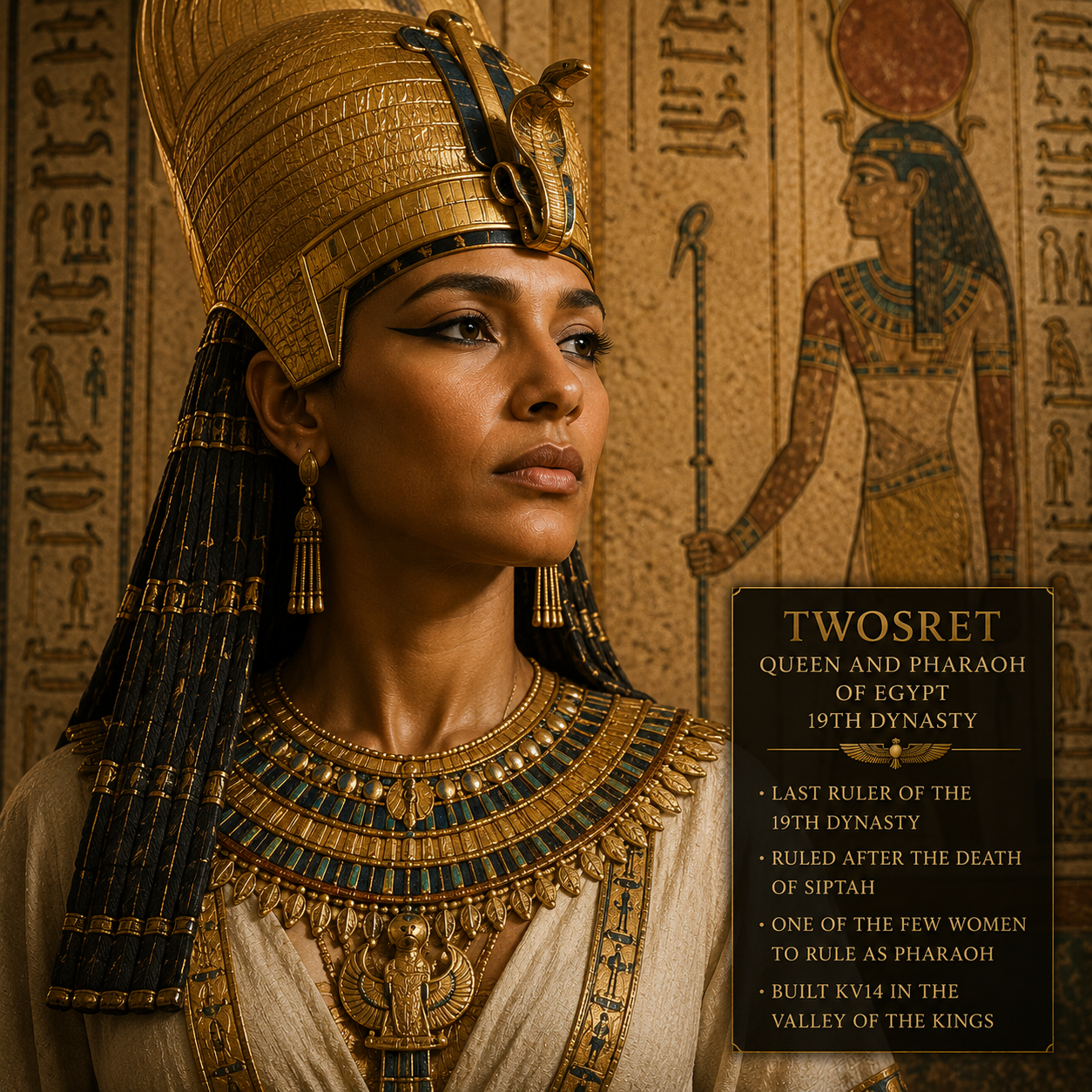
Twosret: Egypt’s Last Female Pharaoh of the New Kingdom
Twosret was one of the few women to rule Egypt as pharaoh in her own right. Following the death of her husband Seti II and the brief reign of Siptah, she assumed full royal authority and adopted the traditional titles of a king.
Her reign marked the final years of the Nineteenth Dynasty before political unrest brought the dynasty to an end. Although later overshadowed by rulers of the Twentieth Dynasty, KV14 preserves important evidence of her status as one of ancient Egypt’s last great female pharaohs.
Dating
This site was used during the following periods:
- New Kingdom, Dynasty 19, reign of Twosret
- New Kingdom, Dynasty 20, reign of Setnakhte
- Later activity during antiquity
- Graeco-Roman Period
Conservation History
Modern conservation has focused on stabilizing damaged plaster, documenting the multiple phases of decoration, cleaning painted surfaces, and preserving evidence of inscriptions by both Twosret and Setnakhte.
Archaeologists continue to study KV14 because it preserves one of the clearest examples of the modification of an existing royal tomb.
Site Condition
KV14 has experienced flooding, ancient robbery, and natural deterioration over the past three millennia. Even so, much of its painted decoration remains remarkably well preserved, particularly in the earlier sections created for Twosret.
Interesting Facts About KV14
- KV14 was originally built for Queen Twosret.
- It was later enlarged and reused by Pharaoh Setnakhte.
- It is the only royal tomb in the Valley of the Kings shared by both a ruling queen and a king.
- The tomb stretches more than 112 meters (367 feet), making it one of the Valley’s longest royal tombs.
- Archaeologists can still identify Twosret’s original inscriptions beneath Setnakhte’s alterations.
- Setnakhte was later reburied elsewhere, leaving the tomb closely associated with Twosret.
- KV14 documents the dramatic political transition between the Nineteenth and Twentieth Dynasties.