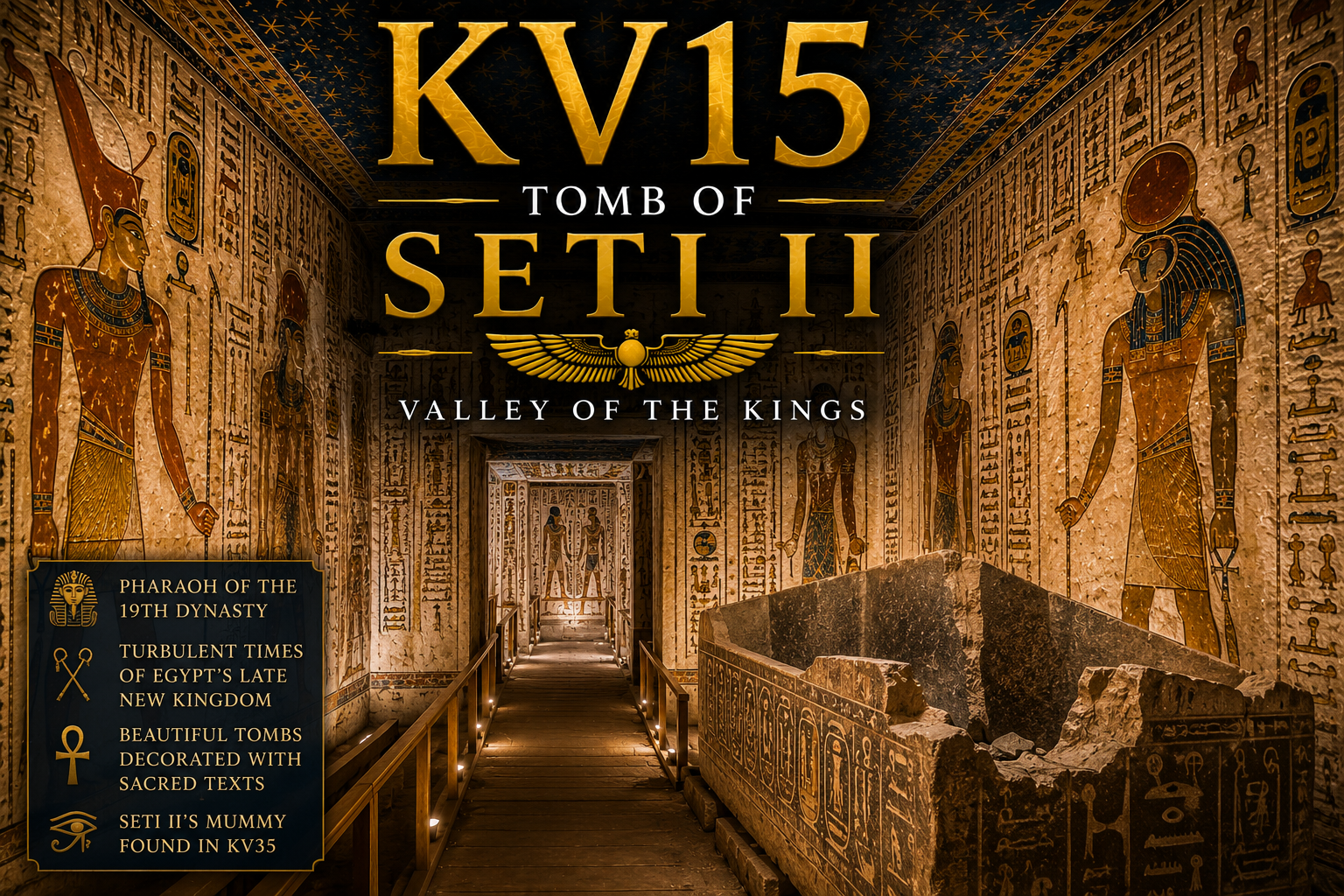
KV15 is the royal tomb of Pharaoh Seti II, one of the last rulers of Egypt’s Nineteenth Dynasty. Located in the East Valley of the Valley of the Kings, the tomb reflects a period of political instability marked by rival claims to the throne, royal usurpation, and shifting power within the Egyptian court. Although modest in size compared to the great tombs of earlier pharaohs such as Seti I and Ramesses II, KV15 provides an important glimpse into the final years of one of Egypt’s most influential dynasties.
The tomb is closely connected with the mysterious reign of Amenmesse, whose rule interrupted Seti II’s kingship. After regaining control of Egypt, Seti II systematically erased many of Amenmesse’s monuments and inscriptions, making KV15 an important monument for understanding this turbulent chapter of Egyptian history.
Although ancient tomb robbers removed most of its burial treasures, KV15 still preserves beautiful painted decoration, remarkable religious texts, and evidence of the changing fortunes of Egypt’s late New Kingdom rulers.
- Structure: KV15
- Location: Valley of the Kings, East Valley, Thebes West Bank, Luxor
- Owner: Seti II
- Other Designations: KV15
- Site Type: Royal Tomb
KV15 is located in the central area of the East Valley of the Valley of the Kings. Unlike many earlier royal tombs, it is relatively compact, consisting of a descending staircase, a series of corridors, a pillared chamber, and a burial chamber with several adjoining side rooms.
Construction appears to have progressed steadily during Seti II’s reign, although some portions of the monument may have remained unfinished when the king died. The tomb follows the traditional straight-axis design favored during the late Nineteenth Dynasty.
The burial chamber originally contained a large quartzite sarcophagus. Fragments of this impressive monument remain inside the tomb today, providing visitors with a glimpse of its original grandeur.
Decoration
Despite its relatively small size, KV15 contains an impressive decorative program featuring many of the most important funerary compositions of the New Kingdom.
The walls include scenes from:
- The Litany of Ra
- The Book of Gates
- The Amduat
- The Opening of the Mouth ritual
- The Book of the Dead
- Representations of Seti II before numerous Egyptian deities
These sacred texts were intended to guide the deceased king safely through the underworld, protect him from dangerous supernatural beings, and ensure his rebirth alongside the sun god Ra.
Although portions of the decoration remain unfinished, the surviving paintings display the elegant artistic style characteristic of the late Nineteenth Dynasty.
Noteworthy Features
KV15 is notable for several reasons:
- It is the burial place of Pharaoh Seti II.
- The tomb preserves beautifully painted scenes from several major funerary books.
- Fragments of the king’s quartzite sarcophagus remain inside.
- It reflects the political struggles between Seti II and Amenmesse.
- The monument escaped the severe flood damage that some neighboring tombs suffered.
- It remains one of the most accessible royal tombs in the Valley of the Kings.
Site History
Construction of KV15 began during the reign of Seti II but was interrupted during the brief rule of Amenmesse, who may have controlled Upper Egypt for several years. After reclaiming the throne, Seti II resumed work on his burial place while simultaneously removing many references to his rival from monuments throughout Egypt.
Following Seti II’s death, the tomb was completed sufficiently for his burial. Like nearly every royal tomb in the Valley of the Kings, however, KV15 was robbed during antiquity. The king’s mummy was later removed by priests of the Twenty-first Dynasty and transferred to the royal cache in KV35, the tomb of Amenhotep II, where it was rediscovered in 1898.
During the Graeco-Roman period, visitors entered the tomb and left numerous graffiti on its walls, continuing a tradition of ancient tourism that is well documented throughout the Valley of the Kings.
Seti II and Amenmesse
One of the most fascinating aspects of KV15 is its connection to the succession dispute between Seti II and Amenmesse.
Although the exact relationship between the two rulers remains uncertain, many Egyptologists believe Amenmesse temporarily seized power over parts of Egypt before Seti II regained full control. After reclaiming the throne, Seti II ordered many of Amenmesse’s names and images to be erased from monuments, including those in KV10.
Together, KV15 and KV10 tell the story of one of the most intriguing political struggles of ancient Egypt’s New Kingdom.
Dating
This site was used during the following periods:
- New Kingdom, Dynasty 19, reign of Seti II
- Twenty-first Dynasty (removal of the royal mummy)
- Graeco-Roman Period
- Byzantine (Coptic) Period
Conservation History
Modern conservation efforts have focused on stabilizing the painted plaster, documenting surviving inscriptions, repairing structural cracks, and improving visitor access. The tomb has also undergone cleaning to remove soot, dust, and salt deposits that accumulated over centuries.
Site Condition
KV15 is in relatively good condition compared to many royal tombs of the Nineteenth Dynasty. Although portions of the decoration have faded or been damaged, much of the painted artwork remains visible. Fragments of the royal sarcophagus continue to occupy the burial chamber, while ancient graffiti testify to the monument’s long history of visitation.
Interesting Facts About KV15
- KV15 is the tomb of Pharaoh Seti II.
- The tomb is closely connected to the political rivalry between Seti II and Amenmesse.
- Seti II’s mummy was discovered in KV35, not in his original tomb.
- Fragments of the king’s massive quartzite sarcophagus remain inside the burial chamber.
- Ancient Greek and Roman visitors left graffiti on the tomb’s walls.
- KV15 preserves beautifully painted scenes from the Litany of Ra, Book of Gates, and Amduat.
- The tomb offers valuable insight into the final years of Egypt’s Nineteenth Dynasty.