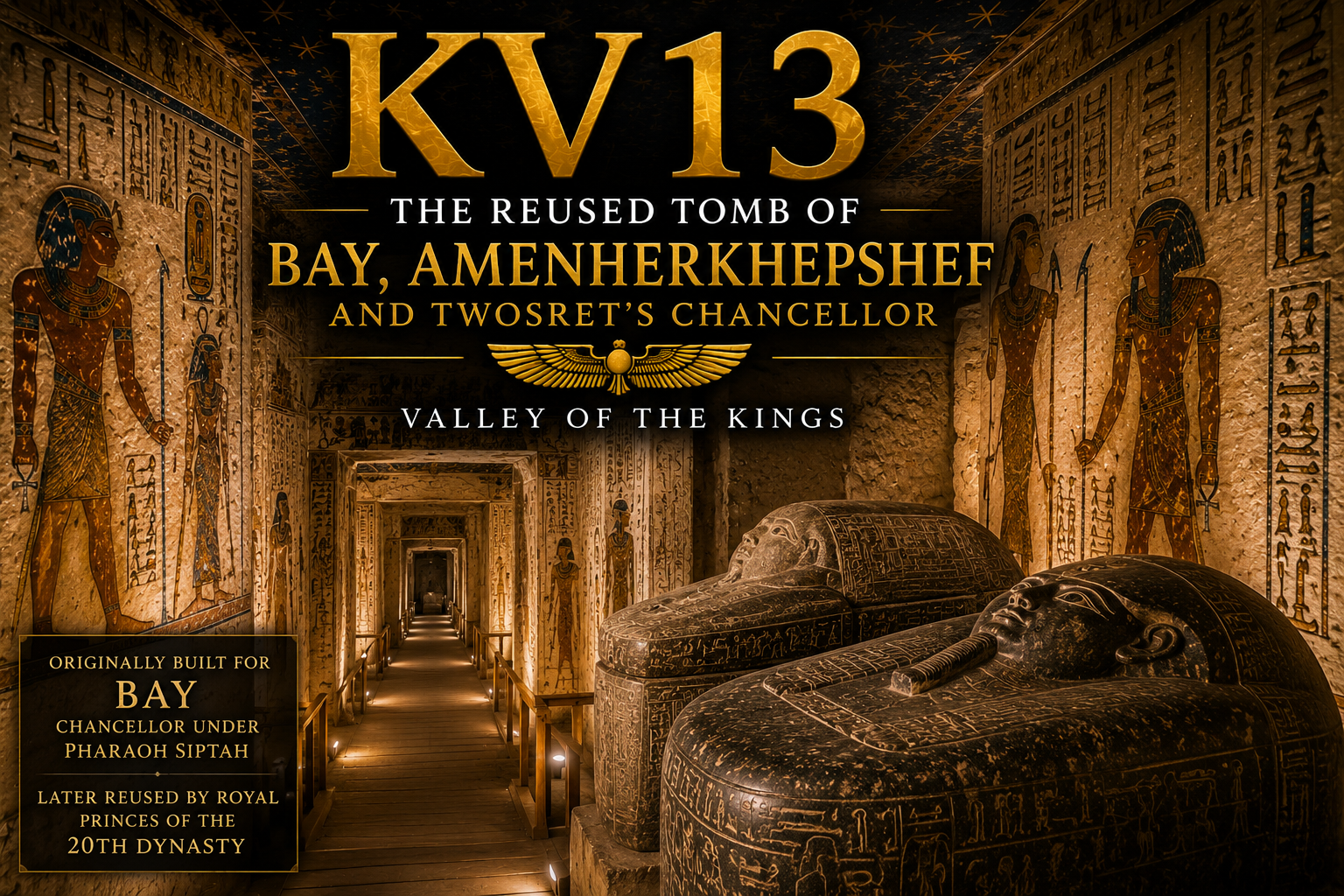
KV13 is one of the most fascinating examples of how royal tombs in the Valley of the Kings were reused over time. Originally believed to have been constructed for Bay, the influential Chancellor who served under Pharaoh Siptah and Queen Twosret during the late Nineteenth Dynasty, the tomb was never used for his burial. Instead, it later became the resting place of several high-ranking princes during the Twentieth Dynasty.
Located in the East Valley of the Valley of the Kings, KV13 demonstrates that not every tomb remained associated with its original owner. Over the centuries, the monument was adapted, reoccupied, and modified to accommodate new burials, providing archaeologists with valuable evidence for changing funerary practices during Egypt’s New Kingdom.
Although much of the tomb’s decoration was altered and damaged by ancient flooding and robbery, KV13 has yielded remarkable discoveries, including beautifully carved sarcophagi belonging to royal princes.
- Structure: KV13
- Location: Valley of the Kings, East Valley, Thebes West Bank, Luxor
- Original Owner: Probably Bay, Chancellor under Pharaoh Siptah
- Later Burials: Amenherkhepshef, Mentuherkhepshef, and possibly other members of the royal family
- Site Type: Tomb
KV13 follows a relatively simple straight-axis plan typical of late Nineteenth Dynasty tombs. A descending entrance leads through a sequence of corridors before opening into a pillared burial chamber with several side rooms.
The architecture closely resembles that of nearby non-royal tombs constructed for high officials rather than reigning pharaohs. Despite its modest size, the monument was carefully finished and decorated, suggesting it was intended for an individual of exceptional status.
The burial chamber later accommodated multiple interments, reflecting the tomb’s long and complex history of reuse.
Decoration
Much of KV13’s original decoration survives only in fragments. The remaining scenes include traditional funerary imagery depicting the deceased before Egyptian gods and religious texts intended to ensure safe passage through the underworld.
Many of the original inscriptions naming Bay were altered or plastered over when the tomb was reused by later occupants.
Although the decoration is less elaborate than that found in the royal tombs of the Valley, it provides important evidence for elite funerary beliefs during the closing years of the Nineteenth Dynasty.
Who Was Bay?
Bay was one of the most powerful officials of the late Nineteenth Dynasty. Serving as Chancellor under Pharaoh Siptah, he exercised enormous political influence during a turbulent period of Egyptian history.
Ancient inscriptions describe Bay as a trusted royal advisor who helped place Siptah on the throne following the death of Seti II. However, his remarkable rise to power ended abruptly. An ostracon discovered at Deir el-Medina records that Bay was executed in Year 5 of Siptah’s reign after falling from royal favor.
Because of his execution, scholars believe Bay was never buried in KV13, leaving the tomb available for later occupants.
Later Burials
During the Twentieth Dynasty, KV13 was reused for several royal princes. Among the best-known individuals buried here were:
- Amenherkhepshef, a son of Ramesses III
- Mentuherkhepshef, another royal prince
Large granite sarcophagi belonging to these princes were discovered within the tomb, demonstrating that it had become an important burial place for members of the Ramesside royal family.
The reuse of KV13 illustrates how practical considerations sometimes outweighed the construction of entirely new tombs during the later New Kingdom.
Noteworthy Features
KV13 is notable because:
- It was probably built for the Chancellor Bay.
- Bay was executed before he could be buried there.
- The tomb was later reused by royal princes of the Twentieth Dynasty.
- Several impressive granite sarcophagi were discovered inside.
- It provides evidence for the political turmoil at the end of the Nineteenth Dynasty.
- The monument demonstrates how tombs in the Valley of the Kings could be repurposed for later burials.
Site History
Construction of KV13 probably began during the reign of Siptah for his influential Chancellor, Bay. However, Bay’s execution prevented him from being buried in the monument.
Instead, the tomb remained available and was later adapted for members of the Ramesside royal family during the Twentieth Dynasty. New burials were added, and the decoration was modified to suit the new occupants.
Like most tombs in the Valley of the Kings, KV13 was robbed in antiquity. Floodwaters also entered the monument repeatedly, carrying mud and debris into the corridors and burial chamber. Despite this damage, important artifacts survived, allowing archaeologists to reconstruct much of the tomb’s later history.
Modern excavations have clarified the sequence of reuse and revealed how the monument evolved over several generations.
Dating
This site was used during the following periods:
- New Kingdom, Dynasty 19, reign of Siptah
- New Kingdom, Dynasty 20, reuse by royal princes
- Graeco-Roman Period
Conservation History
Archaeologists have worked to stabilize the tomb’s architecture, document its surviving decoration, and conserve the sarcophagi and artifacts recovered during excavation. Flood deposits have been cleared, allowing researchers to better understand the monument’s multiple phases of use.
Site Condition
KV13 has suffered considerable damage from ancient flooding and tomb robbery. Much of the painted decoration has deteriorated, but the architecture remains largely intact. The surviving sarcophagi and inscriptions continue to provide valuable information about elite burials during the late New Kingdom.
Interesting Facts About KV13
- KV13 was probably built for Bay, one of ancient Egypt’s most powerful officials.
- Bay was executed before he could be buried in the tomb.
- The tomb was later reused by sons of Ramesses III.
- Several beautifully carved granite sarcophagi were discovered inside.
- KV13 provides important evidence for the political instability that followed the reign of Seti II.
- The tomb demonstrates how burial monuments were frequently adapted for new owners during the New Kingdom.
- Its history spans both the Nineteenth and Twentieth Dynasties.