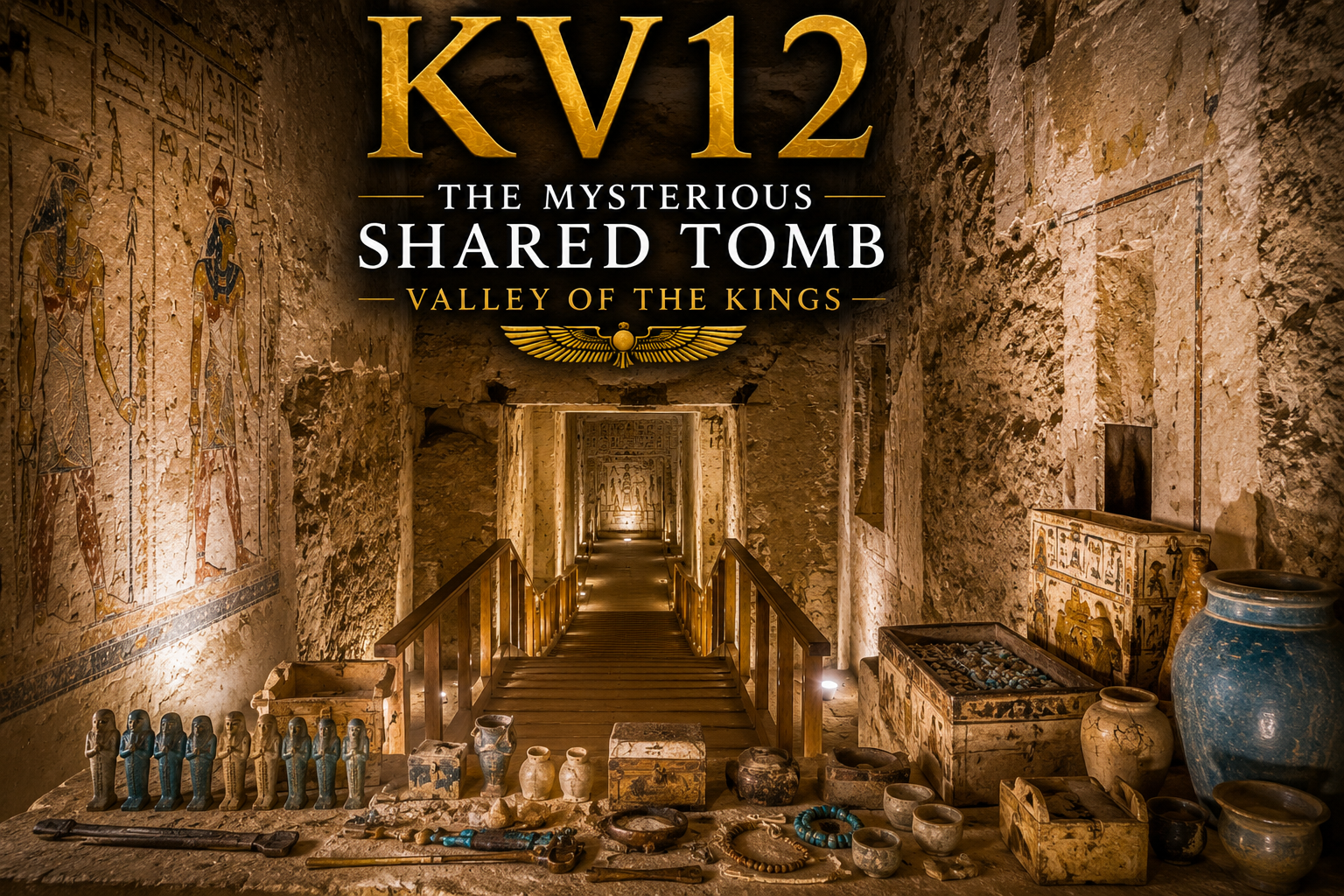
KV12 is one of the most unusual tombs in the Valley of the Kings. Unlike the grand royal tombs built for Egypt’s pharaohs, this monument’s original owner remains unknown, and it appears to have served multiple purposes over several centuries. Located in the East Valley between the tombs of Ramesses II (KV7) and Ramesses VI (KV9), KV12 has yielded an extraordinary collection of artifacts belonging to members of the royal family during the Nineteenth and Twentieth Dynasties.
Although its architecture is relatively modest compared to the great royal tombs nearby, KV12 has become one of the Valley’s most important archaeological sites. Excavations have uncovered thousands of funerary objects, including shabtis, coffins, pottery, jewelry, and fragments of burial equipment, providing valuable insight into the burials of royal princes and other elite individuals during the Ramesside Period.
Today, KV12 remains one of the Valley of the Kings’ greatest archaeological puzzles, with Egyptologists continuing to debate who originally commissioned the tomb and how it evolved over time.
- Structure: KV12
- Location: Valley of the Kings, East Valley, Thebes West Bank, Luxor
- Owner: Unknown (possibly intended for members of the royal family)
- Other Designations: KV12
- Site Type: Royal Tomb
KV12 is located in the central part of the East Valley and follows a relatively simple plan compared to the elaborate royal tombs surrounding it. The entrance leads into a series of corridors and chambers with several unfinished side rooms branching from the main axis.
Unlike the monumental tombs of the reigning pharaohs, KV12 lacks the extensive decorative program normally associated with royal burials. Instead, much of its importance comes from the remarkable archaeological discoveries made inside.
Evidence suggests the tomb was enlarged and modified on several occasions. Additional chambers appear to have been excavated as new burials were added, indicating that the monument may have served as a communal burial place for members of the royal family rather than a single individual.
Decoration
Very little original wall decoration survives within KV12. Most of the chambers are either undecorated or were never fully finished.
This absence of decoration has led many Egyptologists to believe the tomb was never intended for the burial of a reigning king. Instead, its simpler appearance is consistent with a monument designed for princes or other members of the royal household.
Although the walls preserve few painted scenes, the thousands of objects recovered from the tomb provide an invaluable record of Ramesside funerary practices.
Noteworthy Features
KV12 is notable for several reasons:
- The original owner remains unknown.
- The tomb appears to have been reused repeatedly during the Nineteenth and Twentieth Dynasties.
- Archaeologists have recovered thousands of funerary artifacts from the site.
- Many objects belonged to royal princes and other members of the royal family.
- The tomb provides unique evidence for the burial practices of non-reigning royals.
- Excavations are still producing important discoveries today.
Site History
The exact origins of KV12 remain uncertain. Construction probably began during the Nineteenth Dynasty, although it is unclear who originally commissioned the monument.
Rather than serving a single burial, KV12 appears to have become a repository for members of the extended royal family during the Ramesside Period. Numerous inscriptions and funerary objects bear the names of royal princes associated with the courts of Ramesses II, Merneptah, Seti II, and later Twentieth Dynasty rulers.
Unlike many royal tombs, KV12 was not completely emptied by ancient tomb robbers. Large quantities of burial equipment remained scattered throughout the monument, allowing archaeologists to reconstruct aspects of elite funerary customs that would otherwise have been lost.
Modern excavations have recovered thousands of objects, making KV12 one of the richest archaeological deposits in the Valley of the Kings despite its relatively modest architecture.
Archaeological Discoveries
KV12 has produced one of the largest collections of Ramesside funerary objects ever recovered from the Valley of the Kings.
Among the discoveries are:
- Shabti figures
- Fragments of wooden coffins
- Pottery vessels
- Faience objects
- Jewelry
- Canopic equipment
- Funerary papyri fragments
- Ushabti boxes
- Cartonnage fragments
- Bronze and stone artifacts
These discoveries have significantly expanded our understanding of the burials of royal family members who did not ascend the throne.
Dating
This site was used during the following periods:
- New Kingdom, Dynasty 19
- New Kingdom, Dynasty 20
- Later intrusive activity during antiquity
Evidence suggests that the tomb remained in use for several generations, with additional members of the royal family buried within it.
Conservation History
Modern archaeological work has concentrated on clearing debris, documenting the enormous quantity of artifacts recovered from the tomb, stabilizing its architecture, and conserving fragile objects before they deteriorate further.
Because excavations have continued into recent decades, KV12 remains an active source of new archaeological information.
Site Condition
KV12 has suffered from ancient robbery, flooding, and natural deterioration. Even so, its chambers have preserved an exceptional number of artifacts, making it one of the most important non-royal burial complexes in the Valley of the Kings.
Who Was Buried in KV12?
Although the tomb’s original owner remains unknown, inscriptions found inside identify several royal princes and members of the Ramesside royal family.
Scholars generally believe KV12 functioned as a burial place for members of the royal household rather than for a reigning king. The repeated addition of new burials over many decades makes it unique among the tombs of the Valley of the Kings.
Its archaeological importance lies not in magnificent wall paintings, but in the wealth of artifacts that illuminate the lives, deaths, and burial customs of Egypt’s royal family.
Interesting Facts About KV12
- The original owner of KV12 remains unknown.
- The tomb was reused by multiple members of the Ramesside royal family.
- Thousands of artifacts have been recovered from the site.
- KV12 has produced one of the richest collections of objects from any non-pharaonic tomb in the Valley of the Kings.
- Excavations continue to uncover new information about the monument.
- The tomb helps archaeologists understand how royal princes were buried during the New Kingdom.
- Unlike many royal tombs, KV12 is better known for its archaeological discoveries than for its wall decoration.