Tomb KV9 is one of the most spectacular and best-preserved royal tombs in the Valley of the Kings. Originally begun for Pharaoh Ramesses V, the monument was later enlarged, completed, and ultimately occupied by his successor and uncle, Ramesses VI. Today, it is celebrated for its brilliantly preserved wall paintings and astronomical ceilings, making it one of the finest examples of late New Kingdom funerary art.
Unlike many royal tombs that suffered extensive flood damage or later reuse, much of KV9’s decoration remains remarkably vibrant. Its walls are covered with some of the most important religious texts of ancient Egypt, guiding the deceased king through the dangers of the underworld and ensuring his rebirth alongside the sun god Ra.
The tomb is also famous for an unexpected historical connection. During Howard Carter’s excavation of the nearby tomb of Tutankhamun (KV62), the workmen’s huts built during the construction of KV9 had to be removed. Beneath them lay the entrance to Tutankhamun’s long-hidden tomb, making KV9 indirectly responsible for one of archaeology’s greatest discoveries.
- Structure: KV9
- Location: Valley of the Kings, East Valley, Thebes West Bank, Luxor
- Owner: Originally Ramesses V; later enlarged and reused by Ramesses VI
- Other Designations: KV9, Tomb of Ramesses V/VI
- Site Type: Royal Tomb
KV9 lies in the central area of the East Valley and follows the traditional straight-axis plan used during the Twentieth Dynasty. A broad descending entrance leads through a series of corridors, halls, and stairways before reaching the burial chamber.
The tomb contains several side chambers for storing funerary equipment and ritual objects. The spacious burial chamber is supported by four pillars and once housed the king’s massive granite sarcophagus. Beyond the burial chamber are additional storerooms that formed part of the royal burial complex.
Although originally intended for Ramesses V, the tomb was substantially enlarged after Ramesses VI assumed the throne. His cartouches and decorations replaced many belonging to his predecessor, although traces of Ramesses V’s original inscriptions remain visible in several places.
Decoration
KV9 contains one of the most complete decorative programs in the Valley of the Kings. Its walls and ceilings are covered with beautifully preserved religious texts and colorful illustrations that rank among the masterpieces of New Kingdom art.
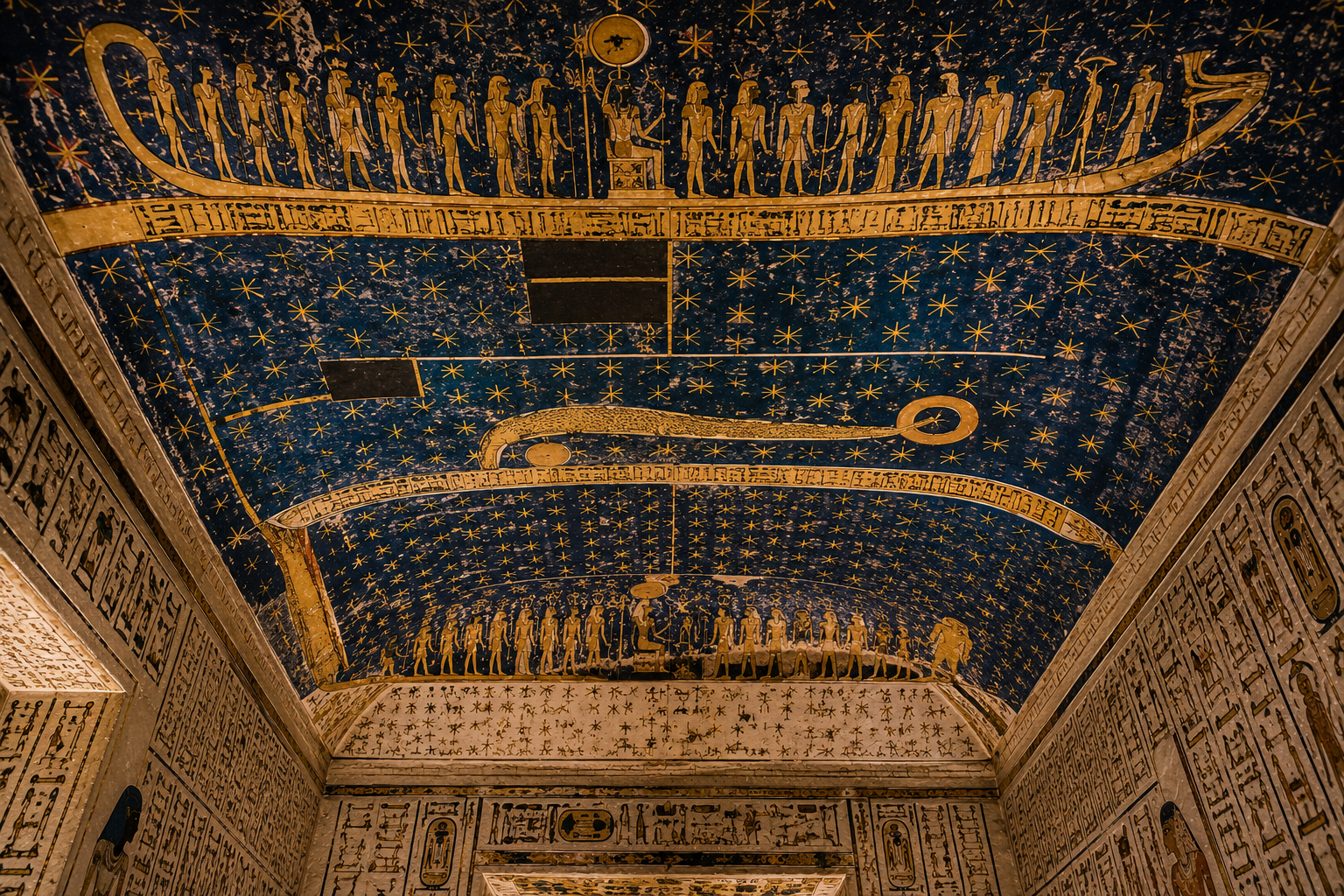
The decorative program includes scenes from:
- The Book of Gates
- The Book of Caverns
- The Book of the Earth
- The Book of the Night
- The Book of the Day
- The Litany of Ra
- The Amduat
- The Book of the Dead
- The Opening of the Mouth ritual
One of the tomb’s greatest treasures is its magnificent astronomical ceiling. Painted deep blue and covered with golden stars, constellations, and celestial figures, it represents the heavens through which the sun god traveled each night before being reborn at dawn.
The vivid colors of the paintings remain among the finest preserved anywhere in the Valley of the Kings.
Noteworthy Features
KV9 is notable for several reasons:
- Originally constructed for Ramesses V before being expanded by Ramesses VI.
- Contains one of the most complete collections of royal funerary texts in Egypt.
- Features one of the finest astronomical ceilings in the Valley of the Kings.
- Among the best-preserved decorated royal tombs open to visitors today.
- The workmen’s huts associated with KV9 concealed the entrance to Tutankhamun’s tomb for over 3,000 years.
Site History
Construction of KV9 began during the reign of Ramesses V but was interrupted when he died after a relatively short reign. His successor, Ramesses VI, appropriated the unfinished monument, extending its length and replacing much of the original decoration with scenes bearing his own royal names and titles.
Like nearly every royal tomb in the Valley of the Kings, KV9 was robbed during antiquity. The mummy of Ramesses VI was eventually removed by priests of the Twenty-first Dynasty and reburied in the royal cache at Deir el-Bahari (DB320) for protection. The mummy of Ramesses V was later discovered in the tomb of Amenhotep II (KV35), where several royal mummies had been hidden.
During the Graeco-Roman period, the tomb remained open and attracted numerous visitors. Ancient Greek, Roman, and later Coptic graffiti still survive on the walls, demonstrating that KV9 had become a popular destination for travelers long before the beginning of modern Egyptology.
Centuries later, KV9 again played an important role in archaeological history. During the excavation of the tomb in the early twentieth century, archaeologists removed the remains of ancient workmen’s huts nearby. Beneath these huts lay the hidden entrance to KV62, the tomb of Tutankhamun, which Howard Carter discovered in 1922.
Dating
This site was used during the following periods:
- New Kingdom, Dynasty 20, reign of Ramesses V
- New Kingdom, Dynasty 20, reign of Ramesses VI
- Twenty-first Dynasty (removal of the royal mummies)
- Graeco-Roman Period
- Byzantine (Coptic) Period
Conservation History
KV9 has benefited from extensive conservation efforts over the past century. Conservators have stabilized damaged plaster, cleaned wall paintings, improved drainage, and installed protective measures to reduce visitor impact while preserving the tomb’s remarkable artwork.
Site Condition
KV9 remains one of the best-preserved royal tombs in the Valley of the Kings. Its brilliant wall paintings and astronomical ceilings survive in exceptional condition, although some areas have suffered fading, smoke damage, and minor deterioration from centuries of visitation.
Interesting Facts About KV9
- KV9 served as the burial place of two pharaohs: Ramesses V and Ramesses VI.
- It contains one of the finest astronomical ceilings in ancient Egypt.
- The tomb preserves nearly every major royal funerary book used during the New Kingdom.
- Ancient Greek, Roman, and Coptic visitors left graffiti throughout the monument.
- The workmen’s huts associated with KV9 concealed the entrance to Tutankhamun’s tomb until Howard Carter’s discovery in 1922.
- KV9 is widely regarded as one of the most beautifully decorated tombs in the Valley of the Kings.
This combination of spectacular artwork, exceptional preservation, and fascinating history makes KV9 one of the absolute highlights of the Valley of the Kings and a must-see for anyone interested in ancient Egyptian royal tombs.