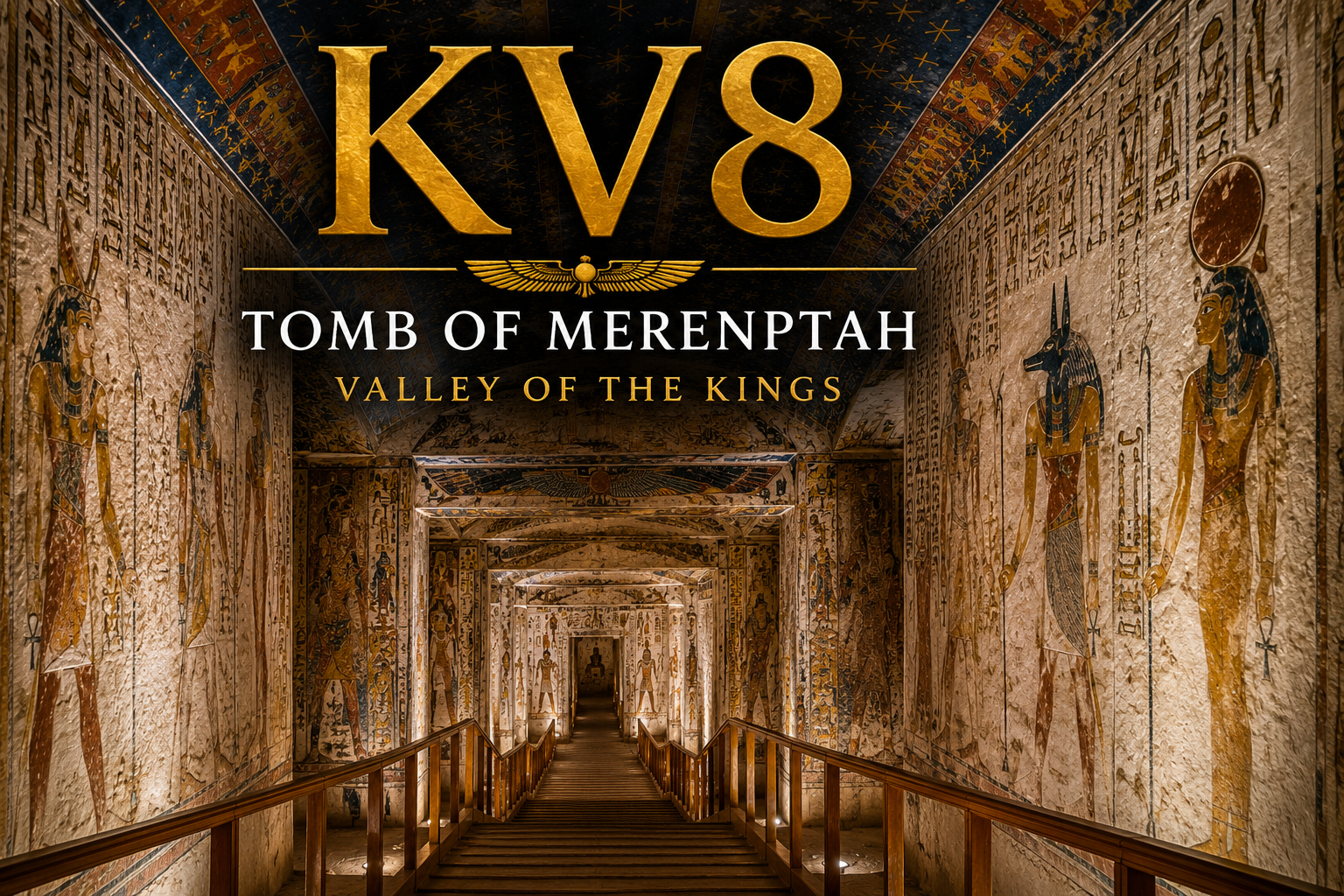
Tomb KV8 is the royal burial place of Pharaoh Merenptah, the thirteenth son and successor of Ramesses II. Located in the East Valley of the Valley of the Kings, KV8 is one of the largest royal tombs in the Valley and reflects the continued grandeur of royal burial traditions during Egypt’s Nineteenth Dynasty.
Merenptah inherited the throne late in life after the exceptionally long reign of his father, Ramesses the Great. Although his reign was much shorter, Merenptah is remembered for his military campaigns, especially his victory over Libyan invaders and their allies. He is also famous for the Merenptah Stele, which contains the earliest known Egyptian reference to Israel.
His tomb, KV8, was designed on a grand scale. It follows a mostly straight axis and descends deep into the limestone bedrock, with long corridors, pillared halls, side chambers, and a large burial chamber. Although the tomb was damaged by floods and ancient robbery, it preserves important traces of its original decoration and burial equipment.
- Structure: KV8
- Location: Valley of the Kings, East Valley, Thebes West Bank, Luxor
- Owner: Merenptah
- Site Type: Royal Tomb
Description
KV8 is located in the East Valley of the Valley of the Kings. Its entrance opens into a long descending passage that leads through a sequence of corridors, chambers, and stairways before reaching the burial chamber. The tomb is larger and more complex than many other royal tombs of the period, reflecting Merenptah’s status as the son and successor of Ramesses II.
The tomb includes several corridors and chambers arranged along a generally straight axis. Like other royal tombs of the New Kingdom, its layout was designed to guide the deceased king symbolically through the underworld and toward rebirth with the sun god Ra.
One of the most notable features of KV8 is its burial chamber, which contains the remains of Merenptah’s massive stone sarcophagus. The king’s burial equipment was severely disturbed in antiquity, but surviving fragments reveal that the tomb was originally furnished on a royal scale.
Decoration
The decoration of KV8 includes scenes and texts from several important ancient Egyptian funerary books. These religious compositions were intended to protect the king in the afterlife and guide him through the underworld’s dangerous regions.
The tomb once contained scenes from texts such as:
- The Litany of Ra
- The Book of Gates
- The Amduat
- The Book of the Dead
- The Opening of the Mouth ritual
- Representations of Merenptah before various gods
These texts emphasized the king’s transformation, protection, and rebirth. They also linked Merenptah with the solar cycle, allowing him to join Ra on his nightly journey through the underworld and emerge renewed with the dawn.
Although much of the decoration has suffered from flood damage, surviving scenes still show the quality and importance of the tomb’s original artwork.
Noteworthy Features
KV8 is notable for several reasons:
- It is the burial place of Merenptah, son and successor of Ramesses II.
- It is one of the larger royal tombs in the Valley of the Kings.
- The tomb contains remains of a massive royal sarcophagus.
- Its decoration includes major funerary texts associated with the king’s journey through the underworld.
- KV8 suffered significant flood damage, but important portions of its architecture and decoration survive.
- The mummy of Merenptah was not found in KV8, but was later discovered in the royal mummy cache in KV35.
Site History
KV8 was constructed during the reign of Merenptah, who ruled Egypt during the Nineteenth Dynasty. As the son of Ramesses II, Merenptah came to the throne after a long period of royal stability and inherited a kingdom still shaped by his father’s monumental legacy.
The tomb was robbed in antiquity, like most royal tombs in the Valley of the Kings. Valuable funerary equipment was removed, and the king’s burial was disturbed. During the Twenty-first Dynasty, priests moved many royal mummies to hidden caches to protect them from further robbery. Merenptah’s mummy was eventually found in KV35, the tomb of Amenhotep II, where several royal mummies had been reburied.
KV8 also suffered from repeated flooding. Water, mud, and debris entered the tomb over time, damaging its walls, decoration, and burial chamber. Despite this damage, the tomb remains an important source for understanding royal burial practices at the end of the Nineteenth Dynasty.
Merenptah and the Merenptah Stele
Merenptah is especially famous because of the so-called Merenptah Stele, also known as the Israel Stele. This victory monument records his campaigns and includes the earliest known Egyptian reference to Israel. While the stele itself was not found in KV8, it is one of the most important historical sources from Merenptah’s reign.
The stele helps place Merenptah within the wider political world of the late Nineteenth Dynasty, when Egypt faced challenges from Libyan groups, Sea Peoples, and unrest in parts of the eastern Mediterranean.
This site was used during the following period: New Kingdom, Dynasty 19, reign of Merenptah
The tomb also shows evidence of later activity connected with ancient robbery, inspection, and reuse of royal burial spaces during the period when priests were relocating royal mummies for protection.
Conservation History
KV8 has received attention from modern archaeologists and conservators because of its size, flood damage, and surviving decoration. Work in the tomb has focused on clearing debris, documenting surviving decoration, stabilizing damaged areas, and protecting what remains of the original painted scenes.
Site Condition
KV8 has suffered considerable damage from flooding and ancient robbery. Many painted surfaces are worn, and some areas of decoration have been lost. However, the tomb’s large architectural layout, burial chamber, and surviving religious scenes continue to make it one of the most significant royal tombs in the Valley of the Kings.
Interesting Facts About KV8
- KV8 belonged to Merenptah, the thirteenth son of Ramesses II.
- Merenptah became pharaoh late in life after the long reign of his father.
- His mummy was discovered in KV35, not in KV8.
- KV8 contains remains of a large royal sarcophagus.
- The tomb suffered heavy damage from flooding.
- Merenptah is famous for the Merenptah Stele, which contains the earliest known Egyptian reference to Israel.
- KV8 is one of the larger royal tombs in the Valley of the Kings.