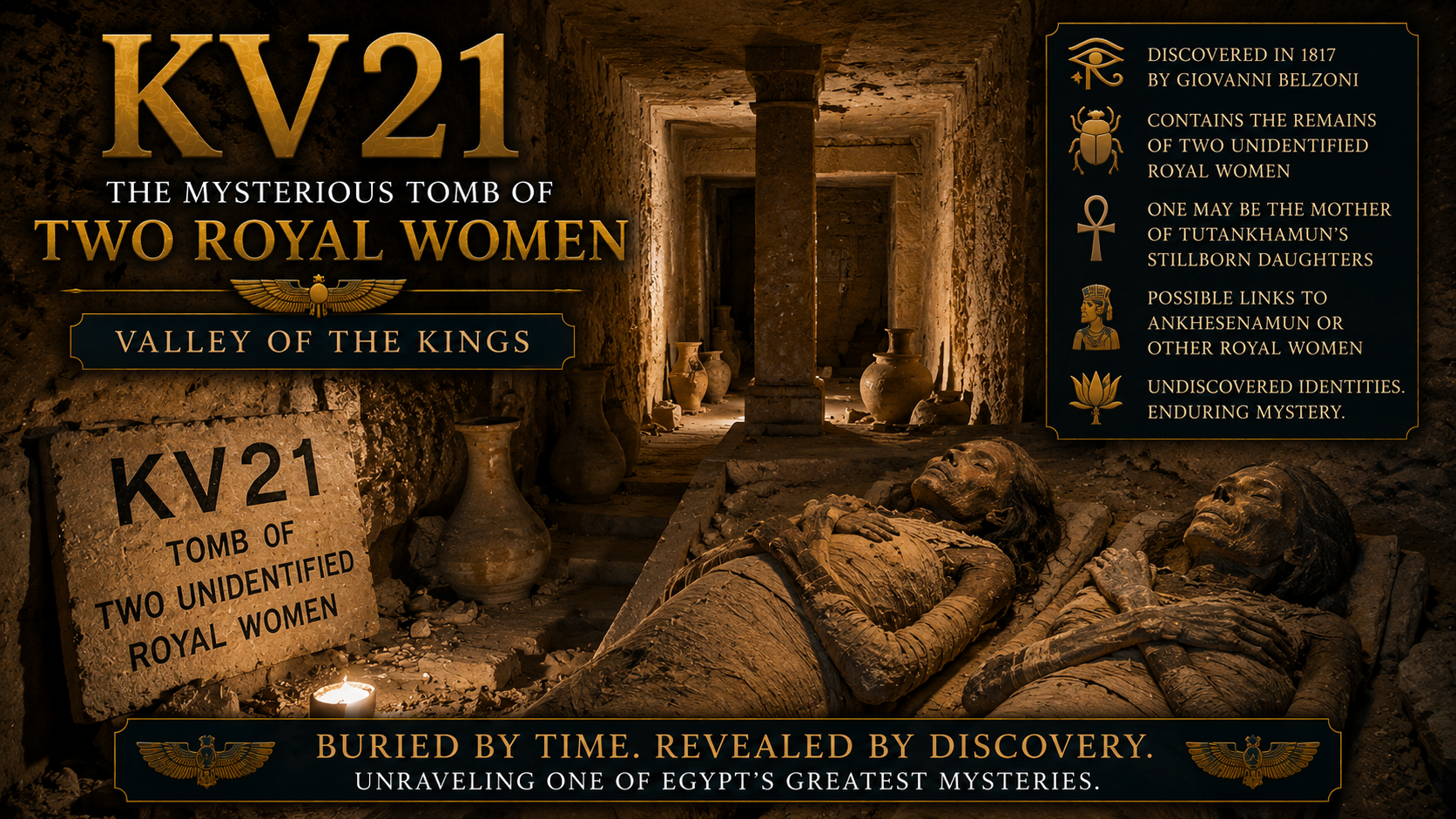
KV21 is one of the most mysterious undecorated tombs in the Valley of the Kings. Although no inscriptions reveal the identity of its original owner, the tomb contained the remains of two women whose mummification and burial positions suggest that they may have belonged to Egypt’s royal family during the Eighteenth Dynasty.
The tomb was discovered in 1817 by the Italian explorer Giovanni Battista Belzoni. When he entered the burial chamber, he found two unwrapped female mummies lying near one another, along with fragments of pottery, alabaster vessels, and other funerary objects. The women’s identities were already lost, but their crossed or flexed arms have often been interpreted as evidence of elevated or royal status.
KV21 later disappeared beneath debris carried into the Valley by flash floods. It was not properly relocated and re-examined until 1989, when archaeologist Donald P. Ryan and the Pacific Lutheran University Valley of the Kings Project cleared its buried entrance.
Modern scientific analysis has made KV21 even more intriguing. DNA testing has suggested that one of the women, known as KV21A, may have been the mother of the two stillborn daughters discovered in the tomb of Tutankhamun. This has led to speculation that she could be Ankhesenamun, Tutankhamun’s queen, although the evidence remains incomplete and her identity has not been confirmed.
Structure: KV21
Location: Valley of the Kings, East Valley, Thebes West Bank, Luxor
Owner: Unknown
Possible Occupants: Two unidentified women, probably members of the Eighteenth Dynasty royal family
Site Type: Tomb
KV21 is located in a side branch of the East Valley of the Kings. Its plan follows a straight axis and is considerably simpler than the elaborate royal tombs constructed for reigning pharaohs.
The entrance leads into a sloping passage, followed by a staircase and a second descending corridor. At the end of this passage is a rectangular chamber containing a single central pillar. A smaller side chamber opens from the principal room.
The walls were carefully cut and appear to have been prepared for plastering, but no finished painted or carved decoration survives. It is uncertain whether the decoration was originally planned and then abandoned, or whether the tomb was always intended to remain undecorated.
Its architecture resembles several tombs associated with royal women of the Eighteenth Dynasty, suggesting that KV21 was created for a queen or another important female member of the royal household.
Decoration
KV21 is undecorated.
Unlike the richly painted royal tombs nearby, its walls contain no surviving funerary texts, divine scenes, or representations of its occupants. This absence of decoration makes identifying the tomb’s owners particularly difficult.
The lack of inscriptions also means that almost everything known about KV21 must be reconstructed from its architecture, funerary objects, human remains, and comparisons with other Eighteenth Dynasty tombs.
The Two Female Mummies
The most important discoveries in KV21 were the remains of two women now known as KV21A and KV21B.
When Belzoni entered the tomb in 1817, he described both women as unwrapped and possessing long hair. They appear to have been comparatively well preserved at the time of their discovery.
Unfortunately, the tomb remained open for several years after Belzoni’s visit. During this period, the mummies were severely vandalized. When Donald Ryan re-excavated KV21 in 1989, their bodies had been broken apart, and their remains were scattered through the corridors and burial chamber.
Despite this destruction, enough survived for later examination, including CT scanning and genetic testing.
KV21A
KV21A is a badly damaged and headless female mummy. Parts of the torso and both legs survive, together with embalming materials placed inside the body.
Her left hand was found clenched, and the position of her arm has sometimes been described as a queenly pose. The precise meaning of this posture is uncertain, but it has contributed to the suggestion that she was a royal woman.
Scientific analysis suggested that she was a young adult. Genetic testing also produced evidence that she may have been the biological mother of the two female fetuses buried with Tutankhamun.
Because Tutankhamun’s principal wife was Ankhesenamun, some researchers have proposed that KV21A may be her mummy. However, the DNA sample was incomplete, and the proposed identification remains tentative.
KV21B
KV21B is also fragmentary. Part of her skull survives, together with dark hair, portions of the torso, and embalming linen.
Her arm appears to have once been flexed across her chest, a feature associated with royal female burials. Changes in her spine suggest that she may have been older than KV21A, although her precise age and identity remain uncertain.
KV21B has occasionally been suggested as a possible candidate for Queen Nefertiti or another woman from the Amarna royal family. There is currently no conclusive evidence supporting a specific identification.
Could KV21A Be Ankhesenamun?
Ankhesenamun was the daughter of Akhenaten and Nefertiti and became the Great Royal Wife of Tutankhamun. Two mummified female fetuses were discovered in Tutankhamun’s tomb, and genetic testing indicated that Tutankhamun was their father.
Testing published in 2010 suggested that KV21A could have been their mother. Since Ankhesenamun is the only wife of Tutankhamun securely known from contemporary evidence, she became the most obvious candidate.
However, the genetic profile obtained from KV21A was incomplete. Researchers were unable to identify her definitively or securely connect her with other members of the royal family.
For this reason, KV21A should be described as a possible candidate for Ankhesenamun rather than as her confirmed mummy.
Could KV21B Be Nefertiti?
The identity of KV21B is even more uncertain.
Some have proposed that the two women buried together could have been related members of the Amarna royal family, possibly a mother and daughter. Under this theory, KV21B could be Nefertiti and KV21A could be Ankhesenamun.
Although the idea is intriguing, no complete genetic result has proven that the women were related, and no inscription connects either mummy with Nefertiti. Other unidentified royal mummies have also been suggested as candidates for the famous queen.
Until stronger evidence becomes available, KV21B must remain an unidentified royal or elite woman.
Objects Recovered
Belzoni and later investigators reported a relatively small collection of objects from KV21, including:
- Pottery vessels and fragments
- Alabaster vessel fragments
- Whitewashed storage jars
- Fragments of funerary equipment
- Human remains
- Materials dating to the Eighteenth Dynasty
- Objects associated with later reuse
A large pottery vessel was reportedly found near the upper staircase. The smaller chamber also contained fragments of ceramic and stone vessels.
The limited collection of objects suggests that the tomb had been robbed or disturbed long before its modern discovery.
Evidence of Later Reuse
Objects recovered from KV21 indicate that the tomb may have experienced more than one phase of use.
Some artifacts belong to the Eighteenth Dynasty and probably relate to the original burials. Other remains suggest that the tomb was entered or reused during the Third Intermediate Period, when many royal and elite burials in the Theban region were reorganized.
A small number of unrelated objects may have been washed into KV21 during flood events rather than deposited intentionally.
Discovery by Giovanni Belzoni
Giovanni Battista Belzoni discovered KV21 on October 9, 1817.
He encountered evidence that the tomb had already been robbed in antiquity, including a breached brick blocking wall. Inside the principal chamber, he found the two female mummies lying without coffins or visible wrappings.
Belzoni’s account provides the only description of the women before they were badly damaged. He noted their long hair and initially good state of preservation, details that became especially important after the bodies were vandalized.
James Burton later mapped the tomb during the 1820s. At that time, he believed that water had not yet entered it.
Rediscovery and Re-excavation
After the early nineteenth-century visits, KV21 was gradually buried beneath flood-borne debris, and its entrance disappeared.
Donald P. Ryan and the Pacific Lutheran University Valley of the Kings Project relocated and re-excavated the tomb in 1989. The entrance was deeply buried, requiring several days of excavation before the team could enter.
Inside, the archaeologists found evidence that water had penetrated the tomb. A visible waterline on the walls showed that the lower chambers had held standing water.
They also discovered that the two mummies had been broken apart, storage jars had been smashed with rocks, and a large nineteenth-century graffito had been carved onto one of the walls.
The re-excavation transformed KV21 from a nearly forgotten tomb into one of the most discussed sites connected with the search for Tutankhamun’s family.
Flood Damage and Human Destruction
KV21 demonstrates how both natural forces and human behavior have damaged the Valley of the Kings.
Flash floods buried its entrance, carried sediment into its passages, and soaked the remains inside. Water and pressure may have contributed to the distortion and separation of parts of the mummies.
Human damage was even more severe. Visitors entered the unprotected tomb after Belzoni’s discovery, smashed vessels, scattered the bodies, and may have removed parts of the mummies as souvenirs.
The condition of KV21 is therefore the result of ancient robbery, nineteenth-century vandalism, later flooding, and natural deterioration.
Noteworthy Features
KV21 is notable for several reasons:
- It contained the remains of two unidentified female mummies.
- Both women may have belonged to the Eighteenth Dynasty royal family.
- One mummy, KV21A, may have been the mother of Tutankhamun’s stillborn daughters.
- KV21A has been proposed as a possible candidate for Ankhesenamun.
- The tomb was discovered by Giovanni Belzoni in 1817.
- Its entrance later disappeared beneath flood debris.
- Donald P. Ryan relocated and re-excavated it in 1989.
- The tomb is undecorated but carefully cut.
- Its layout resembles tombs associated with Eighteenth Dynasty royal women.
- The mummies were badly damaged after their original discovery.
Dating
KV21 was probably constructed and first used during the following period:
- New Kingdom, Eighteenth Dynasty
Evidence also suggests later entry or reuse during:
- Third Intermediate Period
- Nineteenth-century exploration
- Modern archaeological investigation
The tomb’s precise construction date remains uncertain because it contains no inscriptions naming an owner or ruler.
Conservation History
Following the 1989 re-excavation, archaeologists documented the tomb, gathered the scattered human remains, and protected the surviving objects.
A monitor was later installed to measure movement in a structural crack. Observations indicated little or no significant movement.
Protective packing helped keep the contents dry when further flooding affected the Valley during the 1990s. KV21 was also used temporarily to protect artifacts removed from other vulnerable tombs.
Site Condition
KV21 has suffered extensive damage from flooding, vandalism, and prolonged exposure.
The architecture remains largely recognizable, but the tomb is undecorated, and its original blocking was breached in antiquity. The female mummies survive only in a fragmentary condition.
The tomb is not normally open to the public.
Why KV21 Matters
KV21 is important not because of monumental architecture or colorful decoration, but because of the questions raised by the two women buried inside.
If KV21A is eventually confirmed as the mother of Tutankhamun’s daughters, she would provide a direct biological link to one of the most famous royal families in ancient history. A secure identification could help answer unresolved questions about Ankhesenamun, Nefertiti, and the final years of the Amarna Period.
For now, the two women remain anonymous. Their damaged remains offer tantalizing clues, but KV21 continues to guard the identities of its original occupants.
Interesting Facts About KV21
- KV21 contained two female mummies rather than a known pharaoh.
- The women were found unwrapped and lying together in the tomb.
- Their arm positions have been interpreted as possible signs of royal status.
- KV21A may have been the mother of Tutankhamun’s two stillborn daughters.
- Ankhesenamun is one possible identification, but it has not been proven.
- The tomb was lost beneath flood debris for more than a century.
- It was relocated by Donald P. Ryan’s team in 1989.
- The mummies were badly vandalized after their discovery in 1817.
- KV21 contains no inscriptions naming its owners.
- Scientific testing may eventually reveal more about the women’s identities.