Tefnut: The Egyptian Goddess of Moisture, Rain, and Balance
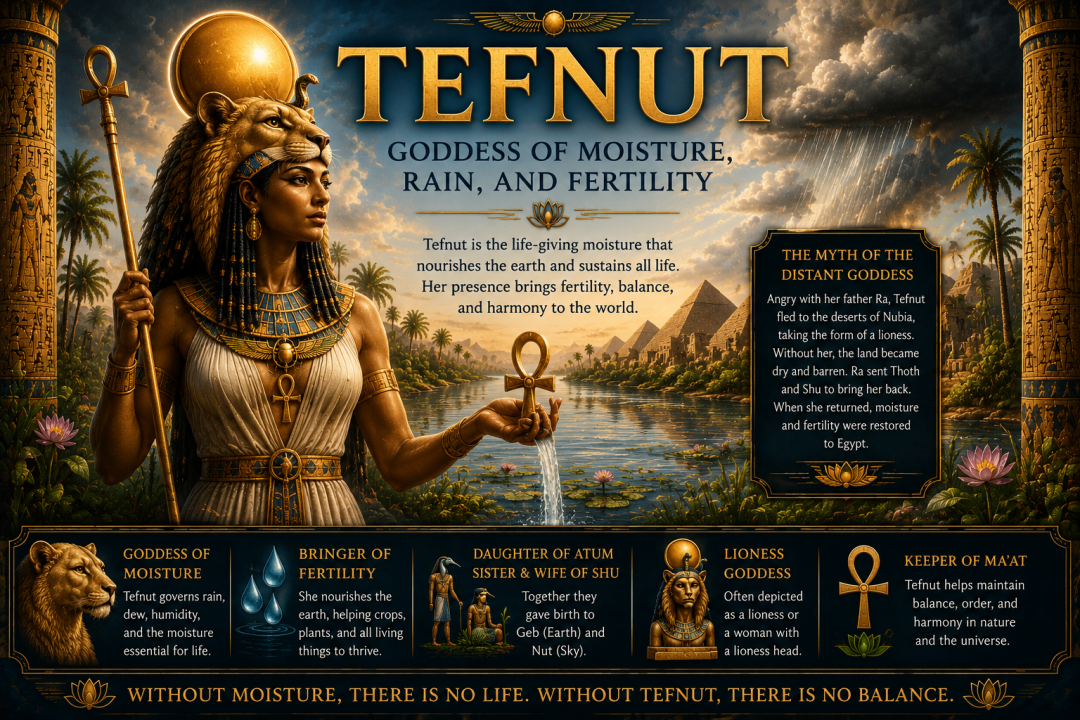
Tefnut was the ancient Egyptian goddess of moisture, rain, dew, humidity, and fertility. As one of the earliest deities created at the dawn of time, Tefnut played a crucial role in Egyptian creation myths and was essential for maintaining balance in the natural world.
Although she is often overshadowed by more famous Egyptian goddesses such as Isis and Hathor, Tefnut was one of the most important members of the Heliopolitan Ennead, the group of nine creator gods worshipped at Heliopolis. Without Tefnut, the ancient Egyptians believed that life on Earth could not exist, for it was her moisture that nourished plants, animals, and humanity itself.
Together with her brother and husband, Shu, the god of air, Tefnut helped create the ordered universe and ensure that the cycles of nature continued uninterrupted.
Origins and Family
According to the Heliopolitan creation myth, Tefnut was one of the first deities brought into existence by the creator god Atum.
Ancient texts provide several accounts of her creation. In some versions, Atum created Tefnut and her twin brother Shu by spitting them out. Other myths describe them as emerging from Atum’s breath, emphasizing their close association with air and moisture.
Tefnut and Shu eventually became husband and wife and produced two children:
Through these children, Tefnut became the grandmother of many of Egypt’s most important deities, including:
As one of the earliest divine beings, Tefnut occupied a central position in Egyptian cosmology.
Goddess of Moisture and Rain
Tefnut primarily governed moisture in all its forms. Ancient Egyptians associated her with:
- Rain
- Dew
- Humidity
- Moisture in the atmosphere
- Fertility
- Water necessary for life
Because Egypt depended heavily on the annual flooding of the Nile and the fertility it brought, moisture was considered sacred.
Although the Nile inundation was more directly associated with other deities such as Hapi, Tefnut represented the life-giving moisture that sustained all living things.
Without Tefnut, the land would become dry, barren, and lifeless.
Tefnut and the Creation of the World
As one of the first gods created by Atum, Tefnut participated in the formation of the cosmos.
Together, Tefnut and Shu gave birth to Geb and Nut. Later, Shu separated Nut from Geb, creating the space in which life could flourish.
This family of gods formed the foundation of the Egyptian universe.
Because Tefnut was present from the very beginning of creation, she was considered one of the forces responsible for establishing cosmic order.
The Myth of the Distant Goddess
One of the most famous stories involving Tefnut is known as the Myth of the Distant Goddess.
According to this tale, Tefnut became angry with her father Ra and fled Egypt for the deserts of Nubia, taking the form of a fierce lioness.
Without Tefnut, Egypt suffered terribly. The land became dry and infertile, and chaos threatened the world.
Realizing the importance of her presence, Ra sent Thoth and Shu to persuade Tefnut to return.
After much effort, the goddess finally agreed to come back to Egypt. Her joyful return restored fertility, moisture, and order to the land.
Scholars believe this myth symbolized the return of life-giving moisture and perhaps even reflected the annual cycles of the Nile.
Appearance and Symbols
Tefnut was usually depicted as a woman with the head of a lioness.
In many artistic representations, she wears:
- A solar disk
- The uraeus cobra
- A long fitted dress
- An ankh, symbolizing life
Sometimes she appears as a fully lioness goddess, emphasizing her fierce and protective nature.
Her principal symbols include:
- The lioness
- The solar disk
- Water and moisture
- The uraeus cobra
- The atmosphere
Because of her leonine form, Tefnut shared many characteristics with other lioness goddesses such as Sekhmet and Hathor.
Tefnut and Ma’at
Ancient Egyptians believed that Tefnut played an important role in preserving Ma’at, the divine principle of truth, balance, and cosmic order.
The natural cycles of rain, moisture, and fertility helped maintain harmony within the universe.
By ensuring that life continued and that nature remained in balance, Tefnut contributed to the stability of both the human world and the divine realm.
Worship of Tefnut
Tefnut was primarily worshipped at Heliopolis alongside Atum, Shu, and the other members of the Great Ennead.
Although she did not possess as many large temples as some major deities, she was widely revered throughout Egypt.
Priests invoked Tefnut in rituals concerning fertility, purification, and cosmic order.
As one of the primordial creator deities, she remained an important figure throughout Egyptian history.
Tefnut in the Afterlife
Like many Egyptian deities, Tefnut also played a role in funerary beliefs.
Water and moisture symbolized rebirth and regeneration in Egyptian religion. As a goddess associated with life-giving moisture, Tefnut could aid the deceased in achieving renewal in the afterlife.
Funerary texts occasionally invoke her blessings to ensure the continued existence of the dead.
Legacy of Tefnut
Tefnut remained an important goddess throughout the long history of Ancient Egypt.
As the goddess of moisture, rain, and fertility, she represented one of the fundamental forces necessary for life. Her role in creation myths ensured her place among Egypt’s most ancient and revered deities.
Today, Tefnut continues to fascinate historians and mythology enthusiasts as one of the primordial goddesses who helped create and sustain the Egyptian universe.