Bes: The Egyptian God of Protection, Childbirth, and the Home
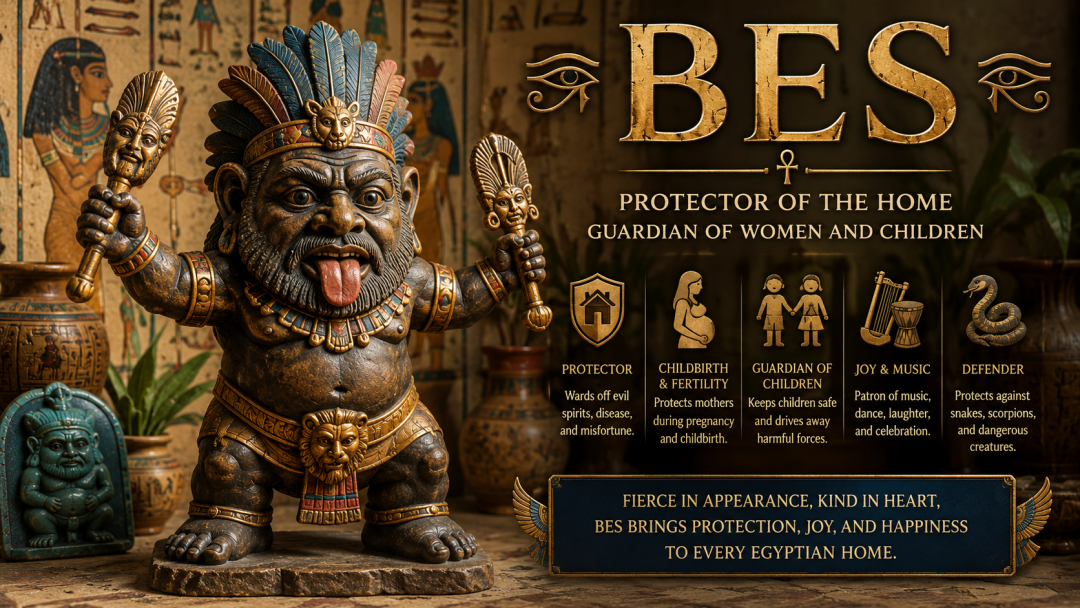
Bes was one of the most unusual and beloved gods in Ancient Egyptian mythology. Unlike most Egyptian deities, who were typically depicted as idealized human or animal figures shown in profile, Bes was portrayed as a dwarf-like figure facing directly forward, often with a fierce expression, protruding tongue, and leonine features.
Bes was primarily the god of protection, childbirth, fertility, music, laughter, and the home. He guarded households against evil spirits, protected women and children, and was believed to ward off dangerous creatures such as snakes and scorpions.
Although he never became one of Egypt’s great state gods like Amun or Ra, Bes was perhaps the most personally beloved deity among ordinary Egyptians. For thousands of years, his image appeared in homes, bedrooms, and nurseries throughout Egypt.
Origins of Bes
The exact origins of Bes remain uncertain.
Unlike many Egyptian gods, Bes does not appear to have originated as a member of a major divine family. Instead, scholars believe that his worship may have developed from older protective spirits associated with childbirth and the household.
Some Egyptologists suggest that Bes may have originally come from Nubia or other regions south of Egypt, as his appearance and associations resemble those of foreign protective deities.
The earliest depictions of Bes date to the Middle Kingdom (c. 2055 to 1650 BCE), although his popularity increased dramatically during the New Kingdom.
By the Late Period, Bes had become one of the most widely worshipped gods in Egypt.
What Does the Name Bes Mean?
The exact meaning of the name Bes remains unknown. Ancient Egyptian texts rarely explain his name, and scholars continue to debate its origins.
Regardless of its original meaning, the name “Bes” became synonymous with protection, domestic happiness, and divine guardianship.
Protector of the Home
Bes was first and foremost a household protector.
Ancient Egyptians believed that malevolent spirits, demons, and supernatural forces could threaten daily life. Bes acted as a powerful guardian who defended families against these dangers.
He was especially invoked to protect homes from:
- Evil spirits
- Nightmares
- Disease
- Misfortune
- Snakes
- Scorpions
Images of Bes commonly appeared on furniture, beds, mirrors, cosmetics containers, and household objects.
Many Egyptians believed that simply displaying his image could repel evil.
God of Childbirth and Fertility
Bes was closely associated with pregnancy, childbirth, and fertility.
Ancient Egyptian women frequently called upon Bes during labor because childbirth was extremely dangerous in the ancient world.
The god was believed to:
- Protect pregnant women.
- Guard mothers during childbirth.
- Protect newborn children.
- Drive away harmful spirits.
Amulets depicting Bes were commonly worn by women during pregnancy and childbirth.
Many birthing chambers and household shrines featured images of the god.
Because of his protective nature, Bes often worked alongside the hippopotamus goddess Taweret, another major protector of mothers and infants.
Bes and Music, Dance, and Joy
Although Bes could appear fierce, he was also a god of happiness, entertainment, and celebration.
Ancient Egyptians associated Bes with:
- Music
- Dancing
- Feasting
- Sexuality
- Humor
- Pleasure
Musicians and entertainers sometimes invoked Bes for inspiration and protection.
His joyful nature made him a popular deity at festivals and family celebrations.
Bes was believed to drive away evil through laughter, music, and noise.
Appearance and Symbols
Bes possessed one of the most distinctive appearances in Egyptian art. Unlike most Egyptian gods, Bes was depicted facing directly toward the viewer.
He was usually portrayed as:
- A dwarf-like figure.
- Bearded.
- Bow-legged.
- Wearing a feathered crown.
- Displaying a lion’s mane and tail.
- Sticking out his tongue.
His frightening appearance was intentional. Ancient Egyptians believed that ugly or terrifying images could scare away evil spirits.
Common symbols associated with Bes include:
- Feathers
- Musical instruments
- Lions
- Knives or swords
- Snakes
In some depictions, Bes is shown dancing, playing musical instruments, or brandishing weapons against evil beings.
Bes and Magic
Bes was strongly associated with magic and protective spells. Ancient magical texts frequently invoke Bes to ward off demons and harmful supernatural forces.
Priests and ordinary Egyptians alike used magical amulets featuring Bes for protection. His image also appears on numerous magical wands and objects used during childbirth and healing rituals.
Because of these associations, Bes became one of Egypt’s foremost protective deities.
Worship of Bes
Unlike major state gods, Bes possessed relatively few large temples. Instead, he was worshipped primarily in homes and private shrines.
His popularity extended across all levels of Egyptian society, from peasants to royalty. Even members of the royal family kept images of Bes within their palaces and private chambers.
Archaeologists have discovered thousands of Bes amulets, statues, and household objects throughout Egypt, demonstrating his immense popularity.
Bes Beyond Egypt
Bes remained popular during the Greco-Roman Period and spread far beyond Egypt.
His worship reached:
- Nubia
- The Levant
- Cyprus
- Greece
- Rome
Foreign cultures often adopted Bes as a protective household deity.
His image appears on artifacts discovered throughout the Mediterranean world.
Legacy of Bes
For more than two thousand years, Bes protected Egyptian homes and families.
As guardian of childbirth, protector against evil, and patron of joy and celebration, Bes occupied a unique place in Egyptian religion.
Unlike many gods who remained distant and majestic, Bes was deeply personal. He was the friendly household protector whom ordinary Egyptians trusted to watch over their daily lives.
Today, Bes remains one of the most recognizable and distinctive figures in Ancient Egyptian mythology, celebrated for his fierce appearance, protective nature, and enduring popularity.