Nut: The Egyptian Goddess of the Sky, Stars, and Motherhood
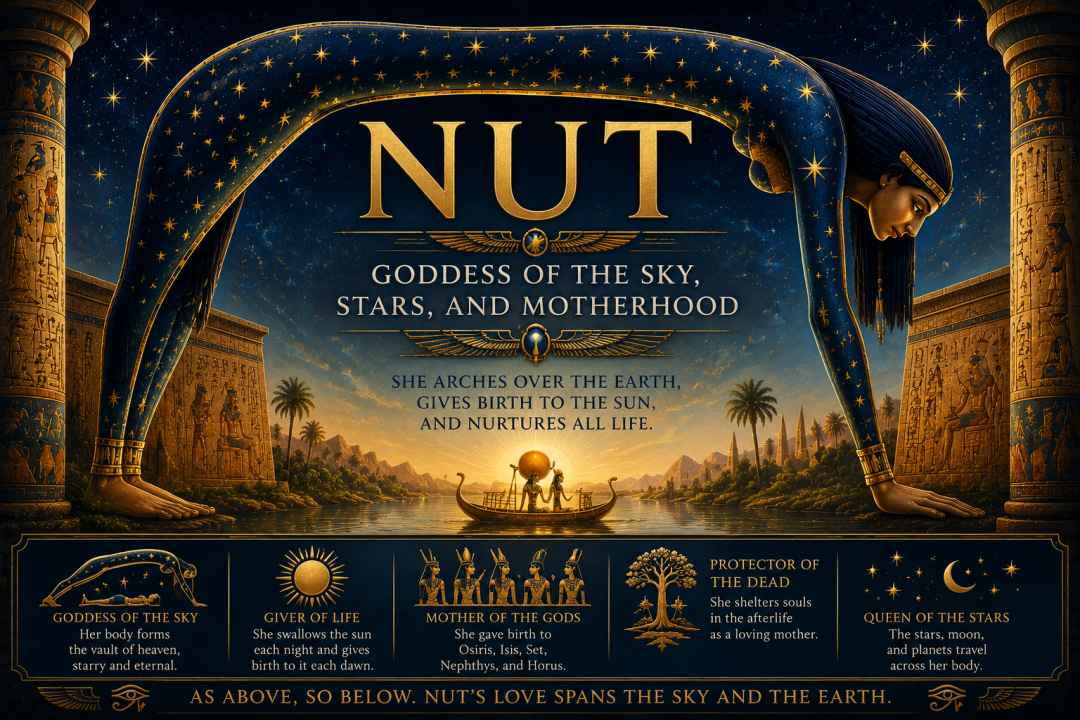
Nut was the ancient Egyptian goddess of the sky, stars, cosmos, and motherhood. She was one of the oldest and most important deities in Egyptian mythology and played a central role in the creation of the world. Every day, Nut swallowed the sun in the evening and gave birth to it again at dawn, making her one of the most powerful symbols of rebirth and renewal in Ancient Egypt.
Ancient Egyptians believed that Nut formed the vault of heaven itself. Her body stretched across the sky, protecting the Earth and everything upon it. Because of her association with the heavens, stars, and the afterlife, Nut became one of the most beloved goddesses in Egyptian religion.
Origins and Family
According to the Heliopolitan creation myth, Nut was the daughter of Shu, the god of air, and Tefnut, the goddess of moisture.
Nut married her brother Geb, the god of the Earth. Together they produced some of the most important gods in the Egyptian pantheon:
- Osiris, god of the underworld
- Isis, goddess of magic and motherhood
- Set, god of chaos and storms
- Nephthys, goddess of mourning and protection
- Horus the Elder, in some traditions
Because she gave birth to so many important gods, Nut was regarded as one of the great divine mothers of Egyptian mythology.
Nut and the Creation of the World
One of the most famous myths involving Nut concerns her separation from Geb.
In the beginning, Nut and Geb were locked together in a close embrace. However, their father, Shu, separated them, lifting Nut high above the Earth and creating the space between heaven and earth.
Ancient Egyptians believed that this act created the world as humans know it.
From that moment onward, Nut arched over Geb, forming the sky itself, while Shu stood between them, supporting the heavens.
This image became one of the most iconic scenes in Egyptian art.
Goddess of the Sky
Nut was primarily worshipped as the goddess of the sky.
Ancient Egyptians imagined her immense body stretching from horizon to horizon. Her hands and feet touched the ground while her star-covered body arched overhead.
Many tomb ceilings depict Nut covered with stars, emphasizing her role as the embodiment of the heavens.
The sun, moon, planets, and stars all traveled across her body.
As a sky goddess, Nut was closely associated with:
- The heavens
- Stars and constellations
- The sun and moon
- Cosmic order
- Rebirth and renewal
Nut and the Sun
According to Egyptian mythology, the sun god Ra traveled across Nut’s body every day.
At sunset, Nut swallowed the sun in the west. Throughout the night, the sun passed through her body as it journeyed through the underworld.
At dawn, Nut gave birth to the sun once more in the east.
This daily cycle symbolized death, rebirth, and eternal renewal.
Because of this myth, Nut became strongly associated with resurrection and the afterlife.
The Birth of the Five Gods
One of the best-known myths involving Nut explains the origin of the Egyptian calendar.
According to legend, the sun god Ra became angry and decreed that Nut could not give birth on any day of the year.
At that time, the Egyptian year contained only 360 days.
Wanting to help Nut, the god Thoth challenged the moon god Khonsu to a series of games. Through his cunning, Thoth won enough moonlight to create five additional days.
These five days did not belong to the original calendar year, allowing Nut to give birth.
During these extra days, Nut gave birth to:
This myth explained both the origin of several major deities and the existence of the 365-day Egyptian calendar.
Nut and the Afterlife
Nut played a crucial role in Egyptian beliefs about death and resurrection.
Ancient Egyptians believed that Nut welcomed the dead into her starry body and helped them achieve rebirth in the afterlife.
Many coffins and sarcophagi feature images of Nut painted on the inside lid. The deceased hoped that the goddess would protect them and grant them eternal life.
Funerary texts often invoke Nut as a loving mother who shelters and nourishes the dead. Pharaohs especially hoped to join the stars within Nut’s celestial realm after death.
Appearance and Symbols
Nut was usually depicted as a beautiful woman arching over the Earth.
Her body was often covered with stars, symbolizing her identity as the sky itself.
Other common depictions show Nut:
- Wearing a water pot hieroglyph on her head
- Standing inside tombs with outstretched wings
- Emerging from a sycamore tree to offer water and food to the dead
The principal symbols associated with Nut include:
- Stars
- The night sky
- The sycamore tree
- The water pot hieroglyph
- The Milky Way
Some modern scholars have suggested that the Milky Way may have been associated with Nut, although this remains debated.
Worship of Nut
Unlike deities such as Amun or Osiris, Nut had relatively few temples dedicated exclusively to her.
Nevertheless, she was widely worshipped throughout Egypt and appeared prominently in temples, tombs, funerary texts, and religious rituals.
Because of her role in the afterlife, Nut became especially important in funerary religion.
Her image appears extensively in the Pyramid Texts, Coffin Texts, and the Book of the Dead.
Legacy of Nut
Nut remained one of Ancient Egypt’s most important goddesses for more than three thousand years.
As the divine mother of gods, protector of the dead, and embodiment of the heavens, she occupied a central place in Egyptian religion and mythology.
Today, Nut continues to fascinate historians and mythology enthusiasts as the star-covered sky goddess who gave birth to the sun each morning and sheltered the souls of the dead among the stars.