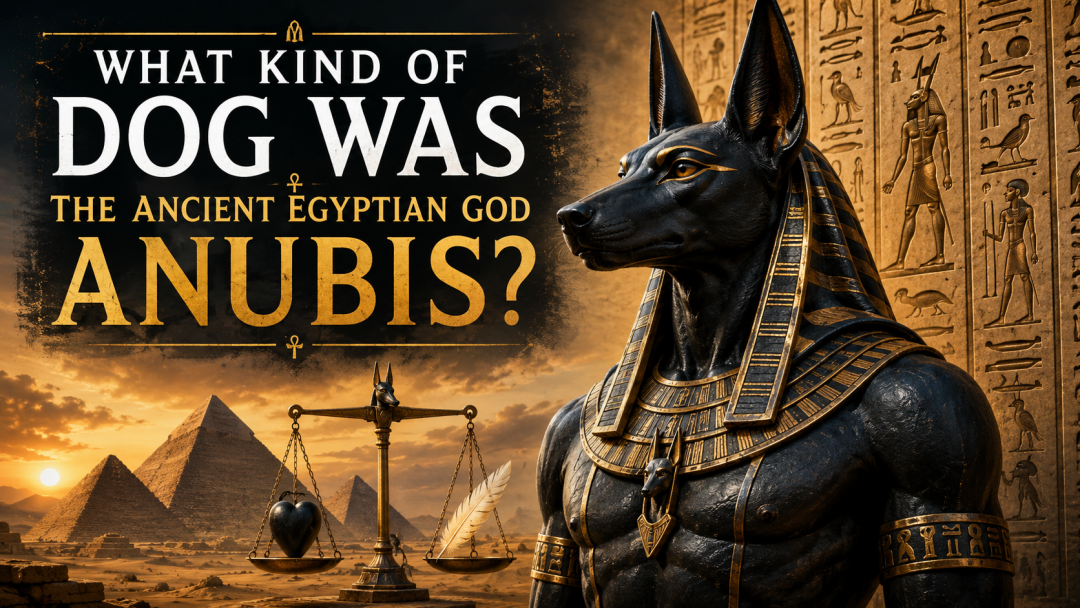
What Kind Of Dog Was The Ancient Egyptian God Anubis?
With his black canine head, tall pointed ears, and human body, Anubis is one of the most recognizable gods of ancient Egypt. His unusual appearance has also inspired a popular question:
What kind of dog was Anubis?
The simplest answer is that Anubis wasn’t based on a specific domestic dog breed. Ancient Egyptian artists portrayed him as a wild desert canid, traditionally identified as a jackal. However, some scholars prefer the more cautious term “canine” or “canid” because the exact species depicted in Egyptian art remains uncertain.
Anubis may share certain features with modern dogs such as the Basenji, Pharaoh Hound, or German Shepherd, but he wasn’t intended to represent any of these breeds. His animal form was connected to the wild canines that lived near Egypt’s deserts and burial grounds.
Was Anubis a Dog or a Jackal?
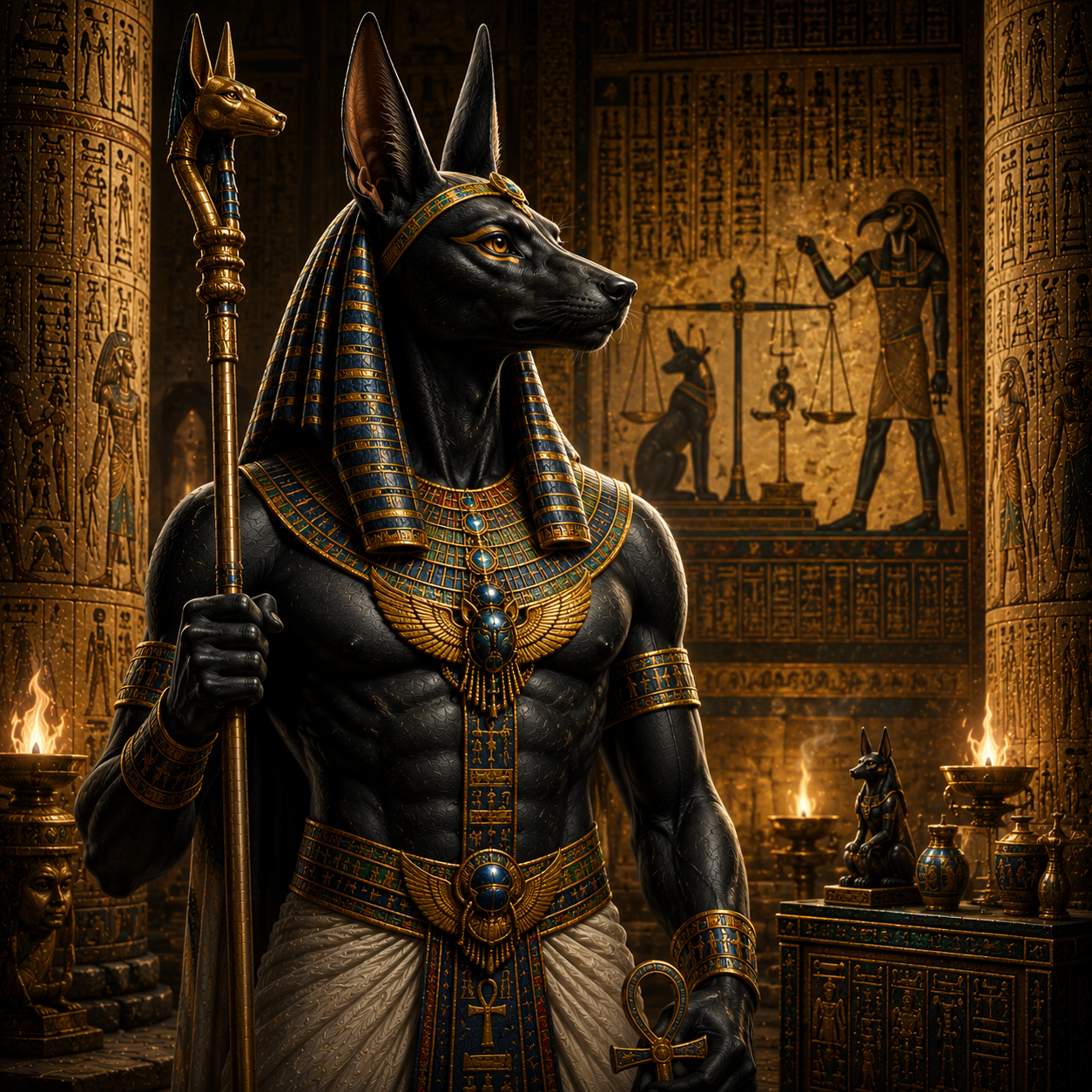
Anubis is usually described as a jackal-headed god. The British Museum identifies his characteristic animal as the jackal, while the Metropolitan Museum of Art more cautiously describes him as a canid-headed deity.
In ancient Egyptian art, Anubis appeared in two principal forms:
- As a black canine lying or standing on four legs
- As a man with the head of a black canine
The animal has a long muzzle, narrow body, pointed ears, and upright or reclining posture. These features resemble several wild canine species that once lived in and around Egypt.
For generations, Egyptologists referred to the animal as a jackal. That identification remains widely used in museums, books, and documentaries. However, modern zoological research has complicated the question.
The animal once commonly called the Egyptian jackal is now usually classified as the African golden wolf, a canid more closely related to wolves than to true golden jackals. This doesn’t prove that Anubis was modeled specifically after an African golden wolf, but it demonstrates why identifying the exact species in ancient art is difficult.
The most accurate description is therefore: Anubis was a canine god whose animal form was probably inspired by the wild desert canids commonly called jackals by Egyptologists.
Was Anubis a Basenji?
Anubis is sometimes compared to the Basenji, an ancient African dog breed known for its pointed ears, slim body, curled tail, and short coat.
There is a superficial resemblance. Both Anubis and the Basenji have:
- Large, erect ears
- A narrow muzzle
- A slender, athletic body
- Short hair
- An alert posture
However, there is no strong evidence that Anubis was specifically intended to represent a Basenji.
The tail is one obvious difference. Basenjis are famous for their tightly curled tails, while artistic representations of Anubis generally show a long, straight tail. Anubis also has the elongated muzzle and body associated with a wild desert canine rather than a clearly identifiable domestic breed.
It is reasonable to say that Anubis resembles a Basenji in some modern reconstructions, but it would be misleading to call him a Basenji.
Was Anubis a Pharaoh Hound?
Anubis is also frequently compared to the Pharaoh Hound. This breed has an elegant body, long muzzle, tall ears, and a distinctly ancient-looking appearance.
Despite its modern name, the Pharaoh Hound isn’t considered a direct reconstruction of the dogs shown in pharaonic Egyptian art. Its resemblance to Egyptian canine images helped inspire the name, but that doesn’t mean the breed was the model for Anubis.
Furthermore, Pharaoh Hounds usually have reddish or tan coats. Anubis was consistently depicted in black, though that color was symbolic rather than naturalistic.
The same problem applies to comparisons with German Shepherds, Dobermans, Greyhounds, and other modern breeds. Some may resemble particular features of Anubis, but none can be conclusively identified as his original animal.
Why Did Anubis Have a Canine Head?
The association between wild canines and death likely stemmed from the landscape surrounding ancient Egyptian cemeteries.
Many Egyptian burial grounds were located in the desert beyond the cultivated Nile Valley. Jackals and other wild canids lived along these desert margins and could sometimes be seen near graves.
These animals may have dug into shallow burials or scavenged exposed remains. This would have made them frightening but powerful symbols of death.
The Egyptians often transformed dangerous forces into protective divine powers. By honoring a canine god associated with the cemetery, they may have hoped that the same kind of creature that threatened the dead would instead guard them.
Anubis was therefore imagined as the supernatural protector of tombs and cemeteries. Rather than attacking the dead, he defended their bodies and helped them reach the afterlife safely.
Why Was Anubis Black?
Real jackals, wolves, and most Egyptian desert dogs aren’t completely black. Anubis’s color wasn’t meant to be a realistic representation of an animal’s fur.
In ancient Egyptian religion, black carried several important meanings.
First, black was associated with the deceased’s preserved body. The processes of mummification, including the application of oils and resins, could darken the appearance of the body and its wrappings.
Black was also the color of the rich soil deposited along the Nile after the annual inundation. That fertile earth allowed crops to grow and symbolized regeneration, fertility, and new life.
Anubis’s black skin or fur therefore represented both death and rebirth. He wasn’t simply a frightening god of corpses. He was a protector who helped make eternal life possible.
The black color of Anubis symbolized:
- Mummification
- The preserved body
- The fertile soil of the Nile
- Regeneration
- Resurrection
- Life after death
This is why Anubis was depicted as black even though the wild canines of Egypt were usually brown, reddish, gray, or golden.
Who Was Anubis?
Anubis was the ancient Egyptian god of embalming, cemeteries, funerary rituals, and the protection of the dead. His Egyptian name was probably pronounced something like Inpu or Anpu. “Anubis” is the later Greek form of his name.
He was one of Egypt’s oldest funerary gods. Images of a canine deity associated with royal burials appeared during the earliest periods of Egyptian history.
Before Osiris became the most important ruler of the underworld, Anubis held a more prominent position as lord of the dead. As the cult of Osiris grew, Anubis’s role changed. Osiris became the judge and king of the afterlife, while Anubis became the protector, embalmer, and guide of the deceased.
The British Museum describes Anubis as the god of mummification, the afterlife, and the dead. He prepared the deceased for burial, guided them through the underworld, and protected them during their journey.
Was Anubis the God of Death?
Anubis is often called the Egyptian god of death, but this description is incomplete.
He wasn’t a god who caused death, nor was he an evil or demonic figure. He was primarily connected with what happened after a person died.
Anubis was associated with:
- Embalming and mummification
- Funerary ceremonies
- Protecting tombs
- Guarding the deceased
- Guiding souls through the underworld
- Supervising the judgment of the dead
A better description would be god of embalming and guardian of the dead.
His frightening appearance reflected the mystery and danger of death, but his purpose was protective. To an ancient Egyptian, Anubis could be a comforting figure who ensured that the body was properly preserved and the soul wasn’t lost.
Was Anubis the Son of Osiris?
Ancient Egyptian religion didn’t have one universal version of every myth. Stories about the gods changed over time and could differ from one region or temple to another.
In a later and widely known tradition, Anubis was the son of Osiris and Nephthys. According to the story, Nephthys conceived Anubis with Osiris and then abandoned the child out of fear. Isis found Anubis and raised him.
Anubis later repaid Isis by helping her preserve the body of Osiris after he was murdered and dismembered by Seth. Through this connection, Anubis became the divine embalmer and protector of the mummification process.
Other traditions gave Anubis different parentage. In some early beliefs, he may have been connected with the sun god Ra. This variation is normal in Egyptian mythology, where religious traditions developed over thousands of years.
What Did Anubis Do During Mummification?
Anubis was believed to have performed the first act of mummification when he embalmed the body of Osiris.
Egyptian priests responsible for embalming worked under Anubis’s divine protection. During certain funerary ceremonies, a priest may have worn a canine mask representing the god.
Anubis was described by titles such as:
- Lord of the Sacred Land
- He Who Is Upon His Mountain
- Foremost of the Divine Booth
- He Who Is in the Place of Embalming
The “sacred land” referred to the desert necropolis, while the “divine booth” was associated with the place where embalming occurred.
Funerary amulets in the shape of Anubis were placed with mummies because the god was believed to protect the body and oversee the embalming process.
What Was Anubis’s Role in the Weighing of the Heart?
One of the most famous scenes in Egyptian religion is the Weighing of the Heart, shown in funerary texts such as the Book of the Dead.
The judgment wasn’t reserved only for kings. Any deceased person who hoped to enter the blessed afterlife could face this test.
During the ceremony, the deceased person’s heart was placed on one side of a balance. On the other side was the feather of Ma’at, representing truth, justice, order, and moral balance.
Anubis attended and supervised the weighing. He was often shown kneeling beside the scales and checking that the balance operated correctly.
The ibis-headed god Thoth recorded the result, while Osiris presided over the judgment as ruler of the underworld.
When the heart balanced with the feather, the deceased was deemed justified and allowed to proceed to the afterlife.
When the heart was weighed down by wrongdoing, it could be consumed by Ammit, a terrifying creature with features of a crocodile, lion, and hippopotamus. This resulted in the destruction of the individual’s hope for eternal life.
Anubis didn’t normally make the final judgment. His role was to guide the deceased and oversee the weighing fairly.
Did Ancient Egyptians Worship Dogs Because of Anubis?
Dogs were important in ancient Egypt, but Egyptians didn’t worship every dog as a god.
Domestic dogs were kept as hunting companions, guards, and household pets. Some received names, collars, and carefully prepared burials. Their owners could mourn them much as people mourn beloved pets today.
Dogs and wild canines were also associated with several deities, including Anubis and Wepwawet. Wepwawet, whose name means “Opener of the Ways,” was another canine god connected with warfare, royal power, cemeteries, and the opening of pathways.
Large numbers of mummified canines have been discovered at Egyptian religious sites. Some were beloved animals, while others were raised or prepared as offerings dedicated to canine deities.
This doesn’t mean that every mummified dog represented Anubis. Canine cults could involve several gods and different religious practices.
Anubis and Wepwawet
Anubis is sometimes confused with Wepwawet because both gods were represented as canines. There were, however, some differences. Anubis was usually depicted as black and was closely associated with mummification, tomb protection, and the journey of the dead.
Wepwawet was often gray or white and was associated with opening roads, leading processions, royal authority, and military victory. He could also guide the deceased through the afterlife.
Their roles sometimes overlapped, which wasn’t unusual in Egyptian religion. Gods could share attributes while maintaining distinct identities and cult centers.
So, What Breed of Dog Was Anubis?
Anubis wasn’t a breed of domestic dog.
He was an Egyptian deity represented as a stylized wild canine, traditionally called a jackal. The precise species can’t be identified with certainty from the surviving artwork.
He may have been inspired by:
- African golden wolves
- Jackal-like wild canids
- Feral or wild dogs
- A combination of several animals familiar to ancient Egyptians
The Basenji, Pharaoh Hound, German Shepherd, and Doberman may resemble Anubis in certain ways, but these comparisons are modern and shouldn’t be treated as historical identifications.
Anubis wasn’t a Basenji, Pharaoh Hound, German Shepherd, or any other known dog breed.
Ancient Egyptian artists portrayed him as a black desert canine, most often described as a jackal. Because the exact species is uncertain, many historians now use the broader term canid.
His pointed ears and long muzzle connected him to the wild canines that roamed near Egypt’s desert cemeteries. His black color symbolized mummification, the fertile soil of the Nile, regeneration, and rebirth.
Anubis may look frightening to modern viewers, but he wasn’t an evil god. He was the divine embalmer, protector of graves, guide of the dead, and guardian of the journey into eternal life.