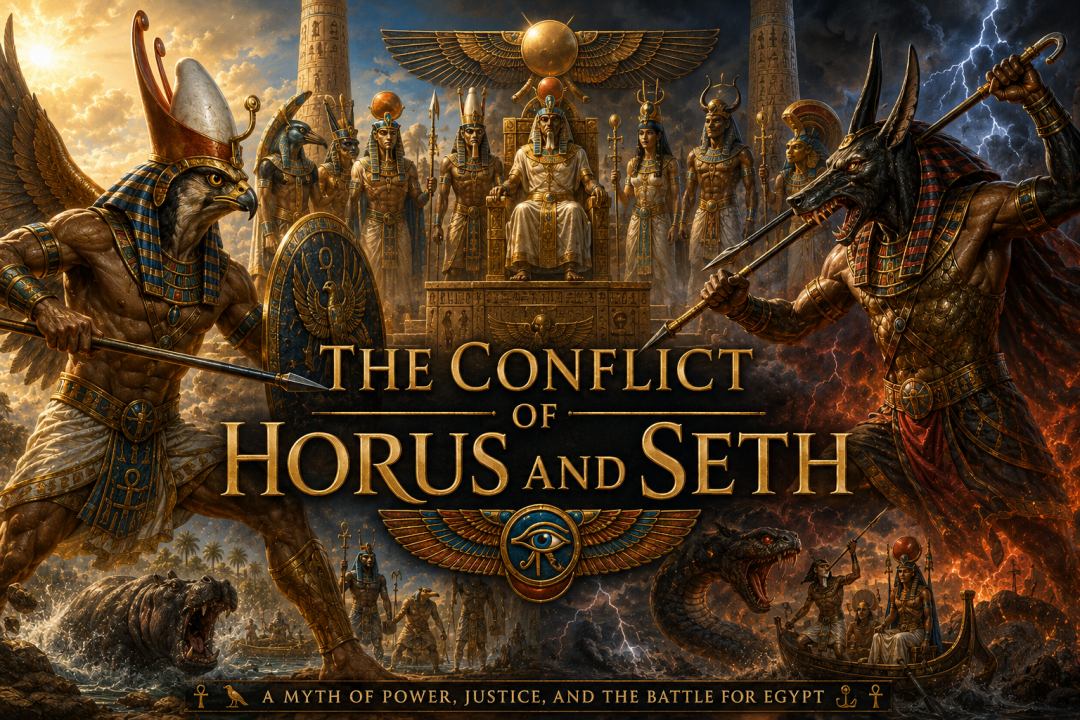
The Conflict of Horus and Seth
When Horus had grown strong enough to challenge his uncle Seth, he summoned the Ennead and many of the other gods to judge the dispute over the throne of Egypt.
Standing beside his mother Isis, Horus spoke of the cruel murder of his father, Osiris, and how Seth had seized the throne that rightfully belonged to the son of the dead king.
The gods listened with sympathy. They admired the young falcon god’s courage and eloquence, and many pitied him.
At last Shu, eldest son of the Creator, rose to speak.
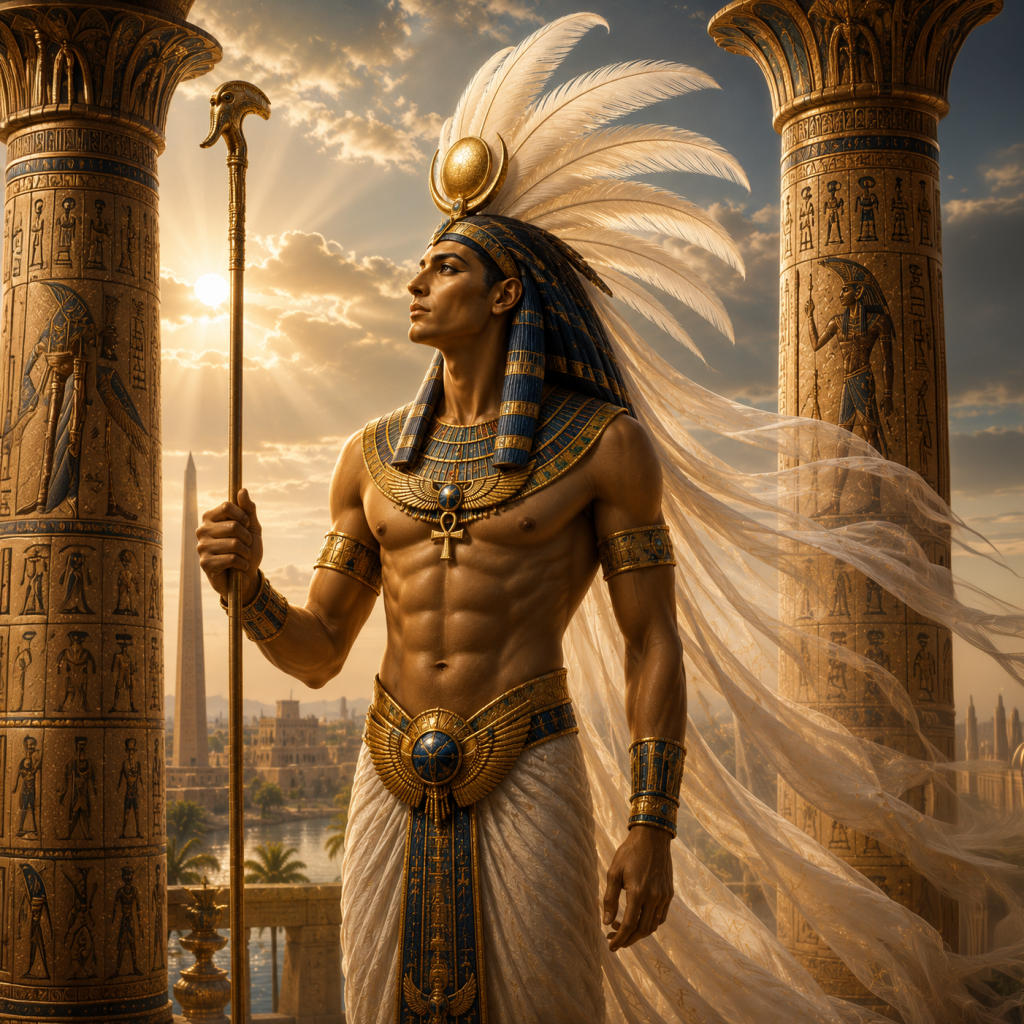
“Right should triumph over might. Seth possessed strength, but Horus possesses justice. The throne belongs to the son of Osiris.”
Then Thoth nodded and declared,
“That judgment is right a million times.”
Isis cried out with joy and prayed that the north wind would carry the good news westward to the Beautiful West, where Osiris ruled among the dead.
“It is clear,” proclaimed Shu, “that the Ennead favors Horus.”
Until that moment, however, no one had asked the opinion of the King of the Gods.
Ra-Atum frowned.
“What is this?” he muttered. “Have the Ennead begun making decisions without consulting me?”
Shu failed to notice the dark expression upon his father’s face.
“Let Thoth present Horus with the royal signet ring,” he continued. “Then let us crown him with the White Crown of Upper Egypt.”
The assembly burst into approval. All except two. Ra-Atum remained silent. Then Seth strode forward.
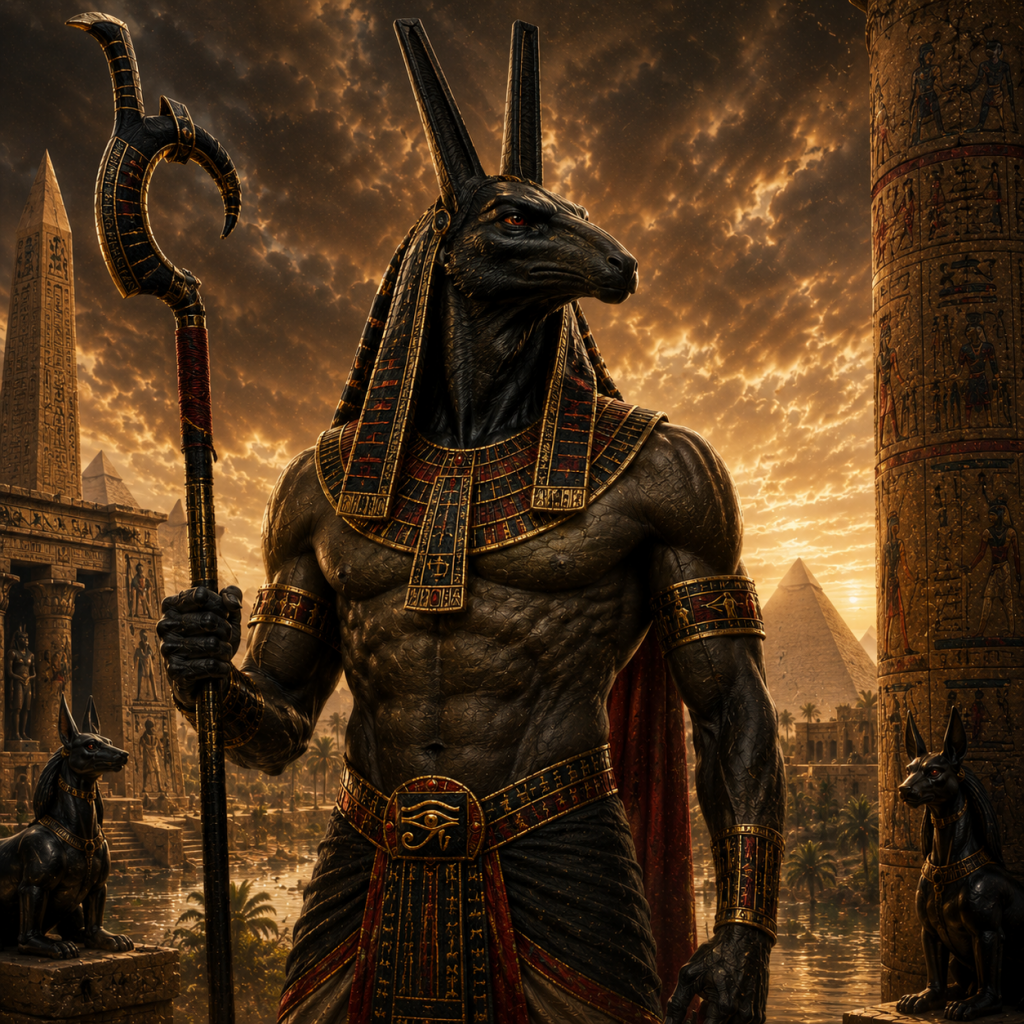
“If there is any doubt about who deserves to rule,” he roared, “let this boy face me himself! Let all the gods watch me defeat him!”
Thoth immediately objected.
“That would be unjust. How can we give the throne of Osiris to his brother while the rightful heir stands before us?”
“I have not agreed to this,” Ra-Atum replied coldly.
The hall fell silent.
At last Shu sighed.
“What shall we do now?”
No one wished to challenge the King of the Gods directly.
Instead, they sent for the ancient ram god Banebdjed of Mendes, hoping his wisdom would settle the dispute.
When the venerable god arrived, Ra-Atum addressed him.
“Judge between these two young gods, so that their quarrel may finally end.”
Banebdjed already knew that Horus possessed the stronger claim, but he also knew how dangerous it was to oppose Ra openly.
“We should seek the wisest counsel available,” he said carefully. “Let us write to the great goddess Neith and ask her judgment.”
The Ennead readily agreed.
“Thoth,” they said, “write to her at once.”
The divine scribe dipped his reed pen into ink, unrolled a sheet of papyrus, and composed a respectful letter to Neith.
The swiftest messenger in heaven carried it north.
Before long, he returned with Neith’s reply. Thoth stood before the assembled gods and read aloud.
“Give the throne of Osiris to Horus, his son. To do otherwise would be so unjust that the sky itself might fall upon your heads. As for Seth, double his possessions and give him two beautiful goddesses as wives, but let him surrender the throne.”
The gods shouted with approval.
“Neith has spoken wisely!”
Only Ra-Atum remained displeased.
He looked contemptuously at Horus.
“How can a mere youth rule Egypt?”
At this, the baboon god Baba leaped to his feet.
“If you refuse justice,” he cried, “then your shrine stands empty, for we shall no longer honor you!”
The words struck Ra like a blow.
Deeply insulted, he covered his face and lay down upon the ground.
When the other gods realized how far Baba had gone, they angrily ordered him to leave the council.
They tried to comfort Ra, but he ignored them all.
At last he rose, entered his tent, and refused to come out.
The Ennead grew anxious.
If Ra would not sail the Solar Boat across the heavens, the world itself might fall into darkness.
Finally Hathor, beloved daughter of Ra, devised a plan. She began to dance before her father’s tent. As she danced, she cast aside her garments one by one.

The assembled gods burst into laughter and applause.
The commotion drew Ra’s attention.
He peered through the entrance of his tent.
When he saw Hathor dancing so joyfully, he could not help but laugh.
His anger faded.
Smiling once more, the Sun God returned to his throne.
“We shall hear the case again,” he declared. “Let both Horus and Seth present their arguments.”
Seth spoke first.
“I am the strongest of the Ennead. When the Sun Boat travels through the underworld and the serpents of chaos attack, it is I alone who defend the gods. Without me, Ra himself would perish. Surely the throne belongs to the one who protects creation.”
Several gods murmured in agreement.
They all remembered Seth’s courage in battling the serpent Apophis.
But Shu and Thoth remained unconvinced.
“Strength alone cannot determine the rightful king,” said Thoth. “The son inherits his father’s throne.”
Banebdjed added thoughtfully,
“Yet should the younger always rule before the elder?”
The debate continued without end.
Finally Horus spoke.
“Will you rob me of my birthright before the entire Ennead?”
Isis could no longer contain herself.
She rebuked the assembled gods until, merely to quiet her protests, they promised that justice would eventually be done.
This only enraged Seth.
“How dare you break your word!” he thundered. “I shall fetch my great scepter and strike one of you down each day! And I swear I shall never again plead my case in any court where Isis is present!”
To preserve peace, Ra-Atum proposed another solution.
“We shall move the trial to the Island-in-the-Midst. There the matter will be decided without interference.”
Then he summoned Nemty, ferryman of the gods.
“Do not ferry Isis across the river,” Ra commanded. “Nor any woman who resembles her.”
Nemty bowed obediently.
Soon the Ennead crossed to the island and pitched magnificent tents along its shores.
But Isis, Mistress of Magic, was not so easily defeated.
She transformed herself into a bent old woman carrying a basket filled with flour and honey cakes.
Shuffling toward the riverbank, she approached Nemty.
“My good ferryman,” she croaked, “please take me across. My son has been tending cattle upon the island for five days, and I have brought him food.”
Nemty shook his head.
“I have strict orders. No woman may cross.”
Isis held out one of her honey cakes.
“Take this as payment.”
The ferryman laughed.
“I ferry the gods themselves. What use have I for cakes?”
Then Isis slipped a gold ring from her finger.
“If you take me across, this shall be yours.”
Nemty stared at the glittering ring.
Temptation overcame obedience.
“Very well,” he said. “Climb aboard.”
Moments later Isis stepped ashore.
Nemty called after her,
“Do not be long!”
But Isis was already hurrying through the trees. Reaching the camp, she transformed herself once more. Now she appeared as an extraordinarily beautiful young widow dressed in mourning.
The gods were feasting. Only Seth stood apart from the celebration.
He noticed the lovely stranger immediately.
“My lady,” he asked, “who are you, and why have you come here?”
Isis lowered her eyes and began to weep.
“My husband has died,” she said. “He left behind a young son and a fine herd of cattle. But now a stranger has seized everything and threatens to drive us away.”
Seth placed a reassuring arm around her.
“Do not cry. I shall defend your son. No stranger has the right to steal a father’s inheritance while his son still lives.”
The beautiful widow suddenly burst into laughter.
In an instant she transformed into a kite and flew into the branches of a nearby acacia tree.
“You have judged yourself, mighty Seth!” she called down. “You have declared that a son should inherit his father’s estate.”
Seth realized too late that he had been tricked and he wept with rage.
The gods demanded to know what had happened.
When Seth repeated the conversation, Ra-Atum merely nodded.
“It seems you have pronounced judgment against yourself.”
Seth’s first response was not to admit defeat.
Instead, he snarled, “Bring me the ferryman!”
Poor Nemty was dragged before the Ennead.
For accepting a bribe and disobeying Ra’s command, he was punished by having his toes cut off.
From that day forward, the ferryman vowed never again to value gold above duty.
The trial now moved to the Western Mountains, where preparations quietly began for Horus’s coronation.
Yet Seth still refused to surrender.
“He may wear the White Crown,” he growled, “but he shall not rule until he defeats me.”
Then he issued a new challenge.
“Let us both transform ourselves into hippopotamuses and battle beneath the waters of the Nile. Whoever rises to the surface first shall lose.”
Horus accepted immediately.
Only Isis trembled with fear.
The two rivals plunged into the river and transformed into gigantic hippopotamuses.
The water churned violently as they fought beneath the surface.
Desperate to protect her son, Isis fashioned a magical harpoon from yarn and copper.
She cast it into the swirling river.
But she could not distinguish Horus from Seth. The weapon struck Horus.
The young god surfaced with a cry of pain.
“Mother! Your spear has wounded me! Release me!”
Horrified, Isis called the harpoon back.
It flew into her hand. She threw it again. This time it pierced Seth. The wounded god emerged roaring.
“O, my sister! Why are you always my enemy? Have mercy! I am your own brother!”
Isis hesitated. Moved by pity, she released him.
Horus was furious. Believing his mother had betrayed him, he leaped from the river in uncontrollable rage. With a single stroke of his copper knife, he severed Isis’s head.
Then he strode into the Western Mountains carrying it beneath his arm. Yet Isis was the greatest magician in Egypt.
She transformed her headless body into a living statue and calmly walked toward the camp of the gods.
The Ennead stared in astonishment.
Ra asked Thoth, “Who approaches us without a head?”
“It is Isis,” replied the wise god. “Horus has struck her down.”
Ra was horrified. He declared that Horus must be punished.
Meanwhile, Isis restored herself through magic, and the gods set out in search of the young falcon. They found him asleep beside an oasis beneath the shade of a palm tree.
Before the others arrived, Seth discovered him first. He seized Horus from behind and tore both eyes from his face.
The young god cried out in unbearable agony. Seth buried the eyes deep in the earth before quietly returning to the camp.
“I found no sign of Horus,” he lied.
All night the blind god lay alone in pain.
By dawn, two beautiful lotus flowers had sprung from the place where his eyes were buried.
Hathor continued searching long after the other gods had abandoned hope.
At last she found Horus.
Filled with compassion, she caught a gazelle and milked it.
Then she knelt beside him.
“Uncover your face.”
Horus obeyed.
Hathor gently poured the milk over his empty eye sockets.
Instantly the pain vanished.
“Now open your eyes.”
Horus did so.
By the healing power of Hathor, his sight had been completely restored.
Hathor hurried back to the Ennead.
“Seth has deceived you,” she declared. “He found Horus, tore out his eyes, and left him for dead. But I have healed him, and he comes even now.”
And so the conflict between Horus and Seth was far from over.
Hathor led Horus back before the Ennead, where the young god stood once more beside his mother.
The gods had grown weary of the endless quarrel.
Again Ra-Atum called both rivals before his throne.
“You have fought long enough,” declared the Sun God. “Let there be peace between you.”
Seth bowed his head as though he accepted the judgment.
“As a sign of goodwill,” he said, “let Horus come and stay in my palace.”
The young falcon god accepted the invitation, but he soon discovered that his uncle’s friendship concealed fresh treachery. Time after time Seth devised new tricks to destroy him, yet each time Isis used her wisdom and magic to protect her son.
At last Seth demanded one final contest.
Standing before the entire Ennead, he proclaimed,
“Let each of us build a ship of stone and race it down the Nile. Whoever wins shall wear the Crown of Osiris.”
Horus immediately agreed.
Confident in his enormous strength, Seth climbed a nearby mountain and struck great blocks of stone loose with his mighty club. Patiently he shaped them into a huge vessel of solid rock and dragged it to the river.
Horus chose a different approach.
Secretly he built his ship from pine wood, then coated it with plaster so that it looked exactly like carved stone.
When the appointed day arrived, the Ennead gathered along the riverbank to watch.
Seth proudly launched his magnificent stone ship.
The moment it touched the water, it sank straight to the bottom of the Nile.
Laughter echoed along the banks.
Furious, Seth transformed himself once again into a gigantic hippopotamus.
He charged through the river and smashed Horus’s boat into splinters.
Enraged, Horus seized his spear and prepared to strike his uncle.
“Stop!” cried the Ennead.
Reluctantly, Horus lowered his weapon.
By now he had begun to despair.
No matter what happened, the dispute seemed destined never to end.
Leaving the court behind, Horus journeyed north to seek the wisdom of the ancient goddess Neith.
Meanwhile Shu and Thoth persuaded the Ennead that only one judge remained whose opinion truly mattered.
A messenger should be sent to Osiris himself.
The journey to the Beautiful West, the realm of the dead, was long and perilous.
At last the messenger returned carrying a letter from the King of the Dead.
Thoth unrolled the papyrus and read aloud.
“Why has my son been denied the throne that belongs to him? Have the gods forgotten that it was I who brought barley and wheat to mankind and taught Egypt the blessings of civilization?”
Ra-Atum frowned.
He disliked being lectured, even by Osiris. Rather than obey, he dictated a proud reply.
Many days later, the messenger returned again with another letter.
This time Osiris’s words were filled with anger.
Thoth read them before the assembled gods.
“So this is the justice of the Ennead,” wrote Osiris. “Justice itself has descended into the underworld.
“Listen well.
“My kingdom is filled with spirits and demons who fear neither god nor goddess.
“If I command them to leave the land of the dead, they will seize the hearts of every evildoer and drag them down to judgment.
“Who among you is stronger than I?
“Even the greatest of the gods must one day come to the Beautiful West.”
A heavy silence fell across the council.
Even Ra-Atum hesitated.
Every god present knew that none could escape death forever.
At last the Sun God spoke.
“The judgment of Osiris shall be honored.”
Isis herself was ordered to seize Seth.
Bound in chains, the storm god was brought before the throne.
Ra-Atum looked down upon him.
“Seth, have you stolen the throne from Horus?”
For the first time, Seth answered without anger.
“No,” he replied quietly. “Bring Horus forward and give him his father’s throne.”
The Ennead breathed a sigh of relief.
At last the long struggle had come to an end.
Horus stepped forward.
Thoth placed the royal signet ring upon his hand.
The White Crown of Upper Egypt was set upon his head, followed by the Red Crown of Lower Egypt.
Together they formed the Double Crown, symbol of the united kingdom.
Horus had become King of Egypt.
Isis lifted her hands toward heaven and cried aloud,
“My son is king!
“My heart rejoices, and the whole earth is filled with your glory.”
The gods cheered. The long conflict was over. Ra-Atum then turned toward Seth. Although the storm god had been defeated, the Sun God remembered his courage.
“Son of Nut,” he said, “you shall not leave my service.
“You shall dwell beside me in the heavens as Lord of Storms.
“When thunder rolls across the sky and lightning splits the clouds, mankind shall know that Seth still rides with the Sun God, defending creation against the powers of chaos.”
Seth accepted the judgment.
His hatred faded, and he made peace with Horus.
From that day onward he stood in the prow of Ra’s Solar Boat, hurling his spear at the great serpent Apophis each night as it rose from the darkness to devour the sun.
Thus Horus ruled the Two Lands as the rightful heir of Osiris, while Seth became the fierce defender of the solar bark.
The struggle between order and chaos would continue forever, but the throne of Egypt had at last passed to its rightful king.
So ended the great conflict between Horus and Seth, one of the longest and most celebrated myths of ancient Egypt, a story of vengeance, justice, endurance, and the triumph of rightful kingship.