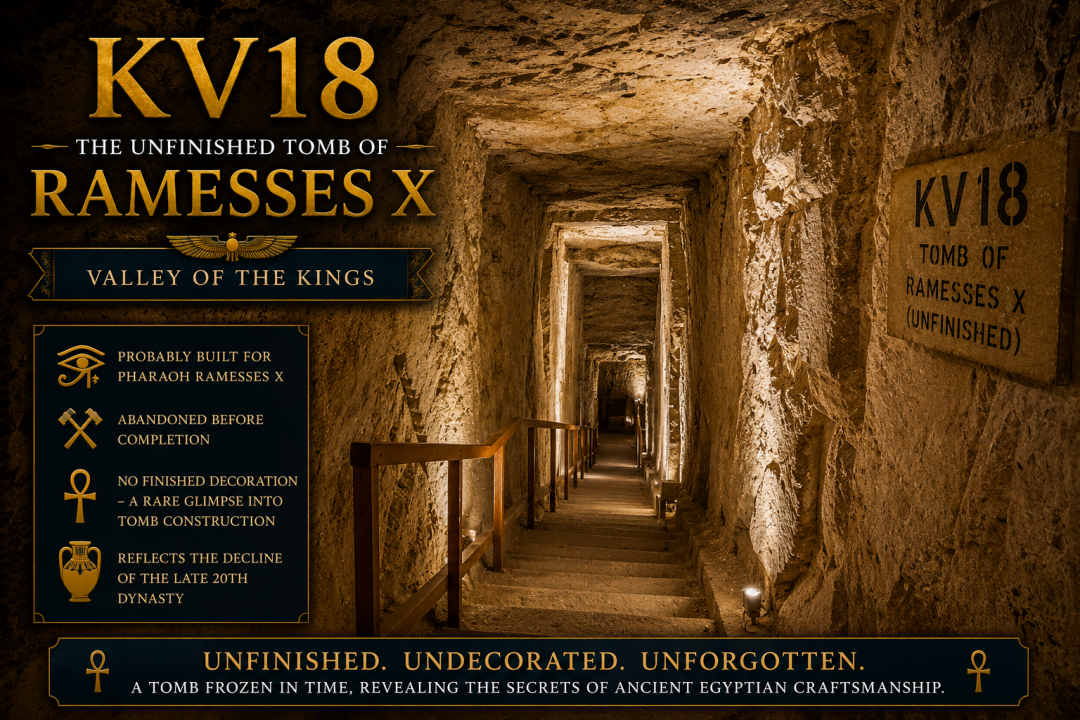
KV18: The Unfinished Tomb of Ramesses X
KV18 is one of the smallest and least complete royal tombs in the Valley of the Kings. Believed to have been intended for Pharaoh Ramesses X of the Twentieth Dynasty, the monument was abandoned before construction was finished and never received its planned decoration. Although modest in appearance, KV18 provides valuable evidence of the declining fortunes of Egypt during the late New Kingdom, when political instability and dwindling resources even affected the construction of royal tombs.
Located near the entrance to the Valley of the Kings, KV18 was discovered in antiquity and has remained open for centuries. Its unfinished corridors and rough-cut walls provide a rare opportunity to see how ancient Egyptian royal tombs were excavated before decoration began.
Despite its incomplete state, KV18 remains an important archaeological site because it illustrates the dramatic contrast between the magnificent tombs of earlier rulers such as Seti I and Ramesses II and the more modest royal monuments built during the final years of the New Kingdom.
- Structure: KV18
- Location: Valley of the Kings, East Valley, Thebes West Bank, Luxor
- Owner: Ramesses X (probably)
- Other Designations: KV18
- Site Type: Royal Tomb
KV18 lies in the central part of the East Valley near several other royal tombs. The monument consists of a descending entrance and a series of unfinished corridors cut into the limestone bedrock.
Unlike the elaborate tombs of earlier pharaohs, KV18 never progressed beyond its initial excavation stages. Several planned chambers were left incomplete, and no burial chamber was fully finished. The walls remain rough in many places, preserving clear evidence of the quarrying techniques used by the royal workmen of Deir el-Medina.
Because construction ceased early, the tomb lacks many of the architectural features normally found in royal burials, such as pillared halls, decorated chambers, and extensive storage rooms.
Decoration
KV18 contains virtually no finished decoration.
Only a few traces of preliminary work survive, including guide lines and isolated evidence that decoration may have been planned before work stopped. Unlike neighboring tombs covered with scenes from the great funerary books, KV18 was abandoned before artists began carving and painting the walls.
Its unfinished condition allows archaeologists to study the earliest stages of royal tomb construction, including the techniques used to shape corridors and prepare surfaces for plaster and decoration.
KV18 is notable for several reasons:
- It was probably intended for Pharaoh Ramesses X.
- The tomb was abandoned before completion.
- It preserves clear evidence of ancient quarrying techniques.
- The monument contains almost no finished decoration.
- It illustrates the decline in royal tomb construction during the late Twentieth Dynasty.
- Its unfinished corridors provide valuable insight into how royal tombs were excavated.
Site History
Construction of KV18 probably began during the reign of Ramesses X. For reasons that remain uncertain, work ceased before the tomb could be completed. The king may have died unexpectedly, or political and economic difficulties may have forced work to stop before decoration began.
Because the monument was never finished, there is no evidence that Ramesses X was ever buried there. His actual burial place remains uncertain, although many Egyptologists believe another unfinished royal tomb may ultimately have been used.
Like many monuments in the Valley of the Kings, KV18 remained open during antiquity and later attracted visitors during the Graeco-Roman period. Modern archaeologists have studied the unfinished corridors to better understand the methods used by ancient workmen when excavating royal tombs.
Who Was Ramesses X?
Ramesses X was one of the final rulers of Egypt’s Twentieth Dynasty. Very little is known about his reign, which appears to have lasted only a few years amid growing political instability and economic decline.
Administrative documents from Deir el-Medina suggest that tomb robberies had become increasingly common during his reign, while strikes and shortages affected the royal workforce responsible for constructing the tombs in the Valley of the Kings.
These difficult conditions may help explain why KV18 remained unfinished.
Dating
This site was used during the following period:
- New Kingdom, Dynasty 20, reign of Ramesses X (probable)
The tomb also shows evidence of later visitation during antiquity.
Conservation History
Modern conservation has focused primarily on clearing debris, documenting the unfinished architecture, and stabilizing the exposed rock surfaces. Because the tomb lacks painted decoration, preservation efforts have concentrated on preventing erosion and structural deterioration.
Site Condition
KV18 remains unfinished much as it was abandoned more than 3,000 years ago. The rough-cut corridors and incomplete chambers survive in relatively stable condition, although natural weathering has affected portions of the exposed limestone.
Why KV18 Matters
Although KV18 lacks the spectacular paintings found in nearby royal tombs, it is extremely valuable to archaeologists. The unfinished walls reveal how the craftsmen of Deir el-Medina excavated tombs before plastering and decoration began.
In many ways, KV18 serves as a snapshot of a royal tomb frozen mid-construction, offering a rare glimpse into the engineering and planning behind some of ancient Egypt’s greatest monuments.
Interesting Facts About KV18
- KV18 was probably intended for Pharaoh Ramesses X.
- The tomb was never completed or decorated.
- It preserves evidence of ancient excavation techniques.
- No confirmed royal burial has been found inside.
- It reflects the economic and political decline of the late Twentieth Dynasty.
- The rough-cut walls show how royal tombs were prepared before decoration.
- KV18 is one of the smallest and simplest royal tombs in the Valley of the Kings.