KV7: The Tomb of Ramesses II
Tomb KV7 is the burial place of Pharaoh Ramesses II, better known as Ramesses the Great, one of the most celebrated rulers in ancient Egyptian history. Located in the East Valley of the Valley of the Kings, the tomb originally reflected the grandeur of a king who ruled Egypt for an extraordinary 66 years during the Nineteenth Dynasty. Ramesses II is remembered for his military campaigns, vast building projects, and monuments such as Abu Simbel and the Ramesseum, making his burial place one of the most significant royal tombs in Egypt.
Although KV7 was once lavishly decorated and richly furnished, it suffered more damage than almost any other royal tomb in the Valley. Repeated flash floods filled the corridors with mud and debris, while ancient tomb robbers stripped away its treasures. Today, much of the decoration survives only in fragments, but archaeological excavations continue to reveal important information about the monument’s original appearance.
Following the widespread tomb robberies at the end of the New Kingdom, the priests of the Twenty-first Dynasty removed the mummy of Ramesses II from KV7 and reburied it in the royal cache at Deir el-Bahari (DB320), where it was rediscovered in 1881.
- Structure: KV7
- Location: Valley of the Kings, East Valley, Thebes West Bank, Luxor
- Owner: Ramesses II (Ramesses the Great)
- Other Designations: KV7, 7 [Lepsius], B [Burton]
- Site Type: Royal Tomb
Description
KV7 is situated near the center of the East Valley, directly opposite the tomb of his sons (KV5). The tomb follows the classic bent-axis design used for many royal tombs of the Nineteenth Dynasty.
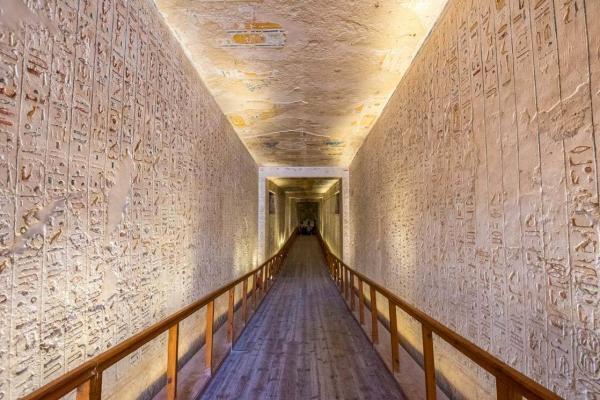
The entrance opens onto a descending corridor leading through a series of halls, corridors, stairways, and pillared chambers before reaching the burial chamber. Numerous side chambers branch from the main axis and were intended to store funerary equipment, offerings, and other objects required for the king’s afterlife.
The burial chamber originally housed a massive red granite sarcophagus, although only fragments survive today. Like many royal tombs, the walls were decorated with religious texts and scenes intended to guide the king safely through the underworld.
Decoration
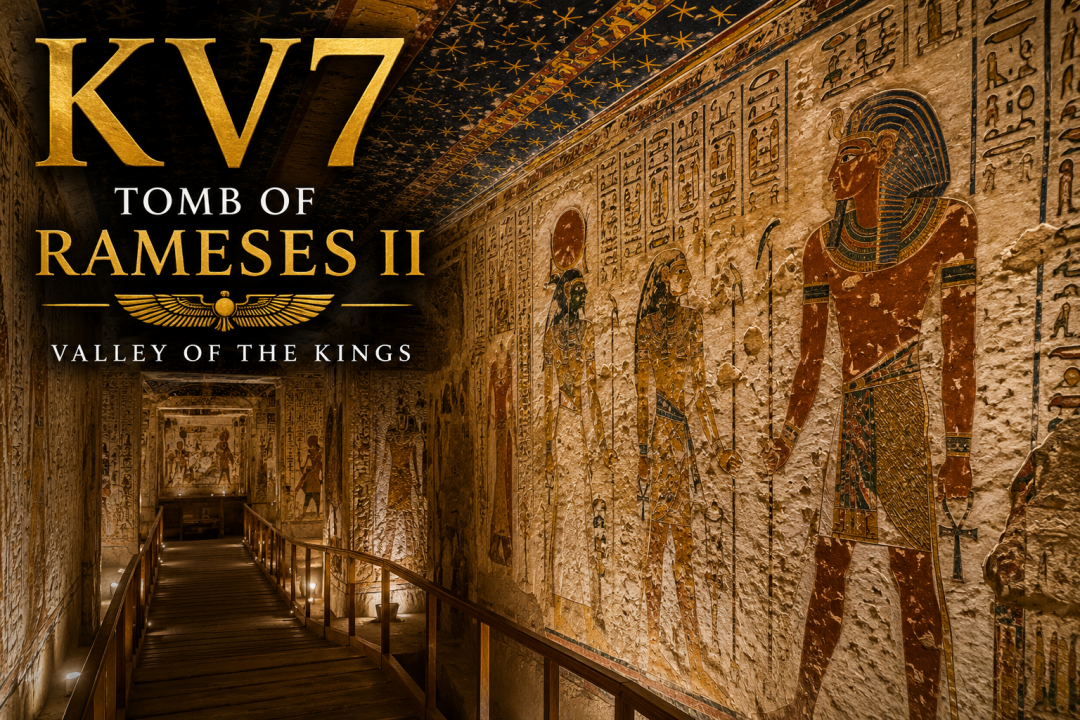
Although much of the decoration has been damaged by flooding and the collapse of plaster, surviving fragments show that KV7 was originally adorned with scenes from several important funerary compositions, including:
- The Book of Gates
- The Amduat (Book of What Is in the Underworld)
- The Litany of Ra
- The Opening of the Mouth ritual
- Scenes of Ramesses II before numerous Egyptian gods
These texts were designed to help the deceased pharaoh overcome the dangers of the underworld and achieve eternal rebirth alongside the sun god Ra.
Noteworthy Features
KV7 is notable for several reasons:
- It served as the original burial place of Ramesses II, one of Egypt’s greatest pharaohs.
- The tomb lies directly opposite KV5, the enormous tomb built for many of Ramesses II’s sons.
- Repeated flooding caused extensive damage, making KV7 one of the most heavily deteriorated royal tombs in the Valley.
- Thousands of fragments of painted plaster recovered during excavations have allowed archaeologists to reconstruct portions of the original decorative program.
- The tomb remains the subject of ongoing conservation and archaeological research.
Site History
Construction of KV7 began early in the reign of Ramesses II and was expanded throughout his long rule. By the time of his death, the tomb had been fully decorated and equipped for burial.
Like nearly every royal tomb in the Valley of the Kings, KV7 was robbed during antiquity. During the political instability that followed the collapse of the New Kingdom, priests transferred the king’s mummy to a series of hiding places before finally placing it in the royal cache at Deir el-Bahari (DB320) to protect it from further desecration.
Unlike many other royal tombs, KV7 suffered catastrophic flood damage over the centuries. Torrents of water and mud repeatedly entered the tomb, burying rooms beneath thick deposits of debris and destroying much of the painted plaster. Modern excavations have recovered thousands of decorated fragments, allowing Egyptologists to reconstruct parts of the tomb’s original appearance.
This site was used during the following periods:
- New Kingdom, Dynasty 19, reign of Ramesses II (c. 1279-1213 BCE)
- Twenty-first Dynasty (removal of the royal mummy)
- Graeco-Roman Period
- Modern archaeological excavations
Conservation History
Extensive archaeological work has been carried out by the Franco-Egyptian Mission since the 1990s. Excavators have removed centuries of flood deposits, documented thousands of decorated plaster fragments, stabilized damaged chambers, and continued efforts to reconstruct the tomb’s original decoration.
Site Condition
KV7 remains one of the most heavily damaged royal tombs in the Valley of the Kings. Repeated flooding destroyed much of the original decoration and buried large portions of the monument beneath mud and rubble. Despite this damage, ongoing conservation continues to reveal new information about one of Egypt’s most famous royal burials.
Interesting Facts About KV7
- KV7 was built for Ramesses II, often regarded as Egypt’s greatest pharaoh.
- The tomb stands opposite KV5, the enormous tomb constructed for many of his sons.
- Flash floods caused more damage to KV7 than almost any other royal tomb in the Valley.
- The mummy of Ramesses II was discovered in the Deir el-Bahari royal cache in 1881.
- Archaeologists have recovered thousands of painted plaster fragments from the tomb, helping reconstruct its original decoration.
- Ramesses II’s reign lasted approximately 66 years, one of the longest in Egyptian history.