Amun: The Hidden King of the Egyptian Gods
Amun was one of the most important and influential gods in Ancient Egyptian mythology. Originally a local deity worshipped in the city of Thebes, Amun rose to become the supreme god of Egypt during the New Kingdom. He was associated with air, creation, fertility, kingship, and the unseen forces of the universe.
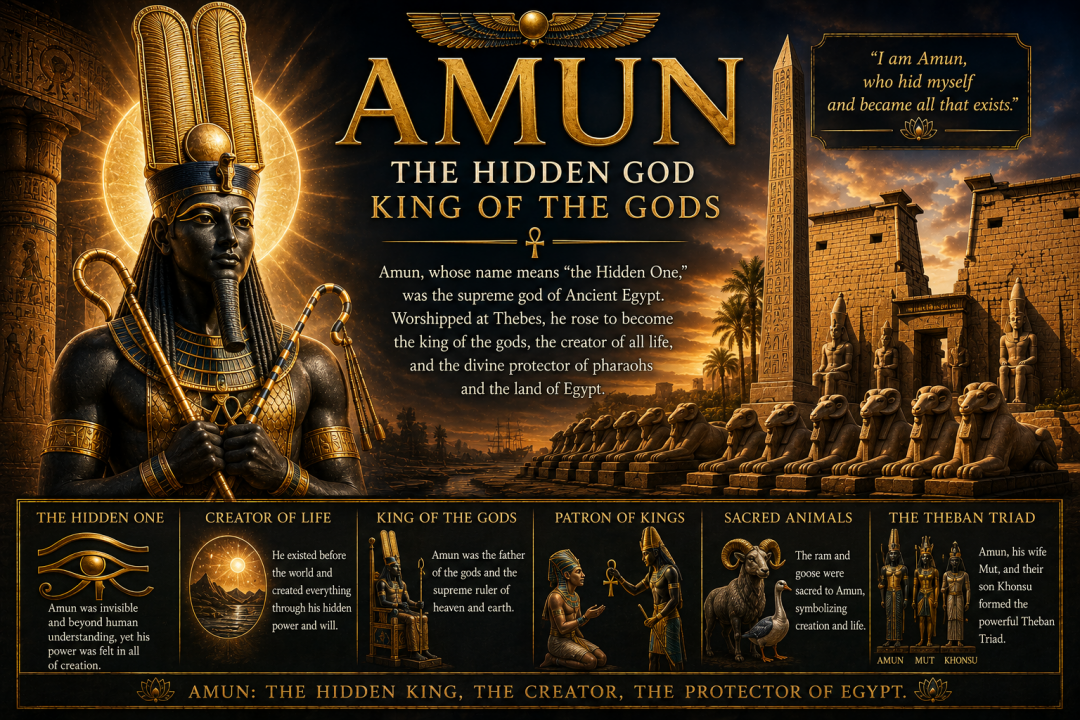
The name Amun means “The Hidden One,” reflecting his mysterious nature. Unlike many Egyptian gods, Amun was believed to exist beyond human understanding. Although invisible, the Egyptians believed his presence could be felt throughout the world.
Over time, Amun became so powerful that he was regarded as the king of the gods and was worshipped throughout Egypt and much of the ancient Near East.
Origins and Early Worship
Amun first appeared in Egyptian religious texts during the Old Kingdom (c. 2686 to 2181 BCE), but at that time he was a relatively minor deity.
His original cult center was Thebes, located in Upper Egypt. During Egypt’s Middle Kingdom (c. 2055 to 1650 BCE), Thebes became the political capital of Egypt, and Amun’s importance grew alongside the city’s power.
When Theban rulers expelled the Hyksos invaders and established the New Kingdom (c. 1550 to 1070 BCE), Amun became the chief deity of the Egyptian state.
Soon, he eclipsed nearly every other Egyptian god in popularity and influence.
What Does the Name Amun Mean?
The name Amun (also written Amen, Amon, or Ammon) derives from the ancient Egyptian word imn, meaning “hidden,” “invisible,” or “concealed.” This title emphasized Amun’s mysterious and transcendent nature.
Ancient Egyptians believed that while Amun could not be seen, his power permeated every aspect of existence. Because he was invisible and unknowable, many Egyptians viewed Amun as a universal creator who existed beyond the physical world.
Amun as a Creator God
As Amun’s importance increased, theologians expanded his role within Egyptian mythology.
In many traditions, Amun became a creator god who brought himself into existence at the beginning of time. Some texts describe him as the “self-created one” who existed before the universe itself.
Unlike creator gods such as Atum, who physically generated other deities, Amun often represented the hidden creative force behind all existence.
Egyptian hymns describe Amun as:
- The father of the gods.
- The creator of humanity.
- The source of life.
- The hidden power behind creation.
By the New Kingdom, many Egyptians regarded Amun as the supreme creator of both gods and humans.
King of the Gods
During the New Kingdom, Amun became the undisputed king of the Egyptian gods. Pharaohs credited their military victories and political success to Amun’s divine favor. Egyptian rulers often claimed that Amun himself had chosen them to rule.
Many royal inscriptions describe Amun as the true king of Egypt, with the pharaoh serving as his earthly representative.
As a result, Amun’s priesthood accumulated enormous wealth and political influence. At the height of their power, the priests of Amun controlled vast estates, temples, workshops, and agricultural lands throughout Egypt.
Amun and Kingship
The relationship between Amun and the pharaoh was extremely important.
Egyptian kings frequently depicted themselves receiving life, power, and authority directly from Amun.
Some rulers even claimed that Amun was their divine father. The famous female pharaoh Hatshepsut, for example, promoted the idea that Amun had personally fathered her, thereby legitimizing her right to rule.
Temples often featured scenes showing Amun blessing or crowning the king. This close association made Amun a central figure in royal ideology.
Appearance and Symbols
Amun was typically depicted as a man wearing a tall crown topped by two long plumes.
In artistic representations, he often carried:
- An ankh, symbolizing life.
- A was-scepter, symbolizing power.
- A ceremonial staff.
Amun could also appear in animal form.
His sacred animals included:
- The ram
- The goose
The ram, in particular, became strongly associated with Amun because it symbolized fertility, strength, and creative power.
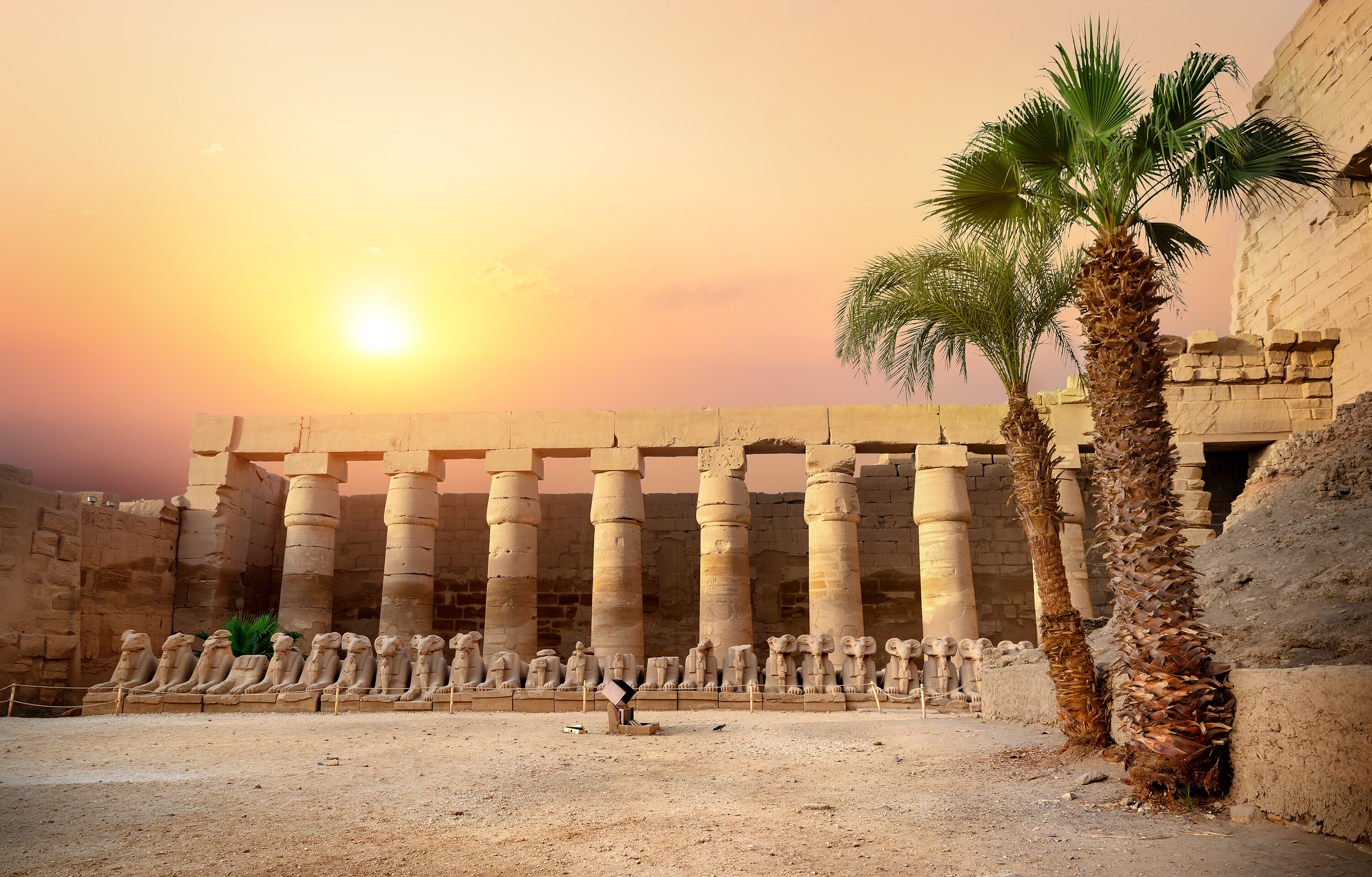
Many temples dedicated to Amun featured long avenues lined with ram-headed sphinxes.
Amun’s Family
At Thebes, Amun formed part of the Theban Triad alongside:
- Mut, goddess of motherhood and queenship, who served as his wife.
- Khonsu, the moon god, who was their son.
This divine family became enormously important during the New Kingdom.
Together, Amun, Mut, and Khonsu were worshipped throughout Egypt.
The Temple of Karnak
Amun’s most important cult center was the Temple of Karnak at Thebes. Karnak eventually became the largest religious complex ever constructed in the ancient world.
For more than two thousand years, successive pharaohs expanded the temple, adding colossal statues, obelisks, pylons, chapels, and sacred lakes.
The Temple of Karnak served not only as a religious center but also as an economic and political powerhouse.
Today, Karnak remains one of Egypt’s most impressive archaeological sites.
The Opet Festival
One of Ancient Egypt’s most important religious celebrations was the Opet Festival.
During this annual event, priests carried the sacred statues of Amun, Mut, and Khonsu from Karnak Temple to Luxor Temple in elaborate processions.
The festival celebrated the renewal of kingship and reaffirmed the divine relationship between Amun and the reigning pharaoh.
Large crowds gathered to participate in music, feasting, and religious ceremonies.
Amun and Akhenaten
Despite Amun’s immense popularity, his supremacy was challenged during the reign of Pharaoh Akhenaten.
Akhenaten attempted to abolish the traditional Egyptian religion and replace it with the exclusive worship of Aten, the solar disk.
Temples dedicated to Amun were closed, his priests lost their influence, and many references to Amun were erased.
However, after Akhenaten’s death, traditional religion quickly returned, and Amun once again became Egypt’s chief deity.
Amun Beyond Egypt
Amun’s influence extended far beyond Egypt.
The Greeks identified Amun with Zeus and referred to him as Zeus-Ammon.
One of the ancient world’s most famous oracles, the Oracle of Amun at Siwa Oasis, attracted visitors from across the Mediterranean.
Alexander the Great famously visited the oracle in 331 BCE, where priests reportedly proclaimed him the son of Amun.
Legacy of Amun
For centuries, Amun was worshipped as the hidden creator, divine king, and protector of Egypt.
Although later generations often combined him with Ra to create Amun-Ra, Amun possessed his own distinct identity and rich mythology long before this merger occurred.
Today, Amun remains one of the most fascinating figures in Egyptian religion, remembered as the mysterious hidden god who rose from local obscurity to become king of the Egyptian pantheon.