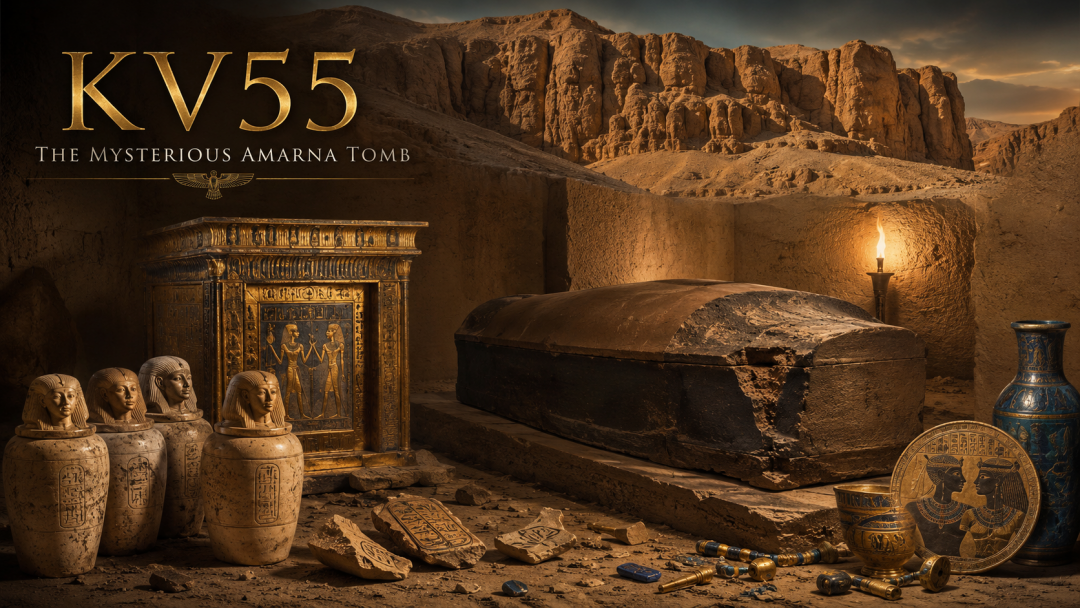
KV55: The Mysterious Amarna Tomb in the Valley of the Kings
KV55 is one of the most mysterious and controversial tombs in the Valley of the Kings. Although the monument is small, undecorated, and architecturally simple, it contained an extraordinary collection of objects associated with several members of the Amarna royal family.
The tomb was discovered in 1907 by archaeologist Edward Russell Ayrton while he was excavating for the wealthy American sponsor Theodore M. Davis. Inside was a badly deteriorated male mummy placed in a modified royal coffin. Other objects bore the names or titles of Queen Tiye, Akhenaten, and additional members of the Eighteenth Dynasty court.
This mixture of funerary equipment led to years of confusion. Davis initially believed he had discovered the tomb of Queen Tiye, while later researchers proposed that the male mummy belonged to Akhenaten, Smenkhkare, or another member of the royal family.
Genetic research published in 2010 identified the KV55 mummy as the biological father of Tutankhamun and a son of Amenhotep III and Queen Tiye. These results are consistent with Akhenaten, but the mummy’s disputed age at death and uncertainties surrounding the DNA evidence have prevented universal agreement.
KV55 may therefore preserve the remains of one of ancient Egypt’s most famous kings, but its anonymous occupant continues to guard his identity.
Structure: KV55
Location: Valley of the Kings, East Valley, Thebes West Bank, Luxor
Owner: Unknown
Possible Occupants: Akhenaten or Smenkhkare
Site Type: Tomb and probable reburial cache
KV55 lies in the central part of the East Valley of the Kings, close to several important royal tombs.
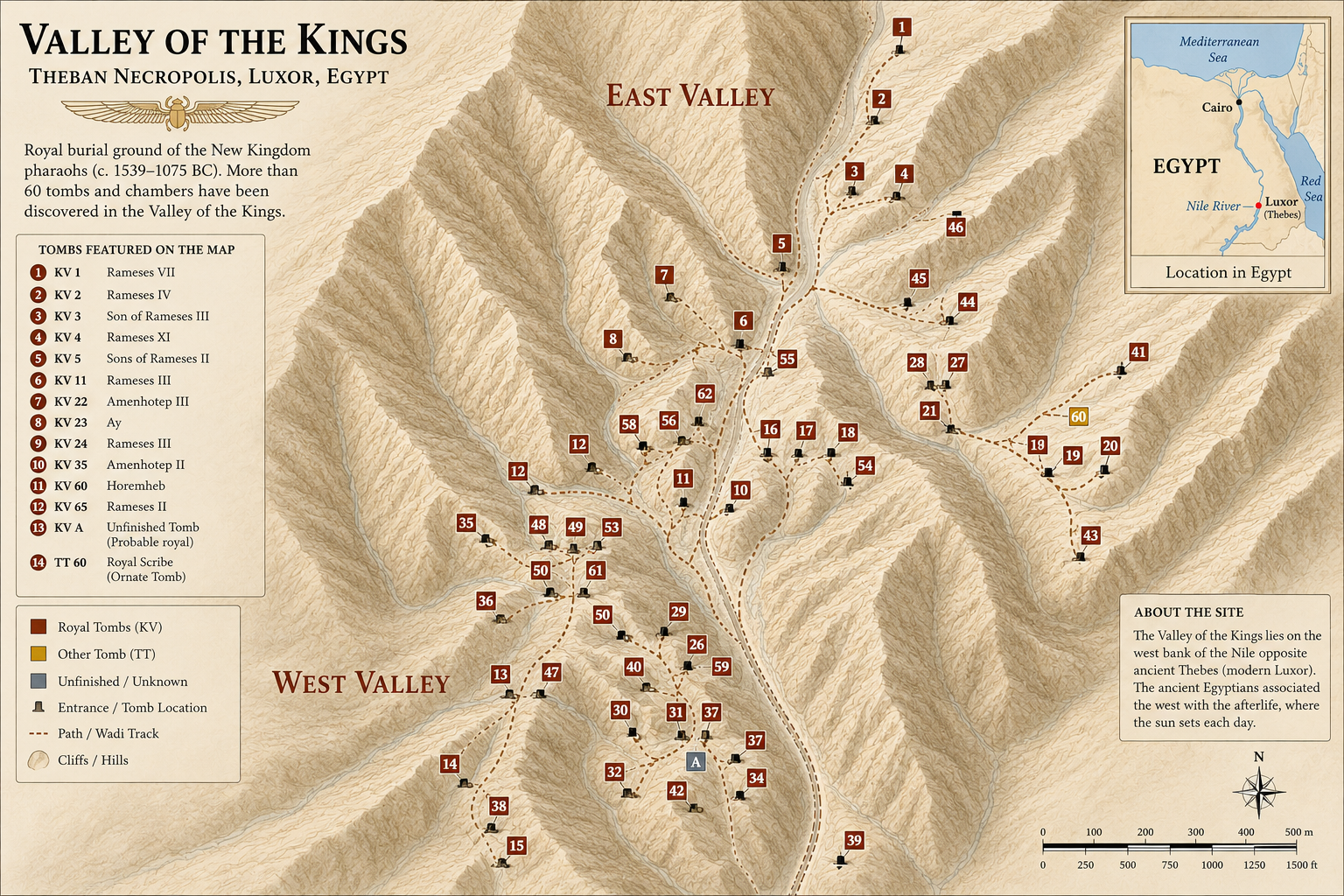
It is located near:
- KV6, the tomb of Ramesses IX
- KV62, the tomb of Tutankhamun
- KV63, a later embalming or storage cache
- KV35, where several members of Tutankhamun’s family were found
Its proximity to Tutankhamun’s tomb is particularly significant. The objects and human remains found in KV55 appear to have been brought from Amarna to Thebes during or shortly after the restoration of traditional religion under Tutankhamun.
Description
KV55 is a small, undecorated tomb with a relatively simple plan.
A flight of approximately twenty-one steps descends to the entrance. Beyond the doorway is a sloping corridor that leads directly into a single rectangular chamber.
A roughly cut niche or unfinished side chamber opens from one wall. Four calcite canopic jars were found in or near this recess.
Unlike the extensive royal tombs built for pharaohs, KV55 contains no pillared halls, elaborate side chambers, decorated corridors, or formal burial suite. Its modest architecture suggests that it may originally have been intended for a private individual or minor member of the royal family.
The monument appears to have been adapted hurriedly to receive objects and at least one body transferred from another burial place.
An Undecorated Tomb
KV55 contains no surviving painted or carved wall decoration.
There are no scenes from the Amduat, Book of Gates, Litany of Ra, or other royal funerary compositions. No inscription on the walls identifies the intended owner.
This absence of decoration is one reason Egyptologists believe KV55 was not originally excavated as the principal tomb of a reigning pharaoh.
Instead, it may have served as an emergency reburial place or cache for members of the Amarna royal family whose original tombs had become vulnerable after the abandonment of Akhetaten.
Discovery in 1907
Edward Russell Ayrton discovered KV55 in January 1907 while working for Theodore M. Davis.
The entrance had been buried beneath rubble. After clearing the stairway, Ayrton encountered a blocked doorway bearing damaged seals associated with the royal necropolis.
The burial chamber contained a chaotic mixture of objects. Some appeared to belong to Queen Tiye, while others were connected with Akhenaten or an unidentified royal woman.
A coffin containing a male mummy lay on the floor. The coffin’s face and cartouches had been deliberately removed, preventing an immediate identification.
The excavation was conducted rapidly, and the tomb’s contents deteriorated quickly after exposure. Incomplete documentation and disagreements among the excavators caused the archaeological context of several objects to be lost.
Theodore M. Davis and the “Tomb of Queen Tiye”
Theodore M. Davis believed that KV55 was the tomb of Queen Tiye, wife of Amenhotep III and mother of Akhenaten.
This conclusion was influenced by the discovery of a large gilded wooden shrine bearing inscriptions and images connected with Tiye. Davis published the tomb under the title The Tomb of Queen Tiyi.
However, the mummy inside the coffin was eventually determined to be male. The shrine had probably been transferred from Queen Tiye’s original burial at Amarna rather than created for KV55.
Davis’s interpretation illustrates the central problem of KV55: objects belonging to several individuals had been deposited together, making it difficult to determine who was actually buried there.
The KV55 Mummy
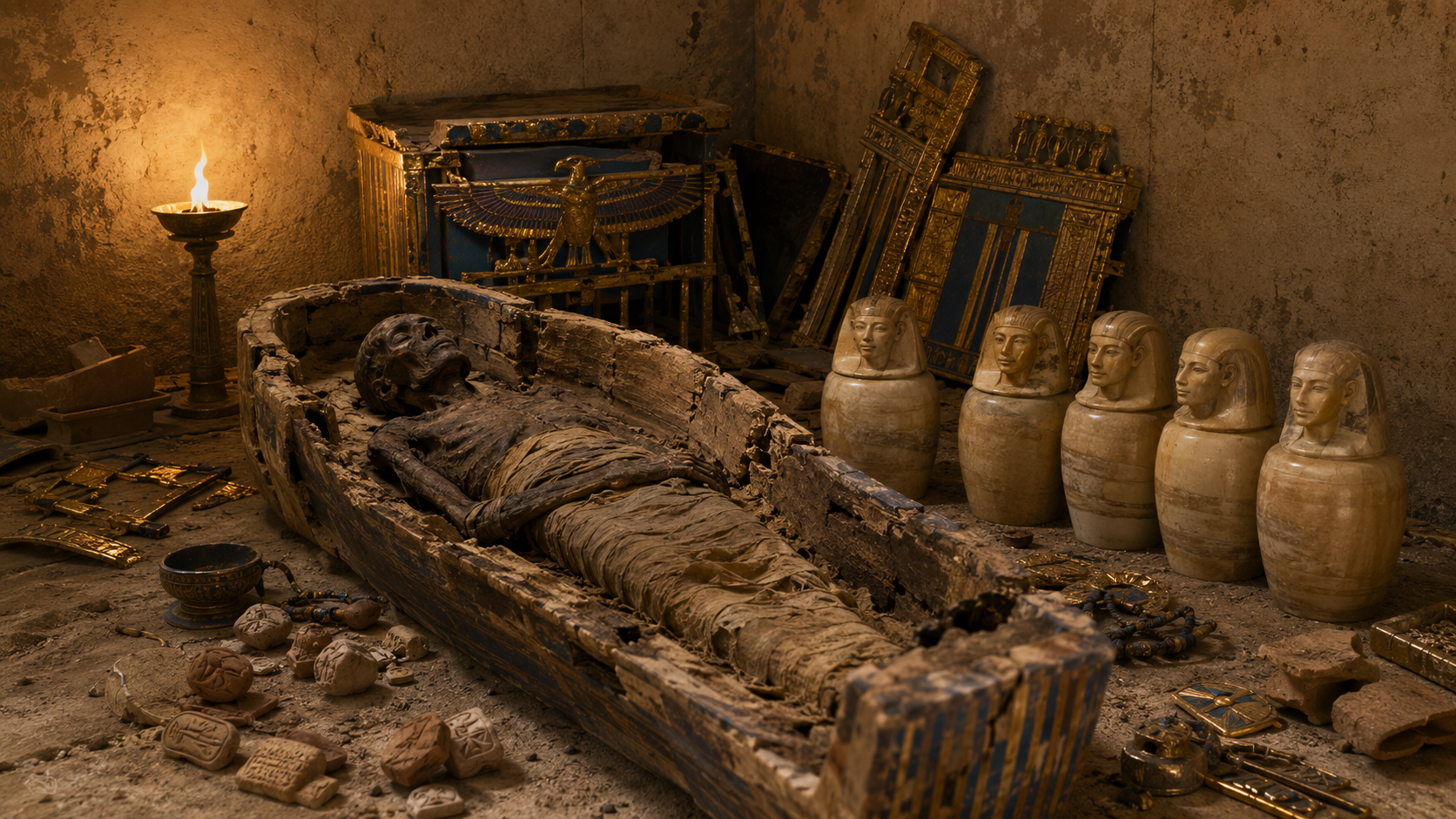
The mummy discovered in KV55 was in extremely poor condition.
Moisture had damaged the body, while chemical reactions involving resins and the coffin caused much of the soft tissue to disintegrate. By the time specialists examined it, the remains were largely skeletal.
The body belonged to a male who shared physical characteristics with other members of the late Eighteenth Dynasty royal family.
The position of the arms and the presence of royal funerary equipment indicated that he was a person of high status. However, the destruction of the coffin’s identifying inscriptions concealed his name.
How Old Was the KV55 Mummy?
The age of the KV55 mummy has long been central to the debate over his identity.
Early examinations suggested that he had died between approximately 20 and 25 years of age. If correct, this would be too young for Akhenaten, who probably ruled for approximately seventeen years and is believed to have fathered several children before becoming king.
The younger age estimate encouraged the identification of the mummy as Smenkhkare, an obscure ruler who briefly reigned near the end of the Amarna Period.
Later examinations proposed a substantially older age, possibly between 35 and 45 years. This range would be more consistent with Akhenaten.
Estimating age from damaged ancient skeletal remains is difficult, and specialists have continued to disagree. The mummy’s poor condition limits the certainty of any conclusion.
DNA and Tutankhamun’s Family
A genetic study published in 2010 examined several mummies believed to belong to Tutankhamun’s family.
The study concluded that:
- The KV55 mummy was the father of Tutankhamun.
- The Younger Lady from KV35 was Tutankhamun’s mother.
- The KV55 mummy and Younger Lady were full siblings.
- Both were children of Amenhotep III and Queen Tiye.
This family relationship strongly supports the identification of KV55 as a son of Amenhotep III and Tiye.
Akhenaten is known to have been their son and is widely considered Tutankhamun’s father. For this reason, the researchers identified the KV55 mummy as probably Akhenaten.
However, some specialists have questioned aspects of the ancient DNA methods and requested independent retesting. The results remain influential, but not every proposed identification in the family tree should be treated as completely settled.
Was the KV55 Mummy Akhenaten?
Akhenaten is the leading candidate for the KV55 mummy.
Evidence supporting the identification includes:
- The mummy was a son of Amenhotep III and Queen Tiye.
- He was identified genetically as Tutankhamun’s father.
- Objects associated with Akhenaten were discovered in the tomb.
- The coffin had been modified for a male ruler of the Amarna Period.
- The body’s physical characteristics resemble other members of the royal family.
- Later age estimates are compatible with Akhenaten’s probable age at death.
Akhenaten abandoned the traditional religious system centered on Amun and promoted the Aten as Egypt’s supreme deity. He moved the royal court from Thebes to Akhetaten, now called Amarna, where he constructed a new city and royal cemetery.
After his death, his religious program collapsed. His monuments were dismantled, his names were erased, and the royal court returned to traditional centers.
His original burial may have been moved from Amarna to Thebes during the reign of Tutankhamun or one of his immediate successors.
Could the Mummy Be Smenkhkare?
Smenkhkare was a poorly documented ruler who reigned near the end of the Amarna Period.
Very little is known about his origins, reign, or relationship to Akhenaten. He may have ruled briefly as Akhenaten’s co-regent or immediate successor.
The younger skeletal age estimates for the KV55 mummy led many scholars to identify the body as Smenkhkare. If the mummy died in his early twenties, Smenkhkare would be a more plausible candidate than Akhenaten.
However, the genetic results create complications. For Smenkhkare to be the KV55 mummy, he would need to have been a son of Amenhotep III and Queen Tiye, a full brother of the Younger Lady, and Tutankhamun’s father.
Such a relationship is possible, but no surviving inscription securely identifies Smenkhkare as a son of Amenhotep III.
The mummy may therefore be Smenkhkare, but the historical evidence currently favors Akhenaten.
The Royal Coffin
The coffin found in KV55 is one of the tomb’s most puzzling objects.
It was originally created for a royal woman during the Amarna Period. Grammatical traces in the inscriptions preserve feminine endings and pronouns, demonstrating that its first owner was female.
The coffin was later altered for the burial of a man. The original names and titles were changed, while a false beard and other masculine royal features were added.
Before the tomb was sealed, or possibly when it was later entered, the golden face mask and royal cartouches were deliberately removed. This destruction appears intended to erase the occupant’s identity and deny him an effective existence in the afterlife.
The original female owner has sometimes been identified as Kiya, a wife of Akhenaten, although this remains uncertain.
The Gilded Shrine of Queen Tiye
One of the most spectacular objects found in KV55 was a dismantled gilded wooden shrine associated with Queen Tiye.
The shrine portrayed Tiye together with Akhenaten and contained inscriptions honoring the queen. It was probably created for her burial at Amarna.
At some point after the abandonment of Akhetaten, the shrine was taken apart and moved to the Valley of the Kings. Its panels were placed inside KV55 along with other Amarna-period burial equipment.
The shrine’s presence initially led Davis to conclude that Tiye had been buried in KV55. Her mummy, however, was later identified as the Elder Lady discovered in KV35.
The Canopic Jars
Four calcite canopic jars with finely carved portrait lids were discovered in KV55.
Canopic jars were used to contain the embalmed internal organs of the deceased. Their lids originally represented the face of the woman for whom they were created.
The owner’s names and titles were erased, making identification difficult. The jars are commonly associated with Kiya, one of Akhenaten’s wives, although other royal women have been proposed.
The portrait lids show a youthful royal woman wearing a Nubian-style wig. Their elegant carving makes them among the most recognizable objects from KV55.
Like the coffin, the jars demonstrate that funerary equipment originally created for a woman was reused, altered, or deposited with a male burial.
Magical Bricks
Four magical bricks were placed around the burial according to traditional Egyptian funerary practice.
These mudbrick objects contained protective spells and were normally positioned at the four cardinal points around a royal coffin. Each carried an amulet or ritual object intended to defend the deceased from supernatural threats.
The magical bricks found in KV55 bore inscriptions naming Akhenaten.
Their presence provides one of the strongest archaeological links between the tomb and the heretic pharaoh. However, they could have been transferred from his original burial at Amarna together with other objects.
Objects Recovered
Objects found inside KV55 included:
- The badly deteriorated male mummy
- A modified royal coffin
- Panels from Queen Tiye’s gilded shrine
- Four calcite canopic jars
- Magical bricks bearing the name of Akhenaten
- Gold jewelry and amulets
- A gold vulture pectoral
- Pottery vessels
- Funerary equipment
- Furniture fragments
- Seals and seal impressions
- Decorative inlays
- Linen and mummy trappings
- Objects associated with several members of the Amarna royal family
The mixture suggests that KV55 was assembled from material removed from more than one original burial.
A Reburial Cache from Amarna
The most widely accepted interpretation is that KV55 served as a reburial cache.
After Akhetaten was abandoned, members of the royal family buried in its eastern desert cemetery became vulnerable. Tutankhamun and his successors restored the worship of Egypt’s traditional gods and moved the royal court away from the city.
At least some Amarna burials may then have been transferred to the Valley of the Kings.
KV55 may have initially contained more than one body, including Queen Tiye and possibly other royal women. These remains were later moved again, leaving only the male mummy.
The hurried arrangement, reused objects, dismantled shrine, altered coffin, and mixture of names are all consistent with a secondary burial rather than an untouched original tomb.
Deliberate Erasure
Several objects in KV55 had been deliberately defaced.
The coffin’s face was removed, its cartouches were cut away, and names on other objects were erased. The damaged condition cannot be explained solely by robbery or natural deterioration.
In ancient Egyptian belief, preserving a person’s name and image was essential to survival in the afterlife. Destroying those elements could condemn the deceased to permanent oblivion.
If the occupant was Akhenaten, the damage may reflect the official campaign against his memory following the collapse of the Amarna religious revolution.
Alternatively, the destruction may have occurred when the burial was reorganized or desecrated during a later reign.
The Amarna Period
The Amarna Period was one of the most dramatic episodes in ancient Egyptian history.
Amenhotep IV changed his name to Akhenaten and increasingly focused royal worship on the Aten, represented as the sun disk whose rays ended in hands.
He founded the new capital of Akhetaten and commissioned a distinctive artistic style characterized by elongated bodies, intimate royal family scenes, and unusually naturalistic details.
After Akhenaten’s death, his religious reforms were reversed. Tutankhamun restored traditional temples and moved the royal residence away from Akhetaten.
Later kings attempted to erase Akhenaten and several of his successors from official history. KV55 preserves physical evidence of this turbulent transition.
Relationship to Tutankhamun
KV55 is closely linked to Tutankhamun.
The male mummy is believed to have been his father, while several objects in the tomb belonged to members of his immediate family.
Tutankhamun may have played a role in transferring Amarna royal burials to the Valley of the Kings. His administration attempted to restore traditional religion while still preserving and reburying deceased relatives.
The close physical location of KV55 and KV62 may be coincidental, but the two tombs preserve complementary evidence about the collapse of the Amarna royal court.
KV55 contains the disturbed and anonymous burial of a possible father, while KV62 contained the nearly intact burial of his young son.
Problems with the Excavation
The excavation of KV55 was poorly documented by modern archaeological standards.
Theodore Davis placed pressure on excavators to work quickly, while several specialists disagreed about the interpretation of the finds. Objects were removed before their exact positions had been fully recorded.
The coffin and mummy deteriorated rapidly after exposure. Pieces of gold leaf, wood, textiles, and skeletal material were lost or dispersed.
Different published accounts contradicted one another, while some artifacts entered museum collections without complete contextual records.
These problems have made it extremely difficult to reconstruct the original arrangement of KV55.
Noteworthy Features
KV55 is notable for several reasons:
- It contained a mysterious male mummy from the Amarna royal family.
- The mummy was identified genetically as Tutankhamun’s father.
- The occupant may be Akhenaten or Smenkhkare.
- The coffin was originally made for a royal woman and altered for a man.
- The coffin’s face and names were deliberately removed.
- Queen Tiye’s gilded burial shrine was found inside.
- Four portrait-headed canopic jars were discovered in the tomb.
- Magical bricks bore the name of Akhenaten.
- Objects belonging to several royal individuals were deposited together.
- The tomb probably served as a reburial cache after the abandonment of Amarna.
Dating
KV55 was used during the following period:
- New Kingdom, late Eighteenth Dynasty
- Amarna and post-Amarna Period
The tomb was probably used or reorganized during the reigns of Tutankhamun, Ay, or Horemheb, although the precise sequence remains uncertain.
History of Exploration
- Edward Russell Ayrton, 1907: Discovery and excavation for Theodore M. Davis
- Theodore M. Davis, 1910: Publication as The Tomb of Queen Tiyi
- Grafton Elliot Smith, early twentieth century: Examination of the mummy
- Later twentieth-century researchers: Re-examination of the skeleton, coffin, and tomb contents
- Egyptian Mummy Project, 2007–2010: CT scanning and genetic investigation of the mummy and Tutankhamun’s family
Conservation History
The fragile coffin, skeletal remains, gilded shrine panels, and other objects were removed from KV55 and transferred to museum storage.
The coffin required extensive reconstruction because much of its wood, gold leaf, and inlay had deteriorated. Conservation has helped reveal evidence that it was originally made for a woman and later altered.
The tomb itself has been cleared, mapped, and protected, although little remains inside today.
Site Condition
KV55 is small, undecorated, and largely empty.
Moisture and flooding damaged the original burial, while the rapid excavation in 1907 caused further losses. The burial chamber and corridor remain structurally recognizable, but most archaeological material has been removed.
The tomb is not normally among the principal monuments open to visitors.
Why KV55 Matters
KV55 is one of the most important tombs for understanding the Amarna Period and the family of Tutankhamun.
Its contents reveal that royal burials were moved, dismantled, altered, and reorganized following the collapse of Akhenaten’s religious revolution. The tomb preserves evidence of Queen Tiye, Akhenaten, an unidentified royal woman, and the mysterious father of Tutankhamun.
The monument also demonstrates the dangers of assuming that all objects found together originally belonged to the same person. KV55 was not a simple intact burial but a complicated collection assembled from several royal tombs.
Whether its male occupant was Akhenaten or Smenkhkare remains debated. Until stronger evidence becomes available, KV55 will remain one of Egyptology’s greatest unresolved mysteries.
Interesting Facts About KV55
- KV55 was discovered in 1907.
- Theodore Davis initially called it the tomb of Queen Tiye.
- The mummy inside was male.
- Genetic testing identified the mummy as Tutankhamun’s father.
- The body was also identified as a son of Amenhotep III and Queen Tiye.
- Akhenaten is the leading candidate, but Smenkhkare remains possible.
- The royal coffin was first created for a woman.
- Its golden face and identifying names were deliberately removed.
- Queen Tiye’s gilded shrine had been dismantled and placed inside.
- Magical bricks carried the name of Akhenaten.
- Four portrait-headed canopic jars probably belonged to a royal woman.
- KV55 may once have held additional mummies that were later moved.
- The poor excavation records have made the tomb especially difficult to interpret.
