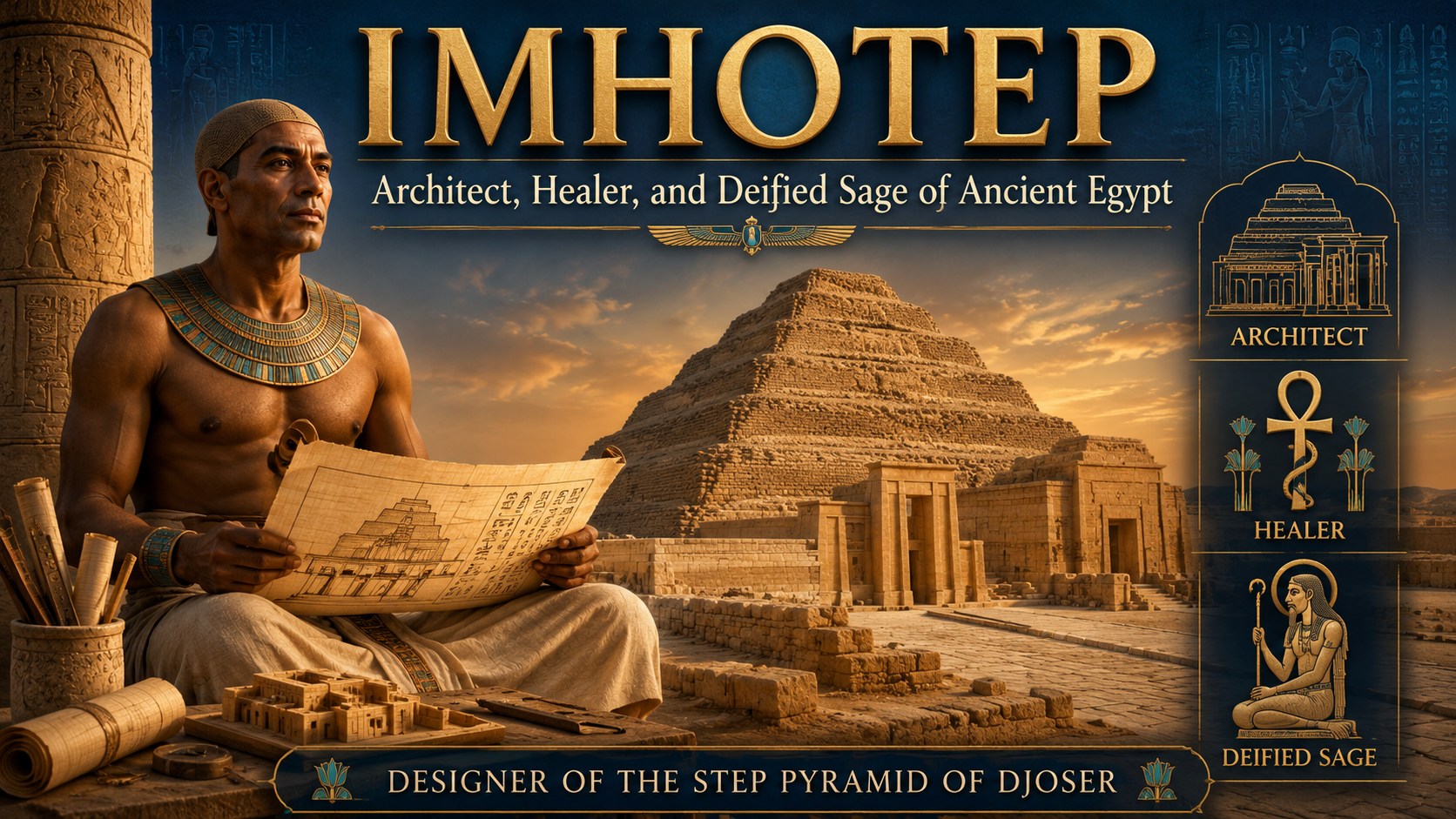
Imhotep was one of the most extraordinary individuals in Ancient Egyptian history. Unlike most figures worshipped as Egyptian gods, he began his life as a mortal man. He served King Djoser during the Third Dynasty and became famous as a royal official, priest, administrator, architect, and man of exceptional learning.
Imhotep is traditionally credited with designing Djoser’s Step Pyramid complex at Saqqara, one of the most revolutionary monuments ever constructed. The Step Pyramid was Egypt’s earliest pyramid and one of the first great monumental buildings made primarily from stone.
His accomplishments made such a lasting impression that Egyptians continued to honor him long after his death. Over the centuries, memories of the historical Imhotep grew into legends. He became a patron of scribes and wisdom, and was eventually worshipped as a god of healing.
Few individuals in the ancient world achieved such a remarkable transformation from royal official to immortal deity.
Who Was Imhotep?
Imhotep lived during the reign of King Djoser, who ruled near the beginning of Egypt’s Old Kingdom during the 27th century BC.
Although many details of his life have been lost, surviving evidence identifies him as an important official at the royal court. His titles indicate that he held positions connected with administration, religion, construction, and royal authority.
Titles associated with Imhotep include:
- Chancellor or chief minister of the king
- Chief of sculptors
- Chief of seers at Heliopolis
- Royal seal-bearer
- High-ranking palace official
- Overseer of major building projects
The title “Chief of Seers” connected Imhotep with the solar religious center of Heliopolis and suggests that he possessed considerable religious authority.
Imhotep’s elevated position was remarkable because he was neither a pharaoh nor a member of the royal family. Nevertheless, his name and titles were recorded alongside those of King Djoser, demonstrating the extraordinary respect he received.
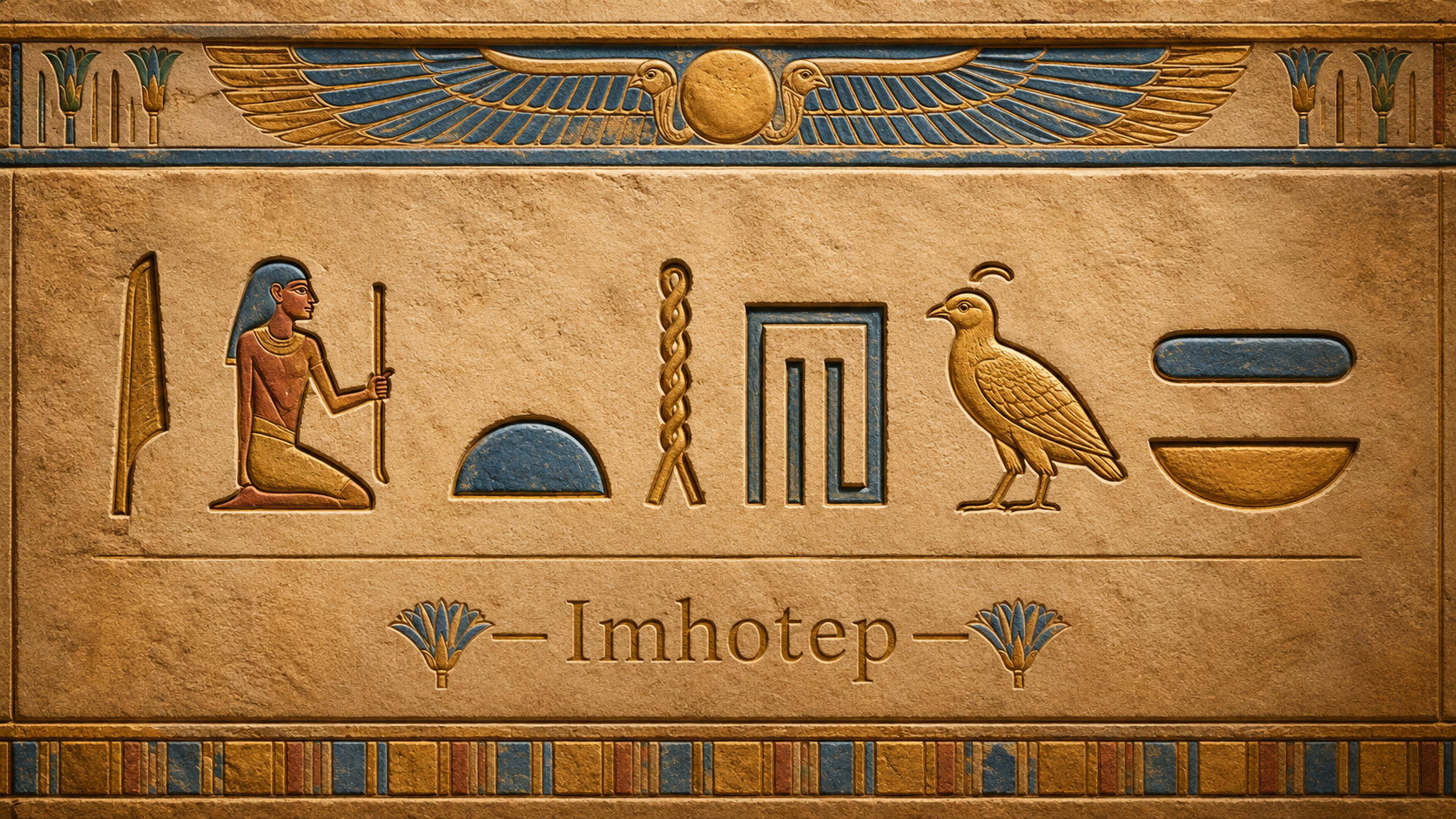
What Does the Name Imhotep Mean?
The name Imhotep is commonly translated as “He Who Comes in Peace” or “The One Who Comes in Peace.”
This peaceful meaning later suited his reputation as a benevolent sage and healer. However, the historical Imhotep was probably best known during his own lifetime for his service to Djoser and his involvement in royal construction.
Imhotep and the Step Pyramid of Djoser
Imhotep’s greatest achievement was his traditional association with the Step Pyramid complex at Saqqara.
Before Djoser’s reign, Egyptian kings were generally buried beneath rectangular, flat-roofed structures known as mastabas. The Step Pyramid began as a mastaba but was repeatedly expanded until it became a six-tiered stone monument rising more than 200 feet above the desert.
This design marked a turning point in Egyptian architecture.
The Step Pyramid was not an isolated monument. It stood inside an enormous funerary complex surrounded by ceremonial courtyards, chapels, shrines, gateways, and a massive limestone wall.
Many of these structures imitated buildings traditionally constructed from wood, reeds, and mudbrick. By reproducing them in limestone, the builders transformed temporary forms into permanent monuments intended to last for eternity.
Imhotep is therefore remembered not only as the architect of a pyramid but as one of the pioneers of monumental stone construction.
Was Imhotep the First Architect?
Imhotep is often described as the world’s first named architect.
People had designed and constructed large buildings long before his lifetime, and earlier Egyptian architects certainly existed. However, their identities are generally unknown.
Imhotep stands apart because his name survived and became directly connected with one of the ancient world’s most important architectural achievements.
For that reason, he is frequently called the first architect known by name.
How Did the Step Pyramid Change Egypt?
The construction of Djoser’s Step Pyramid transformed Egyptian royal architecture.
Its success demonstrated that enormous monuments could be built using carefully cut stone. Later kings expanded upon the idea, eventually producing the smooth-sided pyramids of Sneferu and the great pyramids at Giza.
Without the innovations represented by Djoser’s complex, later pyramids might never have developed in the same form.
The Step Pyramid also strengthened the relationship between monumental architecture and royal divinity. Its towering form visibly separated the king from ordinary humans and connected him with the gods and the heavens.
Imhotep’s influence can therefore be seen throughout centuries of Egyptian architecture.
Imhotep as a Priest and Scholar
Imhotep was more than a builder.
His title as Chief of Seers associated him with the priesthood of the sun god at Heliopolis, one of Egypt’s most important religious centers. This position probably required extensive knowledge of temple rituals, astronomy, sacred texts, and royal ceremonies.
In later tradition, Imhotep became the ideal image of the learned scribe. He represented wisdom, education, observation, and disciplined study.
Scribes sometimes honored him before beginning their work, much as they honored Thoth, the god of writing and knowledge.
Over time, Imhotep came to embody the belief that wisdom and learning brought a person closer to the divine.
Was Imhotep a Physician?
Imhotep is frequently described as the first known physician, but this claim warrants caution.
No surviving medical treatise can be securely identified as his work, and contemporary evidence does not clearly name him as a doctor. His reputation as a physician developed many centuries after his death.
Nevertheless, later Egyptians firmly associated Imhotep with medicine and healing. His temples became places where sick people prayed for cures, presented offerings, and sought divine assistance.
Therefore, it is more accurate to describe Imhotep as an early official who was later revered as a divine healer rather than to claim with certainty that he practiced medicine during his lifetime.
The Deification of Imhotep
Imhotep did not become a god immediately after his death.
For centuries, Egyptians remembered him as a wise and accomplished human being. By the New Kingdom, he was honored as a patron of scribes and learning.
His reputation continued to grow during the Late Period. Eventually, Egyptians worshipped him as a fully divine being and identified him as the son of Ptah, the creator god and patron of craftsmen.
This divine parentage was especially appropriate. Ptah governed craftsmanship, architecture, and creative skill, while Imhotep represented the human mastery of those same abilities.
Imhotep’s mother was later identified as a woman named Khereduankh, who also received divine honors in the Ptolemaic Period.
Imhotep as the Son of Ptah
Once Imhotep became a god, Egyptian theologians incorporated him into the religious traditions of Memphis.
Ptah was the great creator deity of Memphis and the patron of architects, sculptors, builders, and artisans. Imhotep’s connection with construction and wisdom made him a natural divine son of Ptah.
In some traditions, Imhotep appeared alongside Ptah and Sekhmet. His healing role also connected him with Sekhmet, who could both inflict and cure disease.
This divine family relationship helped transform the historical architect into a powerful god of medicine, wisdom, and creative knowledge.
Temples and Healing Sanctuaries
Imhotep’s cult became particularly strong in the area around Memphis and Saqqara.
Worshippers visited sanctuaries dedicated to him to seek relief from illness, infertility, and personal suffering. They offered prayers, statues, inscriptions, and other gifts in hopes that the deified sage would intervene on their behalf.
Some pilgrims slept within or near sacred precincts in a practice often called dream incubation. They hoped Imhotep would appear in a dream, reveal a cure, or provide guidance concerning their condition.
These sanctuaries functioned as religious healing centers rather than hospitals in the modern sense. Prayer, ritual, dreams, and practical medical treatment could all form part of the ancient search for healing.
The exact location of Imhotep’s principal tomb and cult sanctuary at Saqqara remains uncertain.
How Was Imhotep Depicted?
Imhotep was usually represented as a seated man dressed as a scribe.
He often appears holding or reading an open papyrus scroll placed across his lap. This imagery emphasizes his wisdom, literacy, and scholarly authority rather than his architectural achievements alone.
Common features of Imhotep’s later divine images include:
- A seated scribal pose
- A papyrus scroll
- A close-fitting cap or shaved head
- A simple kilt
- A calm and thoughtful expression
Unlike many Egyptian gods, Imhotep was not normally shown with an animal head. His human appearance reminded worshippers that he had once been mortal.
Imhotep and the Greek God Asclepius
During the Ptolemaic and Roman periods, the Greeks identified Imhotep with Asclepius, their god of medicine and healing.
Both deities attracted worshippers seeking cures and divine guidance. Their sanctuaries were associated with offerings, sacred dreams, and miraculous healing.
The identification of Imhotep with Asclepius helped spread his reputation beyond traditional Egyptian religious circles.
Greek-speaking worshippers sometimes referred to him as Imouthes, the Greek form of his Egyptian name.
Despite this association, Imhotep retained his distinctive Egyptian identity as the deified adviser and architect of King Djoser.
Did Imhotep Write Medical or Magical Texts?
Later traditions attributed great knowledge to Imhotep, and numerous modern stories claim that he wrote works about medicine, architecture, astronomy, and magic.
However, no surviving book can be confidently identified as a work written by the historical Imhotep.
His fame became so great that later generations credited him with accomplishments far beyond those documented during his lifetime. This was common in the ancient world, where famous sages often became legendary authors of scientific, religious, or magical writings.
Imhotep’s reputation as a universal genius reflects the admiration later Egyptians felt for him, but historians must distinguish between documented evidence and later tradition.
Imhotep in Popular Culture
Modern movies, novels, television programs, and games often portray Imhotep as a sinister magician, resurrected priest, or supernatural villain.
These fictional depictions bear little resemblance to the historical person.
The real Imhotep was remembered as a wise administrator, religious official, and master builder. Later Egyptians worshipped him as a compassionate healer and patron of knowledge, not as an evil sorcerer.
His transformation into a horror character is a modern invention inspired by fascination with mummies and Egyptian magic.
Why Was Imhotep So Important?
Imhotep’s importance stems from the many roles he held throughout Egyptian history. During his lifetime, he was a trusted official serving one of Egypt’s earliest great pyramid builders.
After his death, he became:
- A legendary architect
- A model of scribal wisdom
- A patron of learning
- A divine healer
- A son of Ptah
- One of the few non-royal Egyptians elevated to full godhood
His story demonstrates that the ancient Egyptians believed extraordinary achievement could overcome the boundaries between mortality and divinity.
Legacy of Imhotep
Imhotep remains one of the most remarkable people of the ancient world.
His connection with Djoser’s Step Pyramid places him at the beginning of Egypt’s great age of monumental stone architecture. His later transformation into a god reveals the immense respect Egyptians held for wisdom, craftsmanship, and healing.
Although legends eventually surrounded his life, the historical foundation of his fame remains extraordinary. Imhotep was a mortal official whose achievements were remembered for thousands of years until people no longer honored him merely as a great man, but worshipped him as a god.