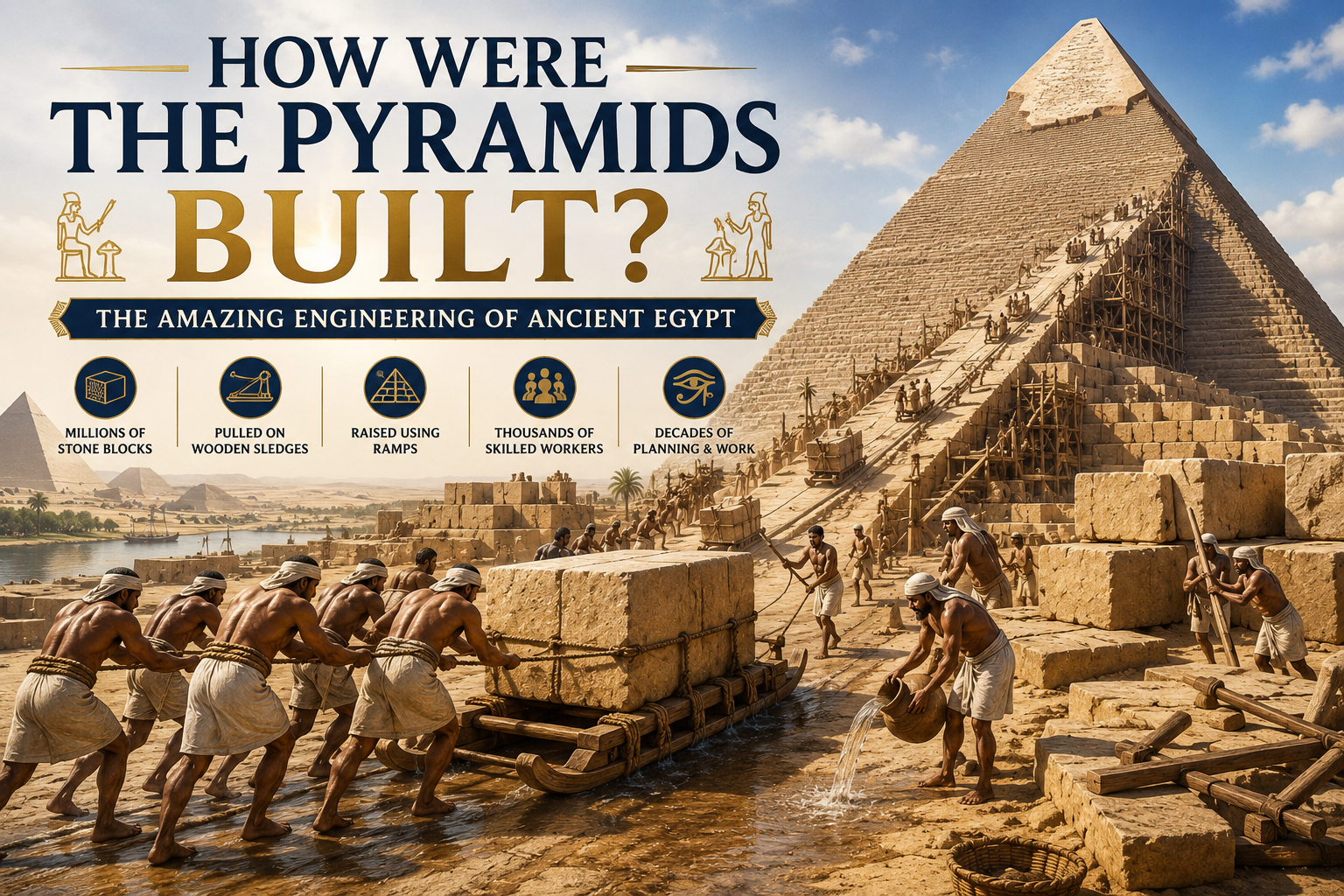
For centuries, people have wondered how the ancient Egyptians built the pyramids. The Great Pyramid of Giza, constructed more than 4,500 years ago for Pharaoh Khufu, remains one of the greatest engineering achievements in human history.
Despite what you may read online, archaeologists are no longer debating whether we know how the pyramids were built. While researchers continue to refine the details, the overall construction process is well understood thanks to archaeological discoveries, ancient inscriptions, worker settlements, surviving tools, and experimental archaeology.
The pyramids were not built by aliens, lost civilizations, or mysterious technology. They were built by skilled Egyptian laborers using stone tools, copper chisels, wooden sledges, ropes, and ramps, with remarkable organization.
The ancient Egyptians built the pyramids by:
- Quarrying limestone and granite blocks.
- Transporting the stones on wooden sledges.
- Wetting the sand to reduce friction while dragging the blocks.
- Moving the stones up carefully constructed ramps.
- Positioning each block using simple machines, levers, and thousands of skilled workers.
- Organizing the entire project through a highly efficient government that supplied food, housing, tools, and labor.
The process took decades, but there is no evidence that it required any lost technology or supernatural assistance.
How Many Stones Were Used?
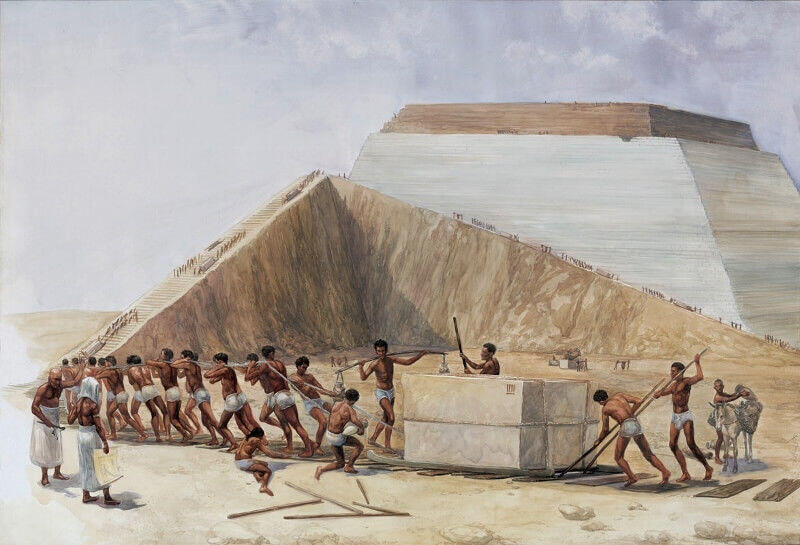
The Great Pyramid of Giza contains approximately 2.3 million stone blocks.
Most limestone blocks weighed between 2.5 and 15 tons, while the massive granite beams used inside the King’s Chamber weighed 70 to 80 tons.
Although these numbers may sound overwhelming, construction spanned roughly 20 to 30 years, meaning workers needed to place only a few hundred blocks each day. With thousands of laborers working simultaneously on different parts of the monument, this was a remarkable but achievable engineering project.
Step 1: Quarrying the Stone
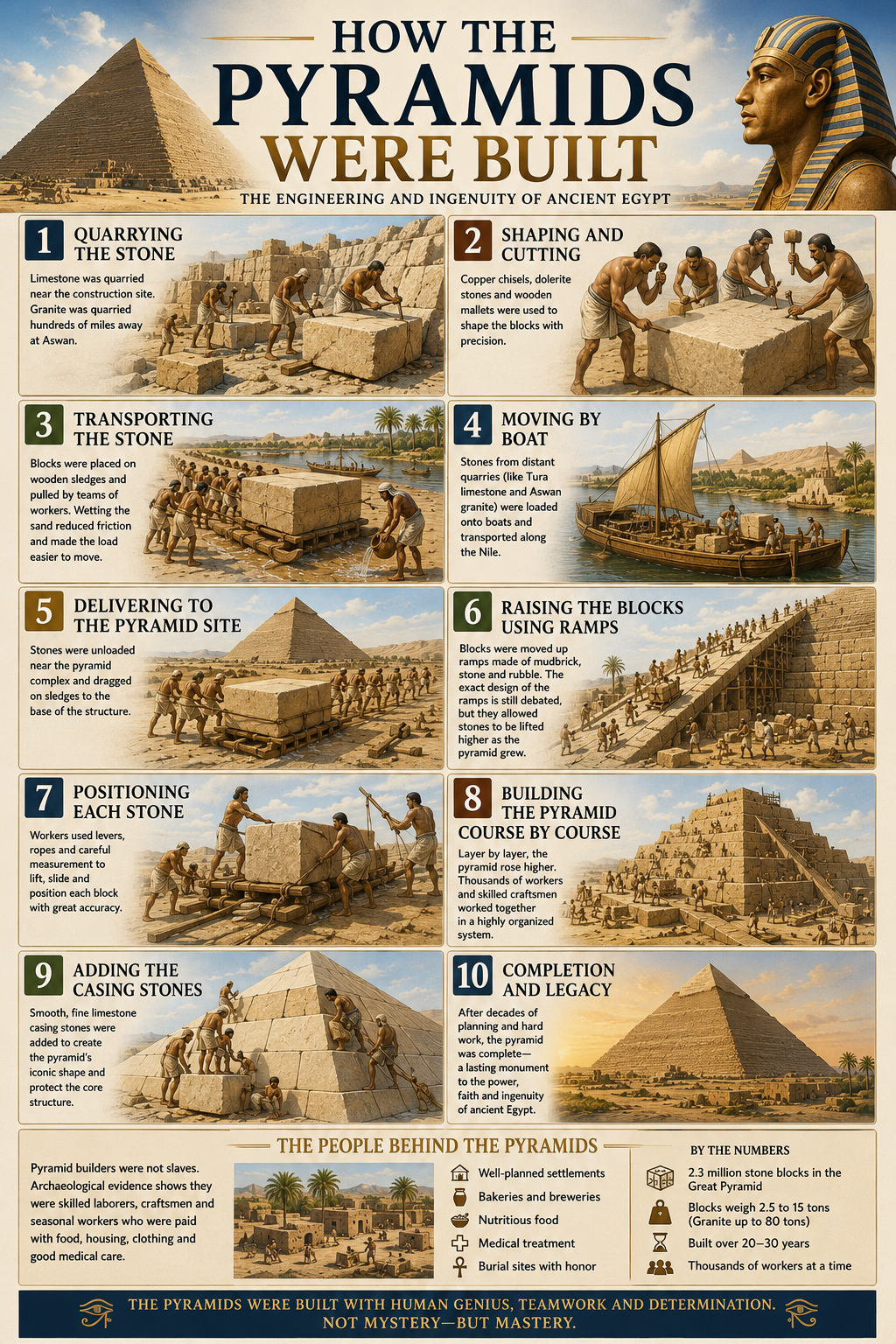
Most of the limestone used for the Great Pyramid came from quarries located only a short distance from the construction site.
Workers used:
- Copper chisels
- Dolerite pounding stones
- Wooden wedges
- Stone hammers
The finer white limestone casing stones came from quarries at Tura across the Nile, while the granite used for the King’s Chamber was transported more than 500 miles from Aswan.
Step 2: Transporting the Blocks
Once cut, the stones were placed on large wooden sledges. Teams of workers pulled these sledges across specially prepared roads.
One of the most important discoveries came from a tomb painting showing workers pouring water onto the sand in front of a sled carrying a massive statue.
Modern experiments have shown this was not symbolic. Wetting the sand reduces friction, making heavy loads significantly easier to move.
This discovery confirmed what many Egyptologists had suspected for years.
Step 3: Moving the Stones to the Pyramid
This is where ramps come in.
Exactly what the ramp system looked like remains one of the remaining engineering questions, but archaeologists agree that ramps played a central role.
Several possibilities have been proposed:
- Straight ramps
- Zigzag ramps
- Spiral ramps
- A combination of different ramp designs as construction progressed
Rather than relying on one enormous ramp for the entire project, many researchers believe the Egyptians adapted their methods as the pyramid grew taller.
Step 4: Positioning Each Stone
Once a block reached the correct level, workers likely used:
- Wooden levers
- Rollers in limited situations
- Ropes
- Careful measurement
- Skilled stone dressing
Each block was shaped so precisely that many fit together with incredibly thin joints, demonstrating the extraordinary craftsmanship of ancient Egyptian masons.
Who Built the Pyramids?
One of the biggest myths is that slaves built the pyramids. Archaeological evidence shows this is not true. Excavations near Giza have uncovered large workers’ villages complete with:
- Houses
- Bakeries
- Breweries
- Kitchens
- Cemeteries
- Medical care
The workers received food, clothing, and housing from the state. Many were skilled craftsmen, stonemasons, engineers, and supervisors.
Others were seasonal laborers.
Every year, the Nile flooded surrounding farmland for several months, preventing many farmers from growing crops. During this period, the government recruited these workers for large construction projects, including the pyramids.
Rather than forced slave labor, pyramid building appears to have been a massive national project supported by taxation, agricultural surpluses, and skilled administration.
The Diary of Merer: The Ancient Logbook That Helped Explain How the Pyramids Were Built
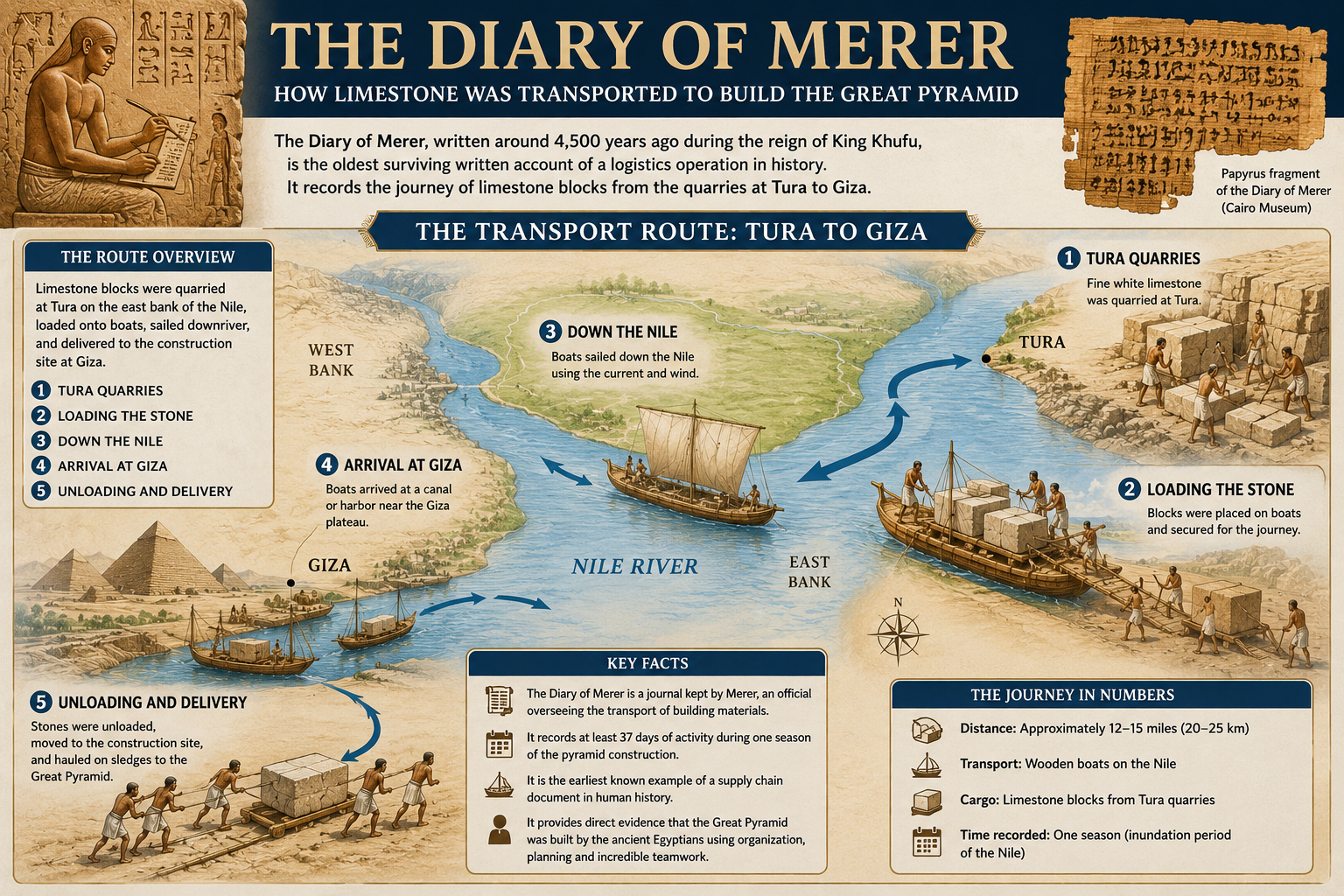
One of the most important archaeological discoveries related to pyramid construction was the Diary of Merer, a collection of papyrus logbooks uncovered in 2013 at Wadi al-Jarf, an ancient harbor on Egypt’s Red Sea coast.
Written during the reign of Pharaoh Khufu (c. 2589 to 2566 BC), the diary belongs to an official named Merer, who supervised a crew of approximately 200 workers. His journal records the day-to-day activities of his team and provides an extraordinary firsthand account of the logistics behind one of history’s greatest construction projects.
The diary is among the oldest surviving papyri ever discovered and offers rare insight into how the Egyptian government organized labor, transportation, and building materials more than 4,500 years ago.

Transporting Limestone from Tura to Giza
Merer’s crew was responsible for transporting fine white limestone from the quarries at Tura, located on the east bank of the Nile, to the construction site at Giza.
The process was highly organized:
- Limestone blocks were cut from the Tura quarries.
- The blocks were loaded onto wooden boats.
- The boats traveled along the Nile and through a network of canals.
- The stone was unloaded near the Giza Plateau.
- Workers hauled the blocks to the pyramid construction site.
Merer’s entries mention repeated journeys between Tura and an administrative center called Akhet-Khufu, meaning “Horizon of Khufu,” the ancient name of the Great Pyramid complex. His crew completed multiple deliveries over the course of a single month, showing that construction relied on a continuous flow of materials rather than isolated shipments.
A Highly Organized Government Project
The diary also reveals just how sophisticated the Egyptian state had become during the Fourth Dynasty.
Rather than describing a mysterious building project, Merer’s records portray a well-managed national operation. Officials coordinated quarrying, shipping schedules, food supplies, labor assignments, and construction activities across hundreds of miles.
The journal frequently mentions the supervision of the powerful official Ankhhaf, believed to have been Khufu’s half-brother and one of the senior administrators overseeing construction at Giza. This demonstrates that the pyramid project was managed through a clear chain of command involving experienced government officials.
Why the Diary Matters
Before the discovery of Merer’s logbook, archaeologists already had substantial evidence for how the pyramids were built, including quarry marks, workers’ villages, ancient tools, and surviving reliefs depicting the transport of massive stone statues.
The Diary of Merer added something unique: a firsthand written account from someone directly involved in supplying materials for the Great Pyramid.
While the diary does not explain every aspect of pyramid construction, it confirms several key points:
- The Egyptians transported high-quality limestone by boat along the Nile.
- Extensive canals connected the river to the Giza construction site.
- Large teams of workers operated under government supervision.
- Building materials were delivered on a carefully planned schedule.
- The Great Pyramid was constructed through organized logistics, not mysterious technology.
Today, the Diary of Merer is considered one of the most important documents ever discovered from ancient Egypt. Combined with archaeological evidence from Giza, it provides compelling proof that the Great Pyramid was built through skilled engineering, careful planning, and an extraordinary level of administrative organization.
How Long Did It Take to Build the Great Pyramid?
Most Egyptologists estimate that the Great Pyramid required approximately 20 to 30 years to complete.
Construction likely began soon after Khufu became king and continued throughout much of his reign.
Because thousands of workers performed different jobs simultaneously, quarrying, transporting, shaping, surveying, and construction occurred simultaneously.
Is it still a mystery how the pyramids were built? Not in the way many headlines suggest. Researchers continue to study details such as:
- The exact ramp configuration
- Construction logistics
- Workforce organization
- Engineering techniques
But these are refinements to an already well-supported understanding. The fundamental process is no longer considered one of history’s unsolved mysteries.
Common Pyramid Myths
Did aliens build the pyramids?
No. There is no archaeological evidence supporting this claim. Every major stage of pyramid construction is supported by physical evidence left by the ancient Egyptians themselves.
Were the pyramids built by slaves?
No. Excavations have revealed organized workers’ villages and cemeteries showing that pyramid builders were paid laborers and skilled craftsmen, not large populations of enslaved people.
Did the Egyptians have advanced lost technology?
No evidence suggests they possessed technology beyond what archaeologists have discovered. Their achievements came from careful planning, mathematics, engineering, skilled labor, and decades of coordinated work.
So, How Were the Pyramids Built?
The answer is surprisingly simple.
The pyramids were built by thousands of highly organized Egyptian workers using tools, engineering, mathematics, manpower, and an incredibly efficient government capable of coordinating one of the largest construction projects in the ancient world.
Far from being an unsolved mystery, the pyramids demonstrate what a determined civilization could accomplish with skilled labor, intelligent planning, and extraordinary persistence.
More than 4,500 years later, they remain one of humanity’s greatest engineering achievements.