The Quarrel of Apophis and Seqenenre: The Hippopotamus War
The story survives on Papyrus Sallier I, a New Kingdom literary manuscript now held by the British Museum. Although it describes rulers from the Second Intermediate Period, the surviving copy was written centuries after their reigns and breaks off before the quarrel is resolved.
During Egypt’s Second Intermediate Period, the country was divided between rival rulers. In the north, the Hyksos king Apophis ruled from Avaris in the eastern Nile Delta. Far to the south, the Egyptian king Seqenenre Tao governed from Thebes.
Between them lay hundreds of miles of river, farmland, towns, and territory controlled by lesser rulers. The two kings lived far apart, but the authority of Apophis stretched deep into Egypt, and Seqenenre appears to have been expected to acknowledge the northern king’s power.
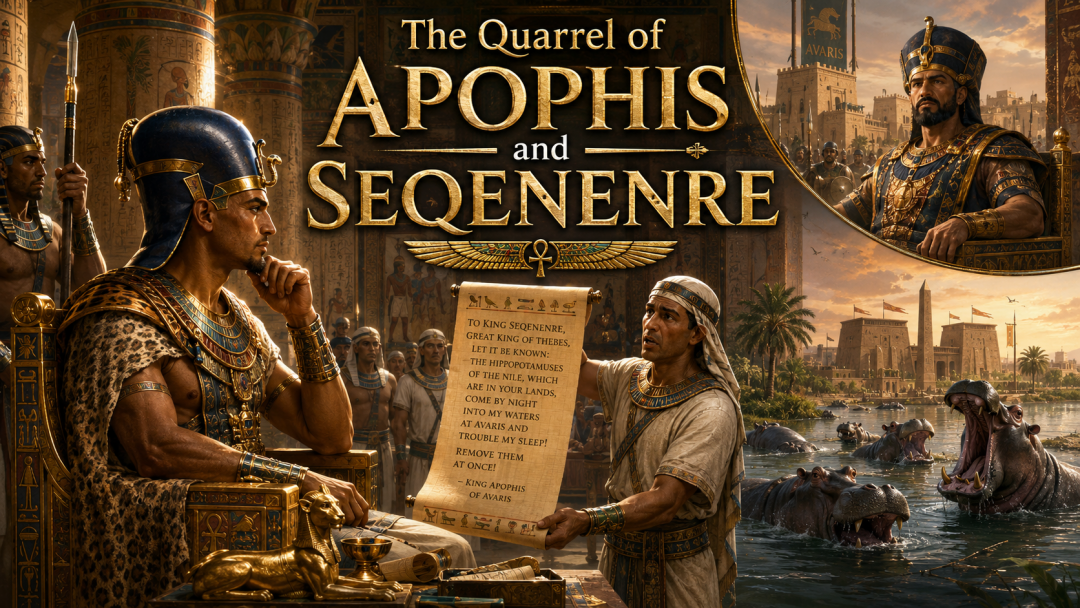
Then Apophis sent the ruler of Thebes an extraordinary message. The hippopotamuses in a pool near Thebes were keeping him awake at night.
It was an impossible complaint. A man living in Avaris could not possibly hear animals roaring hundreds of miles away. Seqenenre understood that the message was not truly about hippopotamuses. It was a deliberate provocation designed to humiliate him, force him into an impossible decision, and demonstrate that the Hyksos king believed he could command even the smallest details of life in Thebes.
The surviving story ends before Seqenenre gives his final answer. History, however, records that war eventually broke out between the Theban rulers and the Hyksos. The quarrel over the hippopotamuses may therefore have been remembered as the absurd challenge that helped ignite Egypt’s struggle for reunification.
Egypt Divided
The Middle Kingdom had once united Egypt under powerful kings, but royal authority gradually weakened. New rulers rose and fell rapidly, while communities of people from western Asia continued settling in the eastern Nile Delta. Many came peacefully as traders, craftspeople, laborers, soldiers, and families searching for new opportunities.
Over time, rulers of western Asian origin gained control of Avaris and the surrounding region. They formed Egypt’s Fifteenth Dynasty and became known as the Hyksos, a Greek form of an Egyptian title meaning “rulers of foreign lands.”
The Hyksos adopted many Egyptian customs. Their kings used Egyptian royal titles, commissioned Egyptian-style monuments, wrote their names in hieroglyphs, and honored Egyptian gods. They did not simply replace Egyptian culture with their own. Instead, life at Avaris blended Egyptian and Near Eastern traditions.
The Hyksos kings controlled Lower Egypt and parts of Middle Egypt, but they never ruled the entire country. Egyptian dynasties continued to govern from Thebes in the south, creating an uneasy political balance along the Nile.
For a time, the Theban rulers may have paid tribute or otherwise acknowledged the superior strength of the Hyksos kings. The arrangement preserved peace, but it also left Egypt divided between competing centers of power.
Apophis, King of the Hyksos
Apophis, also called Apepi, was one of the most powerful Hyksos rulers. He governed from Avaris, a wealthy city filled with palaces, temples, workshops, harbors, and connections to trade routes throughout the eastern Mediterranean.
Although later Egyptian tradition remembered the Hyksos as enemies and foreign oppressors, Apophis ruled as an Egyptian king. He adopted a royal titulary, employed scribes, and honored Egyptian deities.
The surviving tale describes him as a devoted worshiper of Seth.
Seth was the ancient Egyptian god of storms, deserts, violence, foreign lands, and dangerous strength. His principal cult center in the northeastern Delta stood near Avaris, making him a natural divine patron for the Hyksos rulers.
In the story, Apophis honors Seth above all other gods and has a magnificent temple built for him. Every day, the king presents offerings and celebrates the god with music, flowers, and ceremonies.
The author’s emphasis upon Seth probably served a literary purpose. To later Egyptians, Seth could represent disruption and disorder, particularly in stories about his conflict with Horus and his murder of Osiris. By connecting Apophis closely with Seth, the tale places the Hyksos king on the side of aggression and conflict.
Seqenenre, Ruler of Thebes
Far to the south, Seqenenre Tao ruled from Thebes as one of the kings of Egypt’s Seventeenth Dynasty.
His kingdom was smaller than the territory controlled by Apophis. The Hyksos dominated the north, while the independent kingdom of Kush controlled much of Nubia to the south. Thebes stood between two powerful rivals and faced danger from both directions.
Seqenenre nevertheless possessed an important source of strength. He belonged to a Theban royal family that claimed the traditions and divine authority of Egyptian kingship. His people honored Amun, whose temple at Karnak would later become one of the greatest religious centers in the ancient world.
The title of king could not hide the political reality. Seqenenre did not rule the Two Lands, and the ancient unity of Egypt had been broken. As long as Apophis remained dominant in the north, the Theban ruler could not truly claim to be king of all Egypt.
The surviving story places these two rulers in direct opposition. Apophis holds the greater political power, but Seqenenre represents Egyptian resistance and the possibility that the south might one day challenge the Hyksos.
The Hippopotamus Pool
Near Thebes was a pool where hippopotamuses were kept or allowed to gather.
The animals were enormous, aggressive, and extremely dangerous. They could destroy crops, overturn boats, and kill people with their powerful jaws. Egyptian kings sometimes hunted hippopotamuses as a symbolic victory over the wild forces that threatened order.
In the tale, the hippopotamuses appear to have had a connection with Theban ritual or royal recreation. Their exact significance is unclear because the surviving manuscript is damaged and incomplete.
Apophis began searching for a reason to provoke Seqenenre.
The story says that the Hyksos king consulted his officials and scribes, asking them to devise a message that would place the ruler of Thebes in an impossible position.
After considering the matter, Apophis found his excuse. He would complain about the hippopotamuses.
The Impossible Message
Apophis summoned a messenger and sent him south to Thebes.
The journey from Avaris to Seqenenre’s court would have taken many days. The messenger traveled along the Nile, carrying the authority of the Hyksos king into the heart of the Theban kingdom.
When he reached the palace, he was brought before Seqenenre.
The messenger bowed and delivered the words of Apophis.
“Have the hippopotamus pool east of the city destroyed. The roaring of the animals reaches me day and night, and their noise prevents me from sleeping.”
Seqenenre listened in disbelief. Avaris lay hundreds of miles from Thebes. No sound made by an animal in the south could possibly travel such a distance.
Yet the messenger had spoken in the name of a powerful king. Seqenenre could not simply laugh at the demand or dismiss it without risking a confrontation.
He asked the messenger to repeat the message. Again came the command.
The hippopotamus pool must be destroyed because its animals were disturbing the sleep of Apophis.
Seqenenre offered the messenger food, drink, and lodging. He promised that an answer would be given after the matter had been considered. Then he dismissed the envoy and summoned his council.
Seqenenre Consults His Officials
The greatest officials, military commanders, and advisers of Thebes assembled before their king. Seqenenre repeated the demand of Apophis.
The council fell silent. No one knew how to answer.
The message was obviously absurd, but its purpose was deadly serious. Apophis was testing the Theban king. If Seqenenre obeyed, he would publicly acknowledge that the ruler of Avaris could interfere in the affairs of Thebes. If he refused, Apophis could claim that the southern king had defied him.
The hippopotamuses had become instruments in a struggle over sovereignty.
Seqenenre looked from one adviser to another, but the officials remained speechless. The manuscript emphasizes their confusion and fear. They understood that no ordinary answer could solve the problem.
The demand may also have contained a religious insult. If the animals or their pool were connected with a Theban cult, destroying them would force Seqenenre to violate the traditions of his own city. Apophis could then demonstrate that his will mattered more than the gods and customs of Thebes.
The Theban ruler had been trapped between humiliation and rebellion.
What Did Apophis Really Want?
The complaint about the hippopotamuses was almost certainly intended as a provocation within the story.
Apophis did not truly expect their cries to stop disturbing his sleep. He wanted Seqenenre to submit, refuse, or respond with enough anger to justify further action.
The demand resembles the exaggerated challenges found in many royal legends. A powerful ruler invents an impossible grievance, not because the complaint is believable, but because he wishes to demonstrate control over a weaker rival.
The story may have been written as political satire. Apophis appears ridiculous for claiming to hear distant animals, but his absurdity does not make him harmless. His message carries the threat of military power.
Seqenenre, by contrast, is placed in the position of the wronged Egyptian king. He must decide whether to accept humiliation or defend the dignity of Thebes.
The surviving manuscript breaks off while his officials are still struggling to formulate an answer.
We do not know how the ancient story continued.
Where the Ancient Story Ends
The only known copy of the tale is preserved on Papyrus Sallier I. The manuscript dates to the New Kingdom, several centuries after the period in which Apophis and Seqenenre lived.
It appears to have been copied by a student or apprentice scribe. The papyrus contains corrections, damaged sections, and writing exercises, suggesting that literary tales were used in scribal education.
The beginning of the story survives, but the ending has been lost.
We do not know whether Seqenenre answered with another riddle, rejected the demand, prepared for war, or found some clever way to humiliate Apophis.
The ancient audience may already have known the ending, just as they knew that the Theban royal family eventually fought the Hyksos. The surviving fragment could have introduced a longer tale explaining how open conflict began.
Because the original conclusion is missing, any complete retelling must move from literature into historical reconstruction.
A Possible Conclusion
The following conclusion is a modern reconstruction inspired by the historical conflict between the Theban kings and the Hyksos.
Seqenenre remained silent for a long time after his advisers had finished speaking. Then he rose from his throne and looked toward the north.
“If the King of Avaris can hear the hippopotamuses of Thebes,” he said, “then surely he can also hear the suffering of Egypt beneath his rule.”
His officials lowered their heads, for they understood that the king had made his decision.
Seqenenre summoned the messenger of Apophis.
“Return to your master,” he commanded. “Tell him that the hippopotamuses belong to the waters of Thebes, and I shall not destroy them merely because he claims their voices disturb his dreams.
“If Apophis wishes for silence, let him close his ears. If he wishes to command Thebes, let him come south and speak to me himself.”
The messenger departed at once.
When Apophis heard the answer, he flew into a rage. He accused Seqenenre of rebellion and began gathering soldiers, chariots, archers, and ships.
In Thebes, the king also prepared for war.
Bronze weapons were sharpened, bows were strung, and messengers traveled throughout Upper Egypt calling warriors to the royal standard. Priests entered the temples to ask Amun, Montu, and the gods of Thebes to protect the southern army.
Seqenenre stood before his soldiers.
“For too long the Two Lands have been divided,” he declared. “The north commands us, the south is threatened, and foreigners sit upon the throne of Egypt.
“The quarrel began with the cry of a hippopotamus, but it shall end with the roar of Thebes.”
Then the army marched north.
The Historical War Against the Hyksos
Although the literary tale does not preserve its ending, archaeological evidence shows that Seqenenre became involved in violent conflict.
His mummy bears terrible wounds to the head and face. Modern examinations indicate that he died violently, most likely during battle or after being captured by enemies. Several of the injuries resemble wounds that could have been caused by weapons associated with Hyksos forces.
Seqenenre did not live to see Egypt reunited. The struggle continued under his family.
His probable successor, Kamose, launched campaigns against Hyksos territory and challenged their control of the Nile Valley. In inscriptions celebrating his victories, Kamose complained that he was trapped between a ruler in Avaris to the north and the kingdom of Kush to the south.
Kamose attacked northward, captured towns, seized ships, and weakened Hyksos authority.
The final victory belonged to Ahmose I, a younger member of the Theban royal family.
Ahmose captured Avaris and drove the Hyksos rulers from Egypt. He pursued them into southern Canaan and attacked their remaining stronghold at Sharuhen.
Egypt was united again under a single king.
Ahmose founded the Eighteenth Dynasty and began the period now known as the New Kingdom, when Egypt became one of the most powerful states in the ancient world.
Did the Hippopotamus Quarrel Really Happen?
There is no evidence that Apophis truly complained about the noise of hippopotamuses in Thebes.
The tale was written long after the events it describes and should not be treated as an official record of the beginning of the war.
It may preserve a distant memory of political hostility between the two courts, but its details belong to literature.
The absurd message could have been invented to portray Apophis as arrogant, unreasonable, and eager to dominate the south. Seqenenre’s dilemma allowed later Egyptian storytellers to present the conflict as a struggle between foreign oppression and legitimate Egyptian kingship.
The story may also have entertained student scribes. Its impossible complaint, silent council, and dangerous political puzzle created suspense while teaching formal language and royal correspondence.
Historical fiction is not less valuable merely because every detail cannot be verified. The tale reveals how later Egyptians chose to remember the age of the Hyksos.
They remembered division as humiliation, Thebes as the center of resistance, and Seqenenre as one of the first kings willing to oppose foreign rule.
The Meaning of the Story
The Quarrel of Apophis and Seqenenre is a story about power disguised as a complaint about animals.
Apophis demands the destruction of a distant hippopotamus pool because he wishes to prove that his commands reach all the way to Thebes. Seqenenre’s response matters because obedience would confirm the Hyksos king’s authority, while refusal could begin a war.
The story also shows how political conflict can begin with language before it reaches the battlefield. No soldiers appear in the surviving fragment. No weapons are raised. The struggle begins with a message carefully designed to insult, threaten, and trap another ruler.
The hippopotamuses themselves may symbolize the wild force of Egypt. Their cries cannot truly reach Avaris, but their presence gives Apophis a reason to interfere in the south. By refusing to silence them, Seqenenre can be imagined as refusing to silence Thebes.
The historical Seqenenre died violently, but his family continued the struggle. His successors defeated the Hyksos and reunited Egypt.
For that reason, the incomplete quarrel carries meaning far beyond its strange opening.
An impossible complaint about roaring hippopotamuses became, in Egyptian memory, the beginning of a war for the Two Lands.
The Legacy of Seqenenre
Seqenenre never became as famous as Ahmose I, the king who finally captured Avaris. Yet his role in the Theban resistance made him an important figure in the story of Egypt’s reunification.
His violent death gave him the image of a warrior king who sacrificed his life before victory was achieved. Kamose continued the attack, and Ahmose completed what their family had begun.
Together, these rulers transformed Thebes from the capital of a vulnerable southern kingdom into the center of a reunited Egypt.
The conflict also elevated Amun, the god of Thebes. As the Theban dynasty gained power, Amun rose with it and eventually became one of the most important gods of the New Kingdom.
The surviving story never tells us what answer Seqenenre gave the messenger of Apophis.
History provides an answer of its own.
The hippopotamuses may have continued roaring, but the armies of Thebes eventually marched north. The Hyksos kings were driven from Avaris, the Two Lands were reunited, and the descendants of Seqenenre ruled the beginning of Egypt’s greatest imperial age.