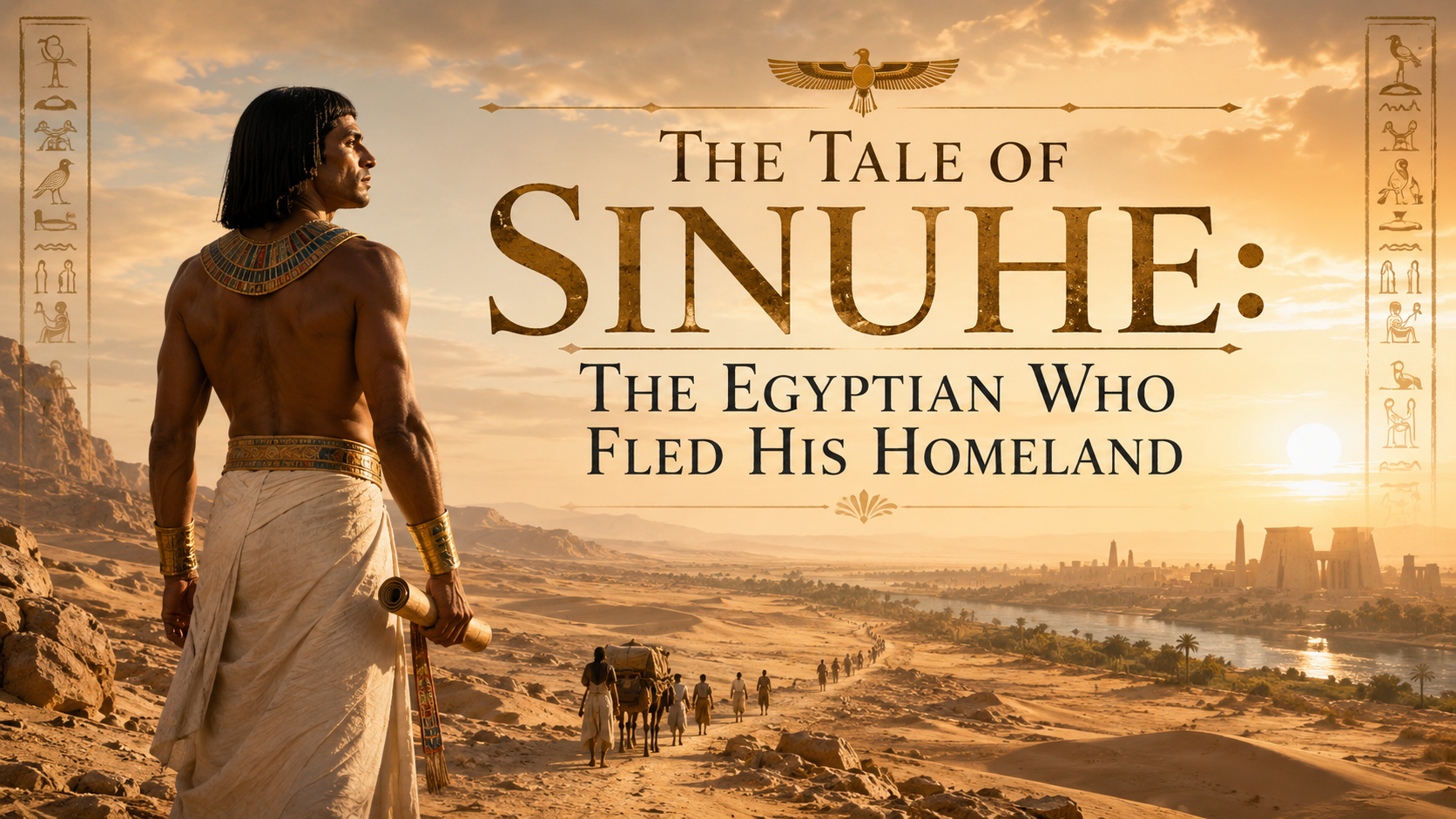
During Egypt’s Middle Kingdom, a royal official named Sinuhe fled his country after hearing that King Amenemhat I had died.
No one ordered him to leave. No enemy pursued him. Yet fear seized his heart, and before he fully understood what he was doing, Sinuhe abandoned the royal court and escaped into the eastern desert.
Far from Egypt, he found protection among foreign rulers, married into a powerful family, became wealthy, and earned fame as a warrior. Still, he never escaped the sorrow of exile.
As Sinuhe grew old, he longed for the land of his birth. More than riches, power, or victory, he desired one final blessing: to return to Egypt and receive the burial of an Egyptian.
His story became one of the greatest works of ancient Egyptian literature.
The Death of Amenemhat I
Sinuhe served at the royal court during the reign of Amenemhat I, founder of Egypt’s Twelfth Dynasty.
Amenemhat had brought stability to Egypt after years of political division. He strengthened royal authority, moved the center of government northward, and defended Egypt’s borders.
His son Senusret served beside him and led military expeditions on behalf of the crown.
At the beginning of Sinuhe’s story, Senusret was returning from a campaign against the Libyans. He had traveled west with the king’s sons and the finest soldiers in Egypt.
Then a secret message arrived from the royal palace. Amenemhat I was dead.
The messengers informed Senusret privately, and the prince immediately left the army. He hurried toward the royal residence before news of his father’s death could spread or a rival could seize the throne.
Sinuhe happened to be standing nearby when another royal son received a message about the king.
He overheard enough to realize that something terrible had happened. The news struck him with overwhelming force.
“My heart stopped,” Sinuhe later recalled. “My arms fell helplessly, and trembling seized my entire body.”
He did not return to his quarters. He did not seek confirmation or offer his loyalty to Senusret. Instead, Sinuhe ran.
Why Did Sinuhe Flee?
The story never fully explains why Sinuhe fled Egypt.
Perhaps he feared a struggle over the succession. He may have worried that his connection to one of the royal sons would place him on the losing side of a palace conflict.
Perhaps he knew something about Amenemhat’s death and feared being accused of involvement.
It is also possible that Sinuhe simply panicked.
His flight is described almost as though another power had taken control of him. He acted before he could think, driven by terror and confusion.
Sinuhe later insisted that he had not planned his escape.
“I do not know what brought me to this foreign land,” he said. “It was like the design of a god.”
Whatever the cause, Sinuhe left behind his position, possessions, family, and homeland.
He hid among bushes to avoid being seen and traveled south before turning eastward across the Nile Valley.
When he reached the edge of the desert, he continued alone.
Crossing the Desert
Sinuhe crossed the waterways near Egypt’s eastern frontier and slipped past the walls built to control movement between the Nile Valley and the desert.
He traveled north through barren country.
The heat became unbearable. His throat burned, and his strength failed.
Before long, Sinuhe believed he was dying. “Is this the taste of death?” he wondered.
Then he heard the sound of cattle.
A group of desert people discovered him lying near collapse. Their leader recognized that Sinuhe was Egyptian and gave him water.
They boiled milk for him and helped restore his strength.
Sinuhe traveled with them for a time before continuing into Retjenu, the Egyptian name for parts of Canaan and Syria.
There he had entered a foreign world.
Sinuhe Meets Amunenshi
News of the Egyptian stranger eventually reached Amunenshi, a powerful ruler of Upper Retjenu.
Amunenshi summoned Sinuhe and questioned him.
“Why have you come here?” the ruler asked. “Has something happened at the royal court?”
Sinuhe remained cautious.
He explained that Amenemhat I had died while Senusret was away campaigning, but he denied knowing exactly why he had fled.
“I was not accused of any crime,” Sinuhe said. “No one spoke against me. I heard no condemnation. My flight was not planned.”
Amunenshi had spent time among Egyptians and understood their language. He welcomed Sinuhe and asked about the new king.
Sinuhe praised Senusret.
He described him as a mighty warrior, a wise ruler, a master of strategy, and a king loved by his people.
“He is a champion who acts with his own strong arms,” Sinuhe declared. “He is merciful when he chooses, but no enemy can stand before him.”
Sinuhe advised Amunenshi to send gifts and acknowledge Senusret’s authority.
“The king of Egypt is powerful,” he warned. “He will extend his influence over every land.”
Amunenshi was impressed by Sinuhe’s knowledge and eloquence.
Rather than treat him as a wandering refugee, the ruler welcomed him into his household.
A New Life in Retjenu
Amunenshi gave Sinuhe his eldest daughter in marriage. He also allowed the Egyptian to choose land from among the finest parts of his territory.
Sinuhe selected a fertile region called Yaa.
The land was rich in figs, grapes, olives, grain, cattle, honey, and fruit. Wine was plentiful, and livestock grazed across its fields.
Sinuhe prospered. He had children, and each of his sons eventually became the leader of his own people.
Amunenshi placed Sinuhe in command of warriors and trusted him to defend the borders. Whenever neighboring groups attacked, Sinuhe led men against them.
He defeated raiders, captured livestock, rescued stolen property, and returned with prisoners.
Years passed. The frightened exile became a respected leader, wealthy landowner, husband, father, and warrior.
Foreigners honored him, and rulers welcomed him at their tables. Yet beneath his success, Sinuhe remained an Egyptian far from home.
The Champion’s Challenge
Sinuhe’s growing reputation eventually attracted the attention of a powerful warrior. The man was a champion of Retjenu, famous for his strength and undefeated in battle.
He came to Sinuhe’s camp and challenged him to single combat. The champion intended to kill Sinuhe and seize his possessions, cattle, and land.
Sinuhe had never quarreled with the man. He believed the warrior had become jealous of his success. That evening, Sinuhe prepared for battle.
He inspected his bow, sharpened his arrows, and tested his weapons. He planned how he would respond to the champion’s attacks.
At dawn, crowds gathered to watch. People from throughout the region came to witness the duel. Many expected the foreign champion to destroy the Egyptian exile.
The warrior advanced carrying a shield, battle-axe, spear, and bundle of javelins. He hurled his weapons at Sinuhe. Sinuhe avoided each one. Then the champion charged.
Sinuhe raised his bow and released an arrow. It struck the warrior in the neck. The champion fell forward, and Sinuhe killed him with his own axe.
Then Sinuhe placed his foot upon the defeated man and cried out in victory. The spectators shouted his name.
The champion who had planned to seize Sinuhe’s possessions lost everything instead. Sinuhe took his cattle, goods, and wealth according to the customs of the land.
His fame grew greater than ever.
Success Without Peace
Sinuhe had achieved everything an exile might desire.
He possessed fertile land, a large family, herds of cattle, loyal followers, and the friendship of rulers. He had defeated one of Retjenu’s greatest warriors and lived as a powerful man.
Yet none of it gave him peace. He grew old in a foreign country. His thoughts returned constantly to Egypt.
Sinuhe remembered the royal court, the Nile, the temples, the language of his people, and the rituals of Egyptian life.
Most of all, he feared dying abroad.
To an Egyptian, burial was not simply the disposal of the body. A proper tomb, mummification, funerary rituals, offerings, and remembrance were essential preparations for eternal life.
Sinuhe imagined his body wrapped in an animal skin and buried in foreign soil.
He dreaded the thought that no Egyptian priests would walk in his funeral procession, no craftsmen would prepare his coffin, and no family members would present offerings at his tomb.
The wealth of Retjenu suddenly seemed meaningless.
“What is more important than being buried in the land where I was born?” he asked.
Sinuhe Prays for Home
Sinuhe raised his voice to the gods.
“O god, whoever you are who ordered this flight, be merciful and bring me home.
“Surely you will allow me to see once more the place where my heart lives.
“What could matter more than having my body buried in the land of my birth?”
He prayed that the king of Egypt would forgive him. He had committed no rebellion and raised no army against Senusret. Yet he knew his unexplained flight could be interpreted as disloyalty.
Sinuhe hoped that news of his longing might reach Egypt. Eventually, it did.
The King’s Letter
King Senusret I learned that Sinuhe still lived in Retjenu. Rather than condemn him, the king sent a royal decree inviting him to return. The letter reminded Sinuhe that he had fled without cause.
“What have you done that requires punishment?” the king asked.
Senusret assured him that the queen and royal children remembered him. He promised Sinuhe a place at court and an honorable burial.
“You shall not die in a foreign land,” the royal message declared.
“You shall not be wrapped in the skin of a ram while foreigners make your grave.
“Your body shall be brought to its tomb with a proper procession. A golden coffin shall be prepared for you, and your funeral shall be worthy of an Egyptian noble.”
When Sinuhe heard the king’s words, he fell upon the ground. For a long time, he could not speak. The mercy he had desired had finally been granted.
Sinuhe’s Reply
Sinuhe sent a humble answer to the king.
He praised Senusret and insisted once again that his flight had not resulted from treason.
“I did not flee because of guilt,” he explained. “My heart did not plan it. I was not accused. No one pursued me.
“It happened like a dream.”
Sinuhe placed his fate in the king’s hands. He declared that his life belonged to Senusret and that he was ready to obey whatever the king commanded.
Then he prepared to leave the life he had built abroad.
Leaving Retjenu
Sinuhe transferred his property to his children. His eldest son inherited his position, and the family remained among the people of Retjenu.
The rulers of the region gathered to say farewell. They embraced Sinuhe and offered gifts for his journey.
Although he had lived among them for many years, he was returning to the land that had never stopped claiming his heart.
Sinuhe traveled south toward Egypt.
At the frontier, Egyptian officials received him and escorted him toward the royal residence. The journey must have felt almost unreal. The exile who had fled in terror was returning by command of the king.
Before the King
Sinuhe entered the palace and found Senusret seated upon his throne. The royal family stood nearby. Overcome by fear and awe, Sinuhe threw himself upon the floor.
He could not speak. The king addressed him kindly.
“So you have returned after wandering through foreign lands. Old age has changed your appearance.”
Sinuhe remained silent, trembling. The king asked why he had fled. Still overwhelmed, Sinuhe could barely answer.
Senusret reassured him. “Do not be afraid. You shall not die by the hand of an enemy. You shall receive the burial of an Egyptian.”
The queen and royal children then entered.
At first they scarcely recognized the weathered, foreign-looking man lying before them.
When the king identified him, they cried out in surprise.
They raised ceremonial instruments and sang before Senusret, asking him to show mercy to the returning exile.
The king smiled.
Sinuhe had been forgiven.
Becoming Egyptian Again
Royal attendants brought Sinuhe to a fine house that had been prepared for him.
The residence contained decorated rooms, cool water, fine clothing, scented oils, and servants.
The transformation began immediately.
Sinuhe’s years abroad had changed his appearance. His hair had grown long, his beard reflected foreign customs, and his clothing marked him as a man of Retjenu.
Servants shaved his body and combed his hair.
His foreign garments were removed and given away.
He bathed, anointed himself with oil, and dressed in fine Egyptian linen.
He slept once again upon a proper bed.
He ate Egyptian food.
The sand of foreign lands was washed from his skin, and Sinuhe became outwardly Egyptian once more.
Yet his return was more than a change of clothing.
He had recovered his identity, his place within society, and his relationship with the king.
The Tomb of Sinuhe
Senusret gave Sinuhe a house that had belonged to a court official.
The king also ordered a stone tomb to be built for him.
Royal craftsmen supervised its construction. Sculptors carved its walls, painters decorated its chambers, and skilled workers prepared everything required for burial.
A pyramid-shaped monument rose above the tomb.
A garden surrounded it, and fields were assigned to provide permanent offerings.
A gilded statue of Sinuhe was created, and funerary equipment was prepared under royal supervision.
Sinuhe had once feared dying unnamed and forgotten in a foreign land.
Now he would receive an honored Egyptian burial near the royal court.
He ended his account with gratitude.
“No common man had ever received such favor,” he declared.
Sinuhe lived out the remainder of his life beneath the protection of the king.
What Does the Tale of Sinuhe Mean?
The Tale of Sinuhe is an adventure, but it is also a story about identity, kingship, exile, and belonging.
Sinuhe succeeds outside Egypt. Foreign lands are not portrayed as empty or uncivilized. Retjenu is fertile, wealthy, and ruled by powerful leaders. Sinuhe finds friendship, family, status, and honor there.
Yet his success remains incomplete.
In the Egyptian worldview expressed by the story, a person belongs within the order represented by Egypt and its king. Sinuhe’s flight removes him from that order. His return restores him to it.
Senusret’s mercy is therefore central to the tale.
The king does not merely pardon a frightened servant. He restores Sinuhe’s identity and guarantees his place in eternity.
The story also explores the power of homesickness.
Sinuhe spends years building a new life, but age strips away the satisfaction of wealth and victory. What he wants in the end is not another field, another herd, or another military triumph.
He wants to go home.
Was Sinuhe a Real Person?
No evidence proves that Sinuhe was a historical individual.
The story uses real kings, recognizable places, court titles, and political conditions, but it is generally treated as a work of literature rather than a straightforward autobiography.
Amenemhat I and Senusret I were historical rulers. Egypt maintained contact with the regions described as Retjenu, and Egyptian officials did travel, fight, trade, and sometimes live abroad.
The tale’s realistic setting may have made Sinuhe seem believable to its original audience.
However, the careful structure, poetic speeches, repeated themes, and dramatic transformation of its hero show that it was shaped as literature.
It may have drawn upon real experiences, but its purpose was greater than recording one man’s career.
The Survival of the Story
The Tale of Sinuhe was copied many times after its original composition.
Fragments survive on papyri and ostraca, pieces of pottery or limestone used as writing surfaces. Copies dating centuries after the Middle Kingdom show that scribes continued studying and enjoying it long after the world of Amenemhat and Senusret had passed.
Students may have copied passages as part of their training.
The story’s elegant language made it a model of literary composition, while its themes remained understandable to every generation.
Fear can cause a person to abandon everything. Success cannot always silence homesickness.
Age changes what people value. Forgiveness can restore what panic destroyed.
More than three thousand years after Egyptian scribes copied Sinuhe’s words, the emotional heart of his story remains familiar.
He fled without fully understanding why. He created an extraordinary life in another land.
He defeated his enemies and gained wealth and honor.
Yet his greatest victory came when he crossed the border one final time and returned to Egypt, the homeland he had never truly left behind.